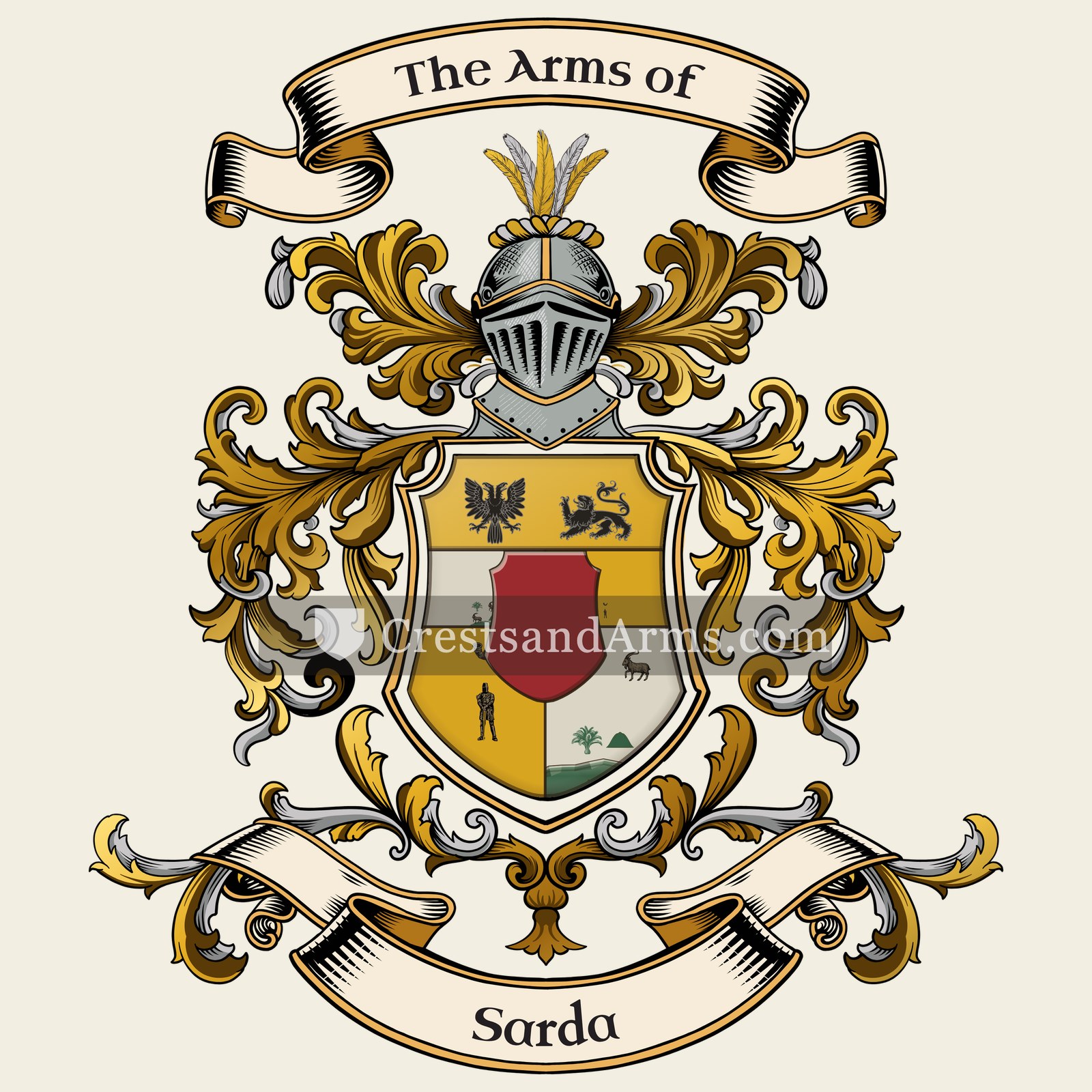
A record of documented arms, meaning and origin, researched for the Sarda family of Austria.
Reg. 1550 · Austrian, T–V
Coat of Arms & Family Crest Details
Symbols on this shield
mountThe ground held, and steadfastness upon it
chiefAuthority, wisdom and dominion
fessThe military belt, and readiness to serve
cross symbolChristian faith and service
eagleNobility, strength and a keen mind
lionCourage, strength and royalty
palm treeVictory, and righteousness that flourishes
goatOne who wins by diplomacy rather than force
knightChivalry and service in arms
hunting horn stringedOne who delights in the chase
Colours
Silver (Argent)Means: Peace and sincerity
Gold (Or)Means: Generosity
Red (Gules)Means: Military strength
Green (Vert)Means: Hope
Black (Sable)Means: Constancy
Historical info
Source
J. B. Rietstap, Armorial Général, Gouda: G. B. van Goor Zonen, 1884–87
Blazon (the actual original written record)
“Ec.: aux 1 et 4 d'arg. à un palmier de sin., accosté de deux bouquetins ramp. et affr. au nat.; le tout soutenu d'une terrasse du sec.; aux 2 et 3 d'or à un sauvage de carn., ceint et cour. de lierre, donnant dans un cor au nat. Au chef de l'écu d'or, br. sur l'écartelé et ch. d'une aigle de sa., cour. d'or. Sur le tout de gu. au lion fascé d'or et d'arg. Quatre cq. cour. C.: 1º un sauvage iss. de carn., ceint et cour. de lierre, tenant de sa main dextre un listel, inscrit du mot NEMO; 2º sept pennons triangulaires de gu., trois à dextre et quatre à sen., attachés à des lances comp. de sa. et d'or; 3º une croix pattée d'arg.; 4º un bouquetin iss., au nat., entre un vol de sa. L. d'or et de sa. S.: à dextre un lion d'or, à sen. un lion iss. d'arg., tous deux arm. et lamp. de gu.”
Austriac. 1774
Digital archive packCoat of arms PNG, gold border print PDF, vector SVG and the certificate of authenticity. Sent to your email in minutes.
Map of Austria showing where the Sarda arms are recorded
The Sarda arms were recorded in Austria, c. 1774.
Arms such as these were typically recorded in Tyrol.
Tyrol was mountain country in western Austria, where the valleys were held by families who had been there a very long time. Old tenure counted for more than money, and old families carried arms.
This is where the arms were entered in the register. Families often moved to other parts of the country, so the same name can turn up in more than one region.
Region
Tyrol
First recorded
1774
Granting Authority for the Sarda Arms
Imperial and Royal chancery
Sodacan · CC BY-SA 3.0
The body that granted and recorded arms in Austria in this period.
Joseph II, Holy Roman Emperor
Sovereign of the period
Joseph II, Holy Roman Emperor
1765–1790
Reigning in Austria when the Sarda arms are first recorded.
How Arms Worked in Austria
Austrian coats of arms were often linked directly to noble titles granted by the Emperor. These symbols belonged to the entire family line rather than just one individual. When a family grew, new branches kept the original design without needing to change it. This system allowed all members of a noble house to share the same identity across many generations.
Granting authority
The Imperial and Royal chancery managed all heraldic matters and controlled the official granting of arms throughout the Austrian lands.
How they got arms
Families typically received their arms through a formal imperial decree that often accompanied the elevation of a person to noble status.
Where arms were recorded
Official records of these grants were kept in the Imperial Register of Nobility which began its formal documentation process in 1453.
The family's standing
Recorded among the armigerous families of Austria.
Origin & History of the Sarda Family in Austria
The family name Sarda has deep roots in the Alpine regions of Europe, with documented evidence placing members of the family in the Tyrol area by 1774. During this period, Tyrol served as a vital crossroads for trade and cultural exchange between the Germanic north and the Italian south. The name itself is often associated with geographic origins, as it shares linguistic ties to the Mediterranean island of Sardinia. Historians suggest that families carrying this name may have migrated northward along established merchant routes, eventually settling in the mountainous terrain of the Austrian Alps. By the late 18th century, these families were well-integrated into the local agrarian and administrative life of the region. Their presence in Tyrol reflects the broader patterns of movement that defined European history before the rise of modern nation-states.
Related Branches & Arms
Root word
Sardus
Latin term referring to someone originating from the island of Sardinia.
This name
SardaA topographic or habitational surname denoting a person who migrated from Sardinia.
also spelled
Suardaa
Suardae
Documented Sources
J. B. Rietstap, Armorial Général, Gouda: G. B. van Goor Zonen, 1884–87
Huter, Franz. Tiroler Urkundenbuch. 1937
Obermair, Hannes. Tirolensia: Archivalien zur Geschichte Tirols. 2005


 mountThe ground held, and steadfastness upon it
 chiefAuthority, wisdom and dominion
 fessThe military belt, and readiness to serve
 cross symbolChristian faith and service
 eagleNobility, strength and a keen mind
 lionCourage, strength and royalty
 palm treeVictory, and righteousness that flourishes
 goatOne who wins by diplomacy rather than force
 knightChivalry and service in arms
 hunting horn stringedOne who delights in the chase