A record of documented arms, meaning and origin, researched for the Sartori family lines. Documented in 2 countries.
Reg. 4684 · German, T–V
Coat of Arms & Family Crest Details
Symbols on this shield
mountThe ground held, and steadfastness upon it
horseReadiness to serve king and country
Colours
Red (Gules)Means: Military strength
Green (Vert)Means: Hope
Silver (Argent)Means: Peace and sincerity
Historical info
Source
J. B. Rietstap, Armorial Général, Gouda: G. B. van Goor Zonen, 1884–87
Blazon (the actual original written record)
“De gu. à un cheval ramp. d'arg., soutenu d'une terrasse de sin. Cq. cour. C.: le cheval. iss., entre deux bras, arm. d'arg., les poings fermés de carn. L. d'arg. et de gu.”
Germanyc. 1765
Digital archive packCoat of arms PNG, gold border print PDF, vector SVG and the certificate of authenticity. Sent to your email in minutes.
Map of Germany showing where the Sartori arms are recorded
The Sartori arms were recorded in Germany, c. 1765.
Arms such as these were typically recorded in Bavaria.
Bavaria was a country of old landed families and walled market towns. Estates passed down the same line for centuries, and both the landowners and the leading townsmen kept arms, which is why so many Bavarian names sit in the registers.
This is where the arms were entered in the register. Families often moved to other parts of the country, so the same name can turn up in more than one region.
The body that granted and recorded arms in Germany in this period.
Francis I, Holy Roman Emperor
Sovereign of the period
Francis I, Holy Roman Emperor
1745–1765
Reigning in Germany when the Sartori arms are first recorded.
How Arms Worked in Germany
In the Holy Roman Empire, coats of arms were often granted to individuals by the Emperor or his representatives. These arms were then passed down through the generations to all legitimate descendants of the original holder. Younger branches of a family usually kept the same shield design without needing to change it, as the arms belonged to the entire lineage.
Granting authority
The Holy Roman Emperor held the sole power to grant new coats of arms throughout his vast imperial territories.
How they got arms
Families typically obtained their coats of arms through a formal imperial grant or by proving their noble status to the authorities.
Where arms were recorded
These grants were officially recorded in the Imperial Chancery registers, which began keeping formal records of such honors during the Middle Ages.
The family's standing
Recorded among the armigerous families of Germany.
Origin & History of the Sartori Family in Germany
The surname Sartori traces its roots to the Latin word sartor, which means a tailor. In the German-speaking regions, this name functioned as an occupational descriptor for those who crafted clothing for their communities. By the middle of the 18th century, the family established a notable presence in the Bavarian region. Records from 1765 confirm that members of the Sartori family were active participants in the social and economic life of this area. During this period, Bavaria was a center for trade and craftsmanship, and families like the Sartoris often held roles that required specialized skills. As they settled into these German lands, they became part of the local fabric of village life. Their history reflects the broader movement of skilled workers who helped shape the development of Bavarian towns and cities during the Enlightenment era.
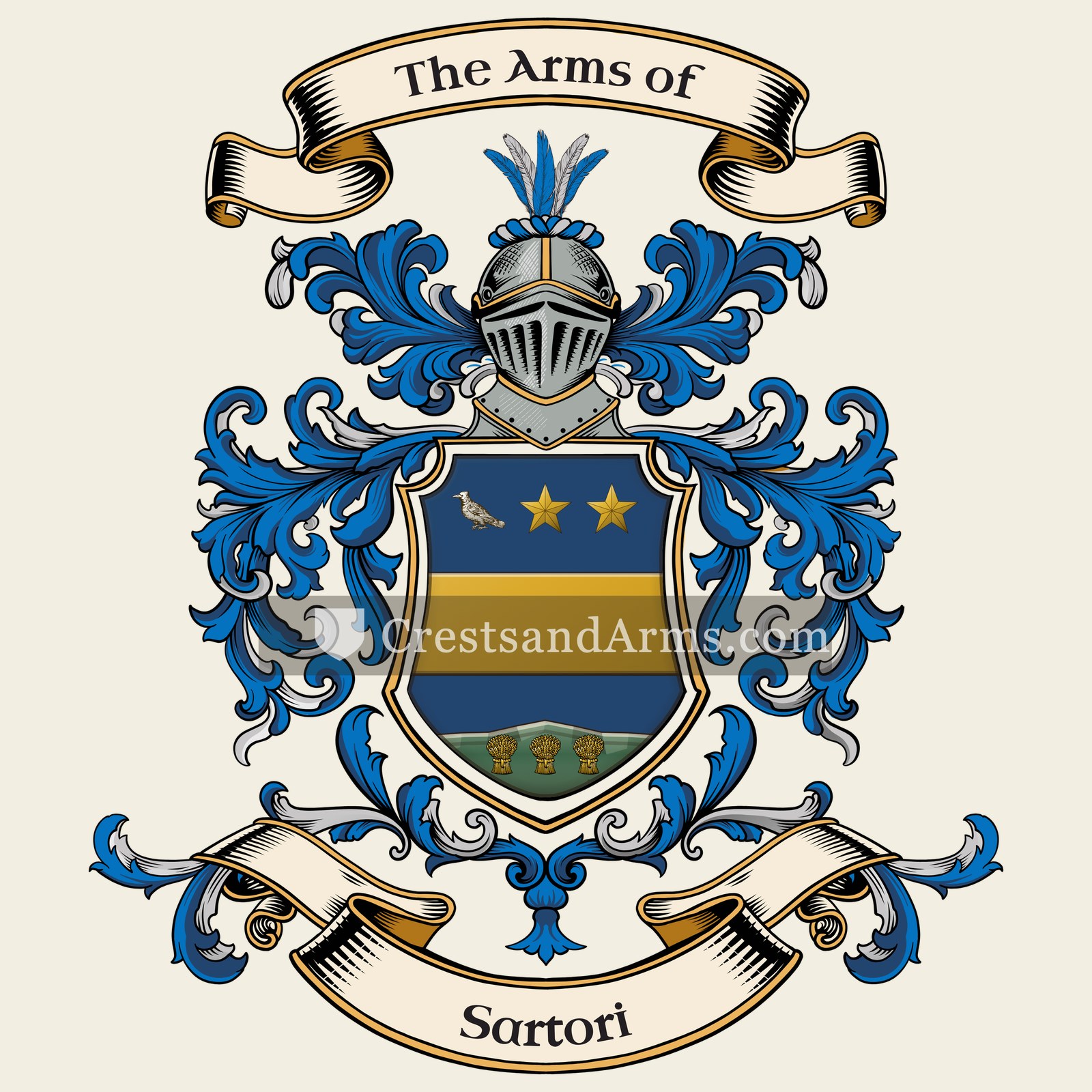
Coat of Arms & Family Crest Details
Symbols on this shield
fessThe military belt, and readiness to serve
mountThe ground held, and steadfastness upon it
dovePeace, love and the Holy Spirit
mulletThe third son, and a divine quality from above
wheatsheafPlenty, and the harvest of one's own labour
Colours
Blue (Azure)Means: Loyalty and truth
Gold (Or)Means: Generosity
Green (Vert)Means: Hope
Silver (Argent)Means: Peace and sincerity
Historical info
Source
J. B. Rietstap, Armorial Général, Gouda: G. B. van Goor Zonen, 1884–87
Blazon (the actual original written record)
“D'azur à la fasce d'or, acc. en chef d'une colombe d'arg. tenant en son bec un rameau d'olivier de sin., accostée de deux étoiles (8) d'or, et en p. de trois épis tigés et feuillés d'or, rangés sur une terrasse de sin.”
ItalyVicence, c. 1775
Digital archive packCoat of arms PNG, gold border print PDF, vector SVG and the certificate of authenticity. Sent to your email in minutes.
Map of Italy showing where the Sartori arms are recorded
The Sartori arms were recorded in Vicence, c. 1775.
This is where the arms were entered in the register. Families often moved to other parts of the country, so the same name can turn up in more than one region.
The body that granted and recorded arms in Italy in this period.
Alvise Giovanni Mocenigo
Sovereign of the period
Alvise Giovanni Mocenigo
1763–1778
Reigning in Germany when the Sartori arms are first recorded.
How Arms Worked in Italy
In the Italian states, coats of arms were often used by noble families to show their status and history. These symbols were passed down through the generations to all legitimate male descendants. Younger branches of a family usually kept the original design but sometimes added small changes to distinguish their specific line from the main branch.
Granting authority
Various local rulers and city governments controlled the use of coats of arms across the different Italian states.
How they got arms
Families often assumed their own arms or received them as official grants from local lords, popes, or city councils.
Where arms were recorded
Arms were recorded in local city archives or private family books rather than in one single national register.
The family's standing
Recorded among the armigerous families of Italy.
Origin & History of the Sartori Family in Italy
The surname Sartori is deeply rooted in the linguistic and social history of Northern Italy, specifically within the Veneto region. The name is derived from the Italian word "sarto," which means tailor. During the Middle Ages and the Renaissance, it was common for families to adopt surnames based on their trade or craft. By the time records confirm the presence of the Sartori family in Vicenza in 1775, the name had likely been established for generations as a way to identify a lineage of skilled artisans. In a society where professional identity was central to community life, being known as a Sartori suggested that early ancestors held a respected position as makers of clothing. This connection to the tailoring trade reflects the broader economic history of Vicenza, a city that was well known for its textile production and craftsmanship during the centuries leading up to the late 1700s.
Related Branches & Arms
Root word
Sartor
Latin term meaning a tailor or patcher of clothes.
This name
SartoriAn occupational surname for a person who worked as a tailor.
also spelled
Sartory
Documented Sources
J. B. Rietstap, Armorial Général, Gouda: G. B. van Goor Zonen, 1884–87
Heintze, Albert. Die deutschen Familiennamen: geschichtlich, geographisch, sprachlich. 1882


 mountThe ground held, and steadfastness upon it
 horseReadiness to serve king and country
 mountThe ground held, and steadfastness upon it
 horseReadiness to serve king and country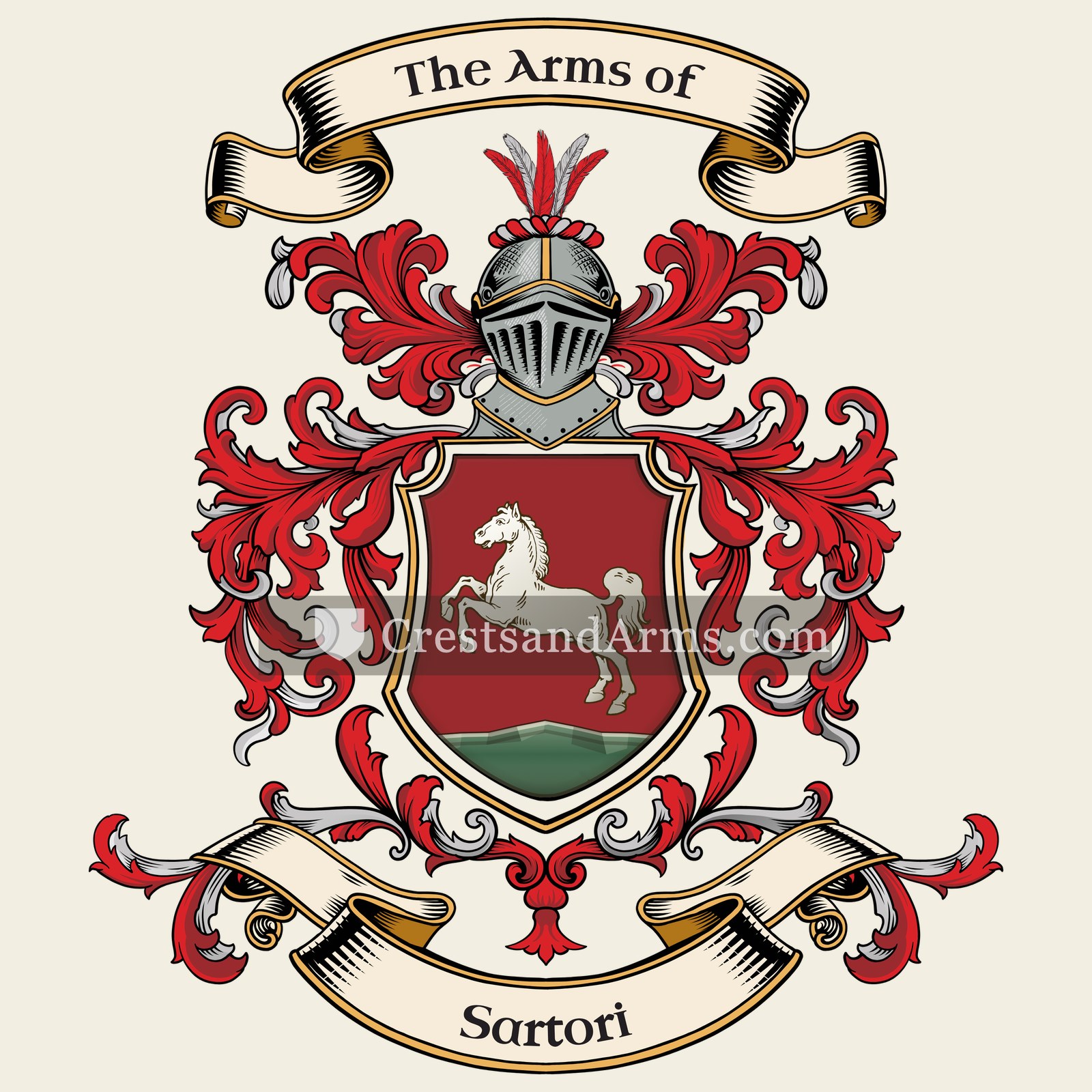


 fessThe military belt, and readiness to serve
 dovePeace, love and the Holy Spirit
 mulletThe third son, and a divine quality from above
 wheatsheafPlenty, and the harvest of one's own labour