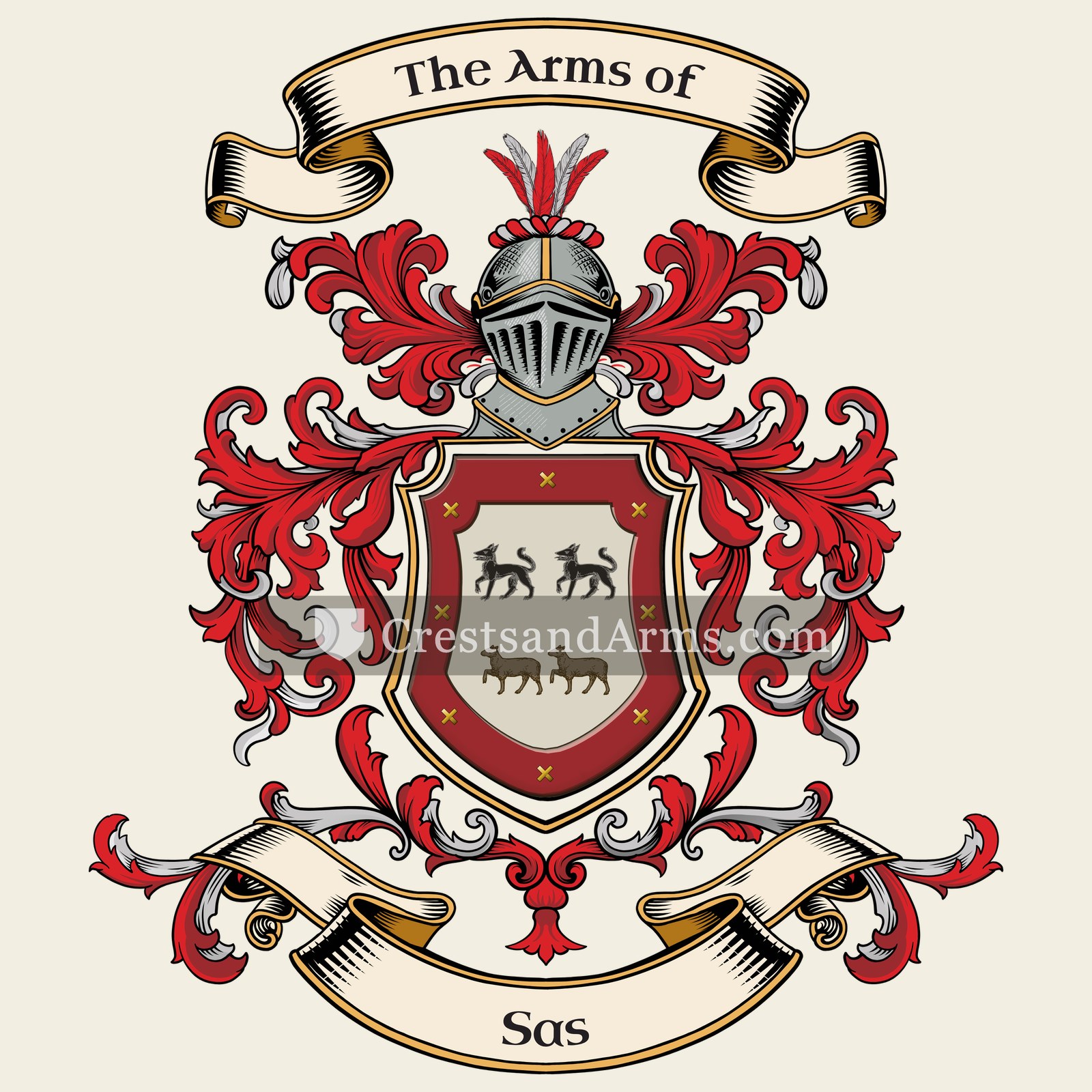
A record of documented arms, meaning and origin, researched for the Sas family lines. Documented in 2 countries.
Reg. 3397 · Dutch, T–V
Coat of Arms & Family Crest Details
Symbols on this shield
fessThe military belt, and readiness to serve
mountThe ground held, and steadfastness upon it
stagPeace and harmony, and one who will not fight unprovoked
horseReadiness to serve king and country
Colours
Blue (Azure)Means: Loyalty and truth
Gold (Or)Means: Generosity
Silver (Argent)Means: Peace and sincerity
Green (Vert)Means: Hope
Black (Sable)Means: Constancy
Historical info
Source
J. B. Rietstap, Armorial Général, Gouda: G. B. van Goor Zonen, 1884–87
Blazon (the actual original written record)
“Coupé: au 1 parti: a. d'azur à la fasce d'arg.; b. d'or à une tête et col de cheval de sa.; au 2 d'arg. à un cerf au nat., couché sur une terrasse de sin.”
Netherlandsc. 1815
Digital archive packCoat of arms PNG, gold border print PDF, vector SVG and the certificate of authenticity. Sent to your email in minutes.
Map of Netherlands showing where the Sas arms are recorded
The Sas arms were recorded in Netherlands, c. 1815.
Arms such as these were typically recorded in Friesland.
Friesland was low, wet country on the northern coast of the Netherlands, farmed by families who had held the same land for centuries. Free landholders were unusually common there, and a free landholder could carry arms.
This is where the arms were entered in the register. Families often moved to other parts of the country, so the same name can turn up in more than one region.
Region
Friesland
First recorded
1815
Granting Authority for the Sas Arms
Hoge Raad van Adel
Photograph made by me · CC BY-SA 3.0
The body that granted and recorded arms in Netherlands in this period.
William I of the Netherlands
Sovereign of the period
William I of the Netherlands
1815–1840
Reigning in Netherlands when the Sas arms are first recorded.
How Arms Worked in Netherlands
In the Netherlands, coats of arms were often used by noble families and those who held specific public offices. These arms were passed down through the generations to legitimate descendants. Younger branches of a family usually kept the original design without needing to add special marks. This system ensured that the family identity remained clear and consistent over many years.
Granting authority
The Hoge Raad van Adel is the official body that regulates and manages noble titles and coats of arms in the Netherlands.
How they got arms
Families typically obtained their coats of arms through official royal grants or by proving their long-standing historical use of the symbols.
Where arms were recorded
Coats of arms are officially recorded in the registers held by the Hoge Raad van Adel, which began its work in 1814.
The family's standing
Recorded among the armigerous families of Netherlands.
Origin & History of the Sas Family in Netherlands
The surname Sas has deep roots in the Low Countries, where it functioned as a descriptive name long before it became a formal family identifier. In the Dutch language, the word *sas* historically referred to a lock or a sluice used to manage water levels in canals and rivers. Because the Netherlands is defined by its complex relationship with water, people who lived near these structures or worked as lock keepers often adopted the name to distinguish themselves in their local communities. By the time official records began tracking residents in the northern province of Friesland in 1815, the name was already well-established among families who lived and worked along the region’s vital waterways. These early ancestors were likely part of the hardworking class of laborers and tradespeople who maintained the infrastructure necessary for travel and agriculture in the marshy Dutch landscape. Over generations, the name transitioned from a simple job title to a permanent family legacy that carried the history of the Dutch struggle to control the sea.
Coat of Arms & Family Crest Details
Symbols on this shield
saltireResolution, and St Andrew's cross
wolfReward from long service and hard work
lambGentleness, patience and faith
saltire coupedResolution, and the cross of St Andrew
Colours
Silver (Argent)Means: Peace and sincerity
Red (Gules)Means: Military strength
Black (Sable)Means: Constancy
Gold (Or)Means: Generosity
Historical info
Source
J. B. Rietstap, Armorial Général, Gouda: G. B. van Goor Zonen, 1884–87
Blazon (the actual original written record)
“D'arg. à deux loups pass. de sa., ravissant chacun un agneau au nat., l'un sur l'autre; à la bord. de gu., ch. de huit flanchis d'or.”
AragonAragon, c. 1722
Digital archive packCoat of arms PNG, gold border print PDF, vector SVG and the certificate of authenticity. Sent to your email in minutes.
Map of Spain showing where the Sas arms are recorded
The Sas arms were recorded in Aragon, c. 1722.
Aragon was mountain and river country in north-eastern Spain, with a strong tradition of small independent landholders. A great many families counted as gentry there, and each one needed a shield to be told apart.
This is where the arms were entered in the register. Families often moved to other parts of the country, so the same name can turn up in more than one region.
The body that granted and recorded arms in Spain in this period.
Philip V of Spain
Sovereign of the period
Philip V of Spain
1714–1724
Reigning in Netherlands when the Sas arms are first recorded.
How Arms Worked in Spain
In Spain, a coat of arms was considered a form of property that belonged to the entire family line. These arms were passed down from a father to all his children equally. Younger branches of the family usually kept the original design without needing to add any special marks to distinguish their specific line.
Granting authority
The Cronista Rey de Armas was the official body that regulated and granted coats of arms throughout Spain.
How they got arms
Families often obtained their arms through royal grants or by proving their noble status to the official heraldic authority.
Where arms were recorded
Coats of arms were officially recorded in the registers of the Cronista Rey de Armas starting in 1496.
The family's standing
Recorded among the armigerous families of Aragon.
Origin & History of the Sas Family in Spain
The family name Sas has deep roots in the rugged landscapes of the Aragon region in northeastern Spain. By the early 18th century, records confirm that members of the Sas family were well-established within this territory. The name itself is often linked to the geography of the Pyrenees mountains, as "sas" is an old term used in local dialects to describe a rocky or stony piece of land. Families during this period were frequently identified by the specific terrain they farmed or lived upon, which suggests that the earliest ancestors were likely mountain dwellers who worked the challenging soil of the high valleys. As they settled in Aragon, these individuals became part of a resilient community that navigated the complex social and agricultural shifts of the Spanish interior during the 1700s. Their presence in official documents from 1722 highlights a family that was integrated into the local parish and tax systems, marking them as established residents of the Spanish countryside.
Related Branches & Arms
Root word
Sasse
A dam, sluice, or lock used to control water levels.
This name
SasA topographic name for someone who lived near a sluice or water gate.
also spelled
Saz
Sass
Related arms
Sazvariant spelling
Documented Sources
J. B. Rietstap, Armorial Général, Gouda: G. B. van Goor Zonen, 1884–87
Beem, H., Nederlandse familienamen, 1963
Meertens, P.J., De betekenis van Nederlandse familienamen, 1959
Tresoar (Fries Historisch en Letterkundig Centrum), Burgerlijke Stand van Friesland, 1815
Digital archive packCoat of arms PNG, gold border print PDF, vector SVG and the certificate of authenticity. Sent to your email in minutes.


 fessThe military belt, and readiness to serve
 mountThe ground held, and steadfastness upon it
 stagPeace and harmony, and one who will not fight unprovoked
 horseReadiness to serve king and country
 fessThe military belt, and readiness to serve
 mountThe ground held, and steadfastness upon it
 stagPeace and harmony, and one who will not fight unprovoked
 horseReadiness to serve king and country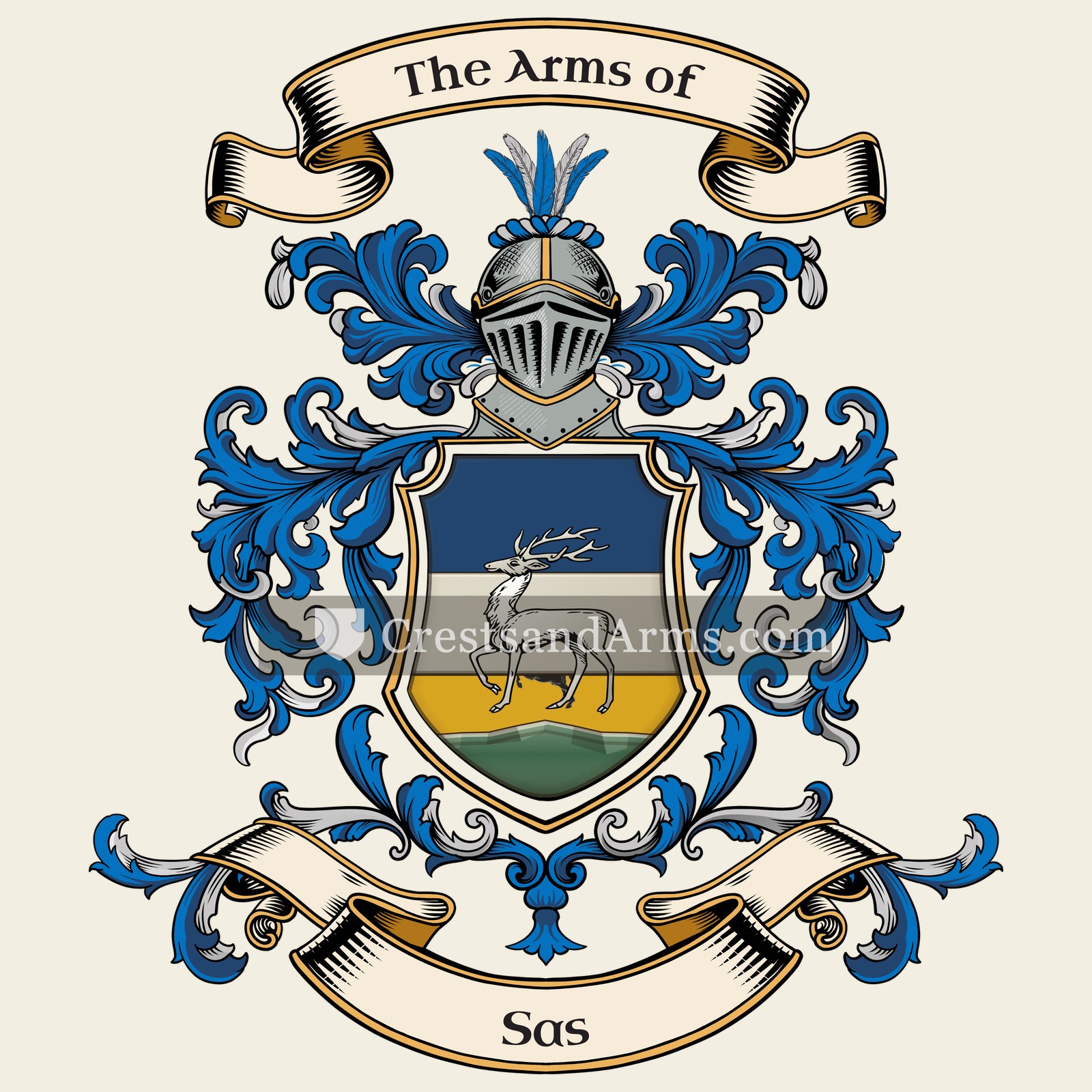


 saltireResolution, and St Andrew's cross
 wolfReward from long service and hard work
 lambGentleness, patience and faith
 saltire coupedResolution, and the cross of St Andrew