A record of documented arms, meaning and origin, researched for the Sass I family lines. Documented in 2 countries.
Reg. 0518 · Polish, T–V
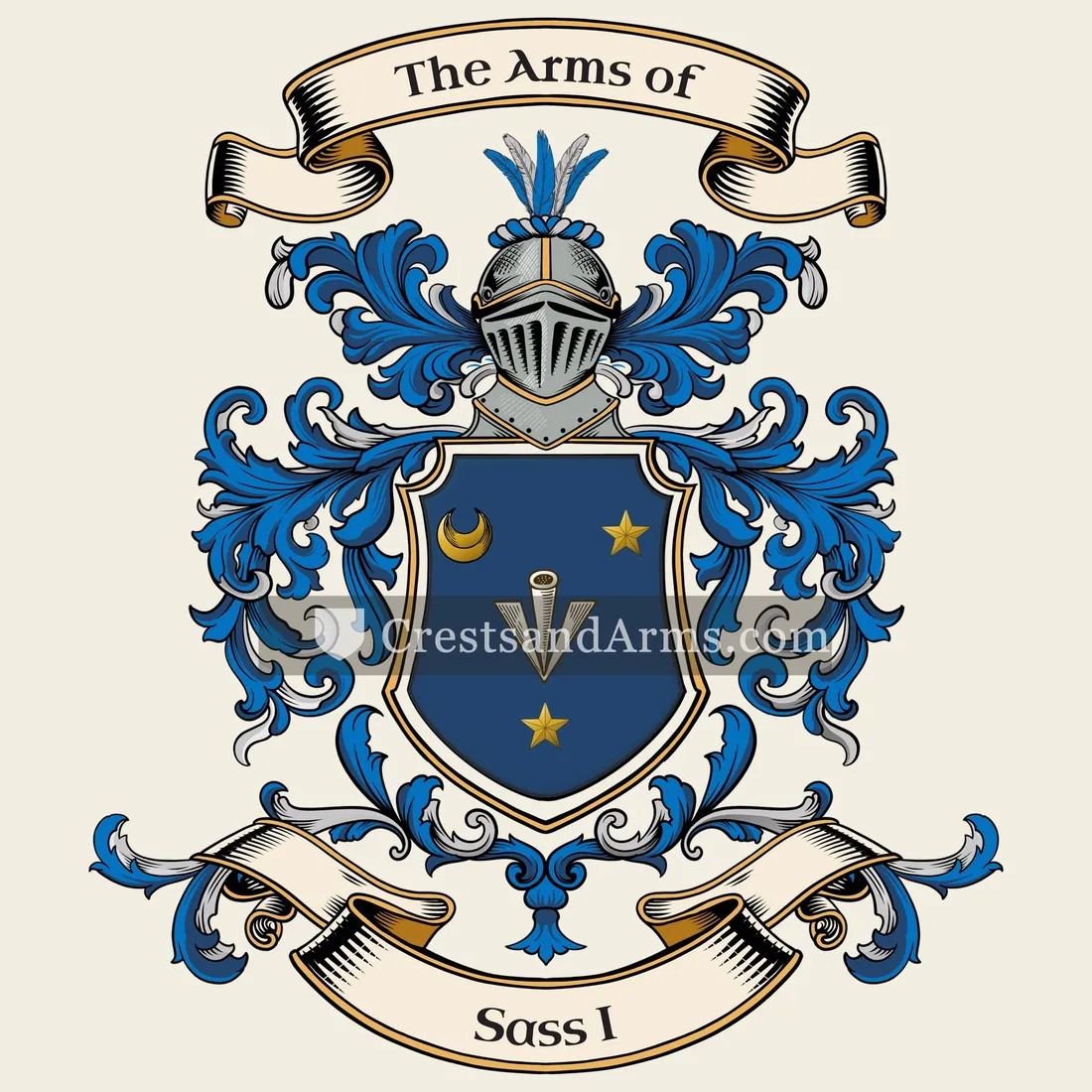
Meaning of the Sass I family crest colors & symbols
Symbols on this shield
arrowReadiness for battle, and affliction endured
crescentHonour by the sovereign, and the second son
mulletThe third son, and a divine quality from above
Colours
Blue (Azure)Means: Loyalty and truth
Silver (Argent)Means: Peace and sincerity
Gold (Or)Means: Generosity
Historical info
Source
J. B. Rietstap, Armorial Général, Gouda: G. B. van Goor Zonen, 1884–87
Blazon (the actual original written record)
“D'azur à une flèche d'arg., soutenue d'un croiss. d'or et accostée de deux étoiles du même. Cq. cour. C.: une queue de paon, au nat., percée d'une flèche d'or, en fasce, la pointe à sen.”
Polandc. 1772
Digital archive packCoat of arms PNG, gold border print PDF, vector SVG and the certificate of authenticity. Sent to your email in minutes.
Map of Poland showing where the Sass I arms are recorded
The Sass I arms were recorded in Poland, c. 1772.
Arms such as these were typically recorded in Mazovia.
Mazovia held Warsaw, the Polish court and the assemblies where the szlachta met. Poland's nobles were unusually numerous and every one of them bore arms, and Warsaw is where those arms were argued over and recorded.
This is where the arms were entered in the register. Families often moved to other parts of the country, so the same name can turn up in more than one region.
Region
Mazovia
First recorded
1772
Granting Authority for the Sass I Arms
Ennoblement by the Sejm
Author: Olek Remesz · CC BY-SA 3.0
The body that granted and recorded arms in Poland in this period.
Stanisław August Poniatowski
Sovereign of the period
Stanisław August Poniatowski
1764–1795
Reigning in Poland when the Sass I arms are first recorded.
How Arms Worked in Poland
Polish noble families shared a single coat of arms across many different surnames, creating large clans rather than individual designs. These symbols were held collectively by all members of the clan regardless of their specific family name. When a new family joined the nobility, they were adopted into an existing clan and began using that group's established shield.
Granting authority
The Sejm, which was the Polish parliament, held the power to grant noble status and the right to bear arms.
How they got arms
Families typically received their coat of arms through a formal act of ennoblement granted by the Sejm for distinguished service.
Where arms were recorded
These grants were officially recorded in the Crown Metrica, which served as the central archive for state documents starting in the sixteenth century.
The family's standing
Recorded among the armigerous families of Poland.
Origin & History of the Sass I Family in Poland
The history of the Sass family in Poland is deeply rooted in the Mazovia region, where members of the family were documented as early as 1772. During this period, the name was often associated with families who lived in rural areas and worked as landowners or local administrators. The name itself is thought to have origins linked to the historical term for settlers who arrived from the German-speaking lands to the west, though by the late 18th century, the family was fully integrated into the social and cultural fabric of the Polish Commonwealth. As the family established their presence in Mazovia, they became part of the local community structure, often appearing in parish registers that tracked births, marriages, and deaths. These records show that the Sass family lived through a time of great political change in Poland, maintaining their identity while adapting to the shifting borders and social expectations of the late 1700s.
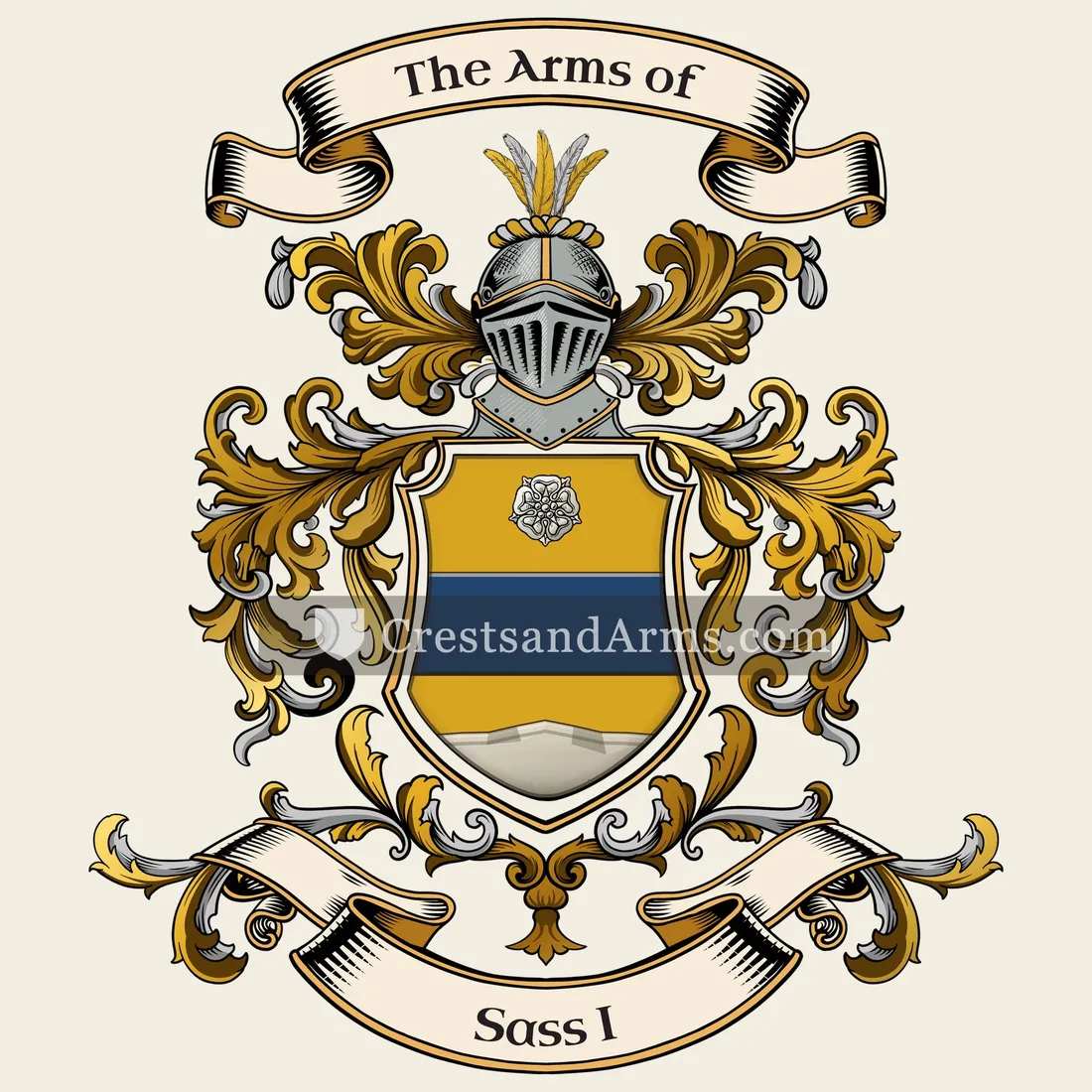
Meaning of the Sass I family crest colors & symbols
Symbols on this shield
fessThe military belt, and readiness to serve
mountThe ground held, and steadfastness upon it
roseThe seventh son, and beauty with grace
Colours
Gold (Or)Means: Generosity
Blue (Azure)Means: Loyalty and truth
Silver (Argent)Means: Peace and sincerity
Historical info
Source
J. B. Rietstap, Armorial Général, Gouda: G. B. van Goor Zonen, 1884–87
Blazon (the actual original written record)
“D'or à la fasce d'azur, acc. en chef d'une rose d'arg. et en p. d'un mont de trois coupeaux du même, mouv. de la p.”
ItalyBologne, c. 1775
Digital archive packCoat of arms PNG, gold border print PDF, vector SVG and the certificate of authenticity. Sent to your email in minutes.
Map of Italy showing where the Sass I arms are recorded
The Sass I arms were recorded in Bologne, c. 1775.
This is where the arms were entered in the register. Families often moved to other parts of the country, so the same name can turn up in more than one region.
The body that granted and recorded arms in Italy in this period.
Alvise Giovanni Mocenigo
Sovereign of the period
Alvise Giovanni Mocenigo
1763–1778
Reigning in Poland when the Sass I arms are first recorded.
How Arms Worked in Italy
In the Italian states, coats of arms were often used by noble families to show their status and history. These symbols were passed down through the generations to all legitimate male descendants. Younger branches of a family usually kept the original design but sometimes added small changes to distinguish their specific line from the main branch.
Granting authority
Various local rulers and city governments controlled the use of coats of arms across the different Italian states.
How they got arms
Families often assumed their own arms or received them as official grants from local lords, popes, or city councils.
Where arms were recorded
Arms were recorded in local city archives or private family books rather than in one single national register.
The family's standing
Recorded among the armigerous families of Italy.
Origin & History of the Sass I Family in Italy
The Sass family name in Italy is deeply tied to the intellectual and social landscape of Bologna during the late eighteenth century. By 1775, records indicate that members of the family were already established within the city, which was then a major center for trade and academic study under the Papal States. The name itself likely originated from a descriptive term, as the word "sasso" in Italian translates to stone or rock, often used in medieval times to denote someone who lived near a prominent geological feature or a fortified stone structure. As residents of Bologna, the family would have lived in a city famous for its ancient university and its complex system of guilds. During this period, families like the Sass were often involved in the professional class, contributing to the vibrant urban life that defined the region before the political upheavals of the Napoleonic era. This early presence in such a historically significant city suggests that the family was well-integrated into the local community and participated in the economic growth of the Emilia-Romagna region.
Sass I Meaning & Related Branches
Root word
Sasso
An Italian or Germanic term referring to a stone or rock.
This name
Sass IA topographic name for someone who lived near a prominent rock or stony outcrop.
also spelled
Sassy
Related arms
Sassyvariant spelling
Documented Sources
J. B. Rietstap, Armorial Général, Gouda: G. B. van Goor Zonen, 1884–87
Archiwum Główne Akt Dawnych (AGAD), Metryki parafialne z terenu Mazowsza (Parish registers of Mazovia)
Archiwum Państwowe w Warszawie, Akta stanu cywilnego parafii rzymskokatolickich (Civil status records of Roman Catholic parishes)
Bieńkowski, Wiesław, Słownik historyczno-geograficzny województwa mazowieckiego w dobie Rzeczypospolitej szlacheckiej (1995)
Kajkowski, Krzysztof, Osadnictwo na Mazowszu w XVIII wieku (2002)
Digital archive packCoat of arms PNG, gold border print PDF, vector SVG and the certificate of authenticity. Sent to your email in minutes.


 arrowReadiness for battle, and affliction endured
 crescentHonour by the sovereign, and the second son
 mulletThe third son, and a divine quality from above
 arrowReadiness for battle, and affliction endured
 crescentHonour by the sovereign, and the second son
 mulletThe third son, and a divine quality from above


 fessThe military belt, and readiness to serve
 mountThe ground held, and steadfastness upon it
 roseThe seventh son, and beauty with grace