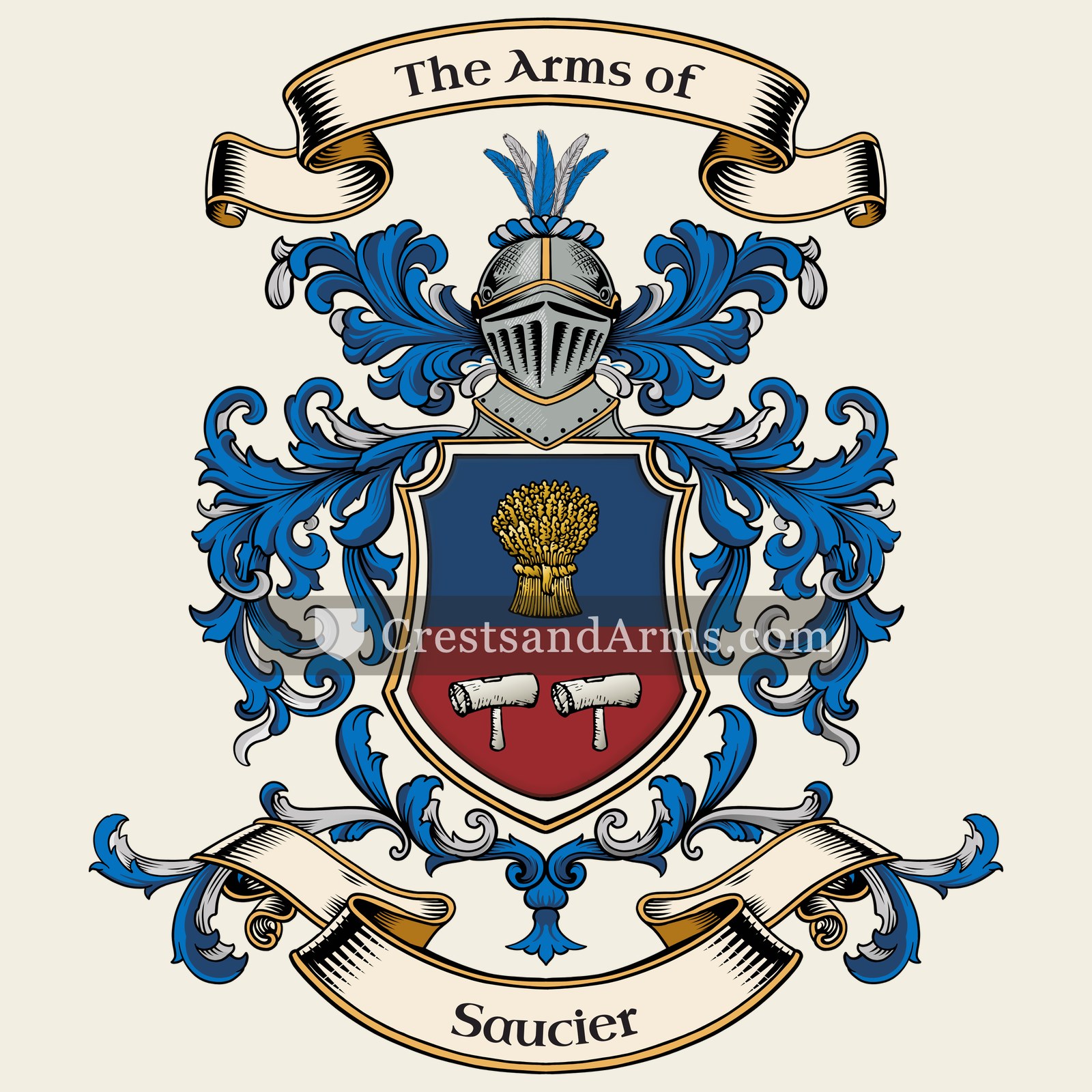
A record of documented arms, meaning and origin, researched for the Saucier family of Austria.
Reg. 6072 · Austrian, T–V
Coat of Arms & Family Crest Details
Symbols on this shield
wheatsheafPlenty, and the harvest of one's own labour
hammerHonest labour, and the smith's craft
Colours
Blue (Azure)Means: Loyalty and truth
Red (Gules)Means: Military strength
Gold (Or)Means: Generosity
Silver (Argent)Means: Peace and sincerity
Historical info
Source
J. B. Rietstap, Armorial Général, Gouda: G. B. van Goor Zonen, 1884–87
Blazon (the actual original written record)
“Coupé: au 1 d'azur à une gerbe d'or; au 2 de gu. à deux marteaux d'arg., emm. d'or, passés en saut., acc. en chef d'un morceau de sel au nat. Deux cq. cour. C.: 1º la gerbe; 1. d'or et d'azur; 2º deux pl. d'aut., de gu. et d'arg.; I. d'arg. et de gu.”
GaliciaGalicia, c. 1818
Digital archive packCoat of arms PNG, gold border print PDF, vector SVG and the certificate of authenticity. Sent to your email in minutes.
Map of Austria showing where the Saucier arms are recorded
The Saucier arms were recorded in Galicia, c. 1818.
Galicia was eastern country of large estates and small farming villages, held by families who had been there for a very long time. Land was what entitled a family to arms, and land there rarely changed hands.
This is where the arms were entered in the register. Families often moved to other parts of the country, so the same name can turn up in more than one region.
Region
Galicia
First recorded
1818
Granting Authority for the Saucier Arms
Imperial and Royal chancery
Sodacan · CC BY-SA 3.0
The body that granted and recorded arms in Austria in this period.
Francis II, Holy Roman Emperor
Sovereign of the period
Francis II, Holy Roman Emperor
1804–1835
Reigning in Austria when the Saucier arms are first recorded.
How Arms Worked in Austria
Austrian coats of arms were often linked directly to noble titles granted by the Emperor. These symbols belonged to the entire family line rather than just one individual. When a family grew, new branches kept the original design without needing to change it. This system allowed all members of a noble house to share the same identity across many generations.
Granting authority
The Imperial and Royal chancery managed all heraldic matters and controlled the official granting of arms throughout the Austrian lands.
How they got arms
Families typically received their arms through a formal imperial decree that often accompanied the elevation of a person to noble status.
Where arms were recorded
Official records of these grants were kept in the Imperial Register of Nobility which began its formal documentation process in 1453.
The family's standing
Recorded among the armigerous families of Galicia.
Origin & History of the Saucier Family in Austria
The Saucier family name has deep roots that trace back to the historical region of Galicia, where members of the family were documented as early as 1818. The name itself is thought to be occupational in origin, likely derived from the Old French word "saucier," which referred to a person who prepared sauces or worked in the kitchen of a noble household. As the family moved and settled into different regions, they often adapted to the local customs and languages of their new homes. By the early 19th century, the presence of the Saucier name in Galicia suggests a history of migration and integration within the Iberian Peninsula. These early ancestors were part of a broader movement of families who maintained their identity while contributing to the social and economic life of their local communities.
Related Branches & Arms
Root word
Salsus
Latin term meaning salted or preserved.
This name
SaucierAn occupational surname for a salt merchant or someone who worked in the salt trade.
also spelled
Sacherer
Sacheri
Sacherre
Saker
Sasher
Documented Sources
J. B. Rietstap, Armorial Général, Gouda: G. B. van Goor Zonen, 1884–87
Dauzat, Albert, Dictionnaire étymologique des noms et prénoms de France, 1951
Archivo Histórico Nacional, Sección Nobleza, Registros de Hidalguía, 1818
Morlet, Marie-Thérèse, Dictionnaire étymologique des noms de famille, 1991
Digital archive packCoat of arms PNG, gold border print PDF, vector SVG and the certificate of authenticity. Sent to your email in minutes.


 wheatsheafPlenty, and the harvest of one's own labour
 hammerHonest labour, and the smith's craft
 wheatsheafPlenty, and the harvest of one's own labour
 hammerHonest labour, and the smith's craft