A record of documented arms, meaning and origin, researched for the Saxe family lines. Documented in 2 countries.
Reg. 5001 · Danish, T–V
Meaning of the Saxe family crest colors & symbols
Symbols on this shield
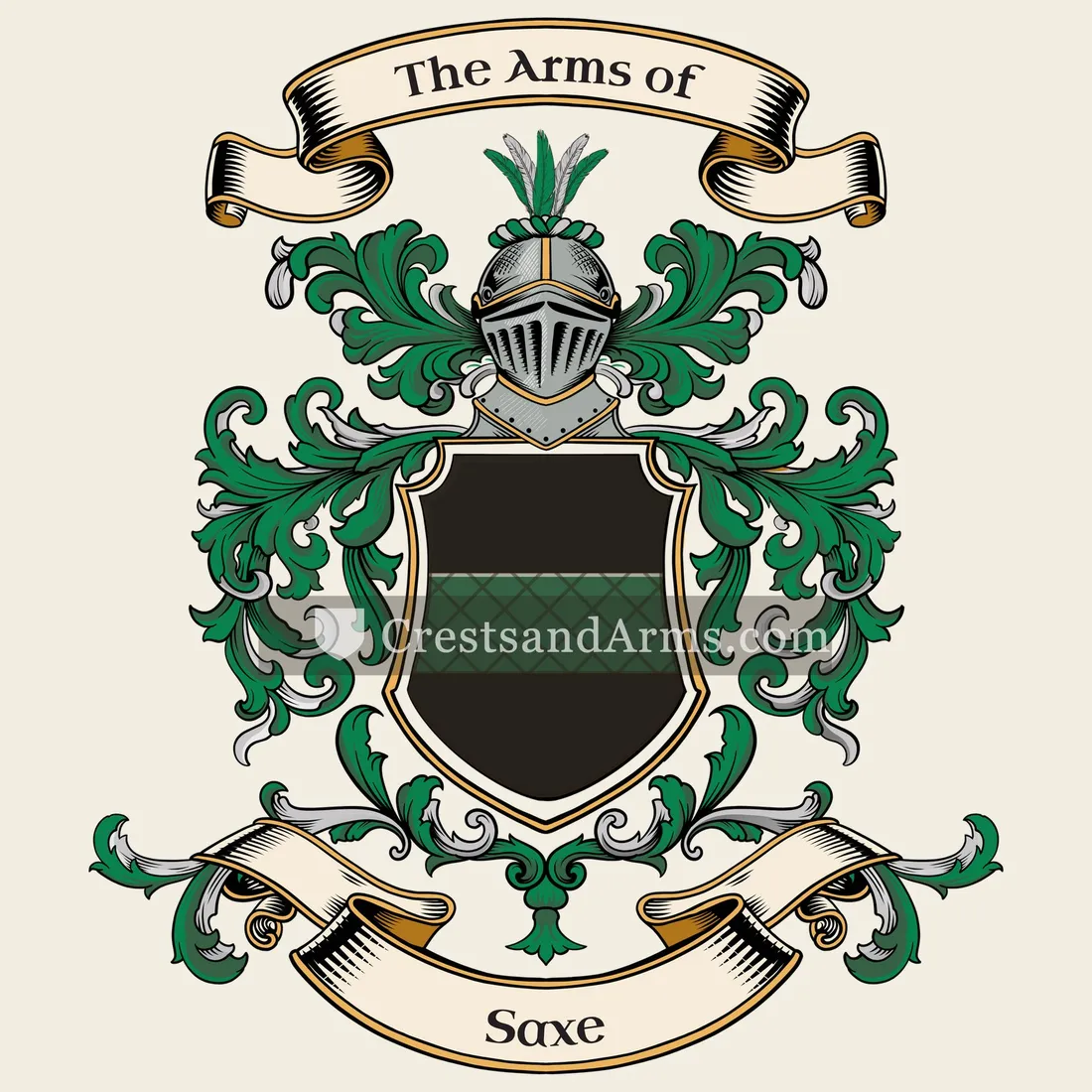
fessThe military belt, and readiness to serve
Colours
Black (Sable)Means: Constancy
Green (Vert)Means: Hope
Historical info
Source
J. B. Rietstap, Armorial Général, Gouda: G. B. van Goor Zonen, 1884–87
Blazon (the actual original written record)
“de sa. et d'or de dix pièces, au crancelin de sin., posé en bande, br. sur le tout, modifiées de telle manière que la troisième burèle de sa. et la troisième burèle d'or sont remplacées par une fasce de sa., brochante sur le crancelin [Jo-seph Joh. George Zabelitz, né vers 1772, tué en duel le 26 juin 1802, fils du prince François Xavier Auguste de Saxe et de son épouse morganatique la comtesse Clara Maria Rosa Spinuzzi, fut an. sous le nom de Chevalier de Saxe.]”
Denmarkc. 1722
Digital archive packCoat of arms PNG, gold border print PDF, vector SVG and the certificate of authenticity. Sent to your email in minutes.
Map of Denmark showing where the Saxe arms are recorded
The Saxe arms were recorded in Denmark, c. 1722.
Arms such as these were typically recorded in Sjaælland.
Zealand held the Danish court, the crown's offices and Copenhagen itself. Families who served the king kept estates within reach of it, and royal service was the ordinary route to a coat of arms.
This is where the arms were entered in the register. Families often moved to other parts of the country, so the same name can turn up in more than one region.
The body that granted and recorded arms in Denmark in this period.
Frederik IV of Denmark
Sovereign of the period
Frederik IV of Denmark
1699–1730
Reigning in Denmark when the Saxe arms are first recorded.
How Arms Worked in Denmark
Danish heraldry during this period was closely tied to noble status and royal favor rather than being open to all citizens. Arms were typically granted by the monarch to individuals, and these symbols were then shared by all members of the noble house. If a family line died out, the right to use those specific arms ended with them.
Granting authority
The Danish royal chancery held the power to issue and regulate official coats of arms for the kingdom.
How they got arms
Families usually received their arms through a formal royal grant that confirmed their noble status and rights.
Where arms were recorded
These grants were officially recorded in the Danish Royal Chancery records starting in the sixteenth century.
The family's standing
Recorded among the armigerous families of Denmark.
Origin & History of the Saxe Family in Denmark
The history of the Saxe family in Denmark is deeply rooted in the agricultural landscape of the island of Zealand, or Sjælland, where the name first appears in official records during the early eighteenth century. By 1722, members of the family were established as active participants in the local community, likely working as tenant farmers or tradespeople within the rigid social structures of the Danish countryside. During this era, surnames were often fluid and tied closely to one’s occupation or place of origin, suggesting that the Saxe name served as a way to distinguish this specific lineage from their neighbors. As the family settled into the rural parishes of Sjælland, they became part of the backbone of the local economy, navigating the transition from traditional feudal obligations to the more structured administrative life of the Danish state. Their presence in the 1722 records provides a clear window into the lives of common families who helped shape the cultural and social fabric of Denmark long before the modern era of industrialization.
Meaning of the Saxe family crest colors & symbols
Symbols on this shield
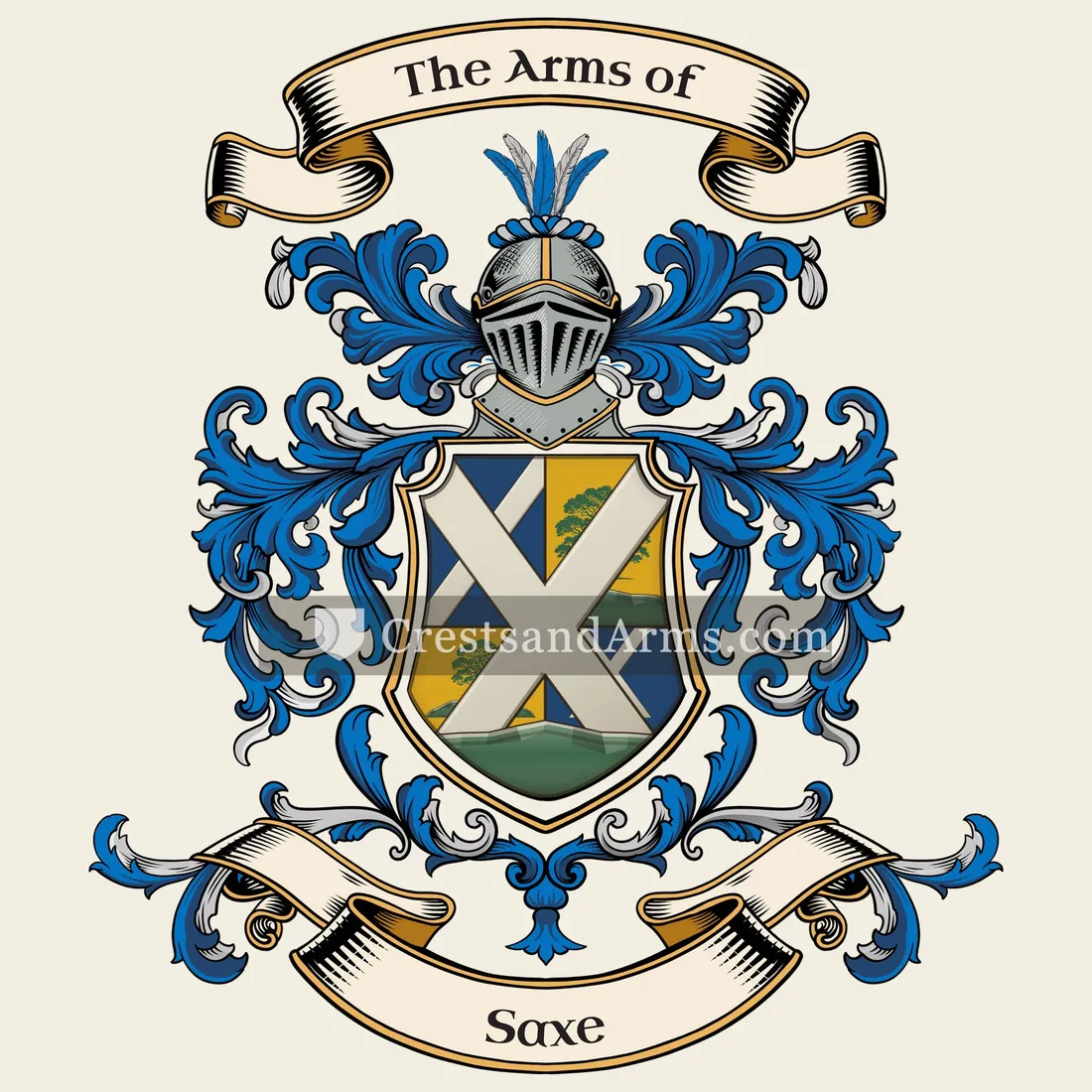
saltireResolution, and St Andrew's cross
mountThe ground held, and steadfastness upon it
treeLife, endurance and deep roots
Colours
Blue (Azure)Means: Loyalty and truth
Gold (Or)Means: Generosity
Silver (Argent)Means: Peace and sincerity
Green (Vert)Means: Hope
Historical info
Source
J. B. Rietstap, Armorial Général, Gouda: G. B. van Goor Zonen, 1884–87
Blazon (the actual original written record)
“Ec.: aux 1 et 4 d'azur au saut. d'arg.; aux 2 et 3 d'or à un arbre terrassé de sin.”
UtrechtUtrecht, c. 1815
Digital archive packCoat of arms PNG, gold border print PDF, vector SVG and the certificate of authenticity. Sent to your email in minutes.
Map of Netherlands showing where the Saxe arms are recorded
The Saxe arms were recorded in Utrecht, c. 1815.
Utrecht was an old church town with rich farming country around it. Both the church and the land produced families of standing, and families of standing kept arms to seal their documents with.
This is where the arms were entered in the register. Families often moved to other parts of the country, so the same name can turn up in more than one region.
Region
Utrecht
First recorded
1815
Granting Authority for the Saxe Arms
Hoge Raad van Adel
Photograph made by me · CC BY-SA 3.0
The body that granted and recorded arms in Netherlands in this period.
William I of the Netherlands
Sovereign of the period
William I of the Netherlands
1815–1840
Reigning in Denmark when the Saxe arms are first recorded.
How Arms Worked in Netherlands
In the Netherlands, coats of arms were often used by noble families and those who held specific public offices. These arms were passed down through the generations to legitimate descendants. Younger branches of a family usually kept the original design without needing to add special marks. This system ensured that the family identity remained clear and consistent over many years.
Granting authority
The Hoge Raad van Adel is the official body that regulates and manages noble titles and coats of arms in the Netherlands.
How they got arms
Families typically obtained their coats of arms through official royal grants or by proving their long-standing historical use of the symbols.
Where arms were recorded
Coats of arms are officially recorded in the registers held by the Hoge Raad van Adel, which began its work in 1814.
The family's standing
Recorded among the armigerous families of Utrecht.
Origin & History of the Saxe Family in Netherlands
The history of the Saxe family in the Netherlands is deeply connected to the city of Utrecht during the early nineteenth century. By 1815, records show that members of the family were established residents in this historic hub, which served as a major center for trade and administration following the end of the Napoleonic era. The name itself reflects a linguistic link to the Saxon regions of Central Europe, suggesting that the family’s ancestors likely migrated westward during periods of regional conflict or economic transition. Once in Utrecht, the family integrated into the local urban society, participating in the professional and civic life of a city that was rapidly modernizing. Their presence in the official municipal registers of 1815 marks a pivotal moment where the family transitioned from their ancestral roots into the structured social fabric of the Dutch state.
Saxe Meaning & Related Branches
Root word
Sax
Derived from the Old Germanic word for a short sword or knife.
This name
SaxeRefers to a person belonging to the Saxon tribe or a knife-wielder.
also spelled
Sacks
Sax
Related arms
Sachsenvariant spelling
Documented Sources
J. B. Rietstap, Armorial Général, Gouda: G. B. van Goor Zonen, 1884–87
Danish National Archives (Rigsarkivet), Sjællandske Tegnelser
Danish National Archives (Rigsarkivet), Kirkebøger for Sjællands Stift
Trap, J.P., Kongeriget Danmark, 1920
Digital archive packCoat of arms PNG, gold border print PDF, vector SVG and the certificate of authenticity. Sent to your email in minutes.


 fessThe military belt, and readiness to serve
 fessThe military belt, and readiness to serve


 saltireResolution, and St Andrew's cross
 mountThe ground held, and steadfastness upon it
 treeLife, endurance and deep roots