Map of France showing where the Schach arms are recorded
The Schach arms were recorded in Strasbourg, c. 1663.
This is where the arms were entered in the register. Families often moved to other parts of the country, so the same name can turn up in more than one region.
The body that granted and recorded arms in France in this period.
Louis XIV of France
Sovereign of the period
Louis XIV of France
1643–1715
Reigning in France when the Schach arms are first recorded.
How Arms Worked in France
In France, a coat of arms was a mark of honor that passed down through the male line to all legitimate descendants. Families often used the same shield without changes to show their shared heritage. If a branch wanted to stand out, they could add a small mark to their shield to show their specific place in the family tree.
Granting authority
The Juge d'armes de France acted as the official authority that regulated and verified coats of arms across the country.
How they got arms
Families typically inherited their arms from ancestors, though they could also receive them through royal grants or by proving their noble status.
Where arms were recorded
Coats of arms were officially recorded in the Armorial Général de France, which began its main collection in the year 1696.
The family's standing
Recorded among the armigerous families of France.
Origin & History of the Schach Family in France
The history of the Schach family in France is deeply tied to the unique cultural landscape of the Alsace region. By 1663, records confirm that members of the family were established in Strasbourg, a city that served as a vital crossroads between French and Germanic influences. During this era, Strasbourg was a center of trade and intellectual exchange, and families like the Schach line often integrated into the local merchant or civic classes. Because the name is rooted in the Middle High German word for chess, it likely originated as a descriptive nickname for a person who was a skilled player or perhaps a strategist. As the family settled in Strasbourg, they navigated the complex political shifts of the seventeenth century, living through a period when the city transitioned from a free imperial status to becoming part of the Kingdom of France. Their presence in the city during this time suggests they were part of the stable urban population that helped define the region’s distinct identity.
Meaning of the Schach family crest colors & symbols
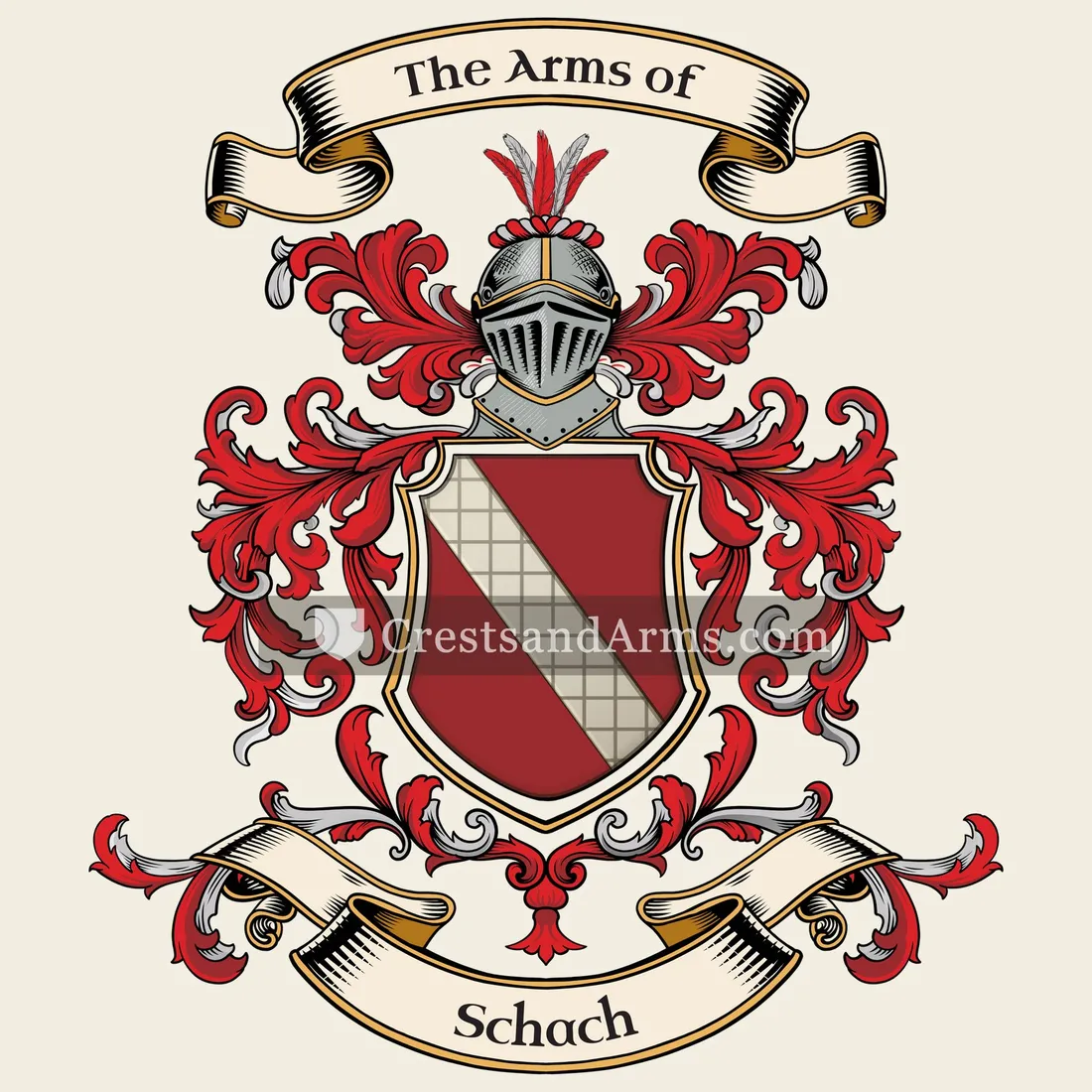
Symbols on this shield
bendDefence, and the scarf of a commander
Colours
Red (Gules)Means: Military strength
Silver (Argent)Means: Peace and sincerity
Historical info
Source
J. B. Rietstap, Armorial Général, Gouda: G. B. van Goor Zonen, 1884–87
Blazon (the actual original written record)
“De gu. à la bande d'arg., ch. de quatre barres vivrées de sa. C.: un demi-vol aux armes de l'écu. L. d'arg. et de gu.”
SwabiaSwabia, c. 1765
Digital archive packCoat of arms PNG, gold border print PDF, vector SVG and the certificate of authenticity. Sent to your email in minutes.
Map of Germany showing where the Schach arms are recorded
The Schach arms were recorded in Swabia, c. 1765.
Swabia was broken into a great many small territories in southern Germany, and each had its own landowners and its own leading townsmen. That fragmentation produced an unusual number of families with arms.
This is where the arms were entered in the register. Families often moved to other parts of the country, so the same name can turn up in more than one region.
The body that granted and recorded arms in Germany in this period.
Francis I, Holy Roman Emperor
Sovereign of the period
Francis I, Holy Roman Emperor
1745–1765
Reigning in France when the Schach arms are first recorded.
How Arms Worked in Germany
In the Holy Roman Empire, coats of arms were often granted to individuals by the Emperor or his representatives. These arms were then passed down through the generations to all legitimate descendants of the original holder. Younger branches of a family usually kept the same shield design without needing to change it, as the arms belonged to the entire lineage.
Granting authority
The Holy Roman Emperor held the sole power to grant new coats of arms throughout his vast imperial territories.
How they got arms
Families typically obtained their coats of arms through a formal imperial grant or by proving their noble status to the authorities.
Where arms were recorded
These grants were officially recorded in the Imperial Chancery registers, which began keeping formal records of such honors during the Middle Ages.
The family's standing
Recorded among the armigerous families of Swabia.
Origin & History of the Schach Family in Germany
The surname Schach has deep roots in the historical region of Swabia, where family members were documented as residents by 1765. In the German language, the name is closely linked to the term for chess, which suggests that early ancestors may have been associated with the game or perhaps earned the name as a nickname for a clever or strategic individual. During the eighteenth century, Swabia was a patchwork of small territories, and families like the Schach line often lived in tight-knit agricultural or craft-based communities. Life in this region was defined by the local customs of the Holy Roman Empire, where families were typically tied to the land and their specific village parishes. By the mid-1700s, the Schach family was part of a stable social structure that relied on regional trade and local governance. Their presence in the historical records of this era highlights a long tradition of settlement in southwestern Germany, reflecting the broader patterns of life for families living in the Swabian countryside before the era of modern industrialization.
Schach Meaning & Related Branches
Root word
Scaccus
Latin term for a chess piece or a square board.
This name
SchachAn occupational name for a chess player or a nickname for someone associated with the game.
also spelled
Schack
Shahk
Shach
Related arms
Schackvariant spelling
Documented Sources
J. B. Rietstap, Armorial Général, Gouda: G. B. van Goor Zonen, 1884–87
Archives de la Ville et de l'Eurométropole de Strasbourg, Registres paroissiaux et d'état civil
Himly, François-Jacques, Chronologie de la Basse-Alsace, 1972
Livet, Georges, L'intendance d'Alsace sous Louis XIV, 1956
Digital archive packCoat of arms PNG, gold border print PDF, vector SVG and the certificate of authenticity. Sent to your email in minutes.


 chequyConstancy, and the counting-board
 chequyConstancy, and the counting-board
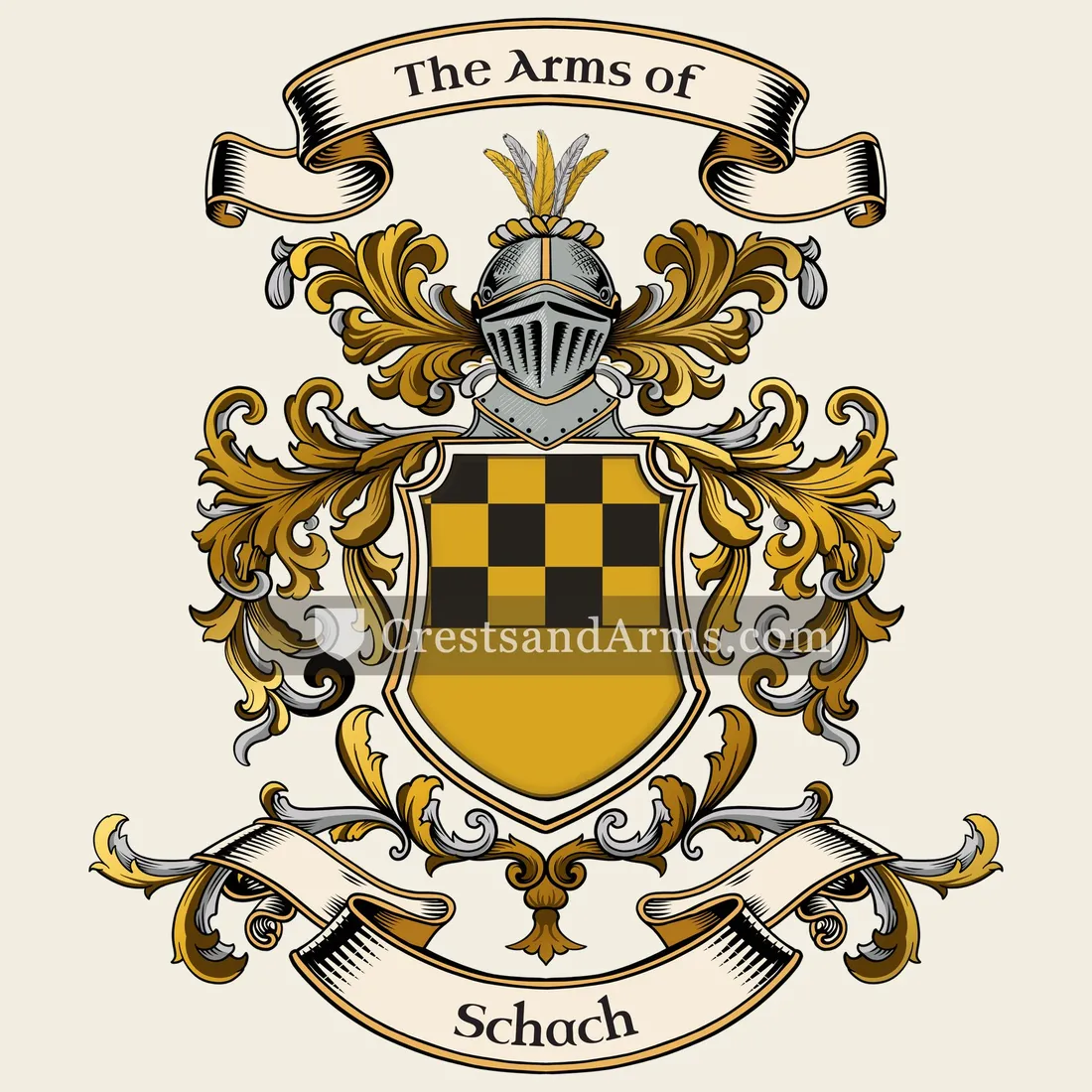


 bendDefence, and the scarf of a commander