Map of Netherlands showing where the Schade arms are recorded
The Schade arms were recorded in Netherlands, c. 1815.
Arms such as these were typically recorded in Friesland.
Friesland was low, wet country on the northern coast of the Netherlands, farmed by families who had held the same land for centuries. Free landholders were unusually common there, and a free landholder could carry arms.
This is where the arms were entered in the register. Families often moved to other parts of the country, so the same name can turn up in more than one region.
Region
Friesland
First recorded
1815
Granting Authority for the Schade Arms
Hoge Raad van Adel
Photograph made by me · CC BY-SA 3.0
The body that granted and recorded arms in Netherlands in this period.
William I of the Netherlands
Sovereign of the period
William I of the Netherlands
1815–1840
Reigning in Netherlands when the Schade arms are first recorded.
How Arms Worked in Netherlands
In the Netherlands, coats of arms were often used by noble families and those who held specific public offices. These arms were passed down through the generations to legitimate descendants. Younger branches of a family usually kept the original design without needing to add special marks. This system ensured that the family identity remained clear and consistent over many years.
Granting authority
The Hoge Raad van Adel is the official body that regulates and manages noble titles and coats of arms in the Netherlands.
How they got arms
Families typically obtained their coats of arms through official royal grants or by proving their long-standing historical use of the symbols.
Where arms were recorded
Coats of arms are officially recorded in the registers held by the Hoge Raad van Adel, which began its work in 1814.
The family's standing
Recorded among the armigerous families of Netherlands.
Origin & History of the Schade Family in Netherlands
The surname Schade has deep roots in the northern regions of the Netherlands, particularly within the province of Friesland. By the early nineteenth century, the family was well-established in this area, living among the unique cultural and linguistic traditions of the Frisian people. The name itself likely originated from a descriptive term, as the word "schade" historically relates to concepts of boundaries, shadows, or even the management of land. During this period, families in Friesland often lived in close-knit agricultural communities where surnames became increasingly fixed due to new government registration requirements. As the family settled into the Frisian landscape around 1815, they became part of a society transitioning through significant political changes under the newly formed Kingdom of the Netherlands. This era marked a time when the family name became a permanent marker of their identity within the local records of the region.
Coat of Arms & Family Crest Details
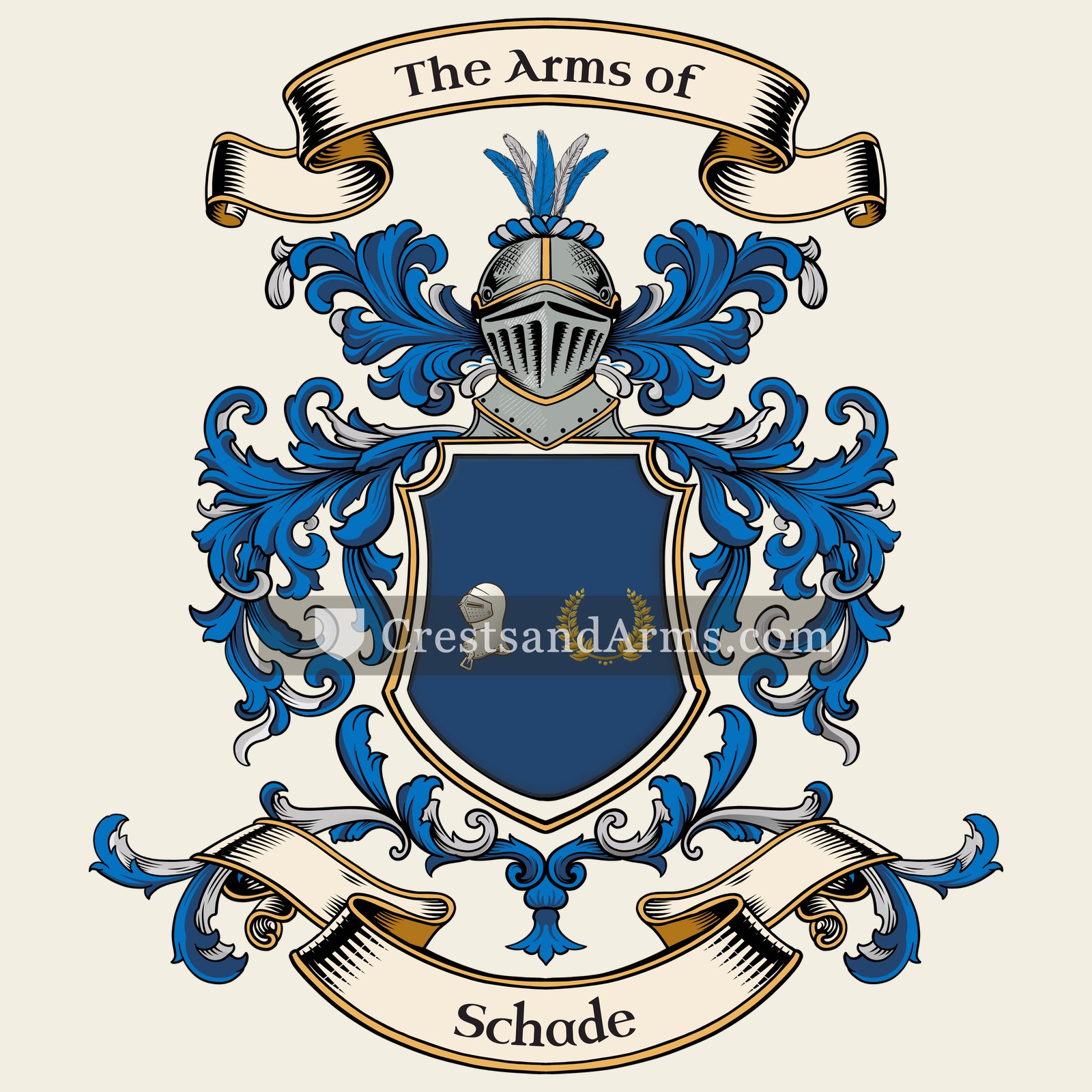
Symbols on this shield
helmetWisdom and security in defence
wreathHonour, and a victory crowned
Colours
Blue (Azure)Means: Loyalty and truth
Silver (Argent)Means: Peace and sincerity
Gold (Or)Means: Generosity
Historical info
Source
J. B. Rietstap, Armorial Général, Gouda: G. B. van Goor Zonen, 1884–87
Blazon (the actual original written record)
“D'azur à un casque d'arg., taré de trois quarts, sommé d'un brl. d'or, de gu. et d'arg., et supp. trois banderoles, 1 à dextre d'arg. et 2 à sen. d'or et de gu. C.: six banderoles, trois à dextre d'arg., d'or et de gu., et trois à sen. d'arg., d'or et de gu. L. d'arg. et d'azur.”
WestphaliaWestphalia, c. 1765
Digital archive packCoat of arms PNG, gold border print PDF, vector SVG and the certificate of authenticity. Sent to your email in minutes.
Map of Germany showing where the Schade arms are recorded
The Schade arms were recorded in Westphalia, c. 1765.
Westphalia was a land of small estates and fortified farmhouses in western Germany. Its families were numerous and not especially rich, but each held its own ground, and holding ground was what brought arms.
This is where the arms were entered in the register. Families often moved to other parts of the country, so the same name can turn up in more than one region.
The body that granted and recorded arms in Germany in this period.
Francis I, Holy Roman Emperor
Sovereign of the period
Francis I, Holy Roman Emperor
1745–1765
Reigning in Netherlands when the Schade arms are first recorded.
How Arms Worked in Germany
In the Holy Roman Empire, coats of arms were often granted to individuals by the Emperor or his representatives. These arms were then passed down through the generations to all legitimate descendants of the original holder. Younger branches of a family usually kept the same shield design without needing to change it, as the arms belonged to the entire lineage.
Granting authority
The Holy Roman Emperor held the sole power to grant new coats of arms throughout his vast imperial territories.
How they got arms
Families typically obtained their coats of arms through a formal imperial grant or by proving their noble status to the authorities.
Where arms were recorded
These grants were officially recorded in the Imperial Chancery registers, which began keeping formal records of such honors during the Middle Ages.
The family's standing
Recorded among the armigerous families of Westphalia.
Origin & History of the Schade Family in Germany
The surname Schade has deep roots in the German language, originating as a descriptive nickname for a person who was perceived as being particularly unlucky or perhaps someone who had suffered a misfortune. By the middle of the 18th century, the family was well-established in the Westphalia region, a historic area known for its dense forests and strong agricultural traditions. In 1765, records indicate that members of the Schade family were active participants in the local community life of this province. During this era, Westphalia was part of the Holy Roman Empire, and families like the Schades were often tied to the land through farming or local trade. As the family grew, they became a part of the social fabric of the region, contributing to the development of the rural villages that defined the landscape of northwestern Germany.
Related Branches & Arms
Root word
Schade
Middle Low German word meaning damage, harm, or injury.
This name
SchadeOriginally a nickname for a person who caused trouble or suffered misfortune.
also spelled
Shada
Related arms
Schadvariant spelling
Documented Sources
J. B. Rietstap, Armorial Général, Gouda: G. B. van Goor Zonen, 1884–87
Tresoar (Fries Historisch en Letterkundig Centrum), Burgerlijke Stand van Friesland (1811-1950)
Ypema, Y., Friese familienamen: een onderzoek naar hun oorsprong en verspreiding (1985)
Centraal Bureau voor Genealogie, Nederland's Patriciaat (Various years)
Digital archive packCoat of arms PNG, gold border print PDF, vector SVG and the certificate of authenticity. Sent to your email in minutes.


 cross symbolChristian faith and service
 orlePreservation, and protection in battle
 roseThe seventh son, and beauty with grace
 cross symbolChristian faith and service
 orlePreservation, and protection in battle
 roseThe seventh son, and beauty with grace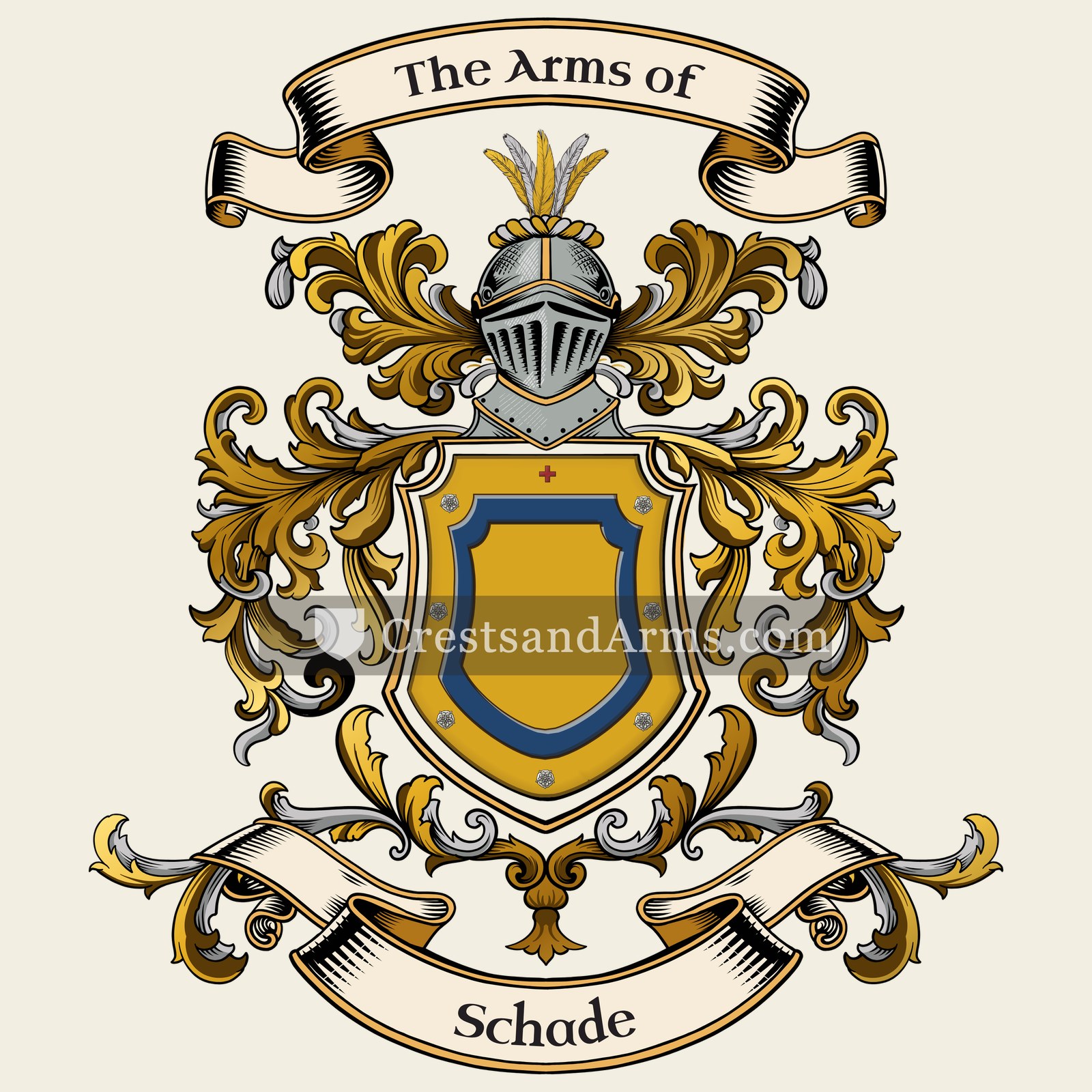


 helmetWisdom and security in defence
 wreathHonour, and a victory crowned