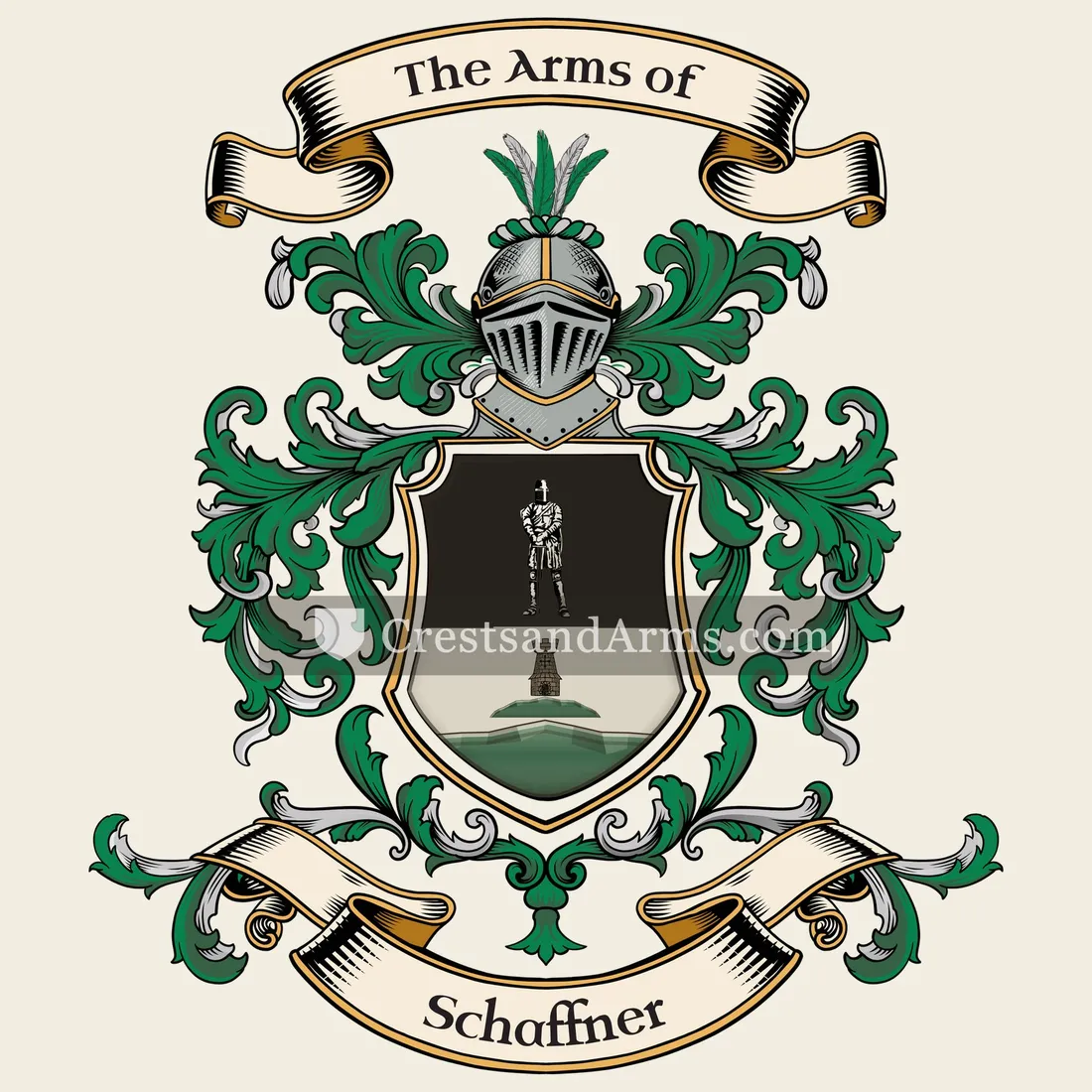
A record of documented arms, meaning and origin, researched for the Schaffner family of Switzerland.
Reg. 5010 · Swiss, T–V
Meaning of the Schaffner family crest colors & symbols
Symbols on this shield
mountThe ground held, and steadfastness upon it
knightChivalry and service in arms
towerGrandeur and solidity, and a stronghold defended
Colours
Black (Sable)Means: Constancy
Silver (Argent)Means: Peace and sincerity
Green (Vert)Means: Hope
Historical info
Source
J. B. Rietstap, Armorial Général, Gouda: G. B. van Goor Zonen, 1884–87
Blazon (the actual original written record)
“Coupé: au 1 de sa. à un homme iss., posé de profil, hab. d'arg., tenant un bâton du même en barre; au 2 d'arg. à une maisonnette au nat., posée sur un tertre de sin. C.: un homme iss., posé de profil, hab. de sa., tenant de sa main dextre un bâton d'arg., en barre. L. d'arg. et de sa.”
SwitzerlandBâle, c. 1745
Digital archive packCoat of arms PNG, gold border print PDF, vector SVG and the certificate of authenticity. Sent to your email in minutes.
Map of Switzerland showing where the Schaffner arms are recorded
The Schaffner arms were recorded in Bâle, c. 1745.
This is where the arms were entered in the register. Families often moved to other parts of the country, so the same name can turn up in more than one region.
The body that granted and recorded arms in Switzerland in this period.
How Arms Worked in Switzerland
In Switzerland, coats of arms were not restricted to the nobility and were often adopted by common citizens and families. These symbols were passed down through generations to show family identity. When branches of a family grew, they often changed small details of the design to distinguish their own line from the original group.
Granting authority
Cantonal and civic authorities managed the use of coats of arms within their specific regions and local jurisdictions.
How they got arms
Families typically assumed their own coats of arms based on local custom rather than receiving them from a central monarch.
Where arms were recorded
Arms were recorded in various cantonal and civic registers starting from the fourteenth century throughout the Swiss region.
The family's standing
Recorded among the armigerous families of Switzerland.
Origin & History of the Schaffner Family in Switzerland
The family name Schaffner originates from the German language and historically functioned as an occupational surname. In the Middle Ages, a "Schaffner" was a steward or an administrator who managed the property, finances, or food supplies for a noble household, a monastery, or a town council. By the time members of the family were documented in Bâle in 1745, the name had long been established as a title for someone in a position of trust and responsibility. Because these individuals were often responsible for handling grain, wine, or taxes, they held significant social standing within their local communities. As the family settled in the Bâle region, they likely continued to integrate into the trade and administrative life of the city, carrying a name that reflected their ancestors' roles as organized overseers of resources.
Schaffner Meaning & Related Branches
Root word
Schaffner
Derived from the Middle High German term for a steward or manager.
This name
SchaffnerAn occupational surname for an official responsible for managing a household or estate.
also spelled
Schaffner de
Schaffner-Allemagne
Schaffner-Suisse
Schaffner-Autriche
Shafner
Documented Sources
J. B. Rietstap, Armorial Général, Gouda: G. B. van Goor Zonen, 1884–87
Brechenmacher, Josef Karlmann. Etymologisches Wörterbuch der deutschen Familiennamen. 1957
Heintze, Albert. Die deutschen Familiennamen: geschichtlich, geographisch, sprachlich. 1903
Digital archive packCoat of arms PNG, gold border print PDF, vector SVG and the certificate of authenticity. Sent to your email in minutes.


 mountThe ground held, and steadfastness upon it
 knightChivalry and service in arms
 towerGrandeur and solidity, and a stronghold defended
 mountThe ground held, and steadfastness upon it
 knightChivalry and service in arms
 towerGrandeur and solidity, and a stronghold defended