Map of France showing where the Schaich arms are recorded
The Schaich arms were recorded in Strasbourg, c. 1663.
This is where the arms were entered in the register. Families often moved to other parts of the country, so the same name can turn up in more than one region.
The body that granted and recorded arms in France in this period.
Louis XIV of France
Sovereign of the period
Louis XIV of France
1643–1715
Reigning in France when the Schaich arms are first recorded.
How Arms Worked in France
In France, a coat of arms was a mark of honor that passed down through the male line to all legitimate descendants. Families often used the same shield without changes to show their shared heritage. If a branch wanted to stand out, they could add a small mark to their shield to show their specific place in the family tree.
Granting authority
The Juge d'armes de France acted as the official authority that regulated and verified coats of arms across the country.
How they got arms
Families typically inherited their arms from ancestors, though they could also receive them through royal grants or by proving their noble status.
Where arms were recorded
Coats of arms were officially recorded in the Armorial Général de France, which began its main collection in the year 1696.
The family's standing
Recorded among the armigerous families of France.
Origin & History of the Schaich Family in France
The history of the Schaich family in France is deeply tied to the unique cultural landscape of Strasbourg during the seventeenth century. By 1663, the family was already established in this region, which served as a vital crossroads between Germanic and French influences. At that time, Strasbourg was a free imperial city that maintained a distinct identity before it officially came under French control in 1681. The name Schaich likely evolved from regional dialects, reflecting the linguistic blending common in the Alsace area. Families like the Schaichs often worked as skilled tradespeople or merchants, contributing to the city's reputation as a center for printing and craftsmanship. Living in this borderland meant that the family navigated a society where local traditions and changing political loyalties shaped their daily lives. Their presence in the city records from this period highlights their role as long-term residents who helped define the community long before the modern borders of France were fully solidified.
Meaning of the Schaich family crest colors & symbols
Symbols on this shield
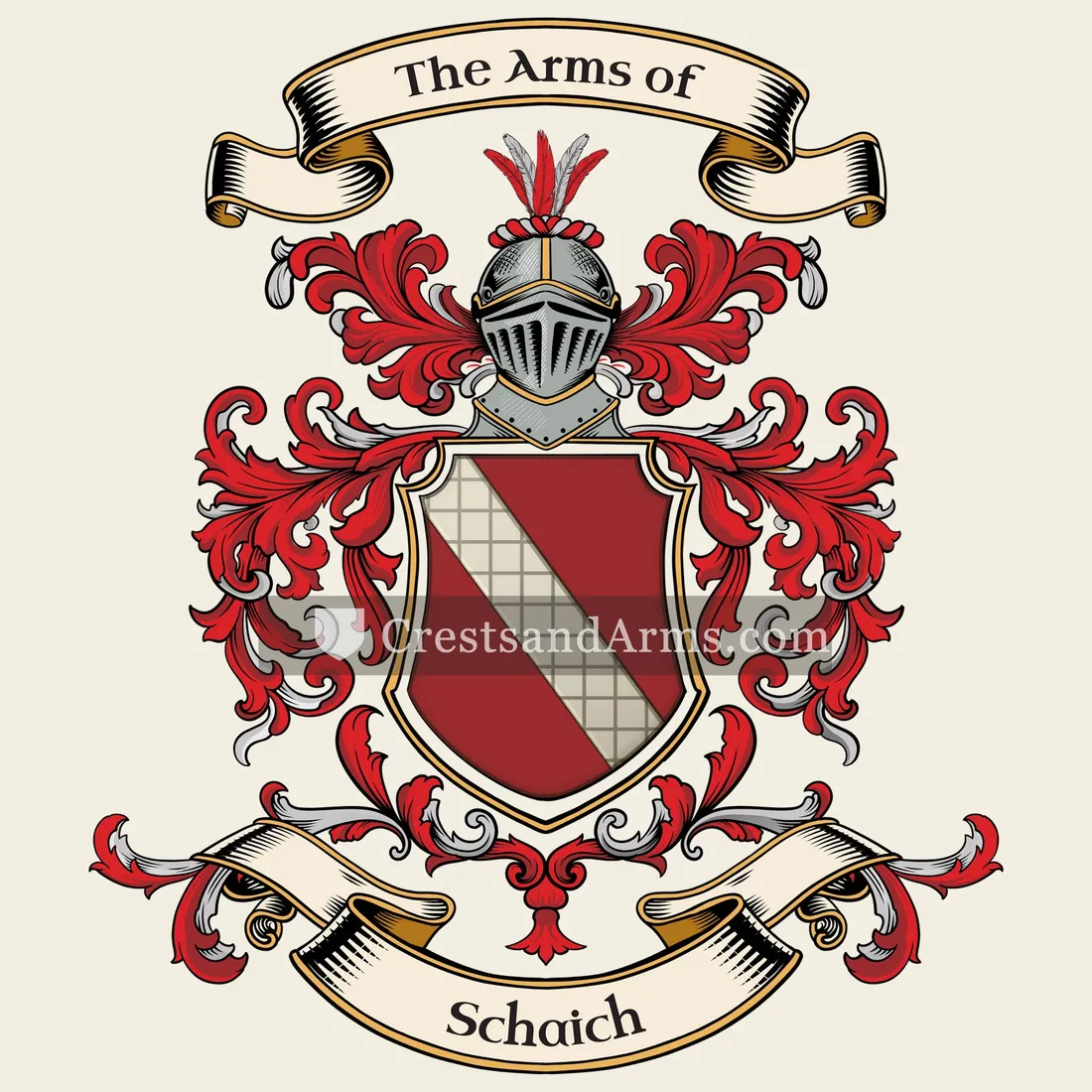
bendDefence, and the scarf of a commander
Colours
Red (Gules)Means: Military strength
Silver (Argent)Means: Peace and sincerity
Historical info
Source
J. B. Rietstap, Armorial Général, Gouda: G. B. van Goor Zonen, 1884–87
Blazon (the actual original written record)
“De gu. à la bande d'arg., ch. de quatre barres vivrées de sa. C.: un demi-vol aux armes de l'écu. L. d'arg. et de gu.”
SwabiaSwabia, c. 1765
Digital archive packCoat of arms PNG, gold border print PDF, vector SVG and the certificate of authenticity. Sent to your email in minutes.
Map of Germany showing where the Schaich arms are recorded
The Schaich arms were recorded in Swabia, c. 1765.
Swabia was broken into a great many small territories in southern Germany, and each had its own landowners and its own leading townsmen. That fragmentation produced an unusual number of families with arms.
This is where the arms were entered in the register. Families often moved to other parts of the country, so the same name can turn up in more than one region.
The body that granted and recorded arms in Germany in this period.
Francis I, Holy Roman Emperor
Sovereign of the period
Francis I, Holy Roman Emperor
1745–1765
Reigning in France when the Schaich arms are first recorded.
How Arms Worked in Germany
In the Holy Roman Empire, coats of arms were often granted to individuals by the Emperor or his representatives. These arms were then passed down through the generations to all legitimate descendants of the original holder. Younger branches of a family usually kept the same shield design without needing to change it, as the arms belonged to the entire lineage.
Granting authority
The Holy Roman Emperor held the sole power to grant new coats of arms throughout his vast imperial territories.
How they got arms
Families typically obtained their coats of arms through a formal imperial grant or by proving their noble status to the authorities.
Where arms were recorded
These grants were officially recorded in the Imperial Chancery registers, which began keeping formal records of such honors during the Middle Ages.
The family's standing
Recorded among the armigerous families of Swabia.
Origin & History of the Schaich Family in Germany
The surname Schaich is deeply rooted in the historical region of Swabia, a territory in southwestern Germany known for its distinct dialect and long-standing agricultural traditions. By the mid-18th century, records confirm that families bearing this name were well-established within the Swabian landscape, particularly in areas near the Swabian Jura mountains. The name itself is thought to be derived from local occupational or descriptive terms common to the Middle High German language spoken in that era. During the 1760s, families with this name were typically integrated into the village life of the Duchy of Württemberg, where they often worked as farmers, craftsmen, or laborers. Because the region was composed of many small, independent territories, the Schaich family likely lived in a close-knit community where local church records served as the primary way to track births, marriages, and deaths. This environment shaped the early identity of the family, anchoring them to the fertile valleys and rolling hills that defined the Swabian way of life for generations.
Schaich Meaning & Related Branches
Root word
Schach
A Middle High German term referring to a chess player or king.
This name
SchaichAn occupational surname for a chess player or someone who played the game skillfully.
also spelled
Schack
Shahk
Shach
Documented Sources
J. B. Rietstap, Armorial Général, Gouda: G. B. van Goor Zonen, 1884–87
Archives de la Ville et de l'Eurométropole de Strasbourg, Registres paroissiaux et d'état civil
Livet, Georges, L'intendance d'Alsace sous Louis XIV, 1648-1715, 1956
Rapp, Francis, Le diocèse de Strasbourg, 1982
Digital archive packCoat of arms PNG, gold border print PDF, vector SVG and the certificate of authenticity. Sent to your email in minutes.


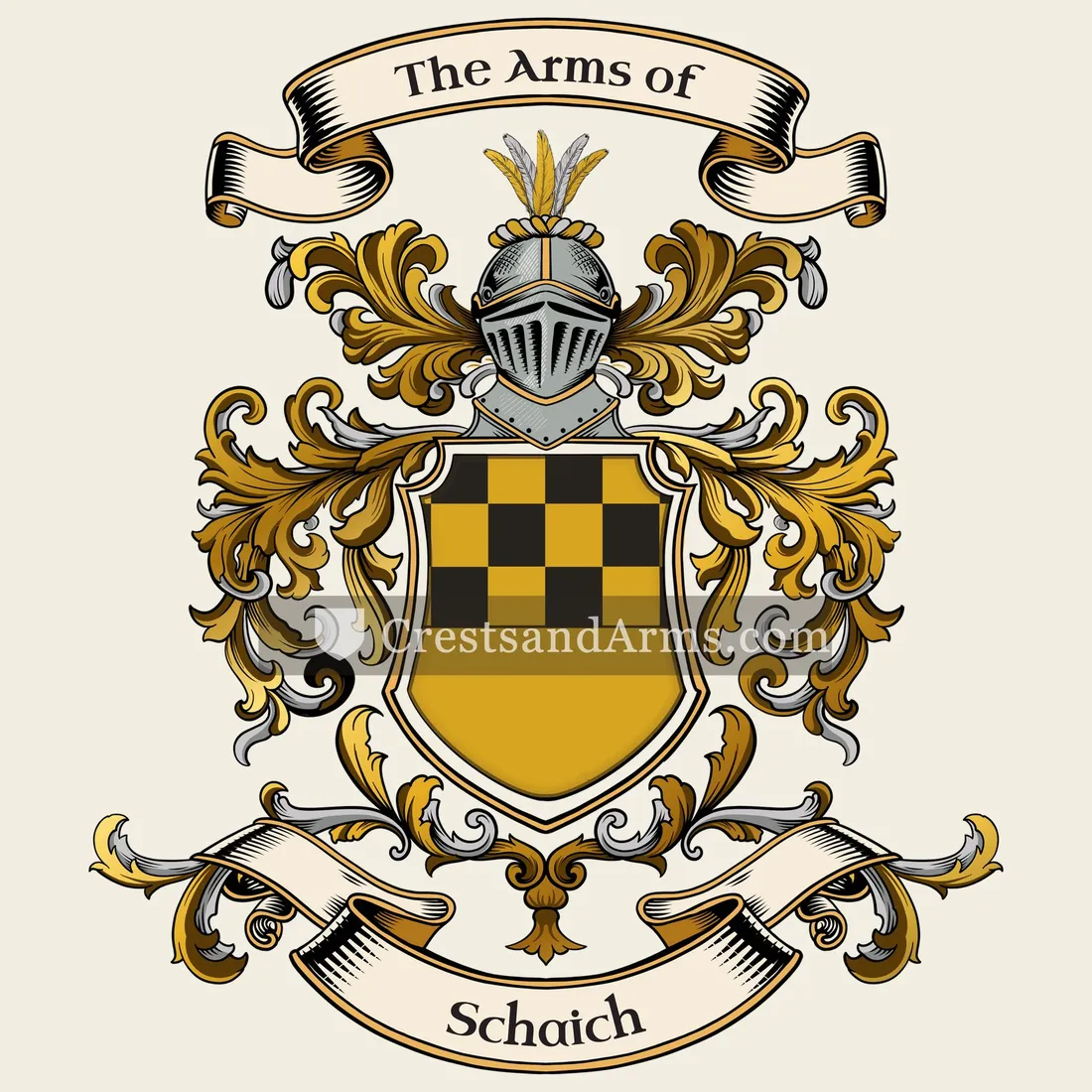
 chequyConstancy, and the counting-board
 chequyConstancy, and the counting-board


 bendDefence, and the scarf of a commander