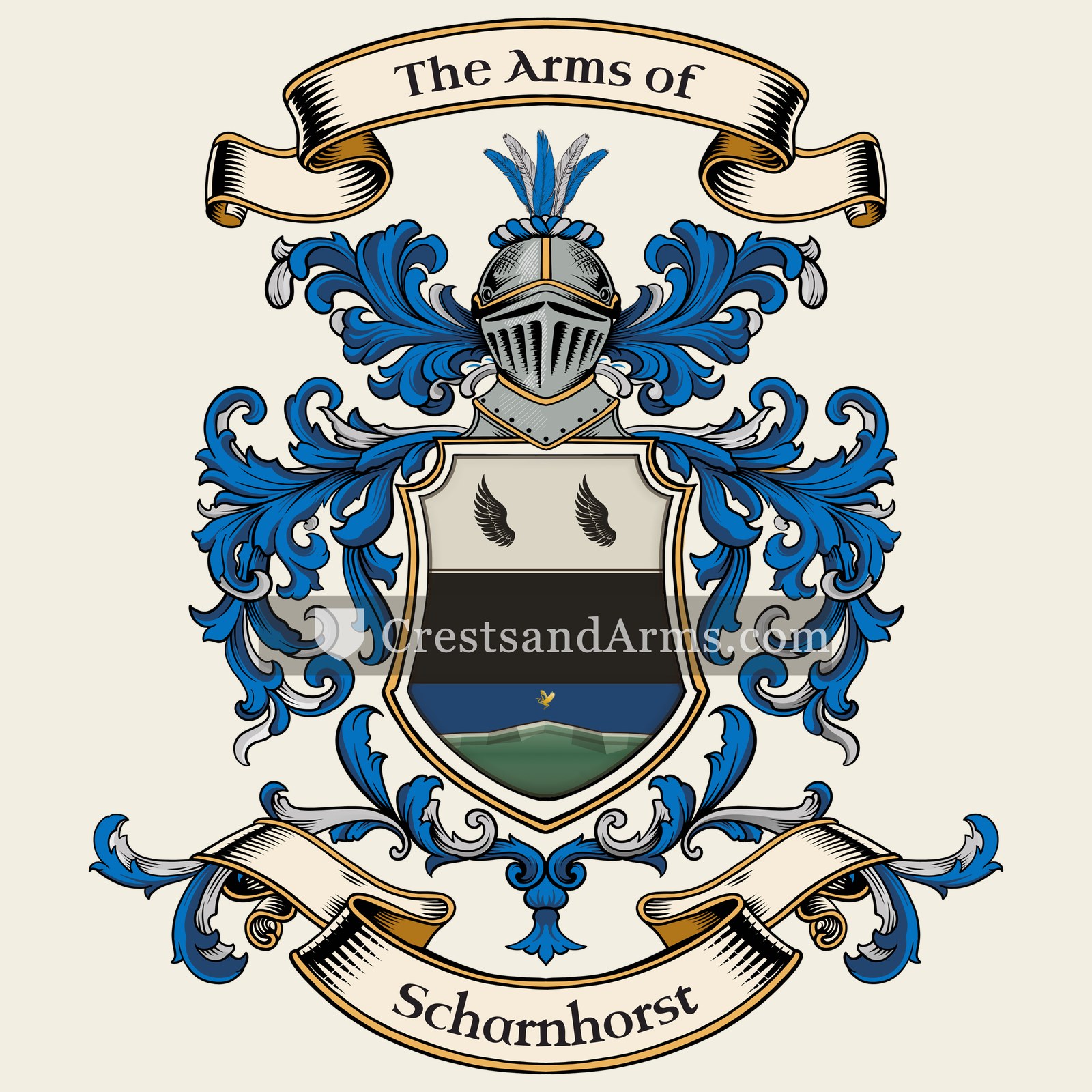
A record of documented arms, meaning and origin, researched for the Scharnhorst family of Germany.
Reg. 4365 · German, T–V
Coat of Arms & Family Crest Details
Symbols on this shield
mountThe ground held, and steadfastness upon it
wingSwiftness, and protection under a raised wing
heronPatience and quiet watchfulness
Colours
Silver (Argent)Means: Peace and sincerity
Black (Sable)Means: Constancy
Blue (Azure)Means: Loyalty and truth
Green (Vert)Means: Hope
Gold (Or)Means: Generosity
Historical info
Source
J. B. Rietstap, Armorial Général, Gouda: G. B. van Goor Zonen, 1884–87
Blazon (the actual original written record)
“d'arg., br. sur la division : en chef parti de sa. et d'or, à deux demi-vols adossés de l'un à l'autre; en p. d'azur à une grue avec sa vigilance d'or, posée sur une terrasse de sin. Cq. cour. C.: la grue, devant six plumes de paon, alt. de sa. et d'arg. L.: à dextre d'or, de gu. et de sa., à sen. d'or, de gu. et d'azur.”
GermanyHan, c. 1765
Digital archive packCoat of arms PNG, gold border print PDF, vector SVG and the certificate of authenticity. Sent to your email in minutes.
Map of Germany showing where the Scharnhorst arms are recorded
The Scharnhorst arms were recorded in Han, c. 1765.
This is where the arms were entered in the register. Families often moved to other parts of the country, so the same name can turn up in more than one region.
The body that granted and recorded arms in Germany in this period.
Francis I, Holy Roman Emperor
Sovereign of the period
Francis I, Holy Roman Emperor
1745–1765
Reigning in Germany when the Scharnhorst arms are first recorded.
How Arms Worked in Germany
In the Holy Roman Empire, coats of arms were often granted to individuals by the Emperor or his representatives. These arms were then passed down through the generations to all legitimate descendants of the original holder. Younger branches of a family usually kept the same shield design without needing to change it, as the arms belonged to the entire lineage.
Granting authority
The Holy Roman Emperor held the sole power to grant new coats of arms throughout his vast imperial territories.
How they got arms
Families typically obtained their coats of arms through a formal imperial grant or by proving their noble status to the authorities.
Where arms were recorded
These grants were officially recorded in the Imperial Chancery registers, which began keeping formal records of such honors during the Middle Ages.
The family's standing
Recorded among the armigerous families of Germany.
Origin & History of the Scharnhorst Family in Germany
The surname Scharnhorst originates from the northern regions of Germany, specifically within the historical landscape of Lower Saxony. The name itself is topographic in nature, likely derived from a combination of Middle Low German terms referring to a muddy or swampy piece of land and a wooded hill or ridge. By the mid-18th century, the family was well-established in the village of Bordenau near the town of Neustadt am Rübenberge. Records confirm that members of the family were active in the region of Han by 1765, where they were deeply integrated into the local agricultural and administrative life of the Electorate of Hanover. This setting provided the foundation for the family's later prominence, as the environment of the Hanoverian countryside shaped the upbringing of its most famous member, Gerhard von Scharnhorst, who would eventually rise to become a key military reformer in Prussia.
Related Branches & Arms
Root word
Scharne and Horst
A muddy or swampy area and a wooded elevation or hill.
This name
ScharnhorstRefers to a person who lived near a wooded hill located in a marshy area.
also spelled
Scharnhorster
Scharnhorstt
Scharnhorste
Sharnhorst
Documented Sources
J. B. Rietstap, Armorial Général, Gouda: G. B. van Goor Zonen, 1884–87
Kühn, Johannes, Scharnhorst, 1958
Philippson, Martin, Das Leben des Generals Gerhard von Scharnhorst, 1914


 mountThe ground held, and steadfastness upon it
 wingSwiftness, and protection under a raised wing
 heronPatience and quiet watchfulness
 mountThe ground held, and steadfastness upon it
 wingSwiftness, and protection under a raised wing
 heronPatience and quiet watchfulness