Map of Germany showing where the Scherba arms are recorded
The Scherba arms were recorded in Nördlingen Bav, c. 1765.
This is where the arms were entered in the register. Families often moved to other parts of the country, so the same name can turn up in more than one region.
The body that granted and recorded arms in Germany in this period.
Francis I, Holy Roman Emperor
Sovereign of the period
Francis I, Holy Roman Emperor
1745–1765
Reigning in Germany when the Scherba arms are first recorded.
How Arms Worked in Germany
In the Holy Roman Empire, coats of arms were often granted to individuals by the Emperor or his representatives. These arms were then passed down through the generations to all legitimate descendants of the original holder. Younger branches of a family usually kept the same shield design without needing to change it, as the arms belonged to the entire lineage.
Granting authority
The Holy Roman Emperor held the sole power to grant new coats of arms throughout his vast imperial territories.
How they got arms
Families typically obtained their coats of arms through a formal imperial grant or by proving their noble status to the authorities.
Where arms were recorded
These grants were officially recorded in the Imperial Chancery registers, which began keeping formal records of such honors during the Middle Ages.
The family's standing
Recorded among the armigerous families of Germany.
Origin & History of the Scherba Family in Germany
The surname Scherba is rooted in the linguistic landscape of Central Europe, where it evolved as a descriptive identifier within German-speaking communities. By the mid-eighteenth century, the family established a notable presence in the historic imperial city of Nördlingen. During this period, Nördlingen served as a vital hub for trade and craftsmanship, providing a stable environment for families to integrate into the local social and economic structure. The name itself likely originated from occupational or regional nicknames common in the region, reflecting the diverse cultural exchanges occurring along the trade routes of Bavaria and Swabia. As residents of a city famous for its medieval fortifications and merchant guilds, the early Scherba family members were part of a tradition of urban citizenship that defined life in the Holy Roman Empire. Their presence in the 1765 records highlights a period of transition, as families began to solidify their surnames through local parish registrations and municipal tax documentation.
Meaning of the Scherba family crest colors & symbols
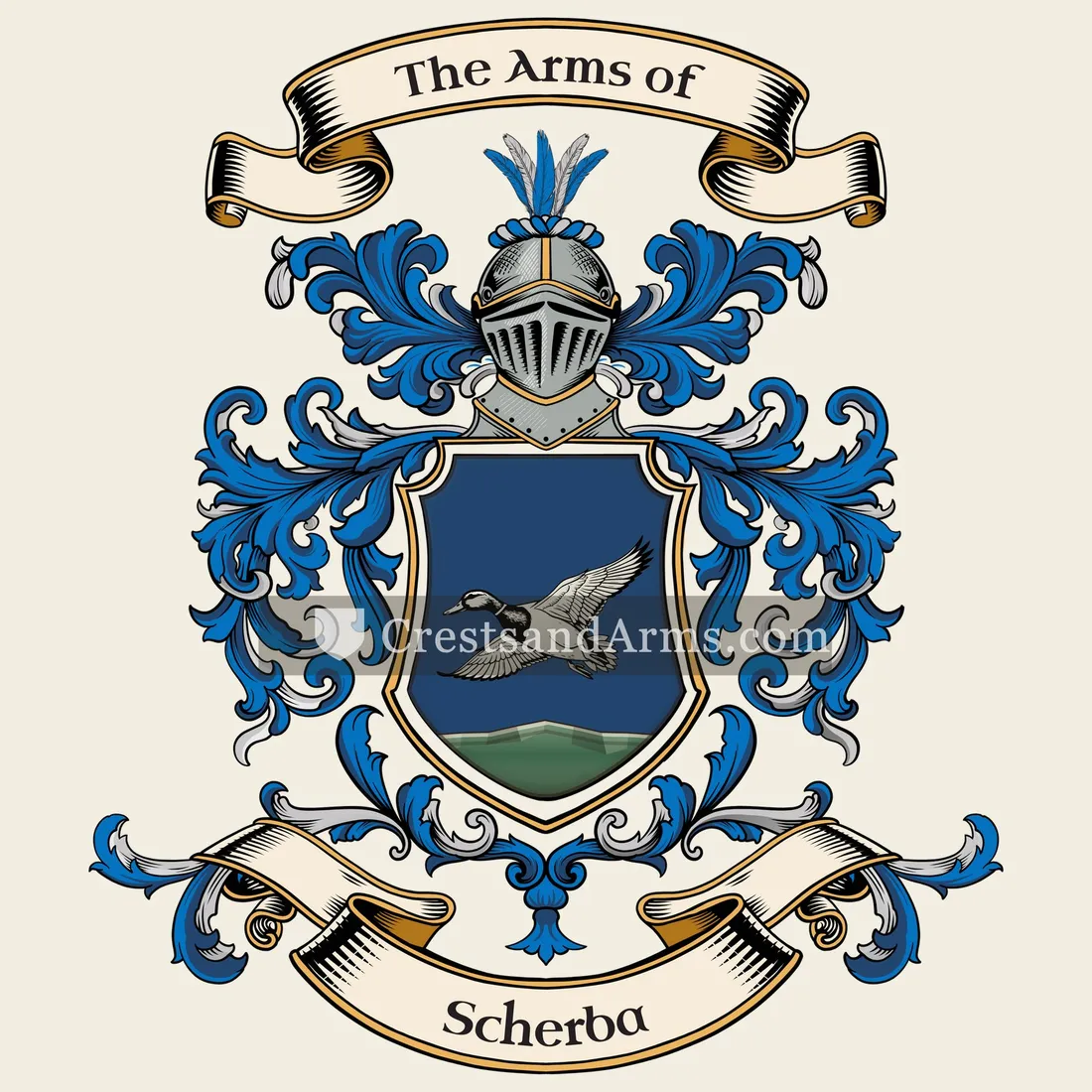
Symbols on this shield
mountThe ground held, and steadfastness upon it
duckResourcefulness on land and water
Colours
Blue (Azure)Means: Loyalty and truth
Green (Vert)Means: Hope
Historical info
Source
J. B. Rietstap, Armorial Général, Gouda: G. B. van Goor Zonen, 1884–87
Blazon (the actual original written record)
“D'azur à un canard au nat., nageant dans une eau d'arg. et tenant en son bec un poisson d'arg., en pal, la tête en bas; sur le devant une terrasse de sin. C.: un vol, d'azur et d'or. L. d'or et d'azur.”
SwitzerlandBâle, c. 1745
Digital archive packCoat of arms PNG, gold border print PDF, vector SVG and the certificate of authenticity. Sent to your email in minutes.
Map of Switzerland showing where the Scherba arms are recorded
The Scherba arms were recorded in Bâle, c. 1745.
This is where the arms were entered in the register. Families often moved to other parts of the country, so the same name can turn up in more than one region.
The body that granted and recorded arms in Switzerland in this period.
How Arms Worked in Switzerland
In Switzerland, coats of arms were not restricted to the nobility and were often adopted by common citizens and families. These symbols were passed down through generations to show family identity. When branches of a family grew, they often changed small details of the design to distinguish their own line from the original group.
Granting authority
Cantonal and civic authorities managed the use of coats of arms within their specific regions and local jurisdictions.
How they got arms
Families typically assumed their own coats of arms based on local custom rather than receiving them from a central monarch.
Where arms were recorded
Arms were recorded in various cantonal and civic registers starting from the fourteenth century throughout the Swiss region.
The family's standing
Recorded among the armigerous families of Switzerland.
Origin & History of the Scherba Family in Switzerland
The family name Scherba, while often associated with Eastern European origins, appears in the historical records of Basel, Switzerland, as early as 1745. During the eighteenth century, Basel was a thriving center for trade and craftsmanship, attracting skilled individuals from various regions seeking new opportunities within the city's guild-regulated economy. The presence of the Scherba family in this urban environment suggests they were likely integrated into the professional life of the city, possibly working as artisans or merchants who navigated the complex social structures of the time. Families settling in Basel during this period often had to prove their economic stability to the local authorities to gain residency rights. By establishing themselves in such a prominent Swiss city, the early members of the Scherba name contributed to the diverse cultural and economic fabric that defined Basel during the Enlightenment era.
Scherba Meaning & Related Branches
Root word
Scherbe
A broken piece of pottery or shard.
This name
ScherbaA topographic or occupational name for someone who worked with or lived near broken pottery.
also spelled
Scherbe
Scherben
Scherp
Sherb
Documented Sources
J. B. Rietstap, Armorial Général, Gouda: G. B. van Goor Zonen, 1884–87
Stadtarchiv Nördlingen, Bürgerbuch der Stadt Nördlingen (1765)
Kohlhammer, W., Historischer Atlas von Bayern: Nördlingen (1977)
Staatsarchiv Augsburg, Reichsstädtische Akten der Stadt Nördlingen (1760-1770)
Digital archive packCoat of arms PNG, gold border print PDF, vector SVG and the certificate of authenticity. Sent to your email in minutes.


 fishA true and generous mind, and Christian faith
 fishA true and generous mind, and Christian faith
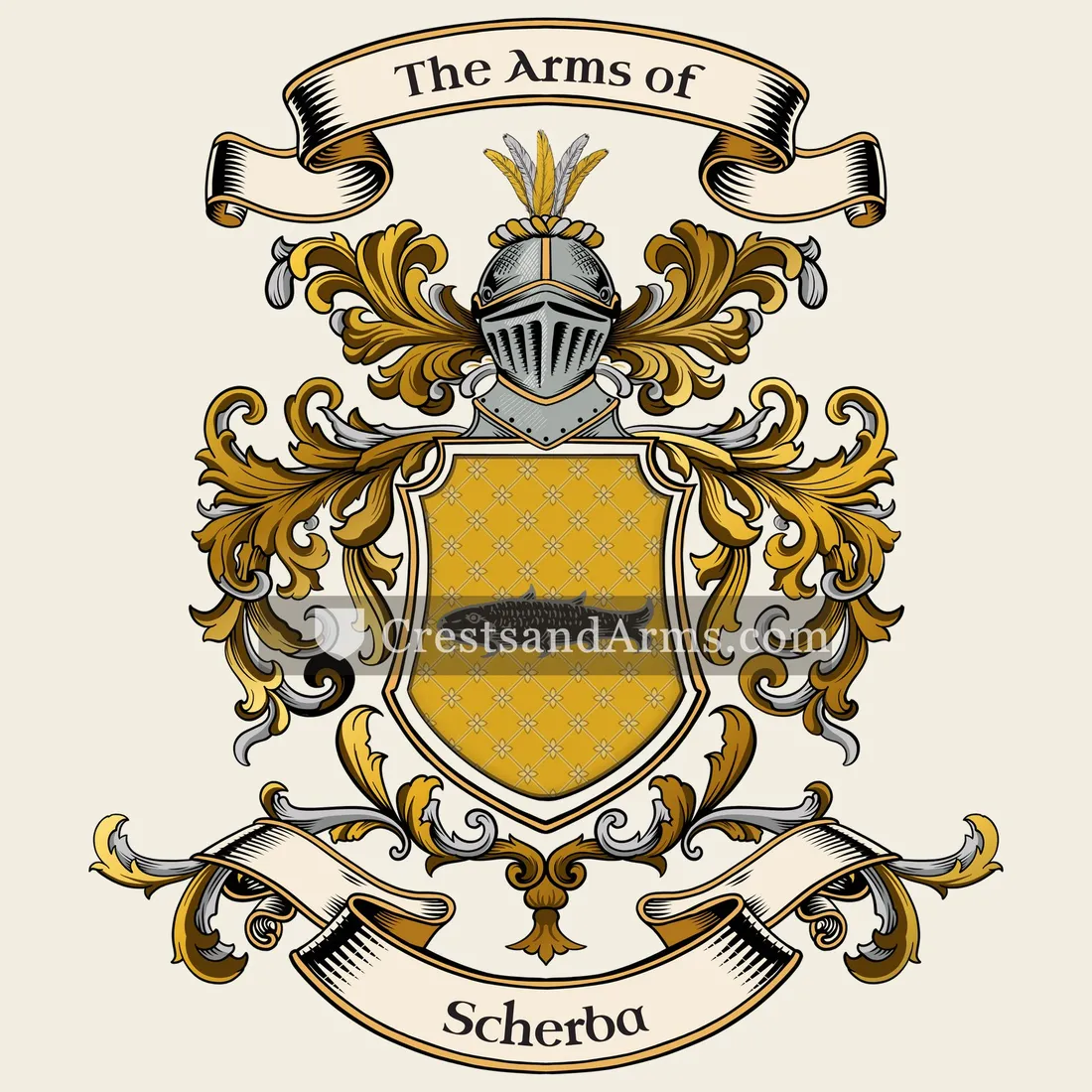


 mountThe ground held, and steadfastness upon it
 duckResourcefulness on land and water