Map of Poland showing where the Scheurer arms are recorded
The Scheurer arms were recorded in Lithuanie, c. 1772.
Arms such as these were typically recorded in Mazovia.
Mazovia held Warsaw, the Polish court and the assemblies where the szlachta met. Poland's nobles were unusually numerous and every one of them bore arms, and Warsaw is where those arms were argued over and recorded.
This is where the arms were entered in the register. Families often moved to other parts of the country, so the same name can turn up in more than one region.
Region
Mazovia
Town
Lithuanie
First recorded
1772
Granting Authority for the Scheurer Arms
Ennoblement by the Sejm
Author: Olek Remesz · CC BY-SA 3.0
The body that granted and recorded arms in Poland in this period.
Stanisław August Poniatowski
Sovereign of the period
Stanisław August Poniatowski
1764–1795
Reigning in Poland when the Scheurer arms are first recorded.
How Arms Worked in Poland
Polish noble families shared a single coat of arms across many different surnames, creating large clans rather than individual designs. These symbols were held collectively by all members of the clan regardless of their specific family name. When a new family joined the nobility, they were adopted into an existing clan and began using that group's established shield.
Granting authority
The Sejm, which was the Polish parliament, held the power to grant noble status and the right to bear arms.
How they got arms
Families typically received their coat of arms through a formal act of ennoblement granted by the Sejm for distinguished service.
Where arms were recorded
These grants were officially recorded in the Crown Metrica, which served as the central archive for state documents starting in the sixteenth century.
The family's standing
Recorded among the armigerous families of Poland.
Origin & History of the Scheurer Family in Poland
The surname Scheurer is rooted in the Germanic linguistic tradition, where it historically identified a person who worked as a barn keeper or a manager of a granary. By the year 1772, members of the family had established a presence in the Mazovia region of Poland. During this era, Mazovia was a central hub of Polish political and social life, and the arrival of families with Germanic roots was often tied to the movement of skilled laborers, craftsmen, or administrators seeking new opportunities in the region. As these individuals integrated into the local Polish community, they adapted to the linguistic and social customs of the area while maintaining their ancestral name. This early presence suggests that the Scheurer family was part of a broader network of migration that connected Central European tradesmen to the agricultural and administrative centers of the Polish heartland. Over time, the family became a part of the diverse social fabric of Mazovia, contributing to the local economy and the evolving identity of the region during a period of significant historical transition.
Meaning of the Scheurer family crest colors & symbols
Colours
Silver (Argent)Means: Peace and sincerity
Historical info
Source
J. B. Rietstap, Armorial Général, Gouda: G. B. van Goor Zonen, 1884–87
Blazon (the actual original written record)
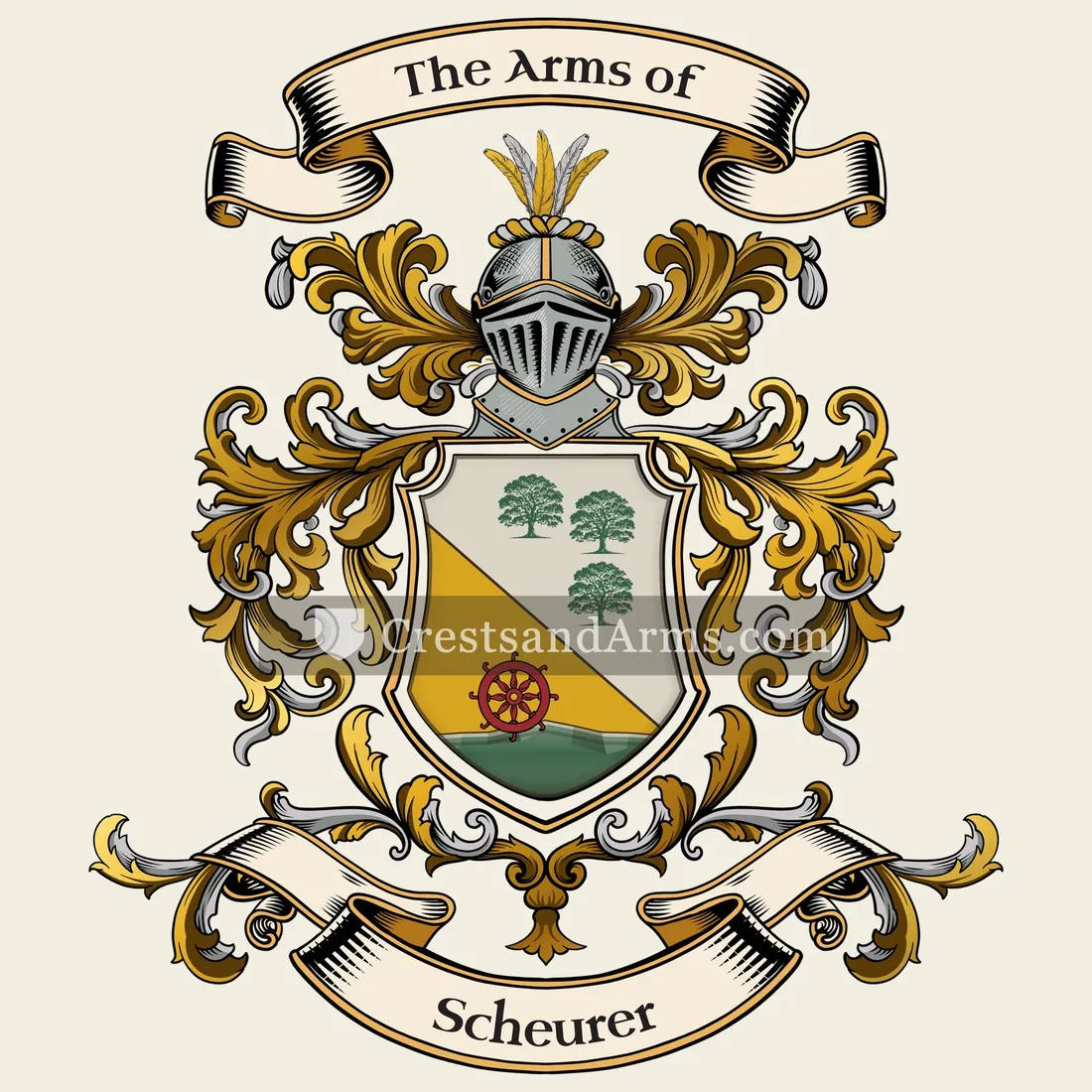
“D'arg. à un grange d'or, essorée de gu. C.: trois pl. d'aut., une d'arg. entre deux de gu.”
SwitzerlandBerne, c. 1745
Digital archive packCoat of arms PNG, gold border print PDF, vector SVG and the certificate of authenticity. Sent to your email in minutes.
Map of Switzerland showing where the Scheurer arms are recorded
The Scheurer arms were recorded in Berne, c. 1745.
This is where the arms were entered in the register. Families often moved to other parts of the country, so the same name can turn up in more than one region.
The body that granted and recorded arms in Switzerland in this period.
How Arms Worked in Switzerland
In Switzerland, coats of arms were not restricted to the nobility and were often adopted by common citizens and families. These symbols were passed down through generations to show family identity. When branches of a family grew, they often changed small details of the design to distinguish their own line from the original group.
Granting authority
Cantonal and civic authorities managed the use of coats of arms within their specific regions and local jurisdictions.
How they got arms
Families typically assumed their own coats of arms based on local custom rather than receiving them from a central monarch.
Where arms were recorded
Arms were recorded in various cantonal and civic registers starting from the fourteenth century throughout the Swiss region.
The family's standing
Recorded among the armigerous families of Switzerland.
Origin & History of the Scheurer Family in Switzerland
The surname Scheurer is deeply rooted in the history of the Swiss cantons, particularly within the region of Berne. The name is occupational in origin, derived from the Middle High German word "schür," which referred to a barn or a storage shed. This suggests that the earliest ancestors bearing this name were likely farmers or laborers who managed agricultural buildings. By the mid-18th century, records confirm that the Scheurer family was well-established in the social and economic life of Berne. During this period, families with this name were often integrated into the local community as skilled tradespeople or landowners. Their presence in the city by 1745 reflects a long history of migration and settlement across the Swiss plateau, where families often moved between rural villages and growing urban centers to seek new opportunities. Over generations, the name became a permanent fixture in the region, representing the hardworking nature of the Swiss population during the pre-industrial era.
Scheurer Meaning & Related Branches
Root word
Scheuer
A barn or granary used for storing harvested crops.
This name
ScheurerAn occupational surname for someone who worked in or managed a barn.
also spelled
Scheurar
Shoirer
Sheurer
Related arms
Scheurevariant spelling
Documented Sources
J. B. Rietstap, Armorial Général, Gouda: G. B. van Goor Zonen, 1884–87
Bieńkowski, Wiesław, Studia nad dziejami Mazowsza, 1970
Central Archives of Historical Records in Warsaw (Archiwum Główne Akt Dawnych w Warszawie), Metryki Koronne, 1772
Gieysztor, Aleksander, Dzieje Mazowsza, 1994
Digital archive packCoat of arms PNG, gold border print PDF, vector SVG and the certificate of authenticity. Sent to your email in minutes.


 mountThe ground held, and steadfastness upon it
 wheelFortune's turning, and the carter's trade
 treeLife, endurance and deep roots
 mountThe ground held, and steadfastness upon it
 wheelFortune's turning, and the carter's trade
 treeLife, endurance and deep roots