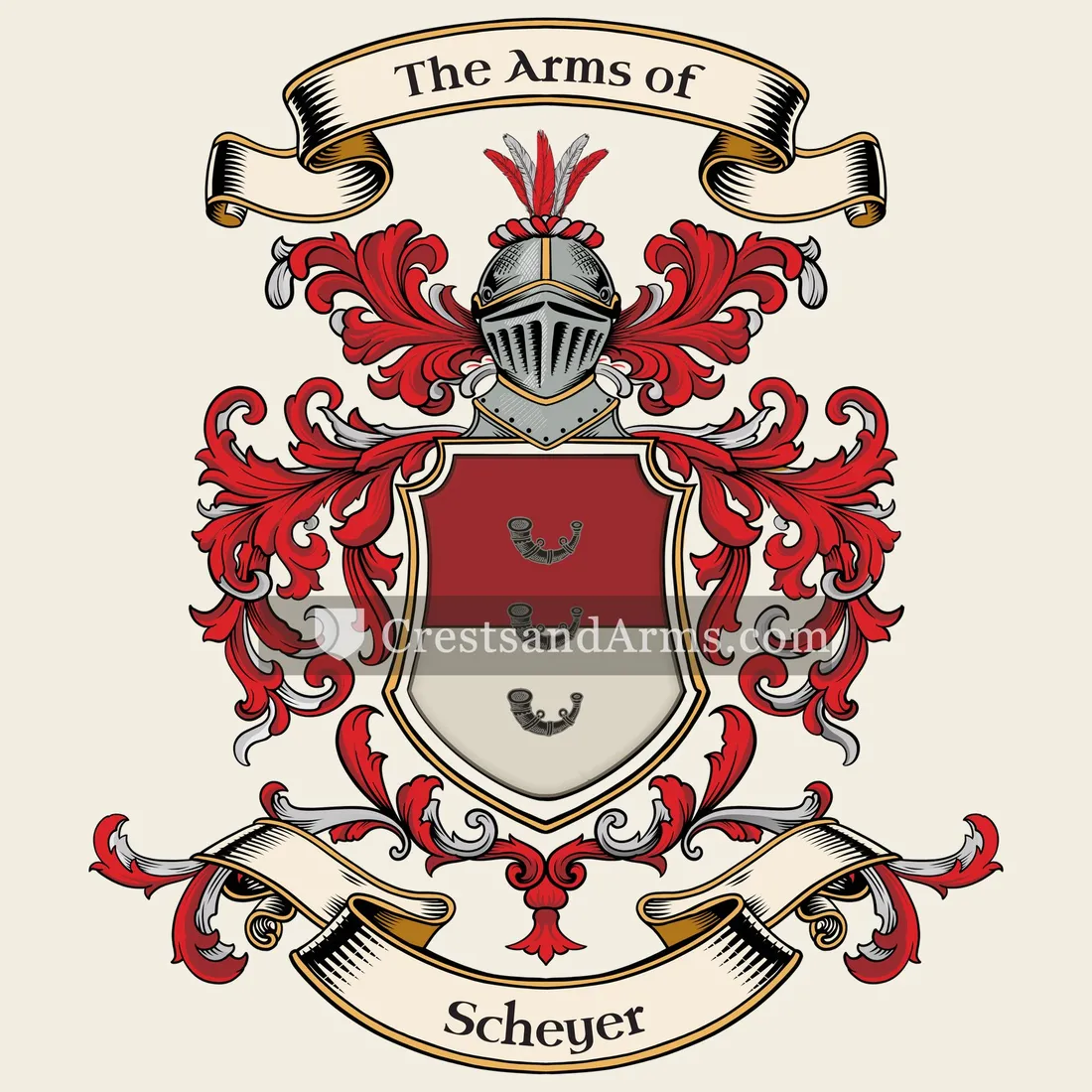
A record of documented arms, meaning and origin, researched for the Scheyer family of Austria.
Reg. 4058 · Austrian, T–V
Meaning of the Scheyer family crest colors & symbols
Symbols on this shield
hunting horn stringedOne who delights in the chase
Colours
Red (Gules)Means: Military strength
Silver (Argent)Means: Peace and sincerity
Black (Sable)Means: Constancy
Historical info
Source
J. B. Rietstap, Armorial Général, Gouda: G. B. van Goor Zonen, 1884–87
Blazon (the actual original written record)
“Coupé de gu. sur arg.; à trois cors-de-chasse de sa., rangés en pal, br. sur le tout. C.: une couronne d'or, sommée d'un vol de sa. et soutenue d'un coussin d'arg., sans houppes.”
CarniolaCarniola, c. 1772
Digital archive packCoat of arms PNG, gold border print PDF, vector SVG and the certificate of authenticity. Sent to your email in minutes.
Map of Austria showing where the Scheyer arms are recorded
The Scheyer arms were recorded in Carniola, c. 1772.
Carniola was Alpine country in what is now Slovenia, held in estates by families who served the Austrian crown. Land and service each brought arms, and most families there had both.
This is where the arms were entered in the register. Families often moved to other parts of the country, so the same name can turn up in more than one region.
Region
Carniola
First recorded
1772
Granting Authority for the Scheyer Arms
Imperial and Royal chancery
Sodacan · CC BY-SA 3.0
The body that granted and recorded arms in Austria in this period.
Joseph II, Holy Roman Emperor
Sovereign of the period
Joseph II, Holy Roman Emperor
1765–1790
Reigning in Austria when the Scheyer arms are first recorded.
How Arms Worked in Austria
Austrian coats of arms were often linked directly to noble titles granted by the Emperor. These symbols belonged to the entire family line rather than just one individual. When a family grew, new branches kept the original design without needing to change it. This system allowed all members of a noble house to share the same identity across many generations.
Granting authority
The Imperial and Royal chancery managed all heraldic matters and controlled the official granting of arms throughout the Austrian lands.
How they got arms
Families typically received their arms through a formal imperial decree that often accompanied the elevation of a person to noble status.
Where arms were recorded
Official records of these grants were kept in the Imperial Register of Nobility which began its formal documentation process in 1453.
The family's standing
Recorded among the armigerous families of Carniola.
Origin & History of the Scheyer Family in Austria
The surname Scheyer is deeply rooted in the history of Central Europe, particularly within the regions that once formed the Duchy of Carniola. By the year 1772, records confirm that members of the family were already established residents in this area, which is located in modern-day Slovenia. The name itself is often associated with the German word *Scheuer*, which historically referred to a barn or a granary. This suggests that the earliest ancestors to carry the name were likely farmers or landowners who were identified by the specific buildings they managed or the property they occupied. As families moved through the shifting borders of the Holy Roman Empire and the Habsburg Monarchy, the name became a marker of their identity in rural communities. Over time, the spelling evolved to reflect local linguistic influences while maintaining its connection to the agricultural heritage of the region.
Scheyer Meaning & Related Branches
Root word
Scheuer
A barn or granary used for storing harvested crops.
This name
ScheyerAn occupational surname for someone who worked in or lived near a barn.
also spelled
Scheyar
Shier
Sheyer
Related arms
Scheyvariant spelling
Documented Sources
J. B. Rietstap, Armorial Général, Gouda: G. B. van Goor Zonen, 1884–87
Valvasor, Johann Weikhard. Die Ehre dess Hertzogthums Crain. 1689
Arhiv Republike Slovenije (Archives of the Republic of Slovenia), Deželno glavarstvo Kranjska (Provincial Administration of Carniola), 1750–1780
Bezlaj, France. Etimološki slovar slovenskega jezika. 1976
Digital archive packCoat of arms PNG, gold border print PDF, vector SVG and the certificate of authenticity. Sent to your email in minutes.


 hunting horn stringedOne who delights in the chase
 hunting horn stringedOne who delights in the chase