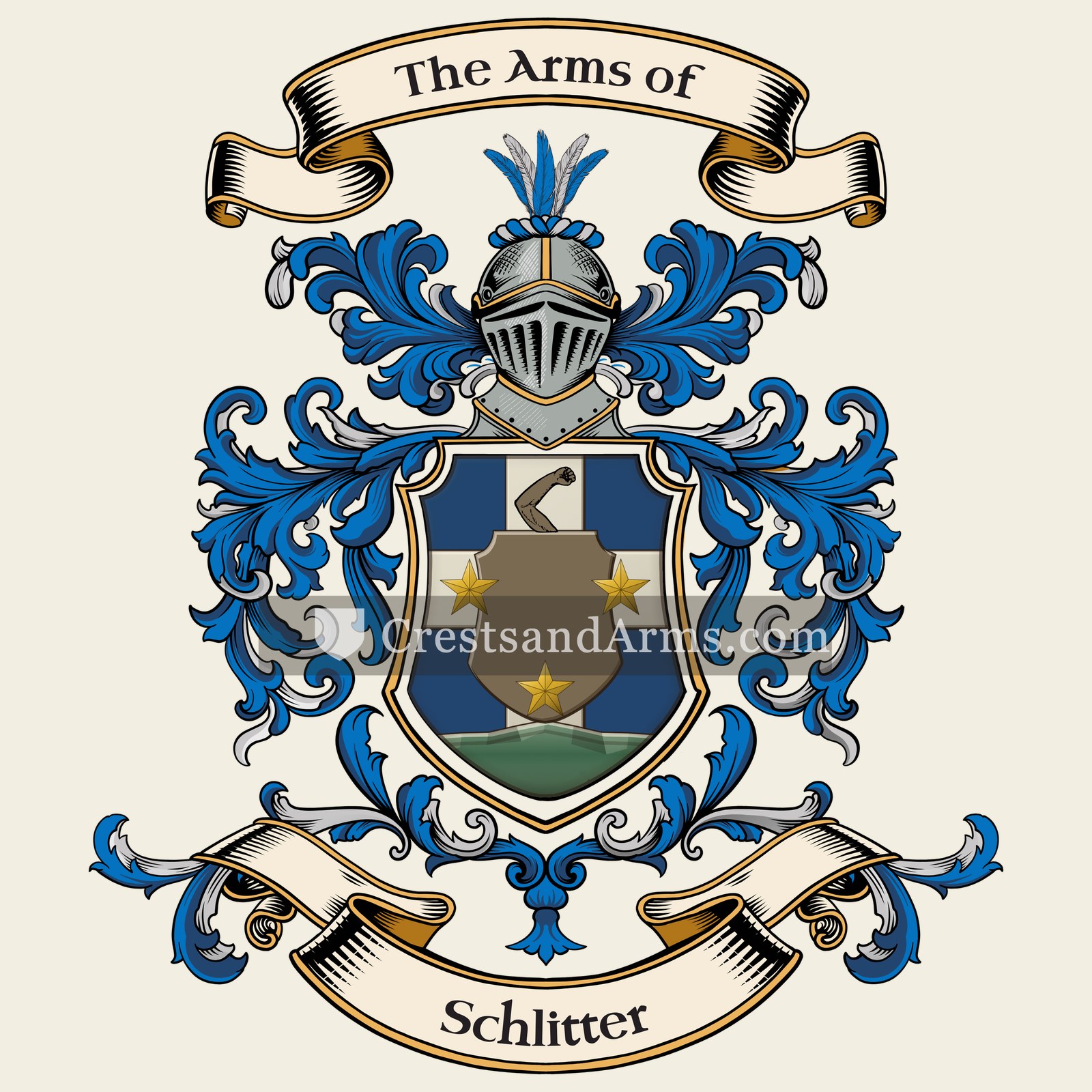
A record of documented arms, meaning and origin, researched for the Schlitter family of Austria.
Reg. 2725 · Austrian, T–V
Coat of Arms & Family Crest Details
Symbols on this shield
cross symbolChristian faith and service
mountThe ground held, and steadfastness upon it
armA person of action, industrious and laborious
mulletThe third son, and a divine quality from above
Colours
Blue (Azure)Means: Loyalty and truth
Silver (Argent)Means: Peace and sincerity
Green (Vert)Means: Hope
Gold (Or)Means: Generosity
Historical info
Source
J. B. Rietstap, Armorial Général, Gouda: G. B. van Goor Zonen, 1884–87
Blazon (the actual original written record)
“D'azur à la croix d'arg. Sur le tout coupé: a. de gu. à un senestrochère, arm. au nat., garni d'or, la main de carn. tenant une épée d'arg., garnie d'or; b. d'azur à une colline de trois coupeaux de sin., mouv. du bas, surm. de trois étoiles d'or, rangées en chef.”
Austriac. 1772
Digital archive packCoat of arms PNG, gold border print PDF, vector SVG and the certificate of authenticity. Sent to your email in minutes.
Map of Austria showing where the Schlitter arms are recorded
The Schlitter arms were recorded in Austria, c. 1772.
Arms such as these were typically recorded in Tyrol.
Tyrol was mountain country in western Austria, where the valleys were held by families who had been there a very long time. Old tenure counted for more than money, and old families carried arms.
This is where the arms were entered in the register. Families often moved to other parts of the country, so the same name can turn up in more than one region.
Region
Tyrol
First recorded
1772
Granting Authority for the Schlitter Arms
Imperial and Royal chancery
Sodacan · CC BY-SA 3.0
The body that granted and recorded arms in Austria in this period.
Joseph II, Holy Roman Emperor
Sovereign of the period
Joseph II, Holy Roman Emperor
1765–1790
Reigning in Austria when the Schlitter arms are first recorded.
How Arms Worked in Austria
Austrian coats of arms were often linked directly to noble titles granted by the Emperor. These symbols belonged to the entire family line rather than just one individual. When a family grew, new branches kept the original design without needing to change it. This system allowed all members of a noble house to share the same identity across many generations.
Granting authority
The Imperial and Royal chancery managed all heraldic matters and controlled the official granting of arms throughout the Austrian lands.
How they got arms
Families typically received their arms through a formal imperial decree that often accompanied the elevation of a person to noble status.
Where arms were recorded
Official records of these grants were kept in the Imperial Register of Nobility which began its formal documentation process in 1453.
The family's standing
Recorded among the armigerous families of Austria.
Origin & History of the Schlitter Family in Austria
The family name Schlitter originates from the German-speaking regions of the Alps, with deep roots established in the mountainous province of Tyrol by at least 1772. The name is likely topographic or occupational in origin, derived from Middle High German terms related to sliding or steep terrain, which reflects the rugged landscape where the family lived. In the eighteenth century, the people of Tyrol were often tied to the land through agriculture, forestry, or small-scale trade in the narrow valleys. Life in this region required great resilience due to the harsh winters and the isolation caused by the surrounding peaks. As the family grew, they became part of the local social fabric, participating in the village life and religious traditions that defined the Tyrolean identity during the late eighteenth century. By remaining in these high-altitude communities, the early members of the Schlitter family helped shape the history of their local parishes and rural districts.
Related Branches & Arms
Root word
Schlitten
A vehicle used for sliding or traveling over snow and ice.
This name
SchlitterAn occupational surname for a maker or driver of sleds.
also spelled
Schlitter
Niedernberg
Schlitter-Niedernberg
Shlitter de Needernberg
Documented Sources
J. B. Rietstap, Armorial Général, Gouda: G. B. van Goor Zonen, 1884–87
Hannes Obermair, Tirolensia: Die geschichtliche Entwicklung des Landes Tirol, 2005
Josef Egger, Geschichte Tirols von den ältesten Zeiten bis in die Neuzeit, 1872
Tiroler Landesarchiv, Tauf- und Heiratsbücher der Pfarreien (Parish baptism and marriage records)


 cross symbolChristian faith and service
 mountThe ground held, and steadfastness upon it
 armA person of action, industrious and laborious
 mulletThe third son, and a divine quality from above
 cross symbolChristian faith and service
 mountThe ground held, and steadfastness upon it
 armA person of action, industrious and laborious
 mulletThe third son, and a divine quality from above