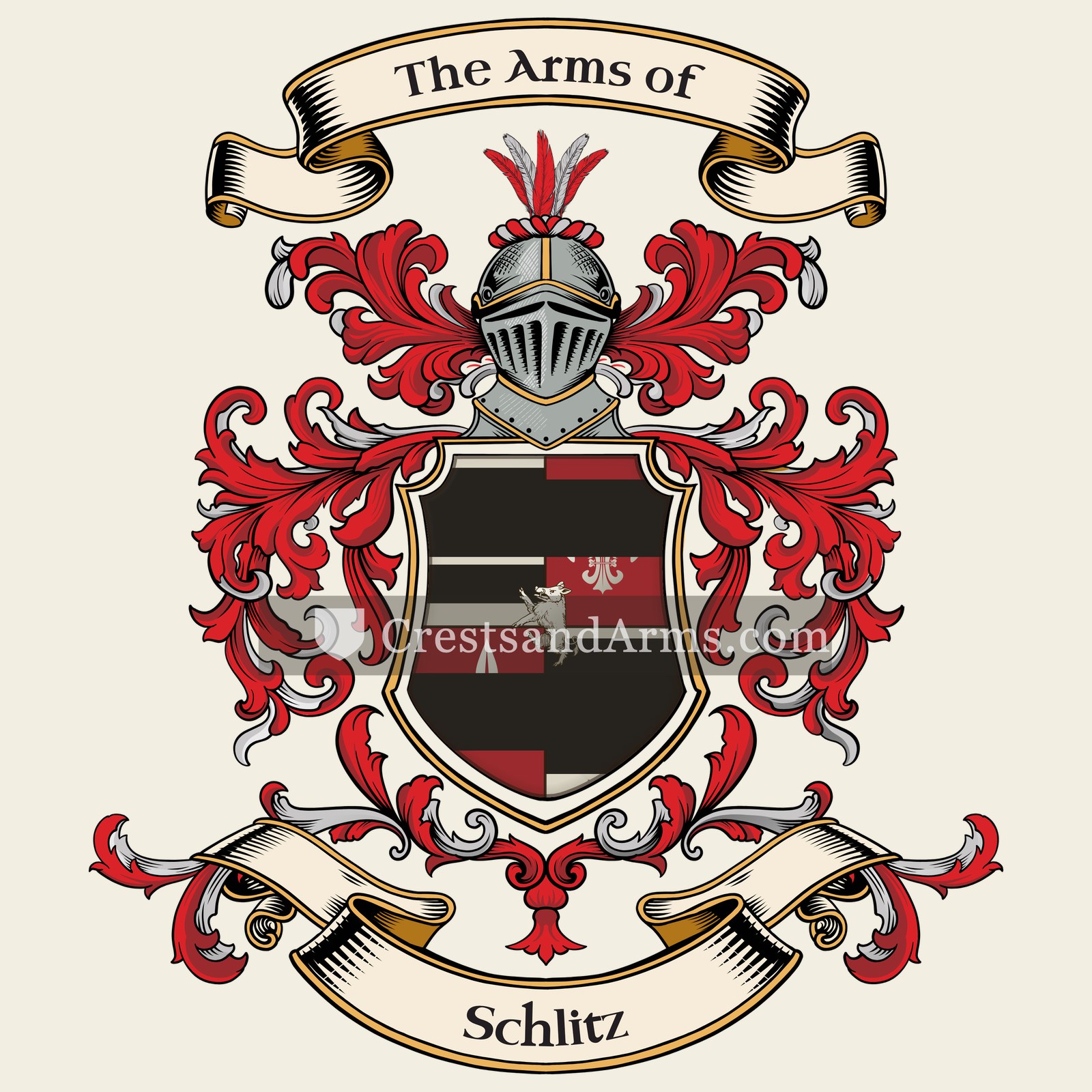
A record of documented arms, meaning and origin, researched for the Schlitz family of Germany.
Reg. 6374 · German, T–V
Coat of Arms & Family Crest Details
Symbols on this shield
boarA fierce fighter who battles to the end
fleur de lisPurity, light, and the sixth son
Colours
Silver (Argent)Means: Peace and sincerity
Red (Gules)Means: Military strength
Black (Sable)Means: Constancy
Historical info
Source
J. B. Rietstap, Armorial Général, Gouda: G. B. van Goor Zonen, 1884–87
Blazon (the actual original written record)
“Ec.: au 1 et 4 d'arg. à deux barres crén. de sa. (Schlitz); aux 2 et 3 de gu. à une fleur-de-lis d'arg. (Labes). Sur le tout d'arg. au sanglier ramp. de sa. (Bassewitz). Cinq cq. cour. C.: 1º un vol aux meubles des 1 et 4 quartiers, ceux de l'aile sen. mis en bande; 1. d'arg. et de sa.; les cim. 2, 3 et 4 comme les trois cimiers de Bassewitz de Dallwitz; 5º une épée d'arg., en pal, entre un vol aux armes des 2 et 3 quartiers; 1. d'arg. et de gu. T.: à dextre un taureau de sa.; à sen. un sauvage de carn., cour. de lierre et arm. d'une massue [Comp. Barons de Labes dit comtes de Schlitz, et Schlitz dit Görtz].”
MecklenburgMecklenburg, c. 1861
Digital archive packCoat of arms PNG, gold border print PDF, vector SVG and the certificate of authenticity. Sent to your email in minutes.
Map of Germany showing where the Schlitz arms are recorded
The Schlitz arms were recorded in Mecklenburg, c. 1861.
Mecklenburg was farming country in the north of Germany, held by a small number of families who kept their estates for generations. Owning land was what entitled a family to arms, so a great many Mecklenburg names ended up in the registers.
This is where the arms were entered in the register. Families often moved to other parts of the country, so the same name can turn up in more than one region.
The body that granted and recorded arms in Germany in this period.
Frederick William IV of Prussia
Sovereign of the period
Frederick William IV of Prussia
1840–1861
Reigning in Germany when the Schlitz arms are first recorded.
How Arms Worked in Germany
Prussian heraldry was strictly tied to social rank and noble status rather than being a free choice for every citizen. These symbols were treated as permanent family property that moved through the generations to all legitimate heirs. If a family branch wanted to change their design to stand out, they had to apply for official permission to alter their specific version of the shield.
Granting authority
The Prussian Heroldsamt acted as the central state office that managed and strictly controlled all noble titles and coats of arms.
How they got arms
Families usually obtained their arms through formal royal grants or by proving their long-standing noble status to the state authorities.
Where arms were recorded
All official coats of arms were kept in the rolls of the Prussian Heroldsamt, which functioned from 1706 until 1918.
The family's standing
Recorded among the armigerous families of Mecklenburg.
Origin & History of the Schlitz Family in Germany
The surname Schlitz is rooted in the historical landscape of northern Germany, particularly within the region of Mecklenburg. During the mid-19th century, families bearing this name were established members of the local community, living in an area defined by its agricultural traditions and rural social structures. The name itself likely originated as a topographical descriptor or a reference to a specific settlement, as was common for surnames emerging from the German-speaking lands during the medieval period. By 1861, the Schlitz family was well-integrated into the social fabric of Mecklenburg, participating in the daily life and economic activities of the region. Their presence during this era reflects the broader patterns of migration and settlement that shaped the demographics of the Baltic coast, where families often remained tied to their ancestral lands for generations.
Related Branches & Arms
Root word
Sliz
A Middle High German term referring to a slit or narrow opening.
This name
SchlitzA topographic name for someone who lived near a narrow passage or gorge.
also spelled
Bassewitz
Schlitz
Basewits Shlits
Documented Sources
J. B. Rietstap, Armorial Général, Gouda: G. B. van Goor Zonen, 1884–87
Lenz, Wilfried, Mecklenburgische Geschichte, 2001
Landeshauptarchiv Schwerin, Mecklenburg-Schwerinsche Volkszählung 1861, Record Series 2.12-1
Digital archive packCoat of arms PNG, gold border print PDF, vector SVG and the certificate of authenticity. Sent to your email in minutes.


 boarA fierce fighter who battles to the end
 fleur de lisPurity, light, and the sixth son
 boarA fierce fighter who battles to the end
 fleur de lisPurity, light, and the sixth son