A record of documented arms, meaning and origin, researched for the Schmeling family lines. Documented in 3 countries.
Reg. 1514 · Austrian, T–V
Meaning of the Schmeling family crest colors & symbols
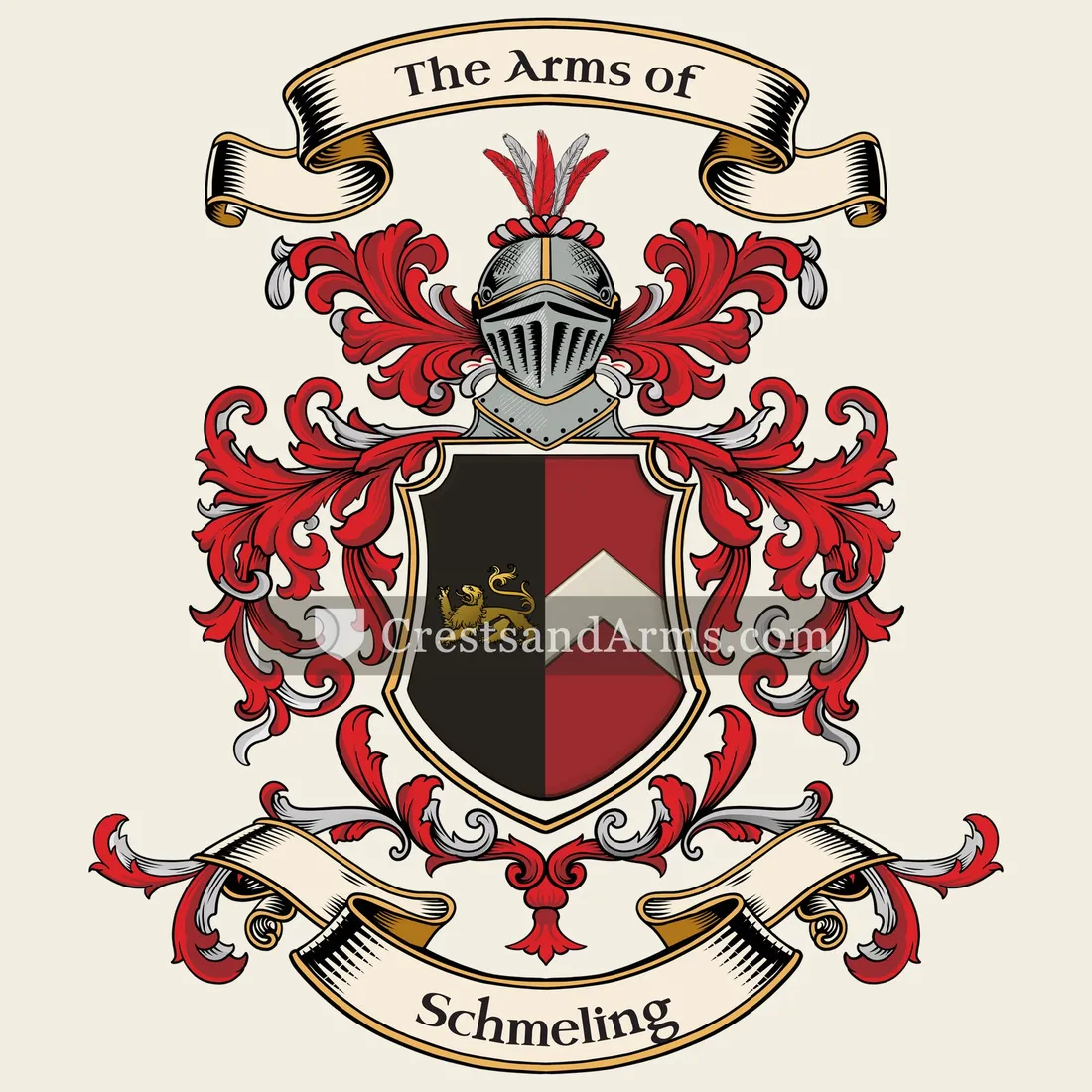
Symbols on this shield
chevronProtection, and faithful service completed
lionCourage, strength and royalty
Colours
Black (Sable)Means: Constancy
Red (Gules)Means: Military strength
Gold (Or)Means: Generosity
Historical info
Source
J. B. Rietstap, Armorial Général, Gouda: G. B. van Goor Zonen, 1884–87
Blazon (the actual original written record)
“Parti: au 1 de sa. au lion d'or; au 2 reparti de gu. et d'arg., au chev. de l'un en l'autre. Brl. d'or, de sa., d'arg. et de gu. C.: le lion, iss., entre deux prob., celle à dextre coupée d'or sur sa., celle à sen. de gu. chargée d'un chev. d'arg.; chaque prob. ornée dans son embouchure de trois pl. d'aut. au nat. L.: à dextre d'or et de sa., à sen. d'arg. et de gu.”
Austriac. 1574
Digital archive packCoat of arms PNG, gold border print PDF, vector SVG and the certificate of authenticity. Sent to your email in minutes.
Map of Austria showing where the Schmeling arms are recorded
The Schmeling arms were recorded in Austria, c. 1574.
Arms such as these were typically recorded in Tyrol.
Tyrol was mountain country in western Austria, where the valleys were held by families who had been there a very long time. Old tenure counted for more than money, and old families carried arms.
This is where the arms were entered in the register. Families often moved to other parts of the country, so the same name can turn up in more than one region.
Region
Tyrol
First recorded
1574
Granting Authority for the Schmeling Arms
Imperial and Royal chancery
Sodacan · CC BY-SA 3.0
The body that granted and recorded arms in Austria in this period.
Maximilian II, Holy Roman Emperor
Sovereign of the period
Maximilian II, Holy Roman Emperor
1564–1576
Reigning in Austria when the Schmeling arms are first recorded.
How Arms Worked in Austria
Austrian coats of arms were often linked directly to noble titles granted by the Emperor. These symbols belonged to the entire family line rather than just one individual. When a family grew, new branches kept the original design without needing to change it. This system allowed all members of a noble house to share the same identity across many generations.
Granting authority
The Imperial and Royal chancery managed all heraldic matters and controlled the official granting of arms throughout the Austrian lands.
How they got arms
Families typically received their arms through a formal imperial decree that often accompanied the elevation of a person to noble status.
Where arms were recorded
Official records of these grants were kept in the Imperial Register of Nobility which began its formal documentation process in 1453.
The family's standing
Recorded among the armigerous families of Austria.
Origin & History of the Schmeling Family in Austria
The family name Schmeling has deep roots in the rugged landscape of the Austrian Tyrol, where records confirm members of the family were established as early as 1574. The name itself is linked to the historical occupation of metalworking, specifically the process of smelting ore. In the sixteenth century, the Tyrol region was a major center for mining and metallurgy, making it likely that the family earned their name through their expertise in refining minerals from the surrounding Alps. As skilled laborers in a vital industry, these early ancestors were often integrated into the local economic structure of mountain villages. Over time, the family name became a permanent fixture in the region, reflecting a history tied to both the physical labor of the mines and the development of early industrial trade in the Austrian territories.
Meaning of the Schmeling family crest colors & symbols
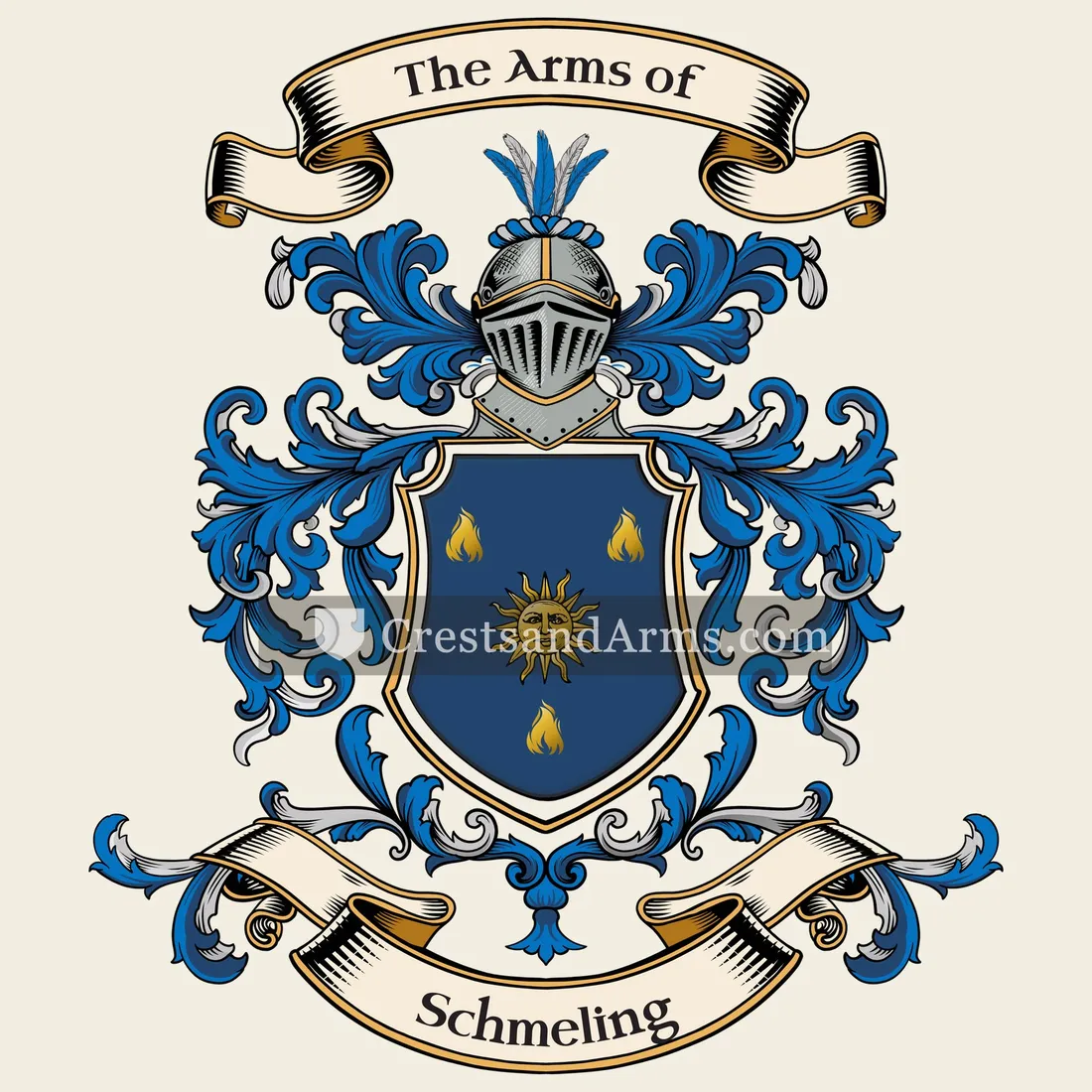
Symbols on this shield
sunGlory, splendour and the source of life
fireZeal and purification
Colours
Blue (Azure)Means: Loyalty and truth
Gold (Or)Means: Generosity
Historical info
Source
J. B. Rietstap, Armorial Général, Gouda: G. B. van Goor Zonen, 1884–87
Blazon (the actual original written record)
“D'azur à un soleil d'or dont sortent trois foudres du même en pairle. C.: le meuble de l'écu.”
SwitzerlandNeufchâtel, c. 1745
Digital archive packCoat of arms PNG, gold border print PDF, vector SVG and the certificate of authenticity. Sent to your email in minutes.
Map of Switzerland showing where the Schmeling arms are recorded
The Schmeling arms were recorded in Neufchâtel, c. 1745.
This is where the arms were entered in the register. Families often moved to other parts of the country, so the same name can turn up in more than one region.
The body that granted and recorded arms in Switzerland in this period.
How Arms Worked in Switzerland
In Switzerland, coats of arms were not restricted to the nobility and were often adopted by common citizens and families. These symbols were passed down through generations to show family identity. When branches of a family grew, they often changed small details of the design to distinguish their own line from the original group.
Granting authority
Cantonal and civic authorities managed the use of coats of arms within their specific regions and local jurisdictions.
How they got arms
Families typically assumed their own coats of arms based on local custom rather than receiving them from a central monarch.
Where arms were recorded
Arms were recorded in various cantonal and civic registers starting from the fourteenth century throughout the Swiss region.
The family's standing
Recorded among the armigerous families of Switzerland.
Origin & History of the Schmeling Family in Switzerland
The history of the Schmeling family in Switzerland is deeply rooted in the region of Neuchâtel, where records confirm their presence by the year 1745. The name itself is derived from the Middle High German word *smelzen*, which refers to the process of smelting or melting metal. This suggests that the earliest ancestors of the family were likely skilled tradespeople, such as blacksmiths or metalworkers, who played a vital role in the local economy. During the eighteenth century, Neuchâtel was a hub for craft and industry, providing an environment where families with technical expertise could establish themselves and grow. By settling in this area, the Schmeling family integrated into a society that valued precision and craftsmanship, leaving a lasting mark on the regional history of the Swiss cantons.
Meaning of the Schmeling family crest colors & symbols
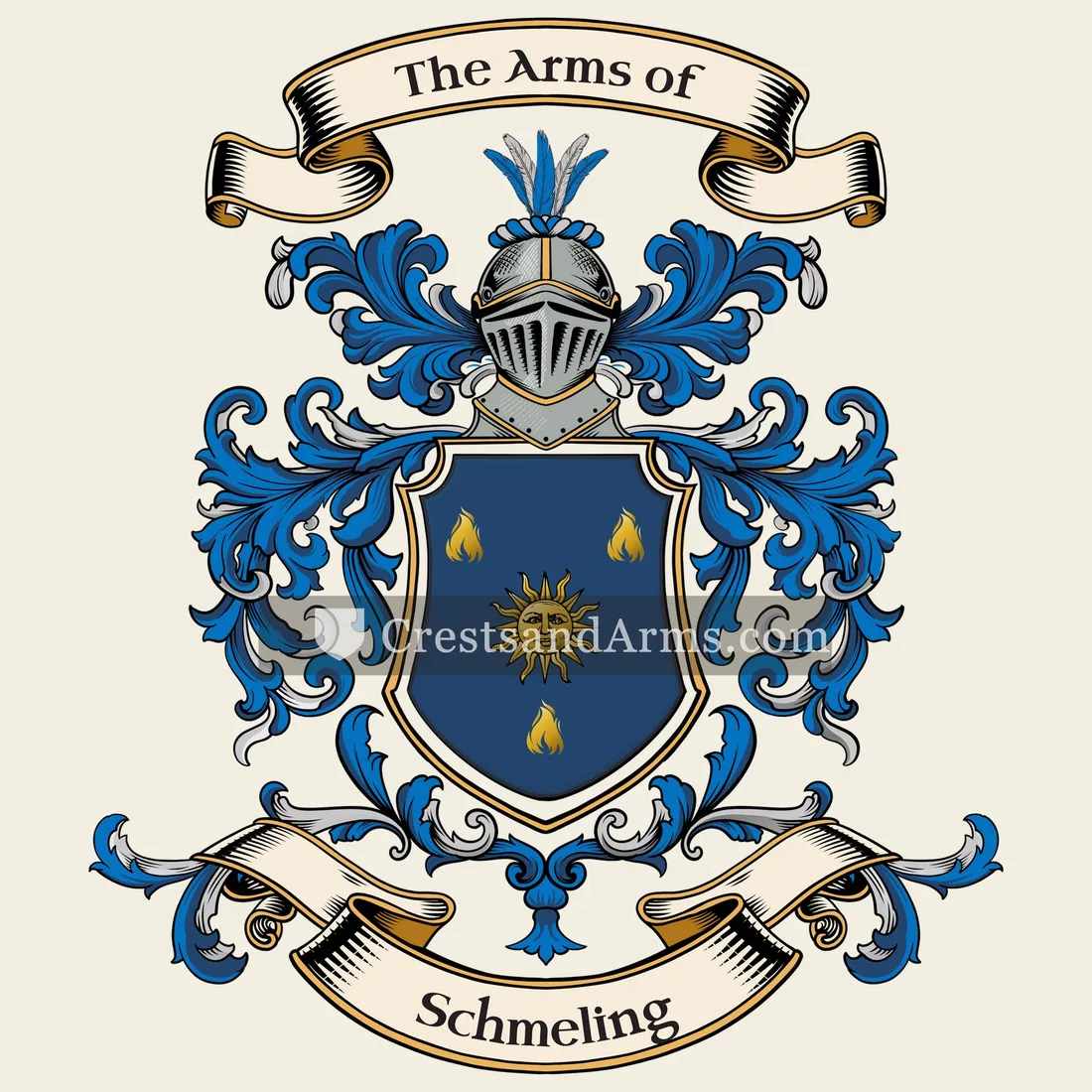
Symbols on this shield
sunGlory, splendour and the source of life
fireZeal and purification
Colours
Blue (Azure)Means: Loyalty and truth
Gold (Or)Means: Generosity
Historical info
Source
J. B. Rietstap, Armorial Général, Gouda: G. B. van Goor Zonen, 1884–87
Blazon (the actual original written record)
“D'azur à un soleil d'or, dont sortent trois foudres du même en pairle. C.: trois femmes iss., hab., la première de gu., la deuxième d'azur, la troisième d'or, ornées chacune d'une fraise d'arg., coiffées de chapeaux d'homme, pareils aux émaux des habits, chaque chapeau sommé à sen. d'une pl. d'aut., la première d'or, la deuxième de gu., la troisième d'azur. L. d'or et d'azur.”
PomeraniaPomerania, c. 1765
Digital archive packCoat of arms PNG, gold border print PDF, vector SVG and the certificate of authenticity. Sent to your email in minutes.
Map of Germany showing where the Schmeling arms are recorded
The Schmeling arms were recorded in Pomerania, c. 1765.
Pomerania was flat farming country on the Baltic coast, held in large estates by a small number of families. They kept their land for generations, and generations of landholding is what fills the registers.
This is where the arms were entered in the register. Families often moved to other parts of the country, so the same name can turn up in more than one region.
The body that granted and recorded arms in Germany in this period.
Francis I, Holy Roman Emperor
Sovereign of the period
Francis I, Holy Roman Emperor
1745–1765
Reigning in Austria when the Schmeling arms are first recorded.
How Arms Worked in Germany
In the Holy Roman Empire, coats of arms were often granted to individuals by the Emperor or his representatives. These arms were then passed down through the generations to all legitimate descendants of the original holder. Younger branches of a family usually kept the same shield design without needing to change it, as the arms belonged to the entire lineage.
Granting authority
The Holy Roman Emperor held the sole power to grant new coats of arms throughout his vast imperial territories.
How they got arms
Families typically obtained their coats of arms through a formal imperial grant or by proving their noble status to the authorities.
Where arms were recorded
These grants were officially recorded in the Imperial Chancery registers, which began keeping formal records of such honors during the Middle Ages.
The family's standing
Recorded among the armigerous families of Pomerania.
Origin & History of the Schmeling Family in Germany
The surname Schmeling finds its historical roots in the northern regions of Germany, particularly within the historic province of Pomerania. The name is derived from the Middle Low German word "smelen," which relates to the act of melting or refining metals. This suggests that the earliest ancestors bearing this name were likely involved in the trade of metalworking or blacksmithing. By the mid-18th century, records confirm that the family had established a firm presence in Pomerania, a region characterized by its agricultural traditions and proximity to the Baltic Sea. Life in this area during the 1760s was shaped by the strict social structures of the Prussian state, where families often remained in the same rural districts for generations. As the family grew, they integrated into the local village life, contributing to the development of the region through their labor and community involvement. This deep connection to the Pomeranian landscape highlights the family's role as part of the hardworking backbone of northern German society during the Enlightenment era.
Schmeling Meaning & Related Branches
Root word
Schmelzen
To melt or smelt metal.
This name
SchmelingAn occupational name for a smelter or someone who worked in a foundry.
also spelled
Schmelling
Shmeling
Related arms
Schmelinkvariant spelling
Documented Sources
J. B. Rietstap, Armorial Général, Gouda: G. B. van Goor Zonen, 1884–87
Huter, Franz. Tiroler Urkundenbuch. 1937
Tiroler Landesarchiv, Verzeichnisse der landesfürstlichen Untertanen in Tirol, 1574
Digital archive packCoat of arms PNG, gold border print PDF, vector SVG and the certificate of authenticity. Sent to your email in minutes.


 chevronProtection, and faithful service completed
 lionCourage, strength and royalty
 chevronProtection, and faithful service completed
 lionCourage, strength and royalty


 sunGlory, splendour and the source of life
 fireZeal and purification