A record of documented arms, meaning and origin, researched for the Schmidley family lines. Documented in 2 countries.
Reg. 0790 · German, T–V
Meaning of the Schmidley family crest colors & symbols
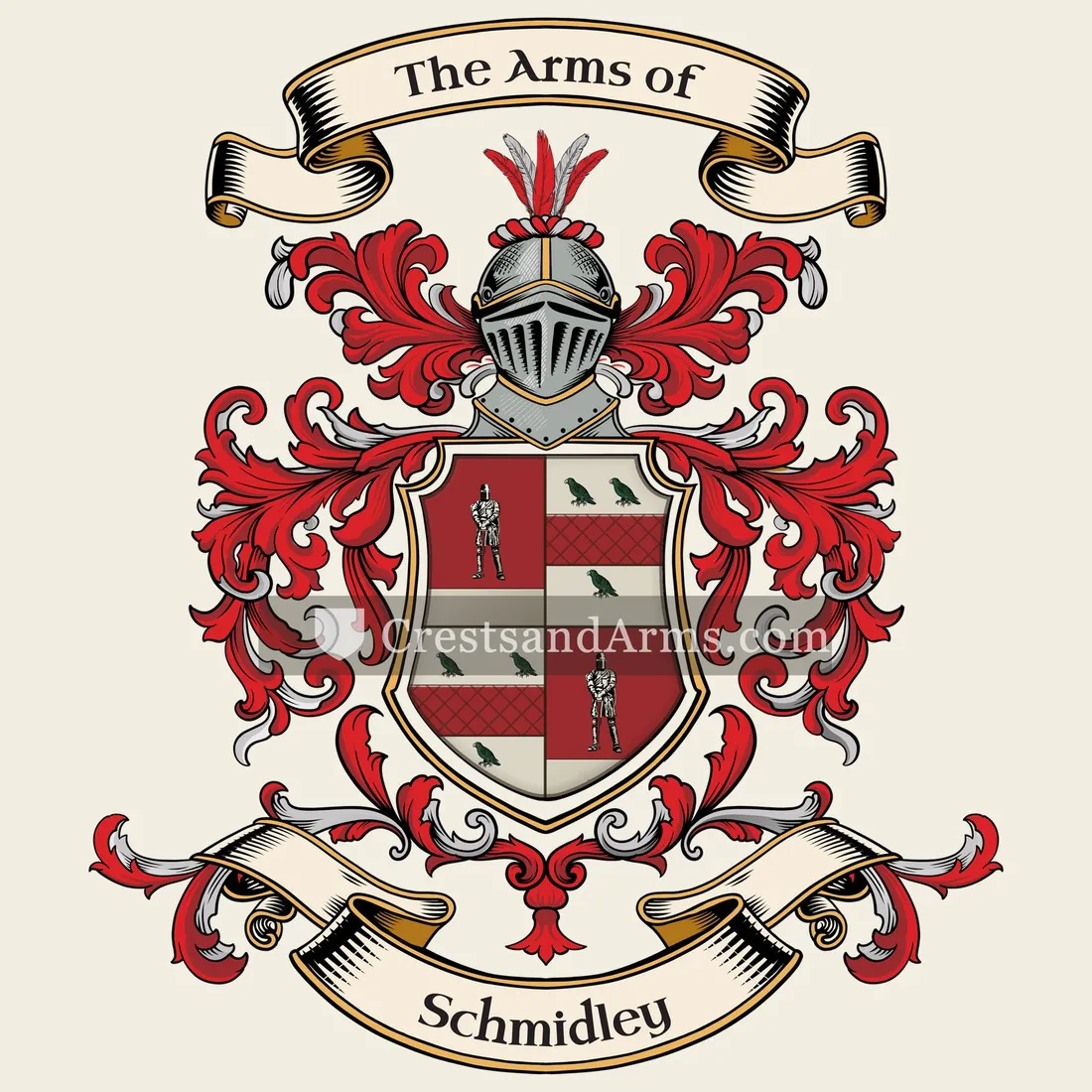
Symbols on this shield
knightChivalry and service in arms
parrotEloquence, and travel in distant lands
Colours
Red (Gules)Means: Military strength
Silver (Argent)Means: Peace and sincerity
Green (Vert)Means: Hope
Historical info
Source
J. B. Rietstap, Armorial Général, Gouda: G. B. van Goor Zonen, 1884–87
Blazon (the actual original written record)
“Ec.: aux 1 et 4 coupé de gu. sur un mur crén. d'arg., maçonné de sa.; le gu. ch. d'un homme iss., posé de profil mouv. du mur, hab. d'arg., cour. de feuillage et tenant un marteau, l'homme du 1 cont.; aux 2 et 3 coupé d'arg. sur gu., à trois perroquets de sin., 2 et 1. Cq. cour. C.: l'homme iss., hab. de gu.; entre un vol coupé alt. d'or et d'arg., chaque aile ch. sur le coupé d'un perroquet de sin., celui de l'aile dextre cont. L.: à dextre d'or et de sa., à sen. d'arg. et d'or.”
Germanyc. 1765
Digital archive packCoat of arms PNG, gold border print PDF, vector SVG and the certificate of authenticity. Sent to your email in minutes.
Map of Germany showing where the Schmidley arms are recorded
The Schmidley arms were recorded in Germany, c. 1765.
Arms such as these were typically recorded in Bavaria.
Bavaria was a country of old landed families and walled market towns. Estates passed down the same line for centuries, and both the landowners and the leading townsmen kept arms, which is why so many Bavarian names sit in the registers.
This is where the arms were entered in the register. Families often moved to other parts of the country, so the same name can turn up in more than one region.
The body that granted and recorded arms in Germany in this period.
Francis I, Holy Roman Emperor
Sovereign of the period
Francis I, Holy Roman Emperor
1745–1765
Reigning in Germany when the Schmidley arms are first recorded.
How Arms Worked in Germany
In the Holy Roman Empire, coats of arms were often granted to individuals by the Emperor or his representatives. These arms were then passed down through the generations to all legitimate descendants of the original holder. Younger branches of a family usually kept the same shield design without needing to change it, as the arms belonged to the entire lineage.
Granting authority
The Holy Roman Emperor held the sole power to grant new coats of arms throughout his vast imperial territories.
How they got arms
Families typically obtained their coats of arms through a formal imperial grant or by proving their noble status to the authorities.
Where arms were recorded
These grants were officially recorded in the Imperial Chancery registers, which began keeping formal records of such honors during the Middle Ages.
The family's standing
Recorded among the armigerous families of Germany.
Origin & History of the Schmidley Family in Germany
The name Schmidley is a variation of the occupational name Schmidt, which was one of the most common surnames in the German-speaking world. In the mid-18th century, the family was established in the region of Bavaria. During this time, the name likely identified a family of blacksmiths or metalworkers who provided essential tools for local farmers and craftsmen. Because Bavaria was a land of small villages and agricultural communities, these families were often central to the local economy. By 1765, the Schmidley name was already rooted in the social fabric of the region, reflecting a long tradition of skilled labor that defined the lives of many German families during the Enlightenment era. These families lived through a period of significant change as the Bavarian state modernized its administration and record-keeping systems.
Meaning of the Schmidley family crest colors & symbols
Symbols on this shield
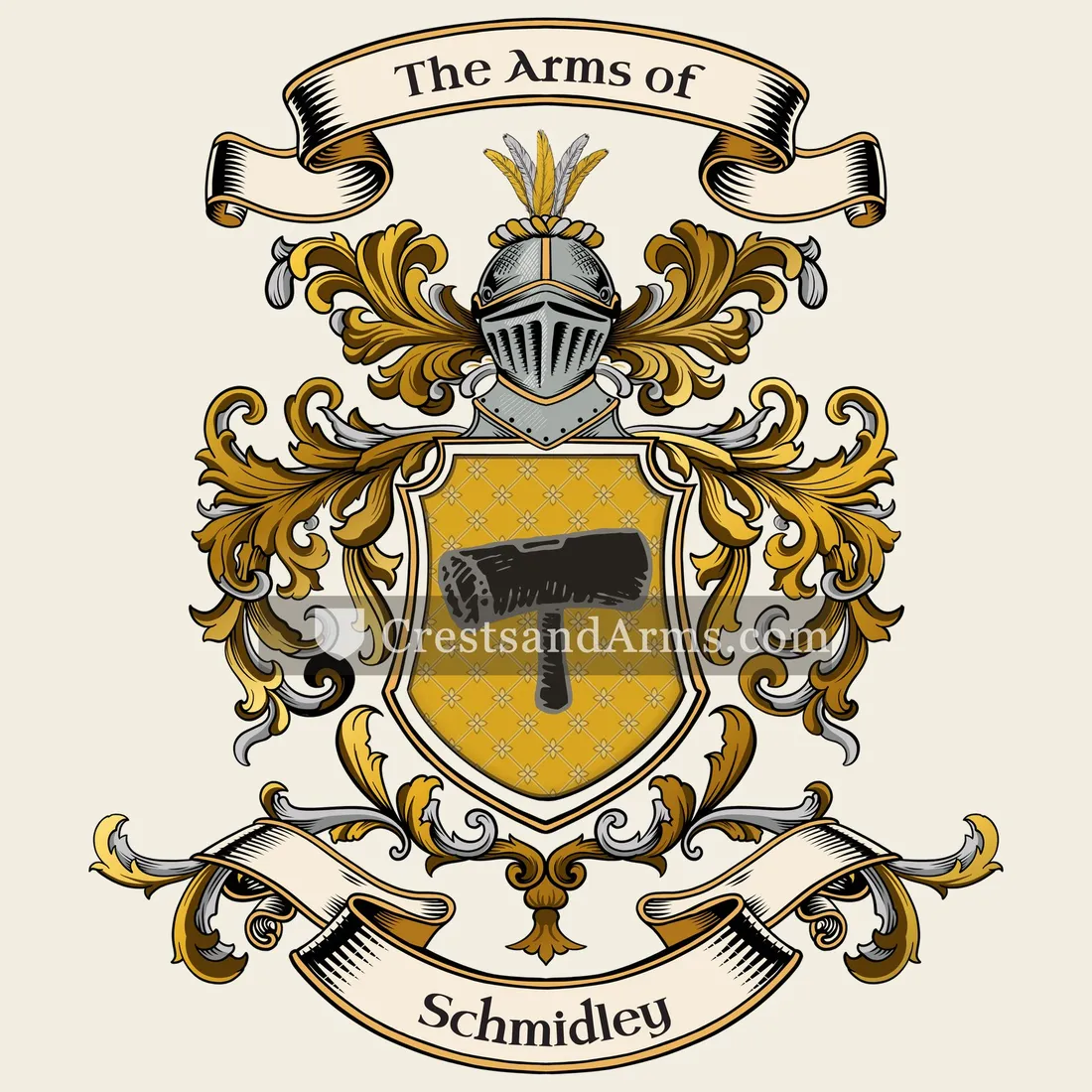
hammerHonest labour, and the smith's craft
Colours
Gold (Or)Means: Generosity
Black (Sable)Means: Constancy
Historical info
Source
J. B. Rietstap, Armorial Général, Gouda: G. B. van Goor Zonen, 1884–87
Blazon (the actual original written record)
“D'or à un marteau de sa., le manche croisé. C.: le meuble de l'écu.”
SwitzerlandBâle, c. 1745
Digital archive packCoat of arms PNG, gold border print PDF, vector SVG and the certificate of authenticity. Sent to your email in minutes.
Map of Switzerland showing where the Schmidley arms are recorded
The Schmidley arms were recorded in Bâle, c. 1745.
This is where the arms were entered in the register. Families often moved to other parts of the country, so the same name can turn up in more than one region.
The body that granted and recorded arms in Switzerland in this period.
How Arms Worked in Switzerland
In Switzerland, coats of arms were not restricted to the nobility and were often adopted by common citizens and families. These symbols were passed down through generations to show family identity. When branches of a family grew, they often changed small details of the design to distinguish their own line from the original group.
Granting authority
Cantonal and civic authorities managed the use of coats of arms within their specific regions and local jurisdictions.
How they got arms
Families typically assumed their own coats of arms based on local custom rather than receiving them from a central monarch.
Where arms were recorded
Arms were recorded in various cantonal and civic registers starting from the fourteenth century throughout the Swiss region.
The family's standing
Recorded among the armigerous families of Switzerland.
Origin & History of the Schmidley Family in Switzerland
The family name Schmidley finds its roots in the linguistic landscape of German-speaking regions, evolving from the occupational term for a smith or metalworker. While the name is often associated with the broader Alpine region, documented evidence places the family firmly in the city of Bâle by 1745. During the mid-eighteenth century, Bâle served as a vital hub for trade and craftsmanship, providing a stable environment for families like the Schmidleys to establish themselves within the local guild system. As residents of this influential Swiss city, early family members likely participated in the urban economy, which relied heavily on skilled labor and merchant networks. Over time, the family integrated into the social fabric of the region, transitioning from their ancestral trade roots to become part of the growing middle class in northern Switzerland.
Schmidley Meaning & Related Branches
Root word
Schmidt
A person who works with metal or a blacksmith.
This name
SchmidleyA diminutive or patronymic form referring to the descendant of a blacksmith.
also spelled
Schmidling
Schmitlin
Schmidlyn
Shmidlin
Smithlin
Documented Sources
J. B. Rietstap, Armorial Général, Gouda: G. B. van Goor Zonen, 1884–87
Bauer, Richard. Geschichte Bayerns. 2004
Dudenredaktion. Duden Familiennamen: Herkunft und Bedeutung. 2005


 knightChivalry and service in arms
 parrotEloquence, and travel in distant lands
 knightChivalry and service in arms
 parrotEloquence, and travel in distant lands


 hammerHonest labour, and the smith's craft