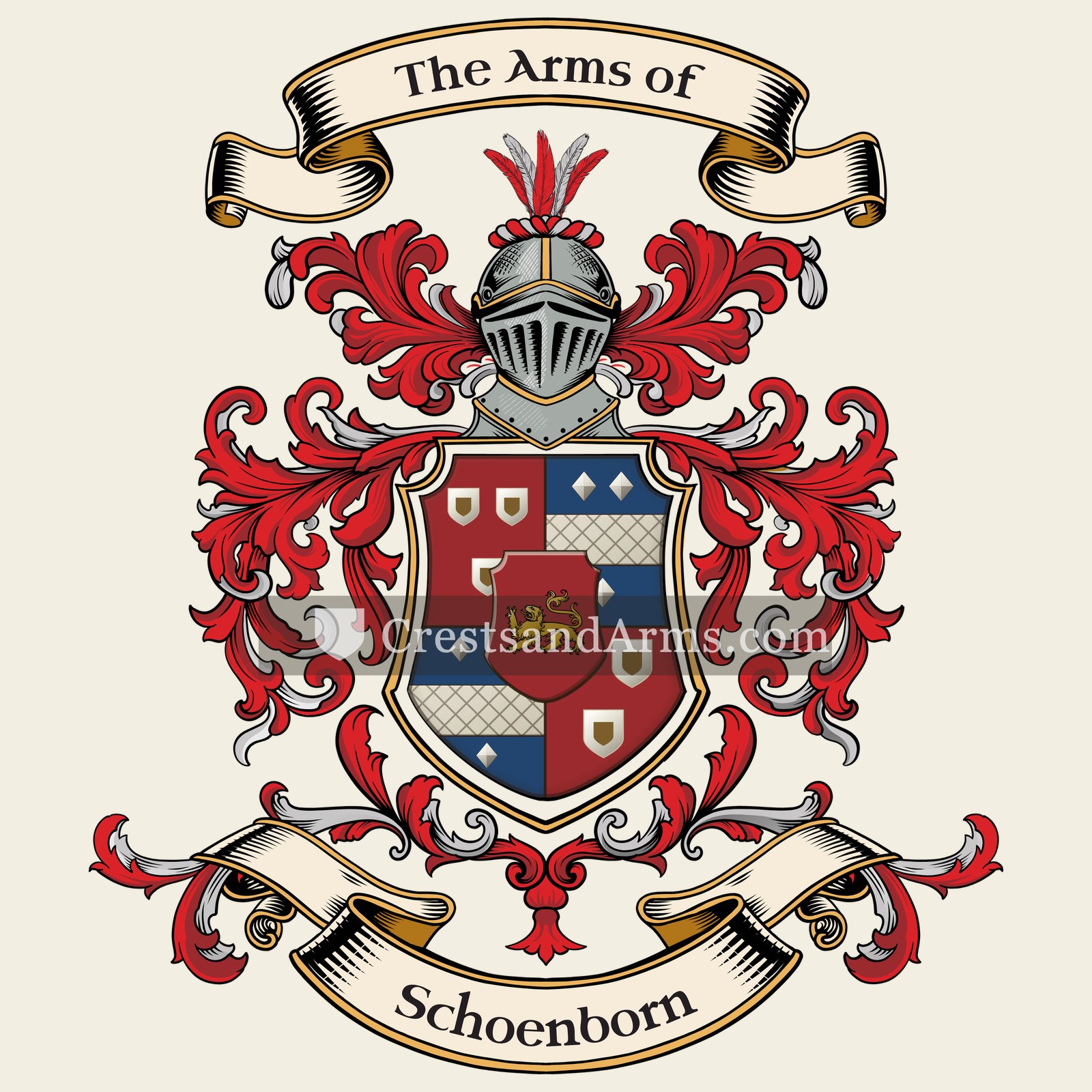
A record of documented arms, meaning and origin, researched for the Schoenborn family lines. Documented in 3 countries.
Reg. 8581 · German, T–V
Coat of Arms & Family Crest Details
Symbols on this shield
lionCourage, strength and royalty
Colours
Red (Gules)Means: Military strength
Silver (Argent)Means: Peace and sincerity
Gold (Or)Means: Generosity
Historical info
Source
J. B. Rietstap, Armorial Général, Gouda: G. B. van Goor Zonen, 1884–87
Blazon (the actual original written record)
“De gu. au lion léopardé d'or, cour. d'azur, soutenu d'une émanche de trois pièces d'arg., mouv. de la p. C.: un lion d'or, cour. d'azur, assis entre deux prob. coupées de gu. sur arg. L. d'arg. et de gu.”
FranconiaFranconia, c. 1765
Digital archive packCoat of arms PNG, gold border print PDF, vector SVG and the certificate of authenticity. Sent to your email in minutes.
Map of Germany showing where the Schoenborn arms are recorded
The Schoenborn arms were recorded in Franconia, c. 1765.
Franconia was a patchwork of small territories in central Germany, full of minor landowners and prosperous market towns. So many separate households held land there that the region produced a great many coats of arms.
This is where the arms were entered in the register. Families often moved to other parts of the country, so the same name can turn up in more than one region.
The body that granted and recorded arms in Germany in this period.
Francis I, Holy Roman Emperor
Sovereign of the period
Francis I, Holy Roman Emperor
1745–1765
Reigning in Germany when the Schoenborn arms are first recorded.
How Arms Worked in Germany
In the Holy Roman Empire, coats of arms were often granted to individuals by the Emperor or his representatives. These arms were then passed down through the generations to all legitimate descendants of the original holder. Younger branches of a family usually kept the same shield design without needing to change it, as the arms belonged to the entire lineage.
Granting authority
The Holy Roman Emperor held the sole power to grant new coats of arms throughout his vast imperial territories.
How they got arms
Families typically obtained their coats of arms through a formal imperial grant or by proving their noble status to the authorities.
Where arms were recorded
These grants were officially recorded in the Imperial Chancery registers, which began keeping formal records of such honors during the Middle Ages.
The family's standing
Recorded among the armigerous families of Franconia.
Origin & History of the Schoenborn Family in Germany
The family name Schoenborn originates from the German language and translates to beautiful spring or beautiful well. This name likely began as a topographic surname, which means it was given to people who lived near a specific local landmark, such as a scenic water source or a village with a pleasant stream. By 1765, records confirm that members of the family were well-established in the region of Franconia. During this era, Franconia was a diverse area within the Holy Roman Empire, characterized by its rolling hills and agricultural communities. Families in this region often relied on the land for their livelihood, and their surnames frequently reflected the natural beauty of their surroundings. As the family grew, they became part of the local social fabric, contributing to the development of the small towns and rural districts that defined the Franconian landscape during the eighteenth century.
Coat of Arms & Family Crest Details
Symbols on this shield
roundelA coin, and one who has been to the crusades
Colours
Red (Gules)Means: Military strength
Silver (Argent)Means: Peace and sincerity
Historical info
Source
J. B. Rietstap, Armorial Général, Gouda: G. B. van Goor Zonen, 1884–87
Blazon (the actual original written record)
“Coupé de gu. sur arg.; à une fontaine de l'un à l'autre, consistant en une colonne dans un bassin, la colonne jaillissante d'arg. par trois têtes de lion au sommet. Cq. cour. C.: trois pl. d'aut., une de gu. entre deux d'arg.”
PolandPosnanie, c. 1812
Digital archive packCoat of arms PNG, gold border print PDF, vector SVG and the certificate of authenticity. Sent to your email in minutes.
Map of Poland showing where the Schoenborn arms are recorded
The Schoenborn arms were recorded in Posnanie, c. 1812.
This is where the arms were entered in the register. Families often moved to other parts of the country, so the same name can turn up in more than one region.
Region
Posnanie
Town
Posnanie
First recorded
1812
Granting Authority for the Schoenborn Arms
Ennoblement by the Sejm
Author: Olek Remesz · CC BY-SA 3.0
The body that granted and recorded arms in Poland in this period.
How Arms Worked in Poland
Polish noble families shared a single coat of arms across many different surnames, creating large clans rather than individual designs. These symbols were held collectively by all members of the clan regardless of their specific family name. When a new family joined the nobility, they were adopted into an existing clan and began using that group's established shield.
Granting authority
The Sejm, which was the Polish parliament, held the power to grant noble status and the right to bear arms.
How they got arms
Families typically received their coat of arms through a formal act of ennoblement granted by the Sejm for distinguished service.
Where arms were recorded
These grants were officially recorded in the Crown Metrica, which served as the central archive for state documents starting in the sixteenth century.
The family's standing
Recorded among the armigerous families of Poland.
Origin & History of the Schoenborn Family in Poland
The family name Schoenborn carries a history deeply rooted in the cultural landscape of Central Europe, with a notable presence in the region of Posnanie by the early nineteenth century. During this period, the territory of Posnanie was a complex crossroads of shifting borders and cultural exchange between German and Polish populations. Families bearing this name were often part of the professional or landholding classes who navigated the changing administrative systems of the era. By 1812, records indicate that members of the Schoenborn family were already established within this region, likely involved in the local economy or civil service during a time of significant political transition under the Duchy of Warsaw. The name itself reflects a linguistic tradition common to the region, and its survival in local records highlights the family's integration into the social fabric of the territory during a formative time in Polish history.
Coat of Arms & Family Crest Details
Symbols on this shield
fessThe military belt, and readiness to serve
lionCourage, strength and royalty
escutcheonA shield within a shield, and a claim inherited
lozengeHonour and nobility, and the arms of a woman
Colours
Red (Gules)Means: Military strength
Blue (Azure)Means: Loyalty and truth
Silver (Argent)Means: Peace and sincerity
Gold (Or)Means: Generosity
Historical info
Source
J. B. Rietstap, Armorial Général, Gouda: G. B. van Goor Zonen, 1884–87
Blazon (the actual original written record)
“Ec.: aux 1 et 4 de gu. à trois écussons d'arg. (seigneurie de Reichelsberg); aux 2 et 3 d'azur à la fasce d'arg., acc. de trois los. du même (Heppenheim). Sur le tout de Schönborn qui est de gu. au lion léopardé d'or, cour. du même, soutenu d'une émanche de trois pièces d'arg., mouv. de la p. (Schönborn). Trois cq. cour. C.: 1° un jeune homme iss., cour. d'or, la tête sommée de cinq plumes de paon au nat., hab. d'un parti de gu. et d'arg., au rabat d'arg., tenant dans ses bras deux poissons au nat., les têtes en bas (Reichelsberg); 1. d'arg. et de gu.; 2° un lion assis de front d'or, cour. du même, entre deux prob. coupées-émanchées de gu. sur arg., ornées chacune à l'ext. de trois grenades d'or (Schönborn); 1. d'arg. et de gu.; 3° deux prob. aux armes du 2 (Heppenheim): 1. d'arg. et d'azur.”
Austriac. 1701
Digital archive packCoat of arms PNG, gold border print PDF, vector SVG and the certificate of authenticity. Sent to your email in minutes.
Map of Austria showing where the Schoenborn arms are recorded
The Schoenborn arms were recorded in Austria, c. 1701.
Arms such as these were typically recorded in Tyrol.
Tyrol was mountain country in western Austria, where the valleys were held by families who had been there a very long time. Old tenure counted for more than money, and old families carried arms.
This is where the arms were entered in the register. Families often moved to other parts of the country, so the same name can turn up in more than one region.
Region
Tyrol
First recorded
1701
Granting Authority for the Schoenborn Arms
Imperial and Royal chancery
Sodacan · CC BY-SA 3.0
The body that granted and recorded arms in Austria in this period.
Leopold I, Holy Roman Emperor
Sovereign of the period
Leopold I, Holy Roman Emperor
1658–1705
Reigning in Germany when the Schoenborn arms are first recorded.
How Arms Worked in Austria
Austrian coats of arms were often linked directly to noble titles granted by the Emperor. These symbols belonged to the entire family line rather than just one individual. When a family grew, new branches kept the original design without needing to change it. This system allowed all members of a noble house to share the same identity across many generations.
Granting authority
The Imperial and Royal chancery managed all heraldic matters and controlled the official granting of arms throughout the Austrian lands.
How they got arms
Families typically received their arms through a formal imperial decree that often accompanied the elevation of a person to noble status.
Where arms were recorded
Official records of these grants were kept in the Imperial Register of Nobility which began its formal documentation process in 1453.
The family's standing
Recorded among the armigerous families of Austria.
Origin & History of the Schoenborn Family in Austria
The family name Schoenborn carries a rich history tied to the rugged landscapes of the Austrian Alps. By the year 1701, records confirm that members of the family were already established in the Tyrol region. During this period, the name was closely associated with the social and economic shifts occurring in the Habsburg territories. Families in this area often lived in mountain valleys where they served as local administrators or skilled craftsmen. The name itself reflects a German linguistic origin, likely referring to a "beautiful spring" or a scenic well, which suggests that the family’s early identity was deeply connected to the natural geography of their home. As the eighteenth century progressed, the family became part of the broader administrative fabric of the Austrian Empire, moving through the alpine provinces and contributing to the local development of the region.
Related Branches & Arms
Root word
Schön + Born
Beautiful or fair combined with a spring, well, or fountain.
This name
SchoenbornRefers to someone who lived near a beautiful spring or a clear well.
also spelled
Schoenborn
Shonborn
Documented Sources
J. B. Rietstap, Armorial Général, Gouda: G. B. van Goor Zonen, 1884–87
Bahlow, Hans, Deutsches Namenlexikon: Familien- und Vornamen nach Ursprung und Sinn erklärt, 1967
Heintze, Albert, Die deutschen Familien-Namen: geschichtlich, geographisch, sprachlich, 1903
Staatsarchiv Bamberg, Standesbuch der Gemeinde- und Pfarreiregister, 1765
Digital archive packCoat of arms PNG, gold border print PDF, vector SVG and the certificate of authenticity. Sent to your email in minutes.


 lionCourage, strength and royalty
 lionCourage, strength and royalty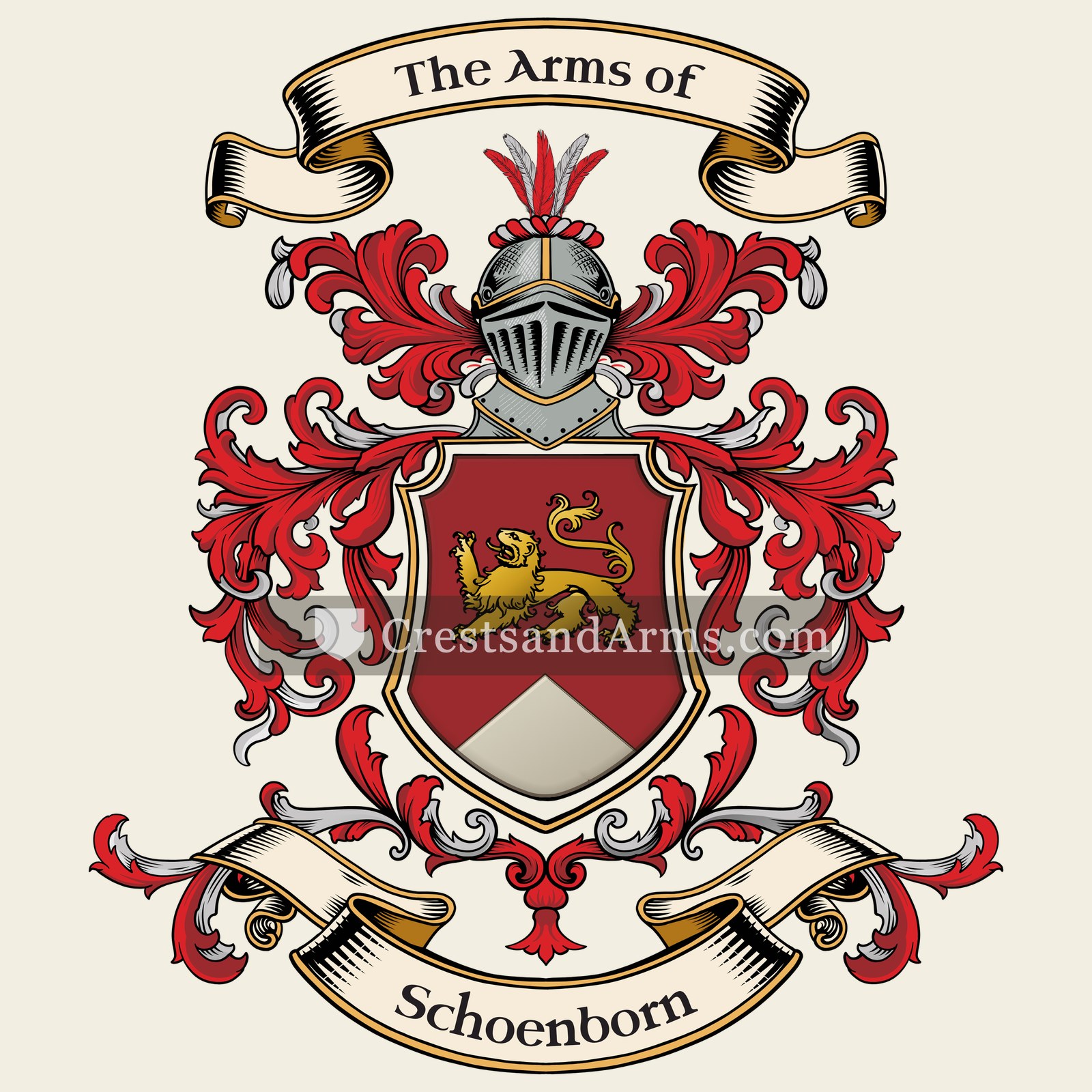


 roundelA coin, and one who has been to the crusades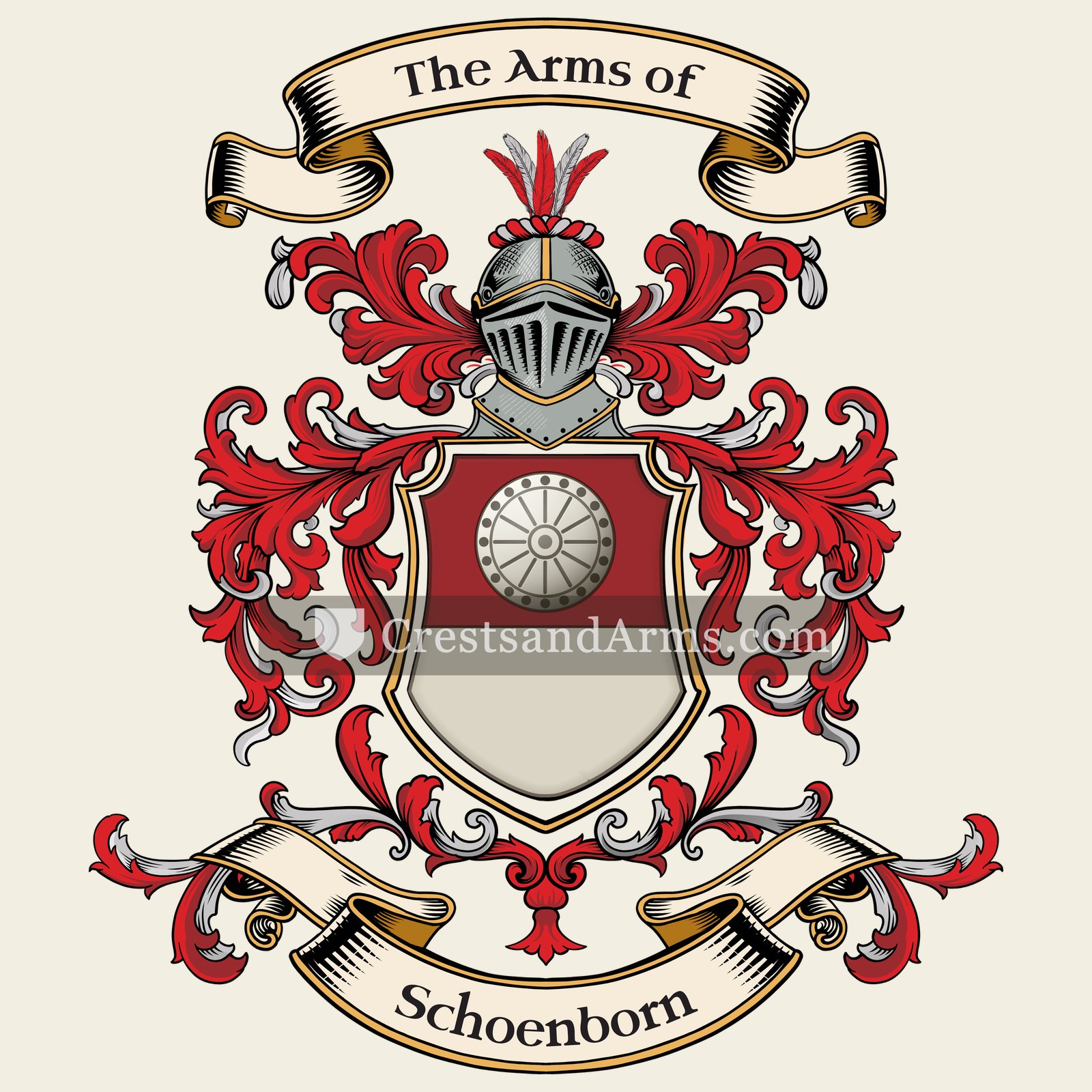

 fessThe military belt, and readiness to serve
 escutcheonA shield within a shield, and a claim inherited
 lozengeHonour and nobility, and the arms of a woman