A record of documented arms, meaning and origin, researched for the Schooler family lines. Documented in 2 countries.
Reg. 5450 · Swiss, T–V
Meaning of the Schooler family crest colors & symbols
Symbols on this shield
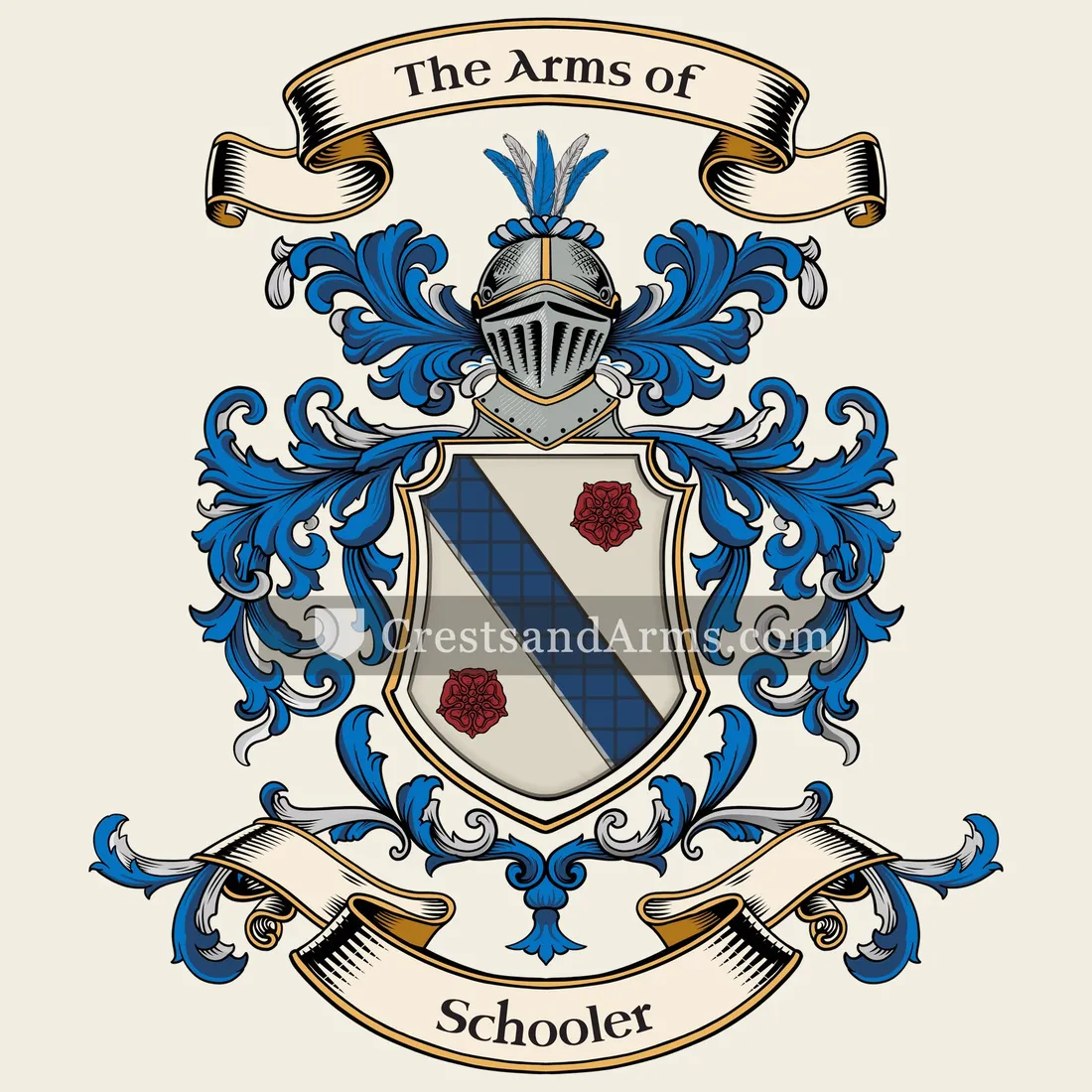
bendDefence, and the scarf of a commander
roseThe seventh son, and beauty with grace
Colours
Silver (Argent)Means: Peace and sincerity
Blue (Azure)Means: Loyalty and truth
Red (Gules)Means: Military strength
Historical info
Source
J. B. Rietstap, Armorial Général, Gouda: G. B. van Goor Zonen, 1884–87
Blazon (the actual original written record)
“D'arg. à la bande d'azur, acc. de deux roses de gu., bout. d'or. C.: trois roses rangées de gu., bout. d'or, sommées chacune de deux pl. d'aut. d'arg. L. d'arg. et d'azur.”
SwitzerlandBâle, c. 1745
Digital archive packCoat of arms PNG, gold border print PDF, vector SVG and the certificate of authenticity. Sent to your email in minutes.
Map of Switzerland showing where the Schooler arms are recorded
The Schooler arms were recorded in Bâle, c. 1745.
This is where the arms were entered in the register. Families often moved to other parts of the country, so the same name can turn up in more than one region.
The body that granted and recorded arms in Switzerland in this period.
How Arms Worked in Switzerland
In Switzerland, coats of arms were not restricted to the nobility and were often adopted by common citizens and families. These symbols were passed down through generations to show family identity. When branches of a family grew, they often changed small details of the design to distinguish their own line from the original group.
Granting authority
Cantonal and civic authorities managed the use of coats of arms within their specific regions and local jurisdictions.
How they got arms
Families typically assumed their own coats of arms based on local custom rather than receiving them from a central monarch.
Where arms were recorded
Arms were recorded in various cantonal and civic registers starting from the fourteenth century throughout the Swiss region.
The family's standing
Recorded among the armigerous families of Switzerland.
Origin & History of the Schooler Family in Switzerland
The family name Schooler carries a deep connection to the historic city of Bâle, Switzerland, where records confirm the presence of family members as early as 1745. During this period, Bâle served as a bustling center for trade and intellectual exchange, situated at the crossroads of German, French, and Swiss cultures. The name itself likely evolved from occupational roots related to the German word "Schule," suggesting that early ancestors may have been involved in education, administration, or the management of local institutions. Life in eighteenth-century Bâle was defined by the strict social structures of the Swiss cantons, where families often held specific roles within the city’s guilds or civic councils. By establishing themselves in this region, the Schooler family became part of a long tradition of Swiss craftsmanship and civic duty that helped shape the identity of the city during the Enlightenment.
Meaning of the Schooler family crest colors & symbols
Symbols on this shield
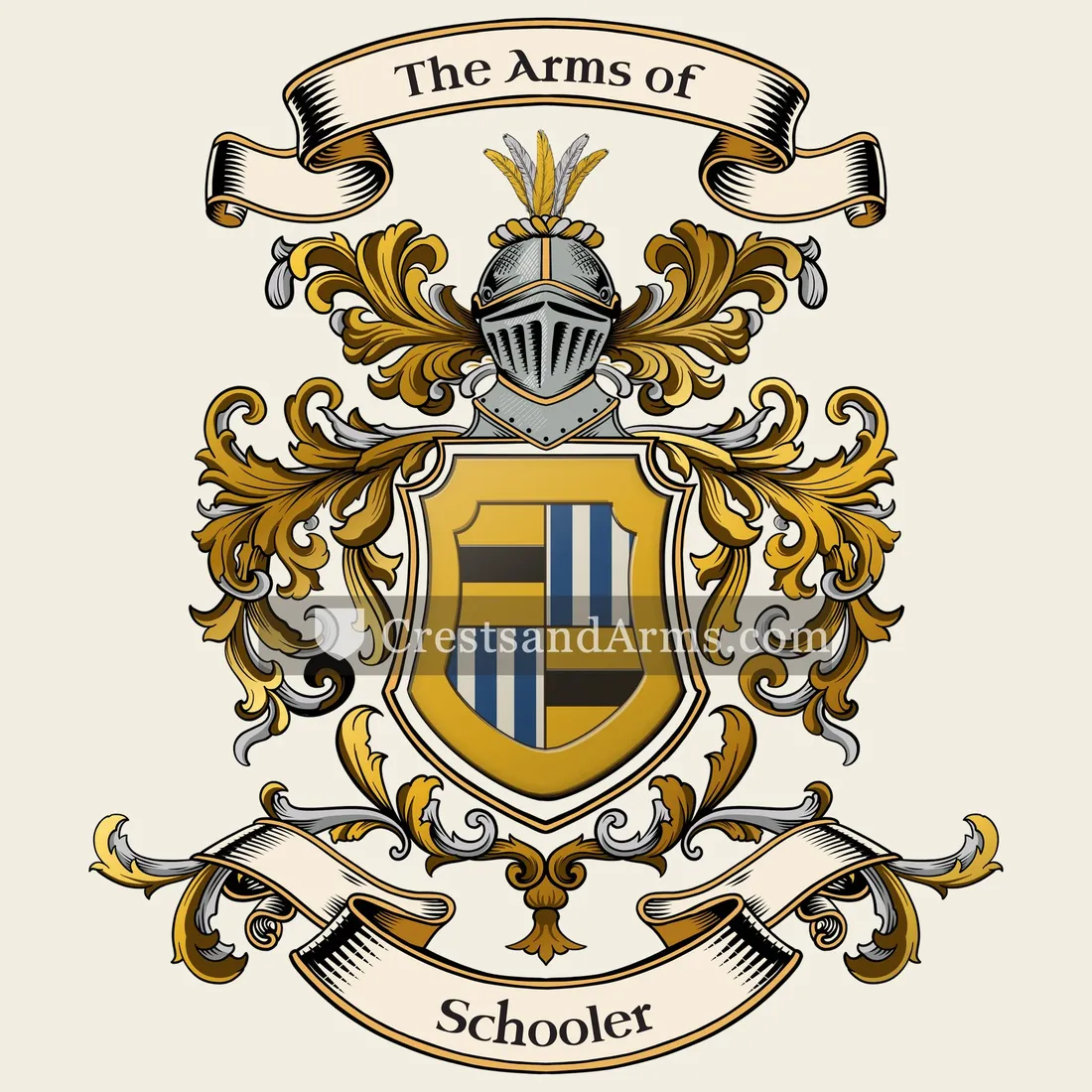
fessThe military belt, and readiness to serve
paleMilitary strength, and a fortified defence
Colours
Gold (Or)Means: Generosity
Blue (Azure)Means: Loyalty and truth
Black (Sable)Means: Constancy
Silver (Argent)Means: Peace and sincerity
Historical info
Source
J. B. Rietstap, Armorial Général, Gouda: G. B. van Goor Zonen, 1884–87
Blazon (the actual original written record)
“Ec.: aux 1 et 4 d'or à la fasce brét. et c.-brét. de sa. (Schöler); aux 2 et 3 d'azur à trois pals d'arg., le troisième retrait en p. l'écu bordé d'or. Cq. cour. C.: une queue de paon au nat. (Schöler). L. d'or et d'azur.”
Francec. 1769
Digital archive packCoat of arms PNG, gold border print PDF, vector SVG and the certificate of authenticity. Sent to your email in minutes.
Map of France showing where the Schooler arms are recorded
The Schooler arms were recorded in France, c. 1769.
Arms such as these were typically recorded in Bretagne.
More families held coats of arms in Bretagne than anywhere else in France. The land was divided into many small estates rather than a few large ones, so far more households counted as gentry, and each needed a shield of its own to be told apart.
This is where the arms were entered in the register. Families often moved to other parts of the country, so the same name can turn up in more than one region.
The body that granted and recorded arms in France in this period.
Louis XV of France
Sovereign of the period
Louis XV of France
1715–1774
Reigning in Switzerland when the Schooler arms are first recorded.
How Arms Worked in France
In France, a coat of arms was a mark of honor that passed down through the male line to all legitimate descendants. Families often used the same shield without changes to show their shared heritage. If a branch wanted to stand out, they could add a small mark to their shield to show their specific place in the family tree.
Granting authority
The Juge d'armes de France acted as the official authority that regulated and verified coats of arms across the country.
How they got arms
Families typically inherited their arms from ancestors, though they could also receive them through royal grants or by proving their noble status.
Where arms were recorded
Coats of arms were officially recorded in the Armorial Général de France, which began its main collection in the year 1696.
The family's standing
Recorded among the armigerous families of France.
Origin & History of the Schooler Family in France
The history of the Schooler family in France is rooted in the coastal region of Bretagne, where records confirm their presence by 1769. During this period, the name likely functioned as a descriptive occupational or locational identifier within the local community. Life in eighteenth-century Bretagne was defined by a strong connection to the land and the sea, and families often settled in specific parishes where they contributed to the agricultural or maritime economy. As the family established their roots in this rugged province, they became part of the complex social fabric of pre-revolutionary France. While the name eventually spread beyond these borders, its early identity remains tied to the traditions and regional history of the Breton people during the late eighteenth century.
Schooler Meaning & Related Branches
Root word
Schule
A place of learning or instruction derived from Latin schola.
This name
SchoolerAn occupational surname for a teacher, scholar, or someone associated with a school.
also spelled
Schole
Sholer
Documented Sources
J. B. Rietstap, Armorial Général, Gouda: G. B. van Goor Zonen, 1884–87
Burckhardt, August, Die Bürger von Basel, 1941
Suter, Andreas, Der schweizerische Bauernkrieg von 1653: Politische Sozialgeschichte – Sozialgeschichte eines politischen Konflikts, 1997
Staatsarchiv Basel-Stadt, Bürgerregister der Stadt Basel
Staatsarchiv Basel-Stadt, Kirchenbücher der Stadt Basel
Digital archive packCoat of arms PNG, gold border print PDF, vector SVG and the certificate of authenticity. Sent to your email in minutes.


 bendDefence, and the scarf of a commander
 roseThe seventh son, and beauty with grace
 bendDefence, and the scarf of a commander
 roseThe seventh son, and beauty with grace

 fessThe military belt, and readiness to serve
 paleMilitary strength, and a fortified defence