Map of Netherlands showing where the Schrader arms are recorded
The Schrader arms were recorded in Leeuwarden, c. 1815.
This is where the arms were entered in the register. Families often moved to other parts of the country, so the same name can turn up in more than one region.
Region
Leeuwarden
Town
Leeuwarden
First recorded
1815
Granting Authority for the Schrader Arms
Hoge Raad van Adel
Photograph made by me · CC BY-SA 3.0
The body that granted and recorded arms in Netherlands in this period.
William I of the Netherlands
Sovereign of the period
William I of the Netherlands
1815–1840
Reigning in Netherlands when the Schrader arms are first recorded.
How Arms Worked in Netherlands
In the Netherlands, coats of arms were often used by noble families and those who held specific public offices. These arms were passed down through the generations to legitimate descendants. Younger branches of a family usually kept the original design without needing to add special marks. This system ensured that the family identity remained clear and consistent over many years.
Granting authority
The Hoge Raad van Adel is the official body that regulates and manages noble titles and coats of arms in the Netherlands.
How they got arms
Families typically obtained their coats of arms through official royal grants or by proving their long-standing historical use of the symbols.
Where arms were recorded
Coats of arms are officially recorded in the registers held by the Hoge Raad van Adel, which began its work in 1814.
The family's standing
Recorded among the armigerous families of Netherlands.
Origin & History of the Schrader Family in Netherlands
The name Schrader is rooted in the Germanic linguistic tradition, where it functioned as an occupational surname derived from the Middle Low German word *schraden*, meaning to cut or to tailor. While the name has deep connections to Northern Germany, its presence in the Netherlands became well-documented during the early nineteenth century. By 1815, families bearing the name were established in the city of Leeuwarden, which served as a major administrative and cultural hub in the province of Friesland. During this period, the Napoleonic administration and the subsequent formation of the Kingdom of the Netherlands required citizens to formally register their surnames for tax and census purposes. The families living in Leeuwarden at this time were part of a broader movement of people who settled in urban centers to participate in the growing trade and professional networks of the region. These early records provide a clear starting point for tracing the family’s integration into Dutch society as they transitioned from their ancestral roots into the structured civil life of the nineteenth-century Netherlands.
Coat of Arms & Family Crest Details
Symbols on this shield
bendDefence, and the scarf of a commander
mulletThe third son, and a divine quality from above
roseThe seventh son, and beauty with grace
treeLife, endurance and deep roots
Colours
Silver (Argent)Means: Peace and sincerity
Blue (Azure)Means: Loyalty and truth
Red (Gules)Means: Military strength
Historical info
Source
J. B. Rietstap, Armorial Général, Gouda: G. B. van Goor Zonen, 1884–87
Blazon (the actual original written record)
“D'arg. à la bande d'azur, ch. de trois étoiles du champ et acc. en chef d'une rose de gu. et en p. d'une tige fruitée de trois glands mal-ordonnés, attachée à un petit chicot en fasce, le tout au nat. Cq. cour. C.: cinq pl. d'aut.: d'azur, d'arg., de gu., d'or et d'azur; entre un vol de sa. L. d'arg. et d'azur.”
GermanyHan, c. 1708
Digital archive packCoat of arms PNG, gold border print PDF, vector SVG and the certificate of authenticity. Sent to your email in minutes.
Map of Germany showing where the Schrader arms are recorded
The Schrader arms were recorded in Han, c. 1708.
This is where the arms were entered in the register. Families often moved to other parts of the country, so the same name can turn up in more than one region.
The body that granted and recorded arms in Germany in this period.
Joseph I, Holy Roman Emperor
Sovereign of the period
Joseph I, Holy Roman Emperor
1705–1711
Reigning in Netherlands when the Schrader arms are first recorded.
How Arms Worked in Germany
In the Holy Roman Empire, coats of arms were often granted to individuals by the Emperor or his representatives. These arms were then passed down through the generations to all legitimate descendants of the original holder. Younger branches of a family usually kept the same shield design without needing to change it, as the arms belonged to the entire lineage.
Granting authority
The Holy Roman Emperor held the sole power to grant new coats of arms throughout his vast imperial territories.
How they got arms
Families typically obtained their coats of arms through a formal imperial grant or by proving their noble status to the authorities.
Where arms were recorded
These grants were officially recorded in the Imperial Chancery registers, which began keeping formal records of such honors during the Middle Ages.
The family's standing
Recorded among the armigerous families of Germany.
Origin & History of the Schrader Family in Germany
The surname Schrader is an occupational name that originated in Northern Germany during the Middle Ages. It is derived from the Middle Low German word "schraden," which means to cut or to tailor. This suggests that the earliest ancestors bearing this name were likely tailors or cloth cutters who played an essential role in their local communities. By the time the family was documented in the town of Han in 1708, the name had become well-established across the German-speaking lands. Families with this name often lived in small agricultural or craft-based villages where they contributed to the local economy through their specialized trade. Over the centuries, the name spread as families moved to find new opportunities, yet it remained deeply connected to the linguistic and social traditions of its German roots.
Coat of Arms & Family Crest Details
Symbols on this shield
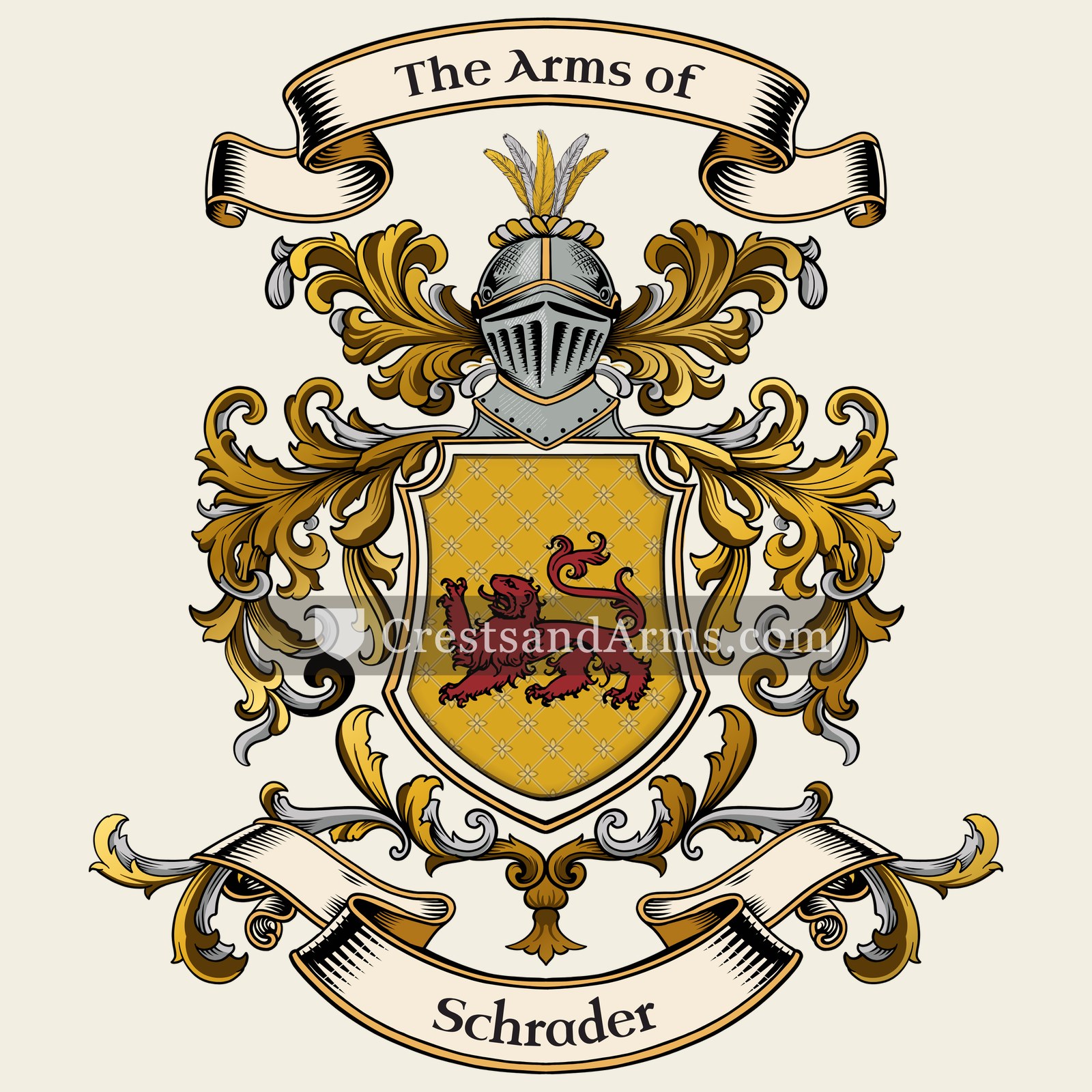
lionCourage, strength and royalty
Colours
Gold (Or)Means: Generosity
Red (Gules)Means: Military strength
Historical info
Source
J. B. Rietstap, Armorial Général, Gouda: G. B. van Goor Zonen, 1884–87
Blazon (the actual original written record)
“D'or à une tête et col de lion de gu., cour. d'or. C.: la tête de lion.”
LivoniaLivonia, c. 1736
Digital archive packCoat of arms PNG, gold border print PDF, vector SVG and the certificate of authenticity. Sent to your email in minutes.
Map of Poland showing where the Schrader arms are recorded
The Schrader arms were recorded in Livonia, c. 1736.
Livonia was Baltic country held by a small number of landed families who kept their estates for centuries. Land there passed down whole rather than being divided, and long unbroken tenure is what fills a register.
This is where the arms were entered in the register. Families often moved to other parts of the country, so the same name can turn up in more than one region.
Region
Livonia
First recorded
1736
Granting Authority for the Schrader Arms
Ennoblement by the Sejm
Author: Olek Remesz · CC BY-SA 3.0
The body that granted and recorded arms in Poland in this period.
Augustus III of Poland
Sovereign of the period
Augustus III of Poland
1733–1763
Reigning in Netherlands when the Schrader arms are first recorded.
How Arms Worked in Poland
Polish noble families shared a single coat of arms across many different surnames, creating large clans rather than individual designs. These symbols were held collectively by all members of the clan regardless of their specific family name. When a new family joined the nobility, they were adopted into an existing clan and began using that group's established shield.
Granting authority
The Sejm, which was the Polish parliament, held the power to grant noble status and the right to bear arms.
How they got arms
Families typically received their coat of arms through a formal act of ennoblement granted by the Sejm for distinguished service.
Where arms were recorded
These grants were officially recorded in the Crown Metrica, which served as the central archive for state documents starting in the sixteenth century.
The family's standing
Recorded among the armigerous families of Livonia.
Origin & History of the Schrader Family in Poland
The Schrader family name traces its roots to the Germanic regions, but its presence in the Baltic and Polish territories became significant during the eighteenth century. By 1736, records confirm that members of the family were established in Livonia, a region that was then deeply connected to the political and cultural spheres of the Polish-Lithuanian Commonwealth. As merchants, craftsmen, or administrators, these early Schraders moved through a landscape defined by the influence of the Hanseatic League and the shifting borders of Northern Europe. They likely settled in these areas to take advantage of the growing trade routes that linked the Baltic ports to the Polish interior. Over time, the family integrated into the local social fabric, adapting to the multilingual environment where German, Polish, and Latin were used in daily life and official documentation. This migration pattern reflects the broader movement of skilled workers who sought new opportunities in the eastern territories during a period of relative regional stability.
Related Branches & Arms
Root word
Schrader
Derived from the Middle Low German word for a tailor.
This name
SchraderAn occupational surname for someone who cut cloth or made garments.
also spelled
Shrader
Related arms
Abadie de Barrausimilar arms
Cabousimilar arms
Documented Sources
J. B. Rietstap, Armorial Général, Gouda: G. B. van Goor Zonen, 1884–87
AlleFriezen, Bevolkingsregister Leeuwarden
Nationaal Archief, Burgerlijke Stand van de provincie Friesland
Van der Schaar, J., Woordenboek van voornamen. 1964
Debrabandere, Frans, Woordenboek van de familienamen in België en Noord-Frankrijk. 2003
Digital archive packCoat of arms PNG, gold border print PDF, vector SVG and the certificate of authenticity. Sent to your email in minutes.


 cantonA mark of honour granted by the sovereign
 armA person of action, industrious and laborious
 cantonA mark of honour granted by the sovereign
 armA person of action, industrious and laborious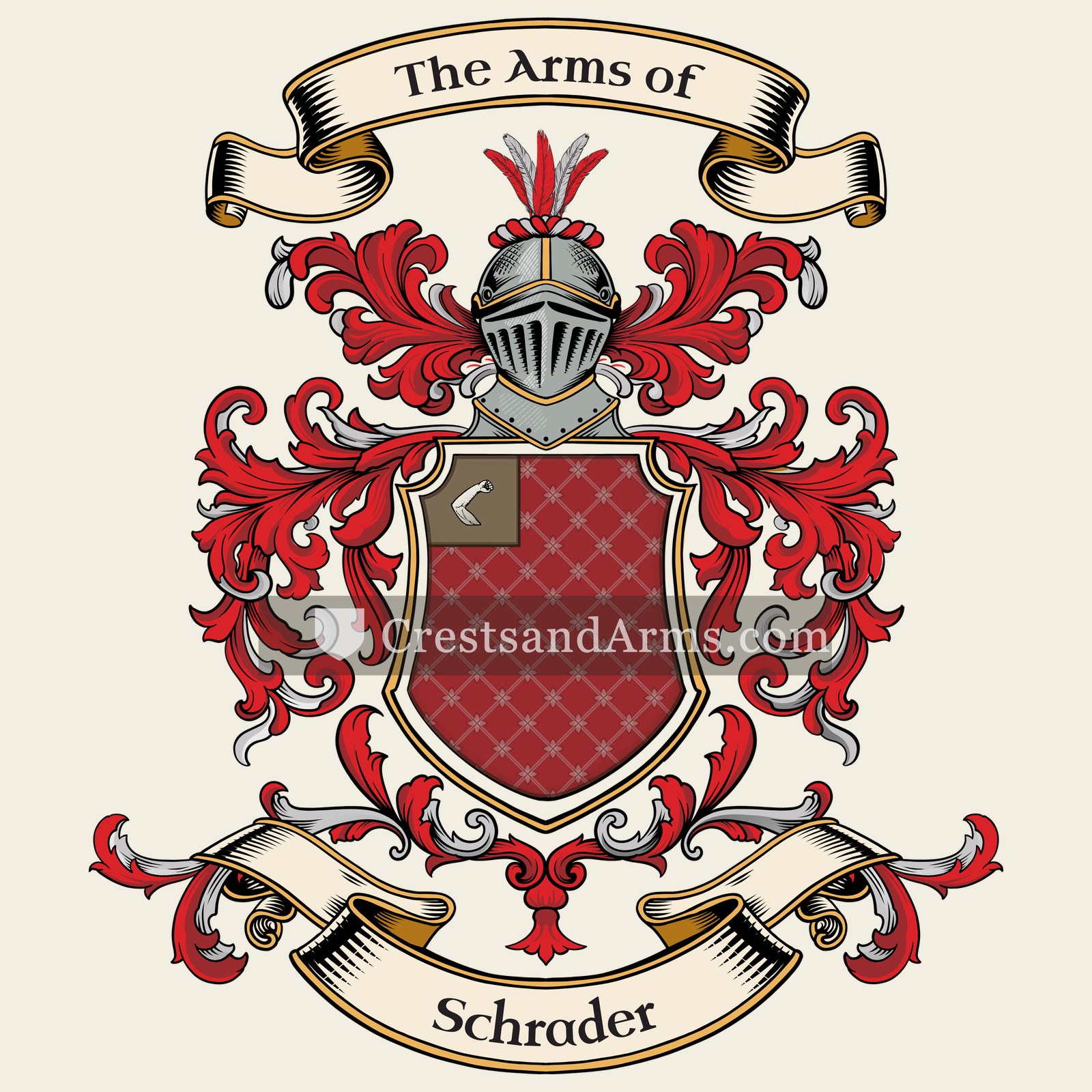


 bendDefence, and the scarf of a commander
 mulletThe third son, and a divine quality from above
 roseThe seventh son, and beauty with grace
 treeLife, endurance and deep roots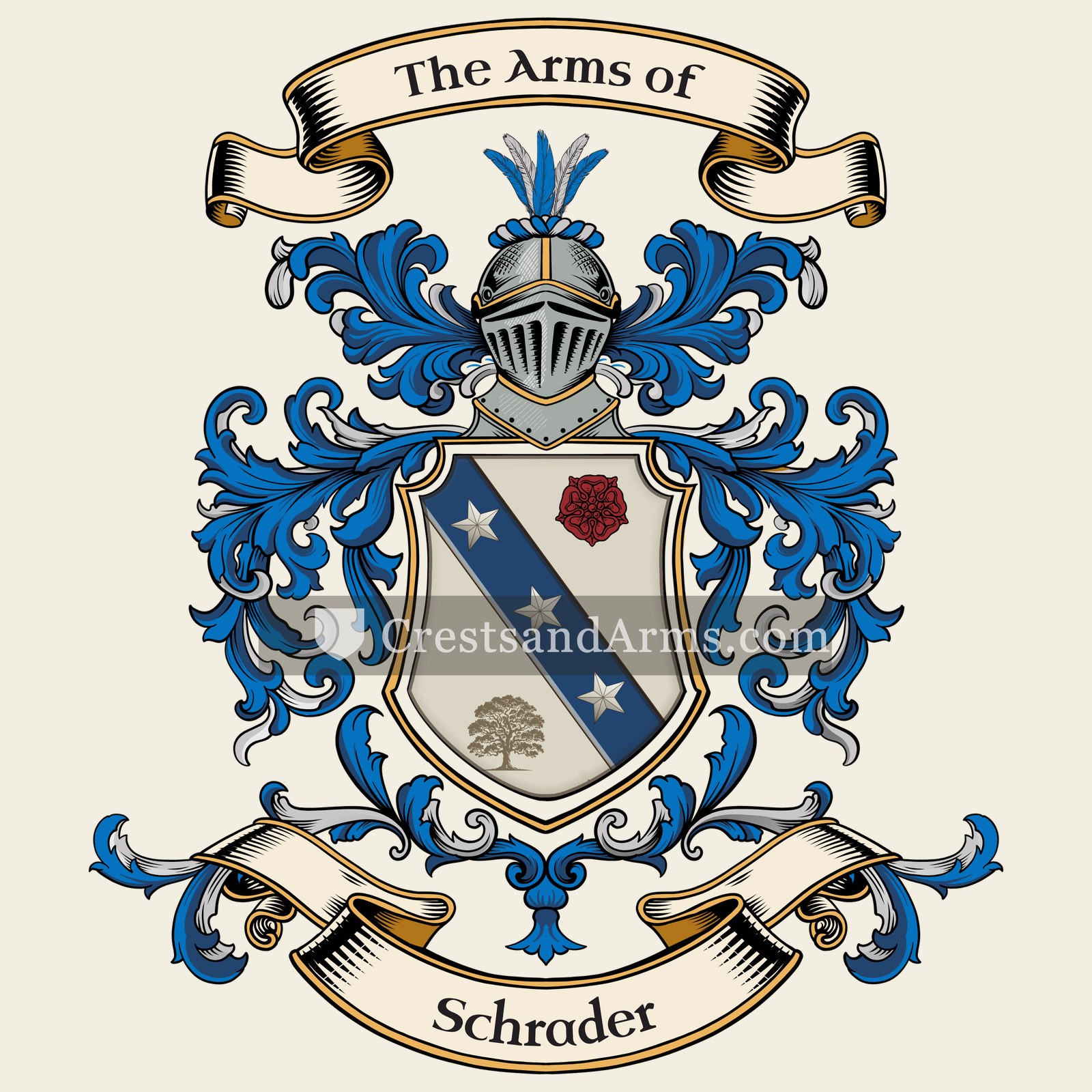


 lionCourage, strength and royalty