Map of Belgium showing where the Schutz arms are recorded
The Schutz arms were recorded in Brabant, c. 1737.
Brabant lay at the heart of the Low Countries, where the trade routes met. Its towns were wealthy and its landowners many, and both kinds of family kept arms, which is why the region is so heavily represented.
This is where the arms were entered in the register. Families often moved to other parts of the country, so the same name can turn up in more than one region.
The body that granted and recorded arms in Belgium in this period.
Charles VI, Holy Roman Emperor
Sovereign of the period
Charles VI, Holy Roman Emperor
1711–1740
Reigning in Belgium when the Schutz arms are first recorded.
How Arms Worked in Belgium
In Belgium, a coat of arms is considered personal property that is passed down through the male line to legitimate descendants. Families often use the same shield design across generations to show their shared heritage. If a branch of the family wants to change the design, they must apply for an official update to their specific version of the arms.
Granting authority
The Conseil héraldique is the official body that regulates and approves all coats of arms in Belgium.
How they got arms
Families obtain their coats of arms through formal royal grants or by confirming their historical right to use existing designs.
Where arms were recorded
All approved coats of arms are officially recorded in the public registers of the Conseil héraldique since 1844.
The family's standing
Recorded among the armigerous families of Brabant.
Origin & History of the Schutz Family in Belgium
The surname Schutz originates from the Middle High German word *schütze*, which historically referred to a marksman, a guard, or a person responsible for protecting a specific area. By the time the family established a documented presence in the Brabant region of Belgium in 1737, the name had already evolved from a functional title into a hereditary surname. During the eighteenth century, Brabant was a bustling center of trade and agriculture under the rule of the Austrian Netherlands. Families like the Schutz line often settled in these areas to work as skilled laborers or local officials who maintained order in the growing towns. As the family integrated into the local community, they participated in the social and economic life of the region, leaving behind records in parish registers and tax documents that help historians trace their movement through the Belgian landscape.
Coat of Arms & Family Crest Details
Symbols on this shield
bowReadiness, and the strength held in reserve
arrowReadiness for battle, and affliction endured
Colours
Gold (Or)Means: Generosity
Black (Sable)Means: Constancy
Historical info
Source
J. B. Rietstap, Armorial Général, Gouda: G. B. van Goor Zonen, 1884–87
Blazon (the actual original written record)
“D'or à un arc de sa. en barre, encoché d'une flèche émoussée du même, empennée d'arg. C.: un homme iss., hab. de sa., rebr. d'or, tort. de sa. et d'or, tenant l'arc et la flèche.”
SaxonySaxony, c. 1486
Digital archive packCoat of arms PNG, gold border print PDF, vector SVG and the certificate of authenticity. Sent to your email in minutes.
Map of Germany showing where the Schutz arms are recorded
The Schutz arms were recorded in Saxony, c. 1486.
Saxony had mines, trade and old landed families all at once. Silver made some fortunes and land held others, and both sorts of family kept arms, which is why Saxon names appear so often in the registers.
This is where the arms were entered in the register. Families often moved to other parts of the country, so the same name can turn up in more than one region.
The body that granted and recorded arms in Germany in this period.
Frederick III, Holy Roman Emperor
Sovereign of the period
Frederick III, Holy Roman Emperor
1440–1493
Reigning in Belgium when the Schutz arms are first recorded.
How Arms Worked in Germany
In the Holy Roman Empire, coats of arms were often granted to individuals by the Emperor or his representatives. These arms were then passed down through the generations to all legitimate descendants of the original holder. Younger branches of a family usually kept the same shield design without needing to change it, as the arms belonged to the entire lineage.
Granting authority
The Holy Roman Emperor held the sole power to grant new coats of arms throughout his vast imperial territories.
How they got arms
Families typically obtained their coats of arms through a formal imperial grant or by proving their noble status to the authorities.
Where arms were recorded
These grants were officially recorded in the Imperial Chancery registers, which began keeping formal records of such honors during the Middle Ages.
The family's standing
Recorded among the armigerous families of Saxony.
Origin & History of the Schutz Family in Germany
The surname Schutz originated in Germany as a descriptive name rooted in the Middle High German word *schütze*, which translates to a guard, watchman, or marksman. During the medieval period, surnames were often adopted to reflect a person’s occupation or their role within the local community. By the late 15th century, the family had established a notable presence in the region of Saxony. Records from 1486 confirm that members of the Schutz family were active in this area, likely serving in roles related to regional defense or local administration. As the name spread across German-speaking lands, it evolved to represent families who held positions of responsibility or protection for their lords and neighbors. This history highlights how a simple occupational title transformed into a lasting family legacy that became deeply woven into the social fabric of early modern Saxony.
Coat of Arms & Family Crest Details
Symbols on this shield
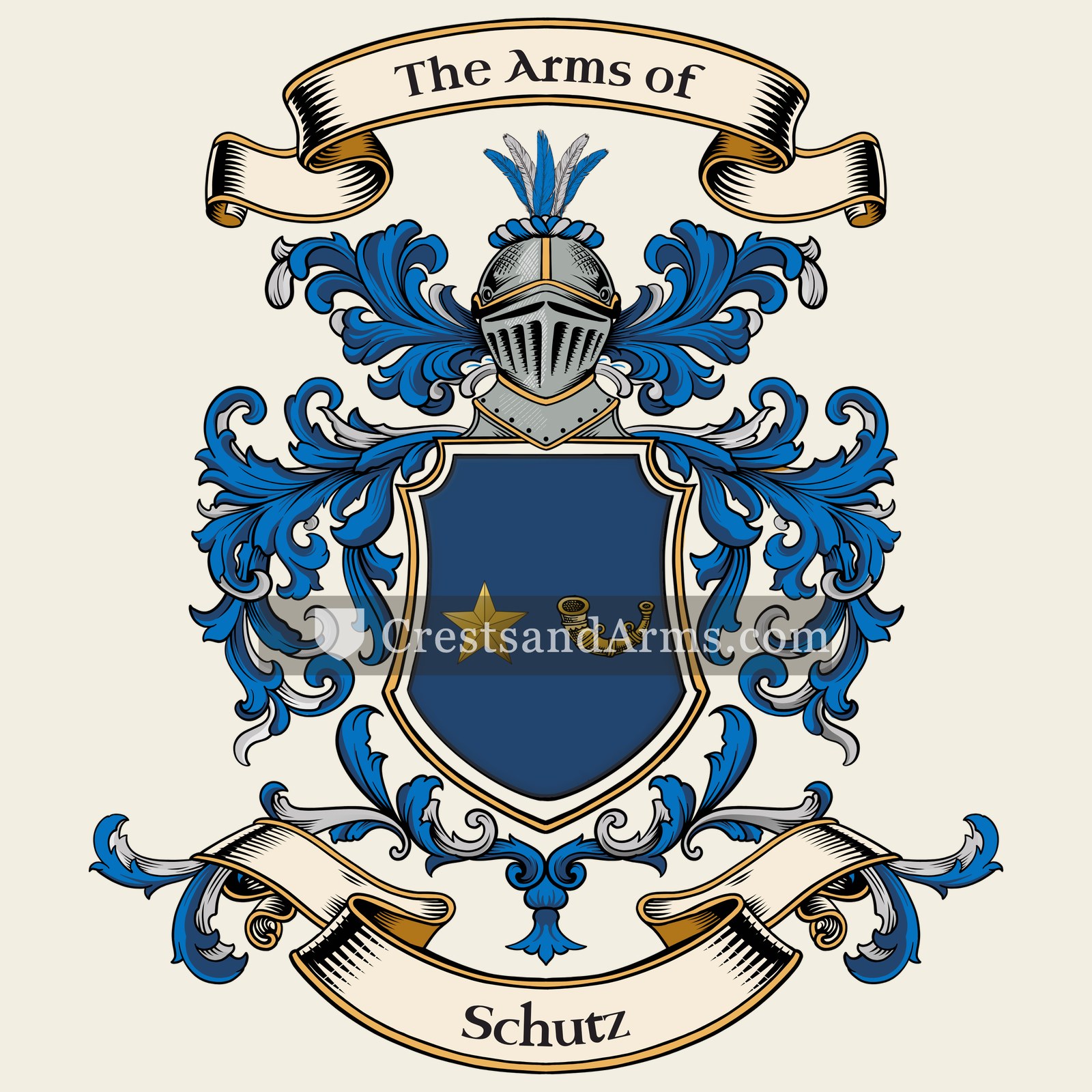
mulletThe third son, and a divine quality from above
hunting horn stringedOne who delights in the chase
Colours
Blue (Azure)Means: Loyalty and truth
Gold (Or)Means: Generosity
Historical info
Source
Sir Bernard Burke, The General Armory of England, Scotland, Ireland and Wales, London: Harrison & Sons, 1884
Blazon (the actual original written record)
“Az. in dexter chief a mullet, in sinister base a stag's horn or”
NorfolkGillingham · Norfolk, c. 1620
Digital archive packCoat of arms PNG, gold border print PDF, vector SVG and the certificate of authenticity. Sent to your email in minutes.
Map of England showing where the Schutz arms are recorded
The Schutz arms were recorded in Norfolk, c. 1620.
Norfolk grew rich on wool and grain, and its wealth was spread among many middling families rather than a few great ones. Households of that kind bought land and took arms, and the county holds a large share of English names.
This is where the arms were entered in the register. Families often moved to other parts of the country, so the same name can turn up in more than one region.
The body that granted and recorded arms in England in this period.
James VI and I
Sovereign of the period
James VI and I
1603–1625
Reigning in Belgium when the Schutz arms are first recorded.
How Arms Worked in England
English heraldry allowed arms to be shared by all legitimate descendants of the original owner. These symbols were treated as personal property that moved through the generations to all children. While the eldest son kept the original design, other family members could use the same shield without needing to change it or register their own unique versions.
Granting authority
The College of Arms in London has regulated the use of coats of arms throughout England and Wales since 1484.
How they got arms
Families typically obtained their coats of arms through a formal grant from the Crown or by proving their ancient right to them.
Where arms were recorded
All official coats of arms are recorded in the registers kept at the College of Arms, which date back to the fifteenth century.
The family's standing
Recorded among the armigerous families of Norfolk.
Origin & History of the Schutz Family in England
The surname Schutz originated as a German occupational name, derived from the word for a guard, watchman, or protector. By the early seventeenth century, members of the family had migrated across the North Sea to settle in England, with records confirming their presence in the county of Norfolk by 1620. During this period, Norfolk was a bustling hub for trade and religious refugees fleeing conflicts on the European continent. These early settlers likely integrated into the local community by working in trades that utilized their existing skills or by establishing themselves as landowners in the fertile East Anglian countryside. Over time, the name became firmly rooted in the English landscape, evolving from its foreign origins into a recognized part of the local population as the family adapted to life in their new home.
Related Branches & Arms
Root word
Schützen
To guard, protect, or defend.
This name
SchutzAn occupational surname for a guard, watchman, or a marksman.
also spelled
Schutze
Schutzs
Schutzer
Shuts
Schut
Related arms
Stehelinrecorded with Schutz, same area
Uhlnrecorded with Schutz, same area
Wangerrecorded with Schutz, same area
Wannerrecorded with Schutz, same area
Documented Sources
J. B. Rietstap, Armorial Général, Gouda: G. B. van Goor Zonen, 1884–87
Debrabandere, Frans, Woordenboek van de familienamen in België en Noord-Frankrijk, 1993
Leys, O., De familienamen in de Zuidelijke Nederlanden, 1970
State Archives in Belgium (Rijksarchief), Parochieregisters van de provincie Brabant
State Archives in Belgium (Rijksarchief), Registers van de Burgerlijke Stand
Digital archive packCoat of arms PNG, gold border print PDF, vector SVG and the certificate of authenticity. Sent to your email in minutes.


 saltireResolution, and St Andrew's cross
 saltireResolution, and St Andrew's cross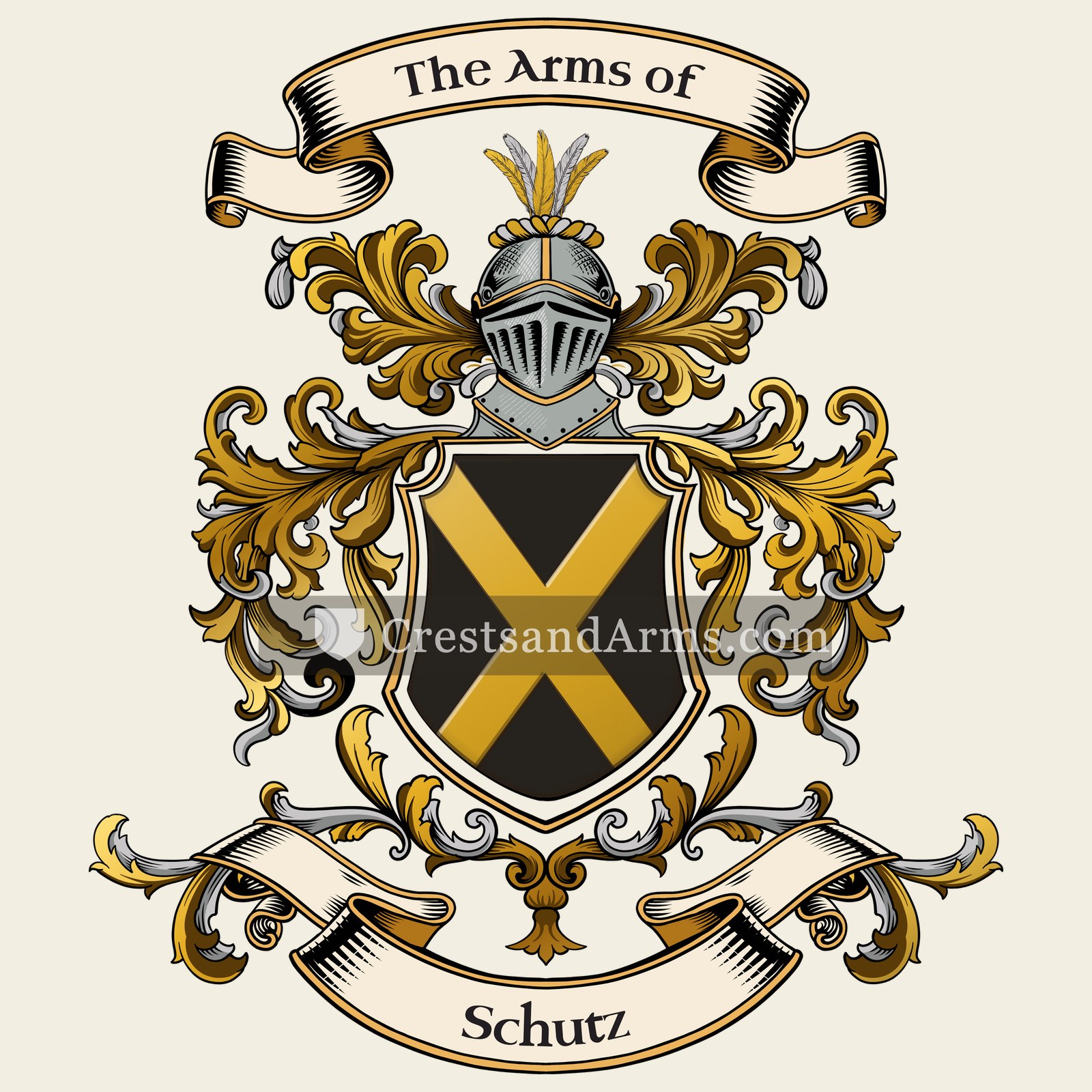


 bowReadiness, and the strength held in reserve
 arrowReadiness for battle, and affliction endured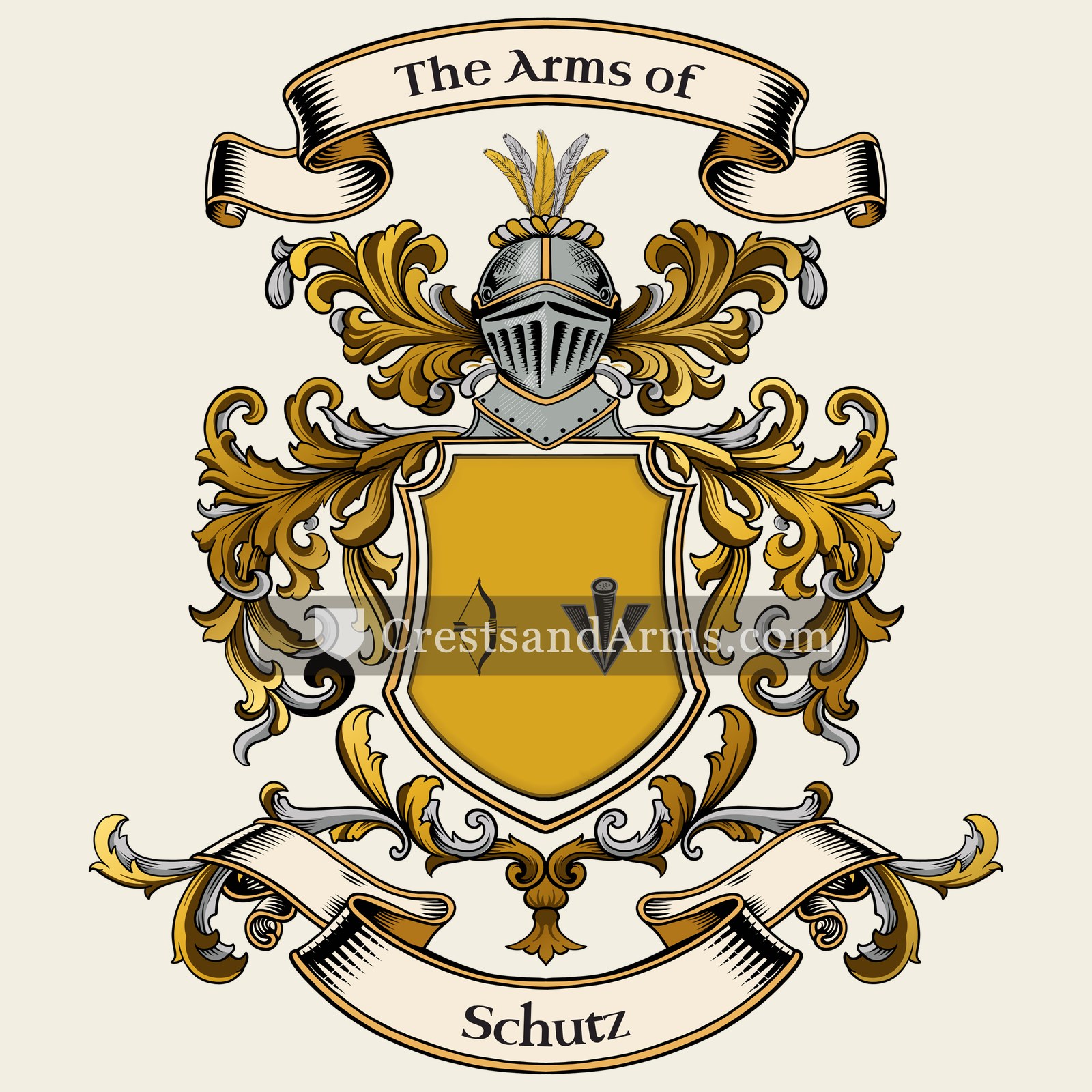


 mulletThe third son, and a divine quality from above
 hunting horn stringedOne who delights in the chase