A record of documented arms, meaning and origin, researched for the Schwebach family lines. Documented in 2 countries.
Reg. 2034 · Austrian, T–V
Meaning of the Schwebach family crest colors & symbols
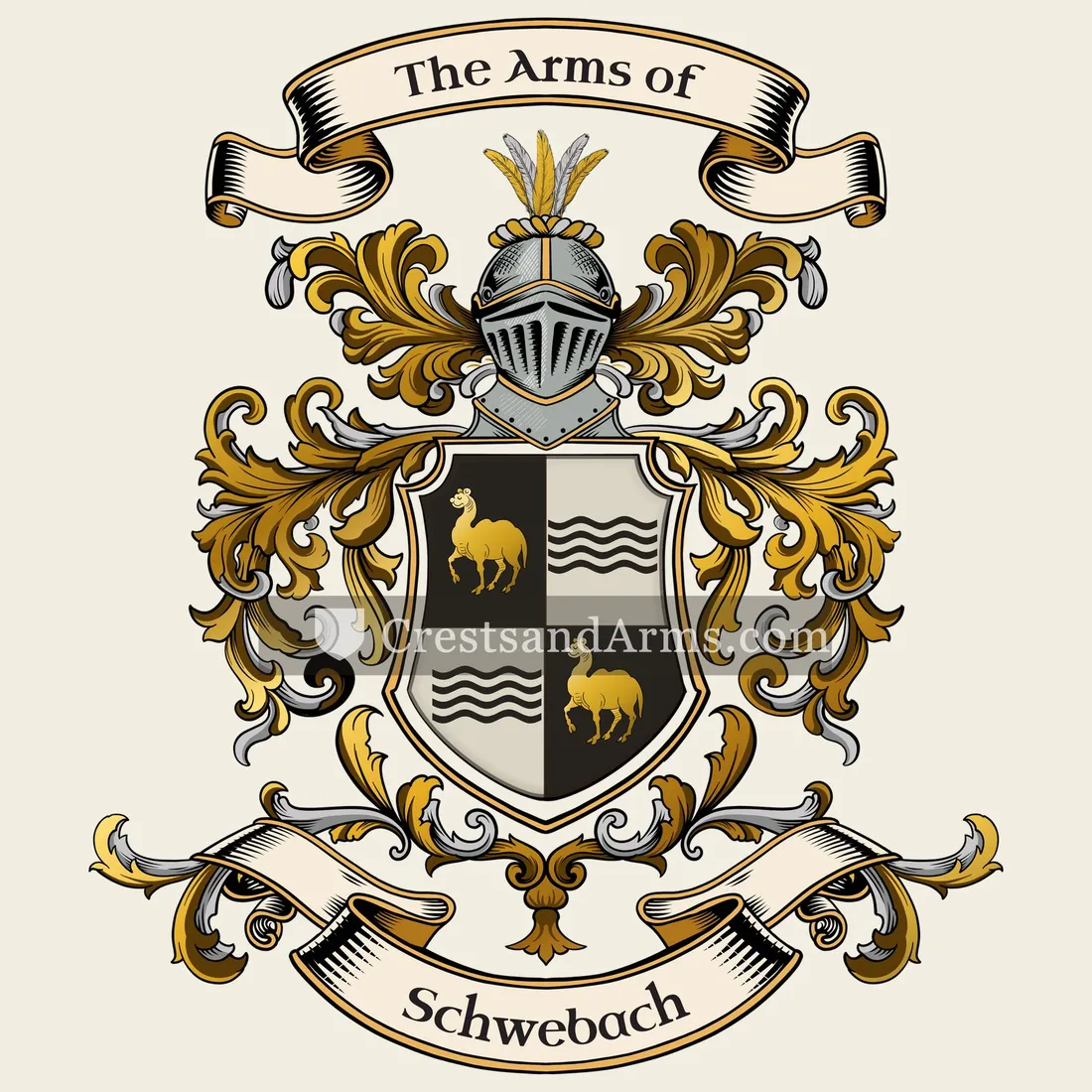
Symbols on this shield
camelPatience and perseverance under burden
riverThe bounds of a land, and life carried through it
Colours
Black (Sable)Means: Constancy
Silver (Argent)Means: Peace and sincerity
Gold (Or)Means: Generosity
Historical info
Source
J. B. Rietstap, Armorial Général, Gouda: G. B. van Goor Zonen, 1884–87
Blazon (the actual original written record)
“Ec.: aux 1 et 4 de sa. à un chameau pass. d'or; aux 2 et 3 d'arg. à un lac d'arg. en forme de losange, dans un pré de sin. Deux cq. cour. C.: 1° deux prob. coupées alt. d'or et de sa., ornées chacune dans son embouchure de trois plumes de paon au nat.; 1. d'or et de sa.; 2° un vol à l'antique de gu., ch. d'une fasce d'arg.; l. d'arg. et de gu.”
Austriac. 1682
Digital archive packCoat of arms PNG, gold border print PDF, vector SVG and the certificate of authenticity. Sent to your email in minutes.
Map of Austria showing where the Schwebach arms are recorded
The Schwebach arms were recorded in Austria, c. 1682.
Arms such as these were typically recorded in Tyrol.
Tyrol was mountain country in western Austria, where the valleys were held by families who had been there a very long time. Old tenure counted for more than money, and old families carried arms.
This is where the arms were entered in the register. Families often moved to other parts of the country, so the same name can turn up in more than one region.
Region
Tyrol
First recorded
1682
Granting Authority for the Schwebach Arms
Imperial and Royal chancery
Sodacan · CC BY-SA 3.0
The body that granted and recorded arms in Austria in this period.
Leopold I, Holy Roman Emperor
Sovereign of the period
Leopold I, Holy Roman Emperor
1658–1705
Reigning in Austria when the Schwebach arms are first recorded.
How Arms Worked in Austria
Austrian coats of arms were often linked directly to noble titles granted by the Emperor. These symbols belonged to the entire family line rather than just one individual. When a family grew, new branches kept the original design without needing to change it. This system allowed all members of a noble house to share the same identity across many generations.
Granting authority
The Imperial and Royal chancery managed all heraldic matters and controlled the official granting of arms throughout the Austrian lands.
How they got arms
Families typically received their arms through a formal imperial decree that often accompanied the elevation of a person to noble status.
Where arms were recorded
Official records of these grants were kept in the Imperial Register of Nobility which began its formal documentation process in 1453.
The family's standing
Recorded among the armigerous families of Austria.
Origin & History of the Schwebach Family in Austria
The family name Schwebach finds its historical roots in the rugged landscape of the Austrian Tyrol, where records confirm the presence of family members as early as 1682. The name itself is likely topographic in origin, suggesting that the earliest ancestors lived near a specific stream or a meadow associated with the word "Schweb." During the late 17th century, the Tyrol region was a vital crossroads for trade and mountain travel, placing the family in an area defined by strong local traditions and a deep connection to the Alpine environment. Living in this mountainous territory required resilience and a close-knit community structure, as families often worked in agriculture or specialized mountain trades to survive the harsh winters. Over time, the name became firmly established within the local parish records, reflecting a history of families who remained deeply rooted in the social and economic life of the Austrian highlands for generations.
Meaning of the Schwebach family crest colors & symbols
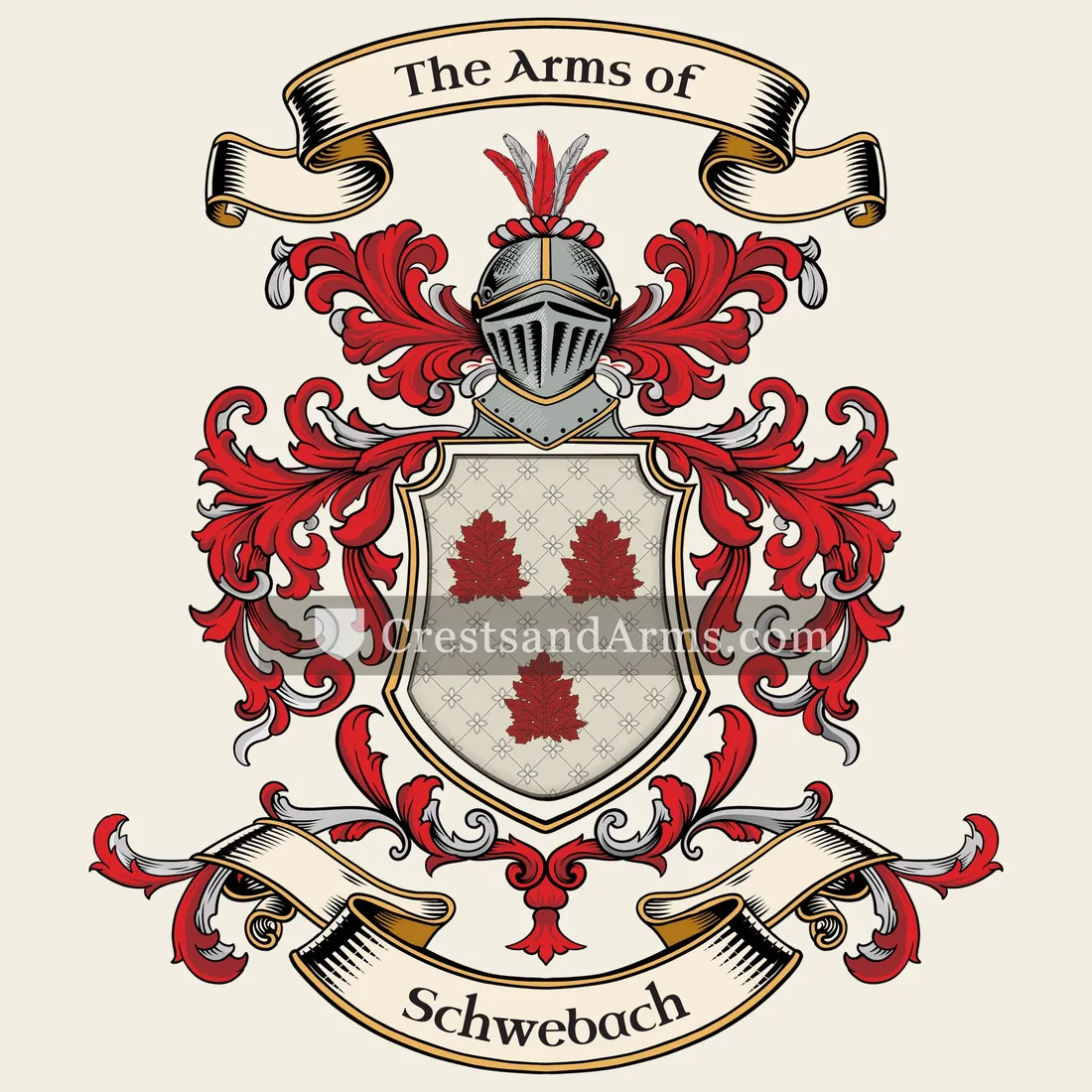
Symbols on this shield
leafHappiness and abundance
Colours
Silver (Argent)Means: Peace and sincerity
Red (Gules)Means: Military strength
Historical info
Source
J. B. Rietstap, Armorial Général, Gouda: G. B. van Goor Zonen, 1884–87
Blazon (the actual original written record)
“D'arg. à trois feuilles de nénuphar de gu. C.: un buste d'homme, de profil, hab. de gu., au rabat d'arg., coiffé d'un bonnet albanais de gu., retr. d'arg.”
SaxonyHan · Saxony, c. 1855
Digital archive packCoat of arms PNG, gold border print PDF, vector SVG and the certificate of authenticity. Sent to your email in minutes.
Map of Germany showing where the Schwebach arms are recorded
The Schwebach arms were recorded in Saxony, c. 1855.
Saxony had mines, trade and old landed families all at once. Silver made some fortunes and land held others, and both sorts of family kept arms, which is why Saxon names appear so often in the registers.
This is where the arms were entered in the register. Families often moved to other parts of the country, so the same name can turn up in more than one region.
The body that granted and recorded arms in Germany in this period.
Frederick William IV of Prussia
Sovereign of the period
Frederick William IV of Prussia
1840–1861
Reigning in Austria when the Schwebach arms are first recorded.
How Arms Worked in Germany
Prussian heraldry was strictly tied to social rank and noble status rather than being a free choice for every citizen. These symbols were treated as permanent family property that moved through the generations to all legitimate heirs. If a family branch wanted to change their design to stand out, they had to apply for official permission to alter their specific version of the shield.
Granting authority
The Prussian Heroldsamt acted as the central state office that managed and strictly controlled all noble titles and coats of arms.
How they got arms
Families usually obtained their arms through formal royal grants or by proving their long-standing noble status to the state authorities.
Where arms were recorded
All official coats of arms were kept in the rolls of the Prussian Heroldsamt, which functioned from 1706 until 1918.
The family's standing
Recorded among the armigerous families of Saxony.
Origin & History of the Schwebach Family in Germany
The family name Schwebach originates from the German regions where local geography and historical migration patterns shaped early identities. The name is likely topographic, derived from the Middle High German term for a marshy area or a specific settlement near a stream, suggesting that the earliest ancestors were farmers or laborers tied to the land. By the mid-19th century, records confirm that members of the family were established in the Kingdom of Saxony. During this period, Saxony was undergoing rapid industrialization and social change, which influenced how families moved and recorded their heritage. As the family lived in this region in 1855, they were part of a society transitioning from traditional agricultural life to the modern structures of the German Empire. The name serves as a linguistic link to these early German roots, reflecting a time when surnames were becoming permanent markers of family lineage within specific local communities.
Schwebach Meaning & Related Branches
Root word
Schwabe
A person originating from the Swabia region of Germany.
This name
SchwebachA topographic name for someone living near a stream or brook in Swabia.
also spelled
Seebachs
Seebachh
Seebak
Documented Sources
J. B. Rietstap, Armorial Général, Gouda: G. B. van Goor Zonen, 1884–87
Tiroler Landesarchiv, Tiroler Tauf- und Heiratsbücher (1682)
Huter, Franz, Tiroler Urkundenbuch, 1937
Kühebacher, Egon, Die Ortsnamen Südtirols und ihre Geschichte, 1991
Digital archive packCoat of arms PNG, gold border print PDF, vector SVG and the certificate of authenticity. Sent to your email in minutes.


 camelPatience and perseverance under burden
 riverThe bounds of a land, and life carried through it
 camelPatience and perseverance under burden
 riverThe bounds of a land, and life carried through it


 leafHappiness and abundance