Map of Britain showing where the Scott arms are recorded
The Scott arms were recorded in Britain, c. 1237.
Arms such as these were typically recorded in Kent.
Kent sits between London and the short crossing to Europe, and the trade passing through made it wealthy. Merchant families bought land with that money, and it was landowners who took coats of arms.
This is where the arms were entered in the register. Families often moved to other parts of the country, so the same name can turn up in more than one region.
The body that granted and recorded arms in Britain in this period.
Henry III of England
Sovereign of the period
Henry III of England
1216–1272
Reigning in Britain when the Scott arms are first recorded.
How Arms Worked in Britain
English heraldry allowed arms to be shared by all legitimate descendants of the original owner. These symbols were treated as personal property that moved through the generations to all children. While the eldest son kept the original design, other family members could use the same shield without needing to change it or register their own unique versions.
Granting authority
The College of Arms in London has regulated the use of coats of arms throughout England and Wales since 1484.
How they got arms
Families typically obtained their coats of arms through a formal grant from the Crown or by proving their ancient right to them.
Where arms were recorded
All official coats of arms are recorded in the registers kept at the College of Arms, which date back to the fifteenth century.
The family's standing
Recorded among the armigerous families of Britain.
Origin & History of the Scott Family in Britain
The surname Scott originated as a descriptive name used to identify people who had traveled from Scotland or who spoke Gaelic. While the name is most famously associated with the Scottish Borders, historical records confirm that members of the Scott family were firmly established in the English county of Kent by 1237. During this period, surnames were becoming increasingly common as a way for officials to track taxpayers and landowners. The Scott family in Kent rose to prominence through their involvement in local administration and land ownership, eventually becoming a significant part of the regional gentry. Their presence in the south of England so early in the thirteenth century suggests that the family name moved quickly across the British Isles through trade, political service, or migration. This early settlement in Kent highlights how a name originally tied to a specific northern identity could become deeply rooted in a completely different part of the country within just a few generations.
Coat of Arms & Family Crest Details
Symbols on this shield
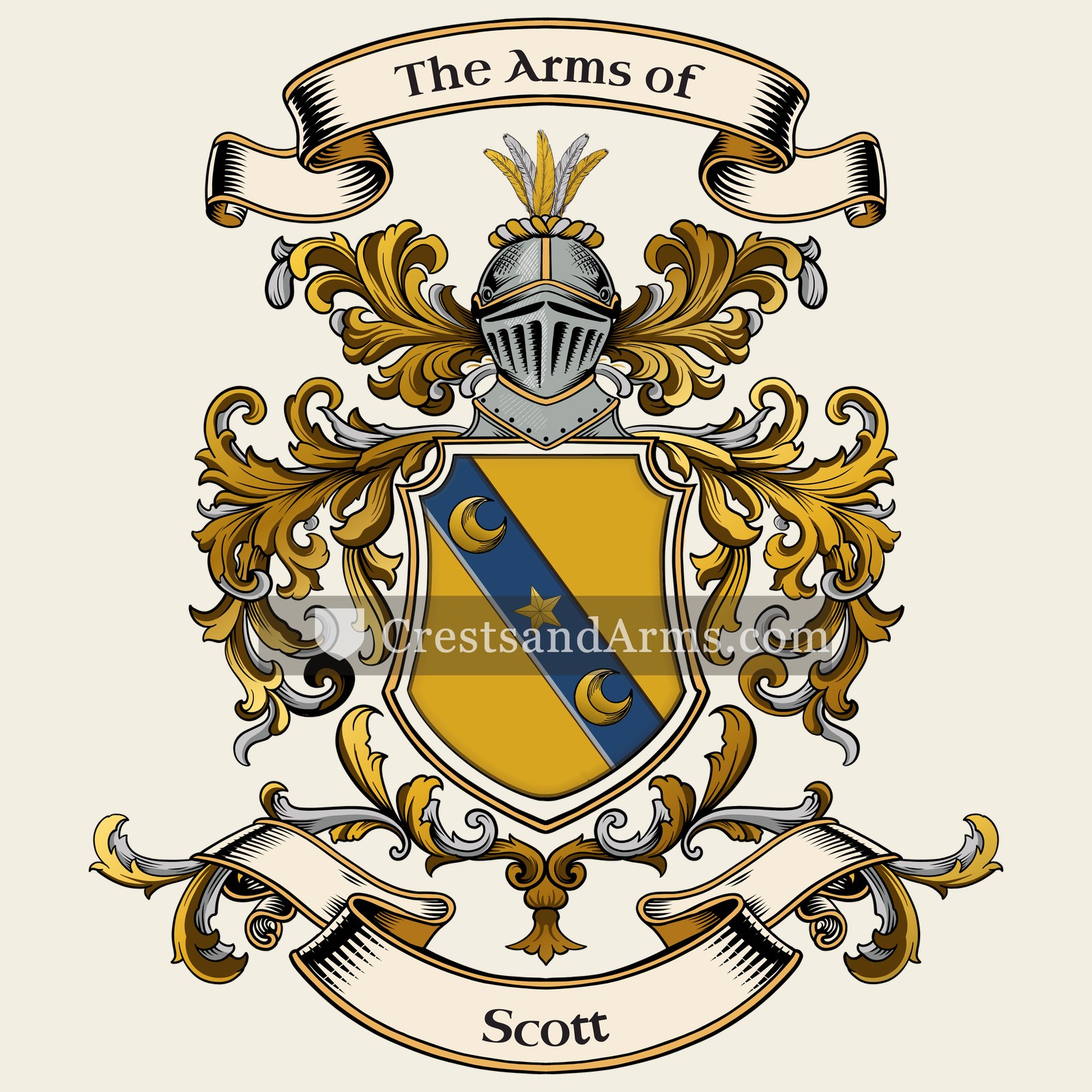
bendDefence, and the scarf of a commander
mulletThe third son, and a divine quality from above
crescentHonour by the sovereign, and the second son
Colours
Gold (Or)Means: Generosity
Blue (Azure)Means: Loyalty and truth
Historical info
Source
Sir Bernard Burke, The General Armory of England, Scotland, Ireland and Wales, London: Harrison & Sons, 1884
Blazon (the actual original written record)
“Or, on a bend az. a mullet pierced betw. two crescents of the first, a double tressure flory counterflory of the second”
SelkirkThirlstane · Selkirk, c. 1666
Digital archive packCoat of arms PNG, gold border print PDF, vector SVG and the certificate of authenticity. Sent to your email in minutes.
Map of Scotland showing where the Scott arms are recorded
The Scott arms were recorded in Selkirk, c. 1666.
Selkirkshire was small border country of forest and sheep walk. Its lairds were few and long-settled, and families who held the same ground for generations ended up with arms.
This is where the arms were entered in the register. Families often moved to other parts of the country, so the same name can turn up in more than one region.
The body that granted and recorded arms in Scotland in this period.
Charles II of England
Sovereign of the period
Charles II of England
1660–1685
Reigning in Britain when the Scott arms are first recorded.
How Arms Worked in Scotland
Scottish heraldry is unique because it treats a coat of arms as a piece of personal property protected by law. Only one person can own a specific design at any given time. When a family grows, the head keeps the original shield while other relatives must apply for their own distinct version with slight changes to prove their specific identity.
Granting authority
The Court of the Lord Lyon acts as the official body that regulates and controls all heraldic matters throughout Scotland.
How they got arms
Individuals obtain a legal right to their arms through a formal petition process that confirms their identity and family connection.
Where arms were recorded
All valid coats of arms are officially entered into the Public Register of All Arms and Bearings starting from 1672.
The family's standing
Recorded among the armigerous families of Selkirk.
Origin & History of the Scott Family in Scotland
The surname Scott originated as a descriptive name used to identify people from Scotland, or those who spoke Gaelic, when they traveled into England. By the time the family established a firm presence in the town of Selkirk by 1666, the name had become deeply rooted in the history of the Scottish Borders. During this era, families in the region often lived in a landscape defined by shifting loyalties and local disputes. The Scotts of the Borders were known for their resilience and their ability to adapt to the rugged environment of the southern uplands. As they settled in Selkirk, they became part of a tight-knit community that relied on agriculture and local trade to survive. Their presence in the town records from the mid-seventeenth century reflects a period when the family was transitioning from a nomadic or clan-based lifestyle to becoming established residents of a growing Scottish burgh.
Coat of Arms & Family Crest Details
Symbols on this shield
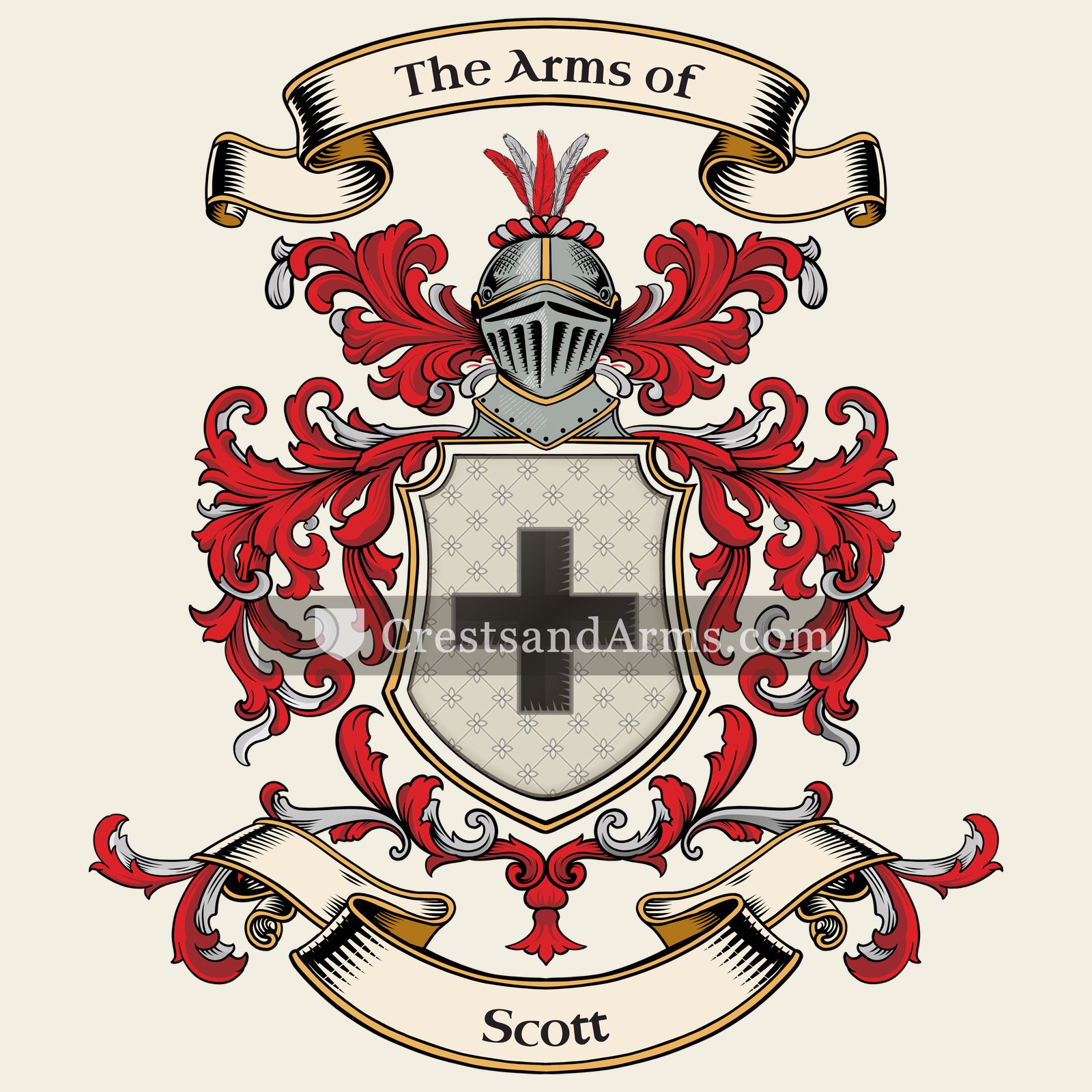
cross symbolChristian faith and service
Colours
Silver (Argent)Means: Peace and sincerity
Black (Sable)Means: Constancy
Historical info
Source
Sir Bernard Burke, The General Armory of England, Scotland, Ireland and Wales, London: Harrison & Sons, 1884
Blazon (the actual original written record)
“Ar. a cross crosslet fitchée sa”
KentHolden · Kent, c. 1380
Digital archive packCoat of arms PNG, gold border print PDF, vector SVG and the certificate of authenticity. Sent to your email in minutes.
Map of England showing where the Scott arms are recorded
The Scott arms were recorded in Kent, c. 1380.
Kent sits between London and the short crossing to Europe, and the trade passing through made it wealthy. Merchant families bought land with that money, and it was landowners who took coats of arms.
This is where the arms were entered in the register. Families often moved to other parts of the country, so the same name can turn up in more than one region.
The body that granted and recorded arms in England in this period.
Richard II of England
Sovereign of the period
Richard II of England
1377–1399
Reigning in Britain when the Scott arms are first recorded.
How Arms Worked in England
English heraldry allowed arms to be shared by all legitimate descendants of the original owner. These symbols were treated as personal property that moved through the generations to all children. While the eldest son kept the original design, other family members could use the same shield without needing to change it or register their own unique versions.
Granting authority
The College of Arms in London has regulated the use of coats of arms throughout England and Wales since 1484.
How they got arms
Families typically obtained their coats of arms through a formal grant from the Crown or by proving their ancient right to them.
Where arms were recorded
All official coats of arms are recorded in the registers kept at the College of Arms, which date back to the fifteenth century.
The family's standing
Recorded among the armigerous families of Kent.
Origin & History of the Scott Family in England
The surname Scott originated as a descriptive label used to identify people who had migrated from Scotland or who spoke the Gaelic language. By the time the name appeared in Kent records around 1380, it had transitioned from a simple nickname into a formal family name passed down through generations. During the late Middle Ages, individuals carrying this name often held positions of local influence and managed land within the English countryside. The presence of the Scott family in Kent suggests that they were part of a broader movement of people traveling south for trade, marriage, or service to the crown. Over time, these families integrated into the local English social structure while maintaining a name that served as a permanent reminder of their northern ancestral roots.
Scott Meaning & Related Branches
Root word
Scotti
A Latin term referring to a Gaelic-speaking person from Ireland.
This name
ScottAn ethnic or geographical identifier for someone from Scotland or a Gaelic speaker.
also spelled
Scot
Skott
Scotte
Skot
Scote
Related arms
Scotsame arms
Scotesame arms
Scot de Conlangesvariant spelling
Scot de Valberyvariant spelling
Documented Sources
J. B. Rietstap, Armorial Général, Gouda: G. B. van Goor Zonen, 1884–87
Reaney, P.H. and Wilson, R.M., A Dictionary of English Surnames, 1991
The National Archives, Curia Regis Rolls, JUST 1/359
Digital archive packCoat of arms PNG, gold border print PDF, vector SVG and the certificate of authenticity. Sent to your email in minutes.


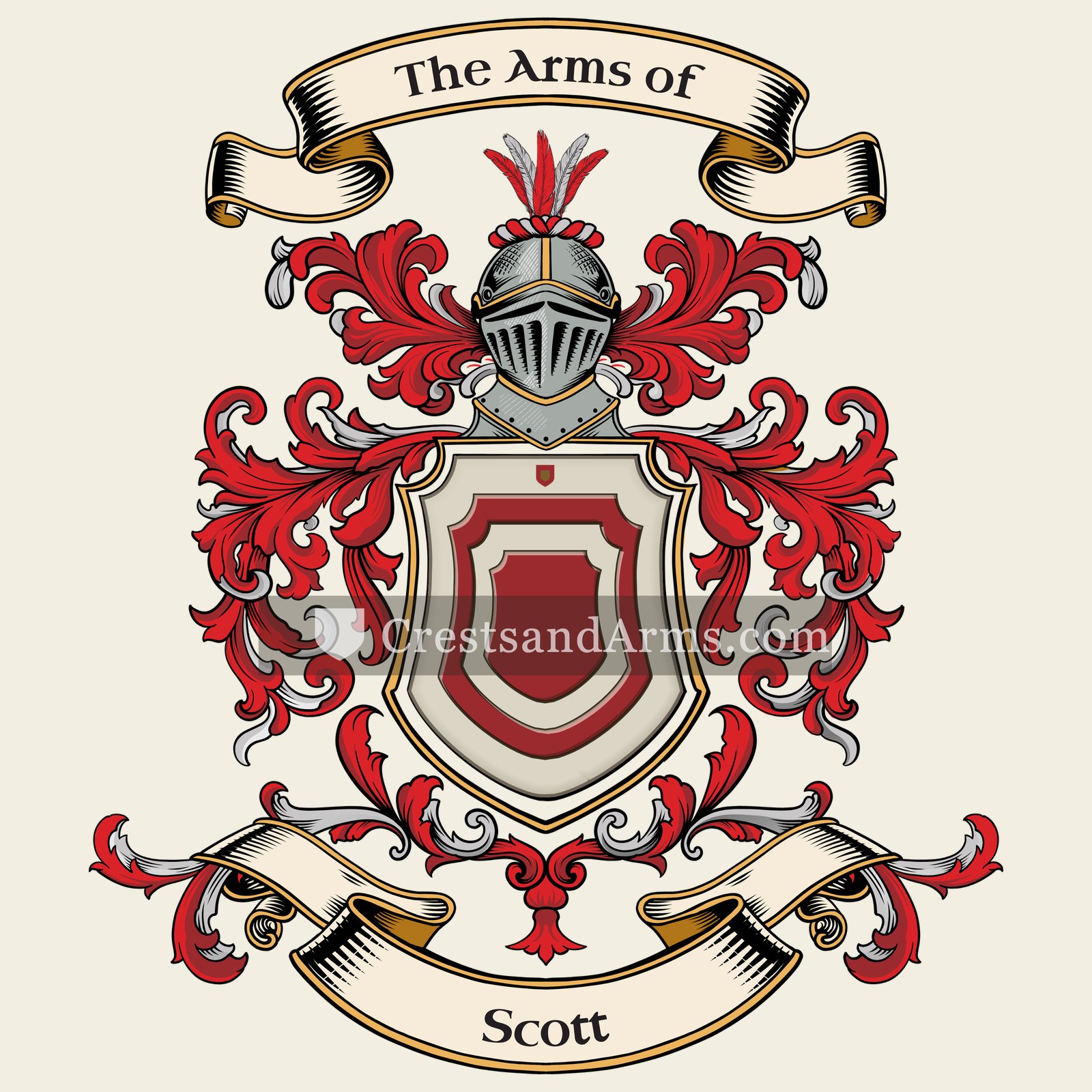
 escutcheonA shield within a shield, and a claim inherited
 escutcheonA shield within a shield, and a claim inherited


 bendDefence, and the scarf of a commander
 mulletThe third son, and a divine quality from above
 crescentHonour by the sovereign, and the second son


 cross symbolChristian faith and service