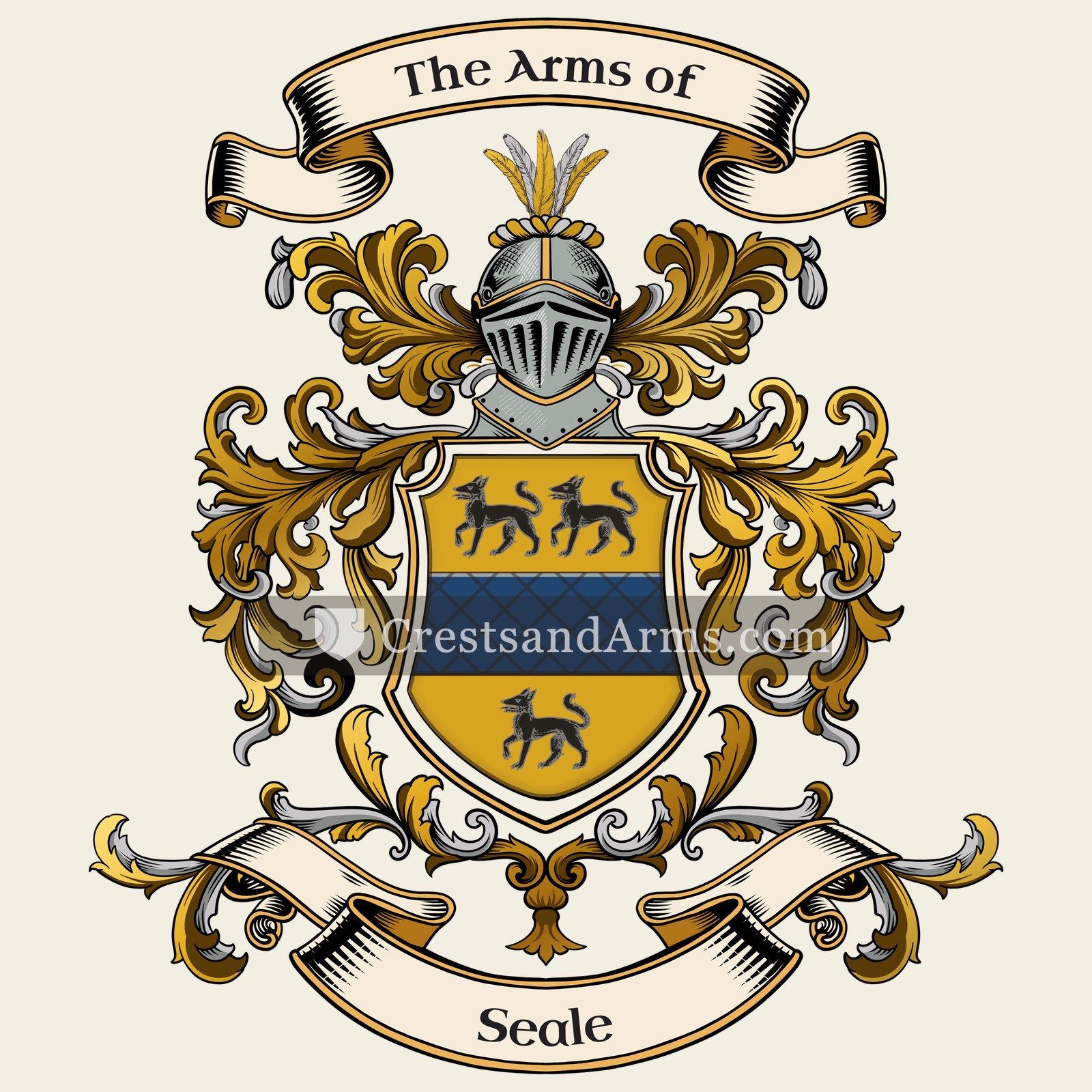
A record of documented arms, meaning and origin, researched for the Seale family lines. Documented in 2 countries.
Reg. 2710 · Britain, T–V
Coat of Arms & Family Crest Details
Symbols on this shield
wolfReward from long service and hard work
Colours
Gold (Or)Means: Generosity
Blue (Azure)Means: Loyalty and truth
Black (Sable)Means: Constancy
Historical info
Source
J. B. Rietstap, Armorial Général, Gouda: G. B. van Goor Zonen, 1884–87
Blazon (the actual original written record)
“D'or à une couronne murale de gu., entre deux burèles d'azur, accompagnées de trois têtes de loup de sa., 2 en chef et 1 en p. Cq. timbré d'une couronne vallaire d'or. C.: une tête de loup d'arg., coll. d'une couronne de chène de sin.”
DevonshireDevonshire, c. 1838
Digital archive packCoat of arms PNG, gold border print PDF, vector SVG and the certificate of authenticity. Sent to your email in minutes.
Map of Britain showing where the Seale arms are recorded
The Seale arms were recorded in Devonshire, c. 1838.
This is where the arms were entered in the register. Families often moved to other parts of the country, so the same name can turn up in more than one region.
The body that granted and recorded arms in Britain in this period.
Victoria
Sovereign of the period
Victoria
1837–1901
Reigning in Britain when the Seale arms are first recorded.
How Arms Worked in Britain
English heraldry allowed arms to be shared by all legitimate descendants of the original owner. These symbols were treated as personal property that moved through the generations to all children. While the eldest son kept the original design, other family members could use the same shield without needing to change it or register their own unique versions.
Granting authority
The College of Arms in London has regulated the use of coats of arms throughout England and Wales since 1484.
How they got arms
Families typically obtained their coats of arms through a formal grant from the Crown or by proving their ancient right to them.
Where arms were recorded
All official coats of arms are recorded in the registers kept at the College of Arms, which date back to the fifteenth century.
The family's standing
Recorded among the armigerous families of Devonshire.
Origin & History of the Seale Family in Britain
The surname Seale is a topographic name that originated in England, likely describing someone who lived near a small wood, a hall, or a specific patch of willow trees. In Old English, the word "sealh" referred to a willow or sallow tree, and families often adopted these local landmarks as identifiers as surnames became common during the Middle Ages. While the name appeared in various parts of the country, the Seale family established a notable presence in the county of Devonshire by the early 19th century. By 1838, records show that members of the family were well-integrated into the local community, participating in the agricultural and social life of the region. This transition from a descriptive label for a person living near a specific tree to a formal family name reflects the broader history of how English surnames evolved from the landscape itself.
Coat of Arms & Family Crest Details
Symbols on this shield
fessThe military belt, and readiness to serve
wolfReward from long service and hard work
Colours
Gold (Or)Means: Generosity
Blue (Azure)Means: Loyalty and truth
Black (Sable)Means: Constancy
Historical info
Source
Sir Bernard Burke, The General Armory of England, Scotland, Ireland and Wales, London: Harrison & Sons, 1884
Blazon (the actual original written record)
“Or, a fess az. betw. three wolves' heads erased sa”
NorthumberlandNorthumberland, c. 1599
Digital archive packCoat of arms PNG, gold border print PDF, vector SVG and the certificate of authenticity. Sent to your email in minutes.
Map of England showing where the Seale arms are recorded
The Seale arms were recorded in Northumberland, c. 1599.
Northumberland was border country facing Scotland, raided and fought over for three hundred years. Families held their land in return for defending it, and a defending household carried a shield.
This is where the arms were entered in the register. Families often moved to other parts of the country, so the same name can turn up in more than one region.
The body that granted and recorded arms in England in this period.
Elizabeth I of England
Sovereign of the period
Elizabeth I of England
1558–1603
Reigning in Britain when the Seale arms are first recorded.
How Arms Worked in England
English heraldry allowed arms to be shared by all legitimate descendants of the original owner. These symbols were treated as personal property that moved through the generations to all children. While the eldest son kept the original design, other family members could use the same shield without needing to change it or register their own unique versions.
Granting authority
The College of Arms in London has regulated the use of coats of arms throughout England and Wales since 1484.
How they got arms
Families typically obtained their coats of arms through a formal grant from the Crown or by proving their ancient right to them.
Where arms were recorded
All official coats of arms are recorded in the registers kept at the College of Arms, which date back to the fifteenth century.
The family's standing
Recorded among the armigerous families of Northumberland.
Origin & History of the Seale Family in England
The family name Seale is deeply rooted in the history of northern England, with records confirming that members of the family were well-established in Northumberland by 1599. The name is generally considered a topographical surname, which means it was originally used to describe the landscape where a person lived. It likely derived from the Old English word "sealh," which refers to a willow tree or a place where willows grew near a stream or marshy ground. During the late sixteenth century, families in Northumberland often lived in small rural communities where their identity was closely tied to the specific geography of their local parish. As the family grew and moved across the region, the name evolved from a simple description of a home site into a permanent family identifier that was passed down through generations. This transition reflects the broader patterns of how surnames became fixed in English society as populations became more mobile and local record-keeping became more formal.
Related Branches & Arms
Root word
Sael
Old English word meaning a hall or a dwelling.
This name
SealeA topographic name for someone who lived near a hall or a house.
also spelled
Seall
Seal
Seel
Seele
Related arms
Seelvariant spelling
Documented Sources
J. B. Rietstap, Armorial Général, Gouda: G. B. van Goor Zonen, 1884–87
Bardsley, Charles Wareing, A Dictionary of English and Welsh Surnames, 1901
Reaney, Percy Hide, A Dictionary of British Surnames, 1958
The National Archives, Census Returns of England and Wales, 1841, HO 107
Devon Archives and Local Studies Service, Parish Registers of Devon, 1838
Digital archive packCoat of arms PNG, gold border print PDF, vector SVG and the certificate of authenticity. Sent to your email in minutes.


 wolfReward from long service and hard work
 wolfReward from long service and hard work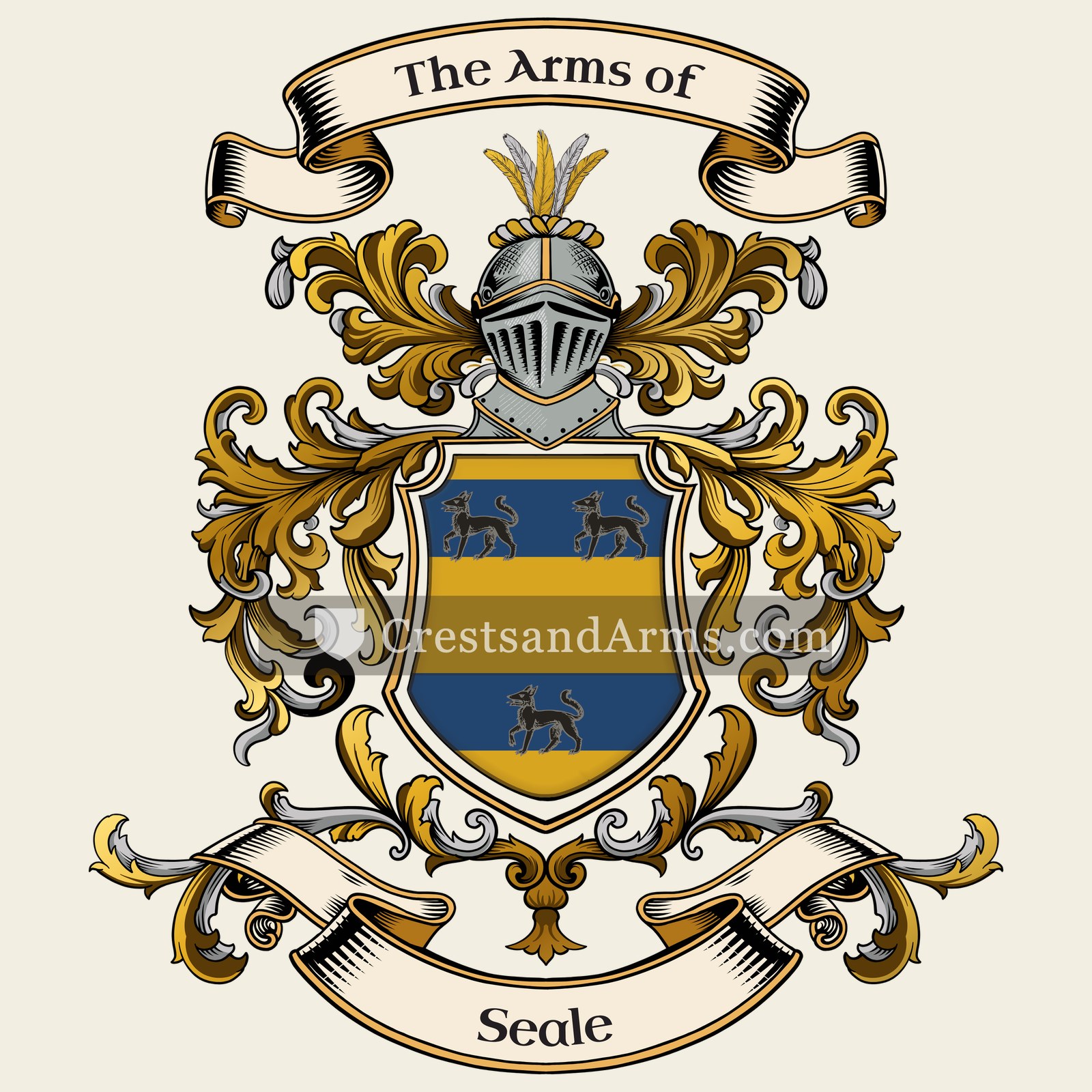


 fessThe military belt, and readiness to serve