Map of France showing where the Sedlacek arms are recorded
The Sedlacek arms were recorded in Artois, c. 1663.
Artois lay on the disputed ground between France and the Low Countries and was fought over for centuries. Families there held their land under arms, and a shield was how a fighting household was known.
This is where the arms were entered in the register. Families often moved to other parts of the country, so the same name can turn up in more than one region.
The body that granted and recorded arms in France in this period.
Louis XIV of France
Sovereign of the period
Louis XIV of France
1643–1715
Reigning in France when the Sedlacek arms are first recorded.
How Arms Worked in France
In France, a coat of arms was a mark of honor that passed down through the male line to all legitimate descendants. Families often used the same shield without changes to show their shared heritage. If a branch wanted to stand out, they could add a small mark to their shield to show their specific place in the family tree.
Granting authority
The Juge d'armes de France acted as the official authority that regulated and verified coats of arms across the country.
How they got arms
Families typically inherited their arms from ancestors, though they could also receive them through royal grants or by proving their noble status.
Where arms were recorded
Coats of arms were officially recorded in the Armorial Général de France, which began its main collection in the year 1696.
The family's standing
Recorded among the armigerous families of Artois.
Origin & History of the Sedlacek Family in France
The surname Sedlacek originates from the Slavic word sedlák, which translates to a farmer or a smallholder. Historically, this name was used to identify individuals who worked the land or held a specific status within a rural community. By the mid-seventeenth century, the family had established a presence in the region of Artois, which was a territory that frequently shifted between different political powers during that era. The movement of families like the Sedlaceks into this area suggests a history of migration, likely driven by the search for agricultural opportunities or the shifting borders of European kingdoms. Over time, the name evolved from a simple description of a person’s occupation into a hereditary family title that was passed down through generations. This transition reflects the broader social changes in Europe where surnames became essential for tracking lineage and legal identity in growing populations.
Related Branches & Arms
Root word
sedlo
A saddle used for riding horses.
This name
SedlacekAn occupational surname for a saddler or someone who makes saddles.
also spelled
Sedlachek
Sedlacek
Documented Sources
J. B. Rietstap, Armorial Général, Gouda: G. B. van Goor Zonen, 1884–87
Kott, František Štěpán. Česko-německý slovník zvláště grammaticko-fraseologický. 1878
Moldanová, Dobrava. Naše příjmení. 2010
Archives départementales du Pas-de-Calais, État civil et registres paroissiaux de l'Artois
Digital archive packCoat of arms PNG, gold border print PDF, vector SVG and the certificate of authenticity. Sent to your email in minutes.


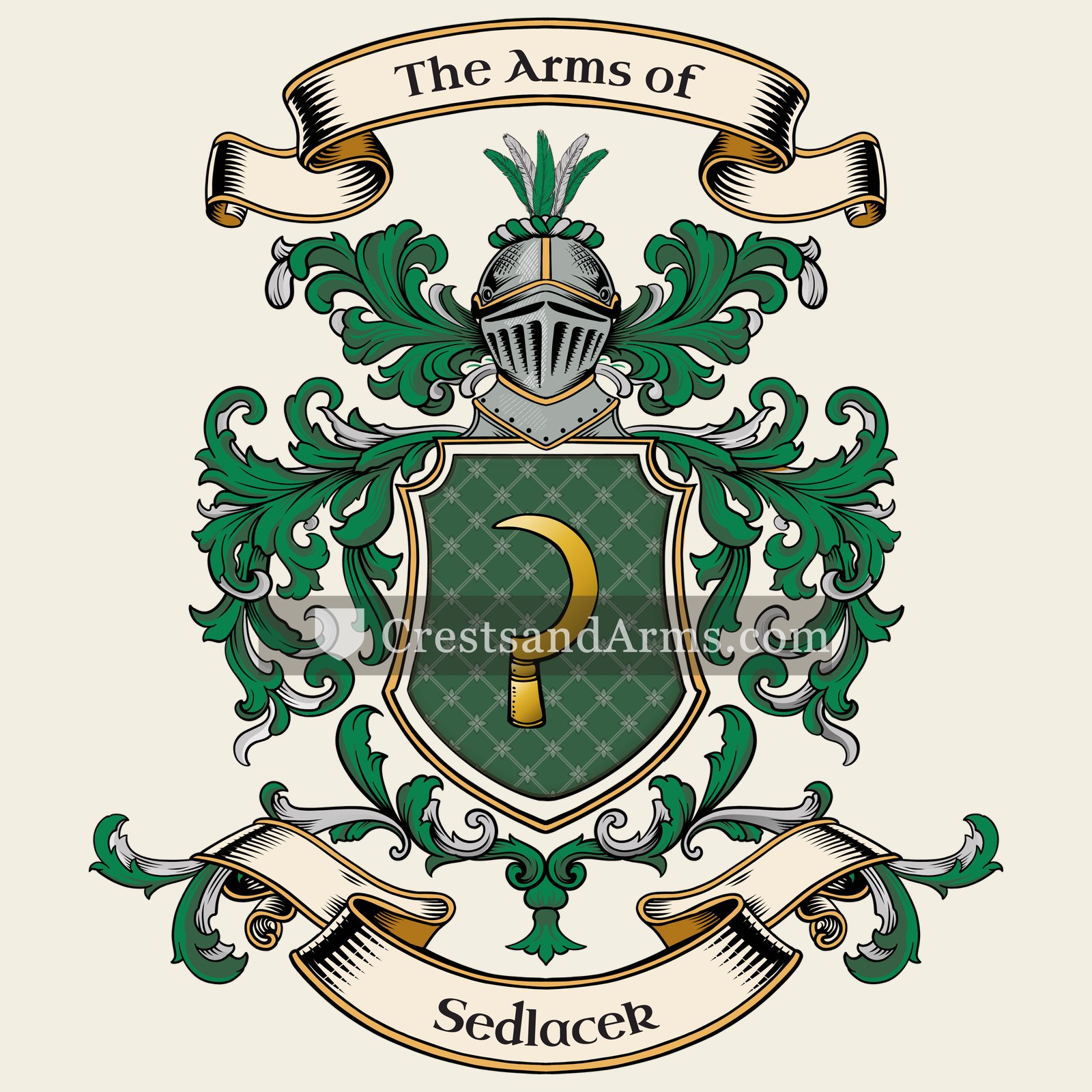
 sickleThe harvest, and the reaping of what was sown
 sickleThe harvest, and the reaping of what was sown