Map of France showing where the Seek arms are recorded
The Seek arms were recorded in Alsace, c. 1663.
Alsace lay between France and the German lands and belonged to both at different times. Its families held small estates and served whichever side ruled, and men who served in arms carried arms of their own.
This is where the arms were entered in the register. Families often moved to other parts of the country, so the same name can turn up in more than one region.
The body that granted and recorded arms in France in this period.
Louis XIV of France
Sovereign of the period
Louis XIV of France
1643–1715
Reigning in France when the Seek arms are first recorded.
How Arms Worked in France
In France, a coat of arms was a mark of honor that passed down through the male line to all legitimate descendants. Families often used the same shield without changes to show their shared heritage. If a branch wanted to stand out, they could add a small mark to their shield to show their specific place in the family tree.
Granting authority
The Juge d'armes de France acted as the official authority that regulated and verified coats of arms across the country.
How they got arms
Families typically inherited their arms from ancestors, though they could also receive them through royal grants or by proving their noble status.
Where arms were recorded
Coats of arms were officially recorded in the Armorial Général de France, which began its main collection in the year 1696.
The family's standing
Recorded among the armigerous families of Alsace.
Origin & History of the Seek Family in France
The family name Seek has deep roots in the Alsace region of France, where records confirm members of the family were living as early as 1663. During the seventeenth century, Alsace was a complex borderland that experienced significant cultural shifts due to the aftermath of the Thirty Years' War. Families in this area often spoke German dialects while living under the influence of the French crown, which led to a unique blending of linguistic traditions. The name itself likely originated as a descriptive term or a nickname related to the local geography or the professional life of early ancestors. As residents of a strategic territory, the Seek family lived through a time of transition where local identity was shaped by both Germanic heritage and the expanding reach of the French state. By settling in this region, the family became part of a resilient community that navigated the challenges of changing borders and shifting political loyalties for generations.
Coat of Arms & Family Crest Details
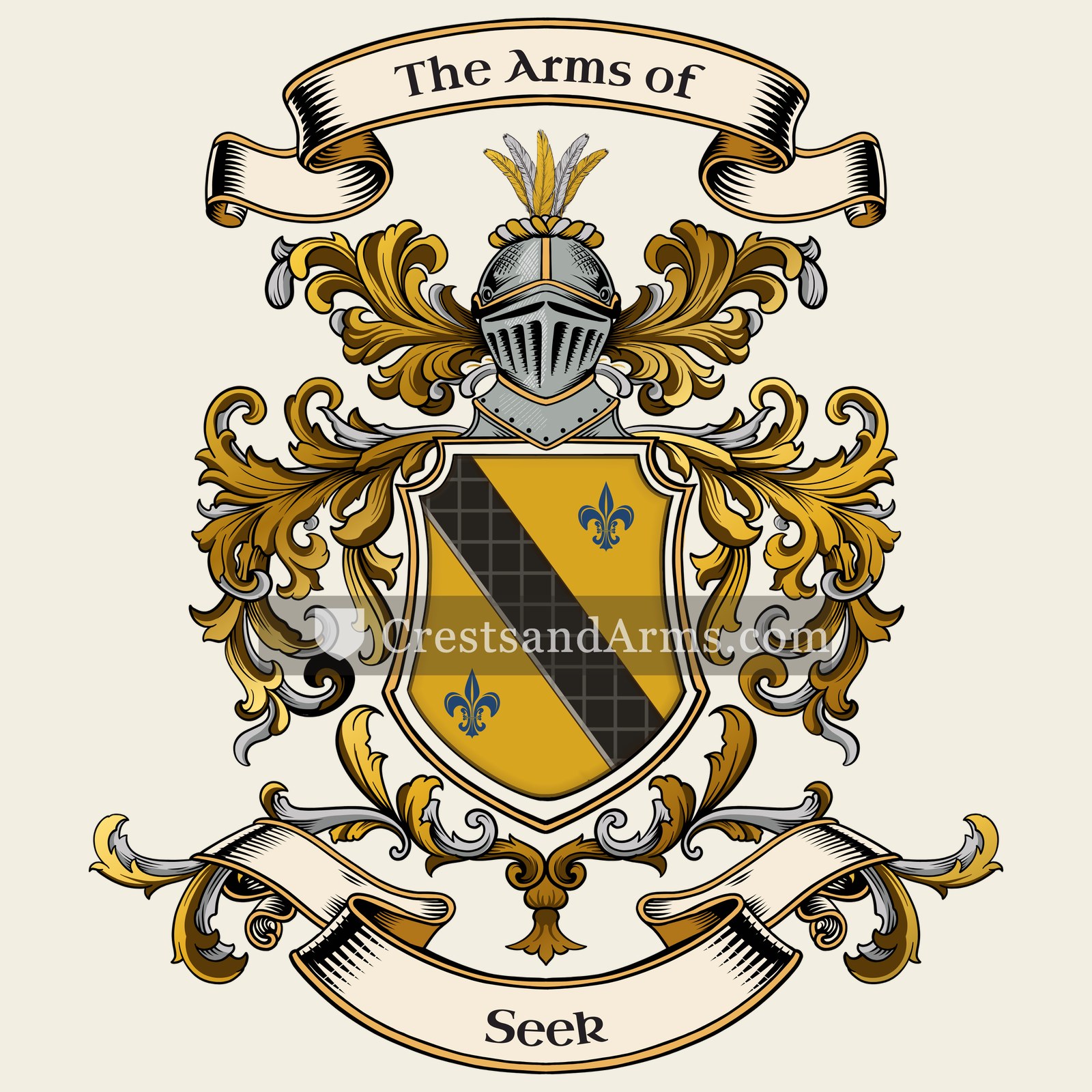
Symbols on this shield
bendDefence, and the scarf of a commander
fleur de lisPurity, light, and the sixth son
Colours
Gold (Or)Means: Generosity
Black (Sable)Means: Constancy
Blue (Azure)Means: Loyalty and truth
Historical info
Source
J. B. Rietstap, Armorial Général, Gouda: G. B. van Goor Zonen, 1884–87
Blazon (the actual original written record)
“D'or à la bande de sa., acc. de deux fleurs-de-lis d'azur et ch. d'un fer de flèche, emm. d'or, posé dans le sens de la bande. Cq. cour. C.: un buste d'homme, à longues moustaches, hab. de sa., ch. du fer de flèche en pal. L. d'or et de sa.”
WurttembergWurttemberg, c. 1855
Digital archive packCoat of arms PNG, gold border print PDF, vector SVG and the certificate of authenticity. Sent to your email in minutes.
Map of Germany showing where the Seek arms are recorded
The Seek arms were recorded in Wurttemberg, c. 1855.
Wurttemberg was southern German country of small estates and well-off market towns. Both landowners and leading townsmen kept arms there, so the region carries far more names than its size suggests.
This is where the arms were entered in the register. Families often moved to other parts of the country, so the same name can turn up in more than one region.
The body that granted and recorded arms in Germany in this period.
Frederick William IV of Prussia
Sovereign of the period
Frederick William IV of Prussia
1840–1861
Reigning in France when the Seek arms are first recorded.
How Arms Worked in Germany
Prussian heraldry was strictly tied to social rank and noble status rather than being a free choice for every citizen. These symbols were treated as permanent family property that moved through the generations to all legitimate heirs. If a family branch wanted to change their design to stand out, they had to apply for official permission to alter their specific version of the shield.
Granting authority
The Prussian Heroldsamt acted as the central state office that managed and strictly controlled all noble titles and coats of arms.
How they got arms
Families usually obtained their arms through formal royal grants or by proving their long-standing noble status to the state authorities.
Where arms were recorded
All official coats of arms were kept in the rolls of the Prussian Heroldsamt, which functioned from 1706 until 1918.
The family's standing
Recorded among the armigerous families of Wurttemberg.
Origin & History of the Seek Family in Germany
The family name Seek has deep roots in the historical region of Württemberg, where records confirm members of the family were established by the mid-19th century. In the German language, the name is closely linked to the Middle High German word *seke*, which historically referred to a small lake or a body of water. Families often adopted these types of names based on the geography of their local landscape, suggesting that the earliest ancestors likely lived near a prominent pond or stream. During the 1850s, Württemberg was a time of significant social change, as many families transitioned from traditional farming roles toward the industrial growth spreading across southwestern Germany. By 1855, the Seek family was part of this stable, local population that helped define the cultural identity of the region through their work and community ties. This connection to the land and the local dialect highlights how the name evolved from a simple description of a person’s home into a lasting family legacy.
Related Branches & Arms
Root word
secare
Latin verb meaning to cut or divide.
This name
SeekAn occupational name for a reaper or someone who harvested crops.
also spelled
Syk
Seek
Documented Sources
J. B. Rietstap, Armorial Général, Gouda: G. B. van Goor Zonen, 1884–87
Archives départementales du Bas-Rhin, Registres paroissiaux de la commune de Sélestat
Kintz, Jean-Pierre, La vie quotidienne en Alsace au XVIIe siècle, 1982
Livet, Georges, L'intendance d'Alsace sous Louis XIV, 1956
Digital archive packCoat of arms PNG, gold border print PDF, vector SVG and the certificate of authenticity. Sent to your email in minutes.


 arms pheon arrowheadReadiness for battle, and the broad arrow of the sovereign
 arms pheon arrowheadReadiness for battle, and the broad arrow of the sovereign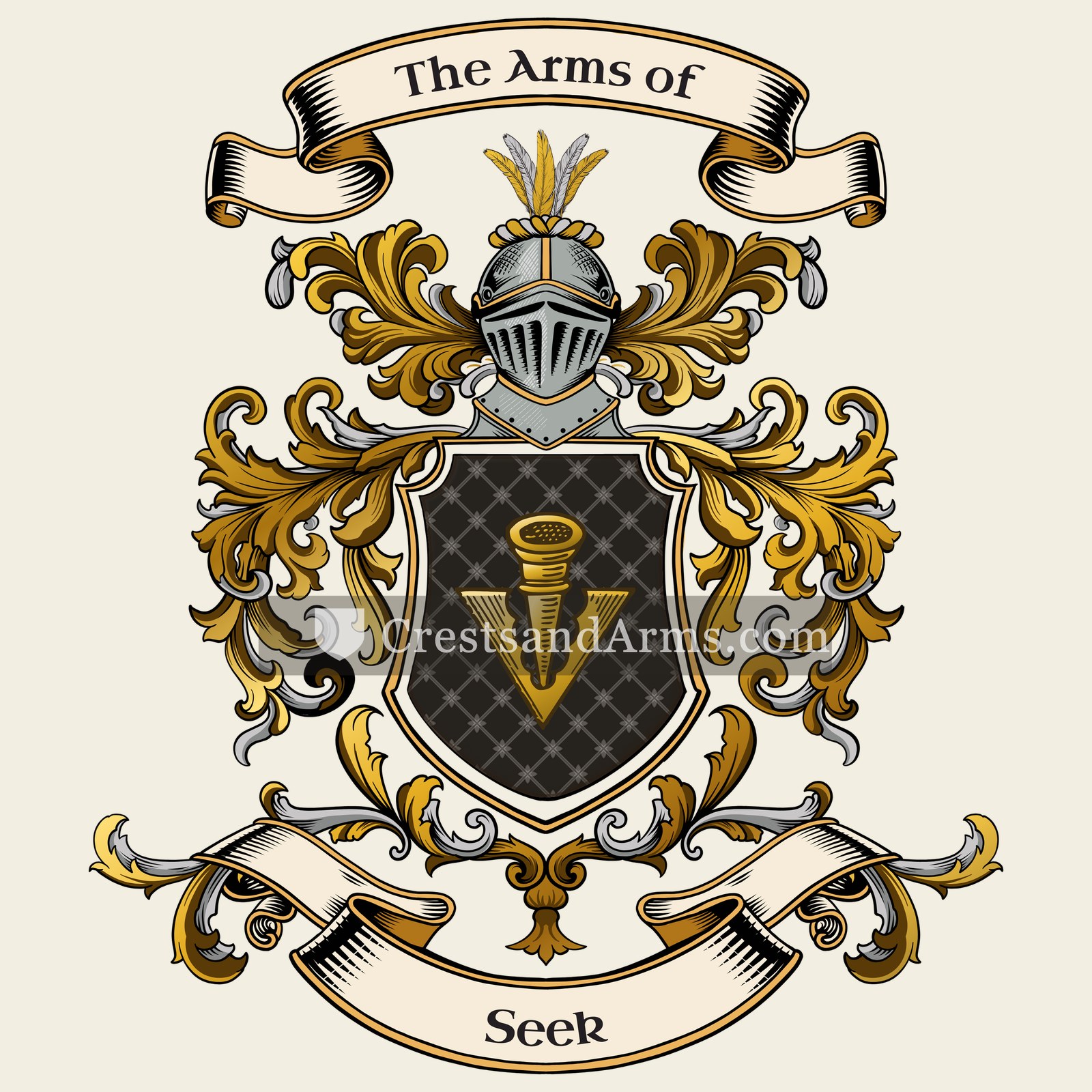


 bendDefence, and the scarf of a commander
 fleur de lisPurity, light, and the sixth son