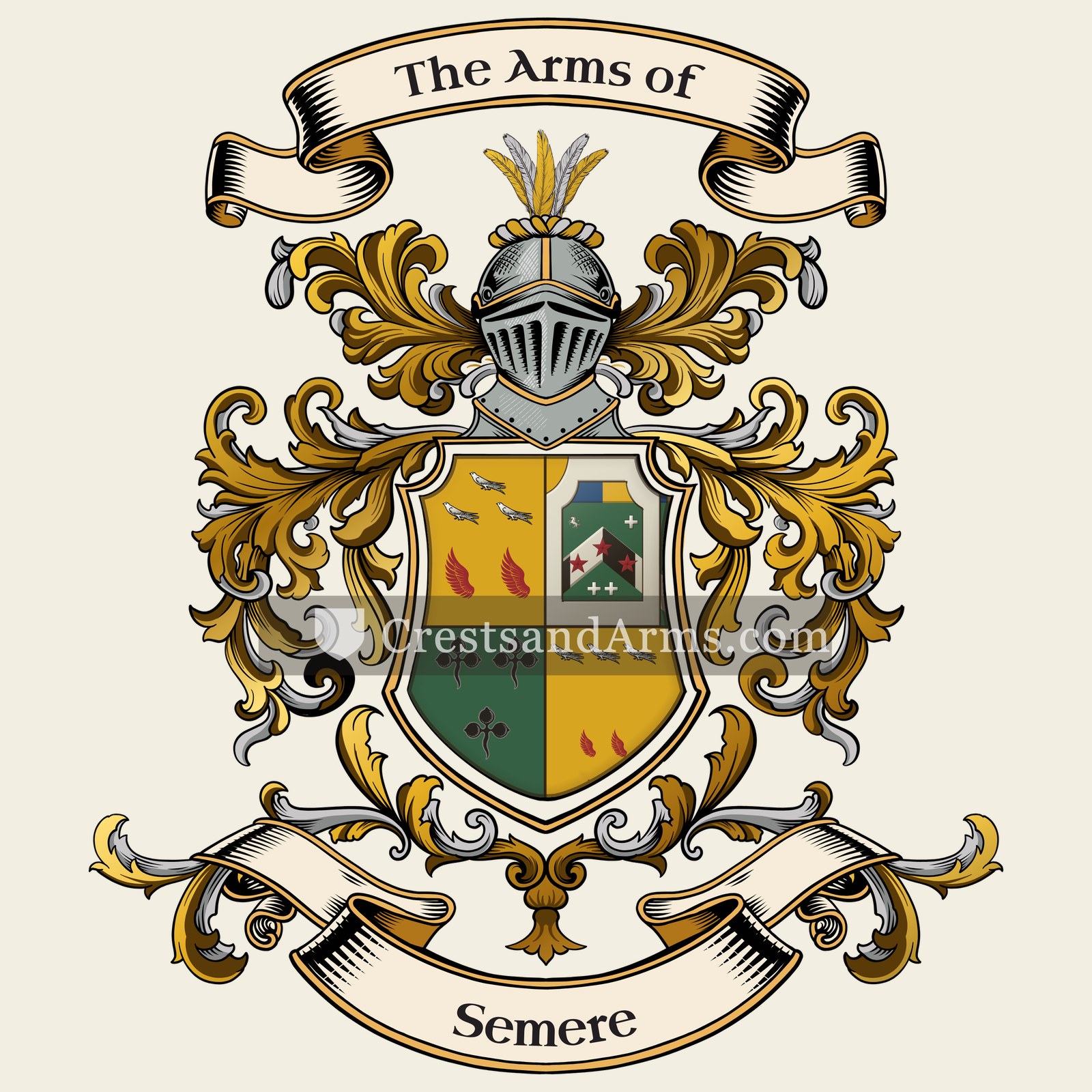
A record of documented arms, meaning and origin, researched for the Semere family of England.
Reg. 5358 · English, T–V
Coat of Arms & Family Crest Details
Symbols on this shield
chiefAuthority, wisdom and dominion
chevronProtection, and faithful service completed
cross symbolChristian faith and service
bordureA difference between branches of one family
wingSwiftness, and protection under a raised wing
martletA younger son, who must win his own land
mulletThe third son, and a divine quality from above
unicornPurity, and extreme courage in defence of honour
trefoilPerpetuity, and the Trinity
Colours
Gold (Or)Means: Generosity
Green (Vert)Means: Hope
Silver (Argent)Means: Peace and sincerity
Black (Sable)Means: Constancy
Blue (Azure)Means: Loyalty and truth
Red (Gules)Means: Military strength
Historical info
Source
Sir Bernard Burke, The General Armory of England, Scotland, Ireland and Wales, London: Harrison & Sons, 1884
Blazon (the actual original written record)
“Quarterly, 1st and 4th, or, two wings conjoined in lure gu. on a chief az. three martlets ar., for SEYMER; 2nd, quarterly, 1st and 4th, vert on a chev. ar. three mullets gu. in base a unicorn's head erased of the second, 2nd and 3rd, az. three crosses moline ar. all within a border of the last, for KER, of Morriston; 3rd, ar. a chev. engr. paly sa. and or, betw. three trefoils slipped of the second, for CLAY”
DorsetDorset, c. 1865
Digital archive packCoat of arms PNG, gold border print PDF, vector SVG and the certificate of authenticity. Sent to your email in minutes.
Map of England showing where the Semere arms are recorded
The Semere arms were recorded in Dorset, c. 1865.
Dorset was quiet farming and grazing country along the south coast. Its gentry were middling rather than grand, but they held their manors for a very long time, and long holding is what puts a name in the records.
This is where the arms were entered in the register. Families often moved to other parts of the country, so the same name can turn up in more than one region.
The body that granted and recorded arms in England in this period.
Victoria
Sovereign of the period
Victoria
1837–1901
Reigning in England when the Semere arms are first recorded.
How Arms Worked in England
English heraldry allowed arms to be shared by all legitimate descendants of the original owner. These symbols were treated as personal property that moved through the generations to all children. While the eldest son kept the original design, other family members could use the same shield without needing to change it or register their own unique versions.
Granting authority
The College of Arms in London has regulated the use of coats of arms throughout England and Wales since 1484.
How they got arms
Families typically obtained their coats of arms through a formal grant from the Crown or by proving their ancient right to them.
Where arms were recorded
All official coats of arms are recorded in the registers kept at the College of Arms, which date back to the fifteenth century.
The family's standing
Recorded among the armigerous families of Dorset.
Origin & History of the Semere Family in England
The family name Semere has deep roots that connect to the rural landscapes of southern England. By the mid-nineteenth century, historical records confirm that members of the family were established in the county of Dorset. During this period, Dorset was a region defined by its agricultural traditions and small market towns. Families living there often worked in farming or local trades that supported the village economy. The presence of the Semere name in 1865 suggests that these ancestors were part of a stable, working community that had likely lived in the area for generations. While the name itself may have evolved from older linguistic roots, the family members in Dorset were typical of the era, living through the social changes of the Victorian age while maintaining their ties to the English countryside.
Related Branches & Arms
Root word
Semer
Old English personal name meaning sea-famous or sea-renowned.
This name
SemereA locational surname derived from the village of Semer in Suffolk, England.
also spelled
Seymar
Seamer
Documented Sources
Sir Bernard Burke, The General Armory of England, Scotland, Ireland and Wales, London: Harrison & Sons, 1884
General Register Office, England and Wales Civil Registration Births Index, 1865
The National Archives, Census Returns of England and Wales, 1861 and 1871
Digital archive packCoat of arms PNG, gold border print PDF, vector SVG and the certificate of authenticity. Sent to your email in minutes.


 chiefAuthority, wisdom and dominion
 chevronProtection, and faithful service completed
 cross symbolChristian faith and service
 bordureA difference between branches of one family
 wingSwiftness, and protection under a raised wing
 martletA younger son, who must win his own land
 mulletThe third son, and a divine quality from above
 unicornPurity, and extreme courage in defence of honour
 trefoilPerpetuity, and the Trinity
 chiefAuthority, wisdom and dominion
 chevronProtection, and faithful service completed
 cross symbolChristian faith and service
 bordureA difference between branches of one family
 wingSwiftness, and protection under a raised wing
 martletA younger son, who must win his own land
 mulletThe third son, and a divine quality from above
 unicornPurity, and extreme courage in defence of honour
 trefoilPerpetuity, and the Trinity