Map of Ireland showing where the Sennott arms are recorded
The Sennott arms were recorded in Wexford, c. 1606.
Wexford was the corner of Ireland closest to Wales, settled early by Norman families. They held their land under arms and kept it for generations, which is why so many Wexford names carry recorded shields.
This is where the arms were entered in the register. Families often moved to other parts of the country, so the same name can turn up in more than one region.
The body that granted and recorded arms in Ireland in this period.
James VI and I
Sovereign of the period
James VI and I
1603–1625
Reigning in Ireland when the Sennott arms are first recorded.
How Arms Worked in Ireland
The Ulster King of Arms granted coats of arms to individuals who proved their social standing and good character. These symbols were typically inherited by all legitimate descendants of the original holder. If a family branch wanted a unique look, they could apply for a specific change to their design through the office to ensure their identity remained distinct.
Granting authority
The Ulster King of Arms acted as the official body that regulated and issued all coats of arms throughout Ireland.
How they got arms
Families obtained their arms through formal grants issued by the office after proving their eligibility and paying the required fees.
Where arms were recorded
All official grants were recorded in the registers held by the Ulster King of Arms starting from the year 1552.
The family's standing
Recorded among the armigerous families of Wexford.
Origin & History of the Sennott Family in Ireland
The family name Sennott has deep roots in County Wexford, where historical records confirm the presence of the family as early as 1606. The name is widely considered to be an anglicized version of the Gaelic name *Ó Sionóid*, which likely evolved from the Old French name Sinod. During the early 17th century, the Sennotts were established as significant landowners and members of the local gentry in the barony of Forth. This region of Wexford was historically distinct due to the influence of earlier settlers from Britain, which created a unique cultural environment where Gaelic and English traditions blended. By the time of the 1641 rebellion and the subsequent Cromwellian land confiscations, the Sennotts were well-documented in official surveys. These records show that the family held substantial estates, positioning them as influential figures in the social and political landscape of southeastern Ireland during a period of great transition.
Coat of Arms & Family Crest Details
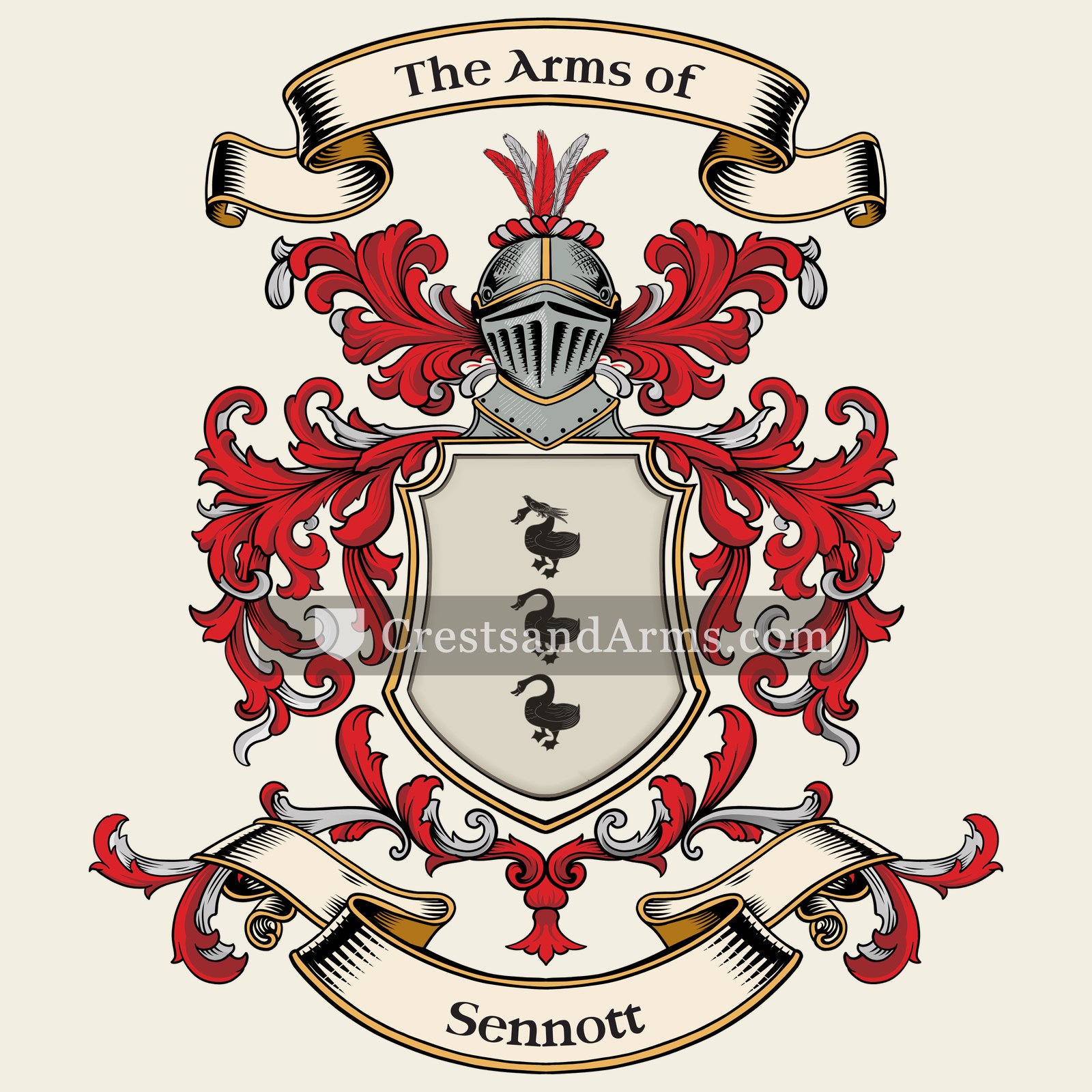
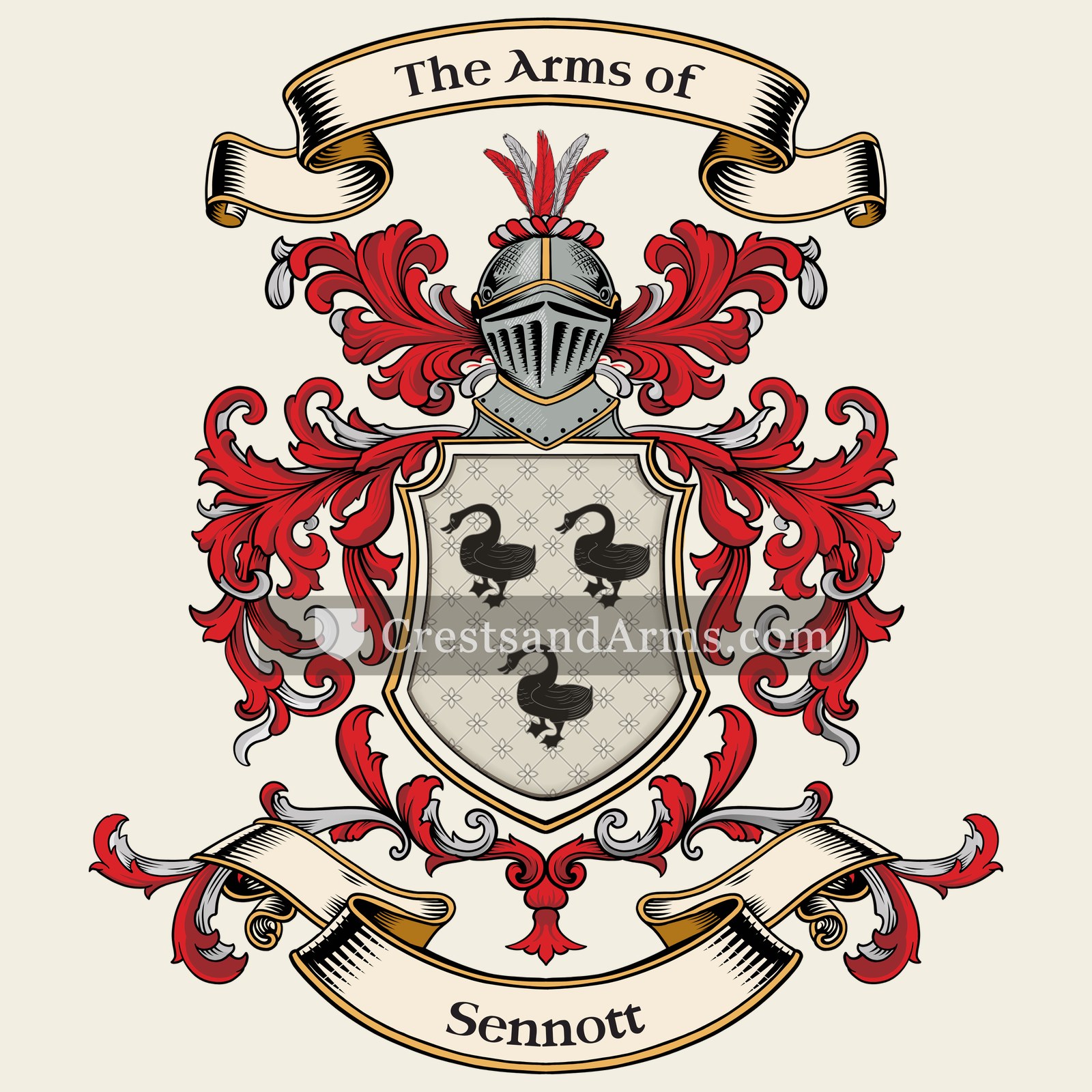
Symbols on this shield
swanGrace, light and the poet's art
Colours
Silver (Argent)Means: Peace and sincerity
Black (Sable)Means: Constancy
Historical info
Source
Sir Bernard Burke, The General Armory of England, Scotland, Ireland and Wales, London: Harrison & Sons, 1884
Blazon (the actual original written record)
“Ar. three swans sa. ducally gorged or”
SpainCadiz, c. 1580
Digital archive packCoat of arms PNG, gold border print PDF, vector SVG and the certificate of authenticity. Sent to your email in minutes.
Map of Spain showing where the Sennott arms are recorded
The Sennott arms were recorded in Cadiz, c. 1580.
This is where the arms were entered in the register. Families often moved to other parts of the country, so the same name can turn up in more than one region.
The body that granted and recorded arms in Spain in this period.
Philip II of Spain
Sovereign of the period
Philip II of Spain
1556–1598
Reigning in Ireland when the Sennott arms are first recorded.
How Arms Worked in Spain
In Spain, a coat of arms was considered a form of property that belonged to the entire family line. These arms were passed down from a father to all his children equally. Younger branches of the family usually kept the original design without needing to add any special marks to distinguish their specific line.
Granting authority
The Cronista Rey de Armas was the official body that regulated and granted coats of arms throughout Spain.
How they got arms
Families often obtained their arms through royal grants or by proving their noble status to the official heraldic authority.
Where arms were recorded
Coats of arms were officially recorded in the registers of the Cronista Rey de Armas starting in 1496.
The family's standing
Recorded among the armigerous families of Spain.
Origin & History of the Sennott Family in Spain
The history of the Sennott family in Spain begins in the bustling port city of Cádiz during the late sixteenth century. By 1580, members of the family were already established in this vital maritime hub, which served as the primary gateway for trade between Europe and the Americas. Because Cádiz was a center for international commerce, the Sennott family likely integrated into a diverse community of merchants, sailors, and agents who facilitated the exchange of goods across the Atlantic. Living in a city defined by its naval strength and global connections, these early family members were positioned at the intersection of Spanish imperial expansion and Mediterranean trade networks. Their presence in such a strategic location suggests that they were active participants in the economic life of the Spanish Golden Age, contributing to the growth of a city that was then one of the most important ports in the world.
Related Branches & Arms
Root word
Seanach
Derived from the Old Irish word for wise or ancient.
This name
SennottA patronymic surname meaning descendant of the wise or old one.
also spelled
Sinnott
Documented Sources
Sir Bernard Burke, The General Armory of England, Scotland, Ireland and Wales, London: Harrison & Sons, 1884
MacLysaght, Edward. The Surnames of Ireland. 1985
Ó Murchadha, Diarmuid. The Surnames of County Wexford. 2005
The National Archives of Ireland, Civil Survey of the County of Wexford. 1654
The National Archives of Ireland, Inquisitionum in Officio Rotulorum Cancellariae Hiberniae Asservatarum. 1606
Digital archive packCoat of arms PNG, gold border print PDF, vector SVG and the certificate of authenticity. Sent to your email in minutes.


 swanGrace, light and the poet's art
 martletA younger son, who must win his own land
 swanGrace, light and the poet's art
 martletA younger son, who must win his own land