A record of documented arms, meaning and origin, researched for the Seton family lines. Documented in 3 countries.
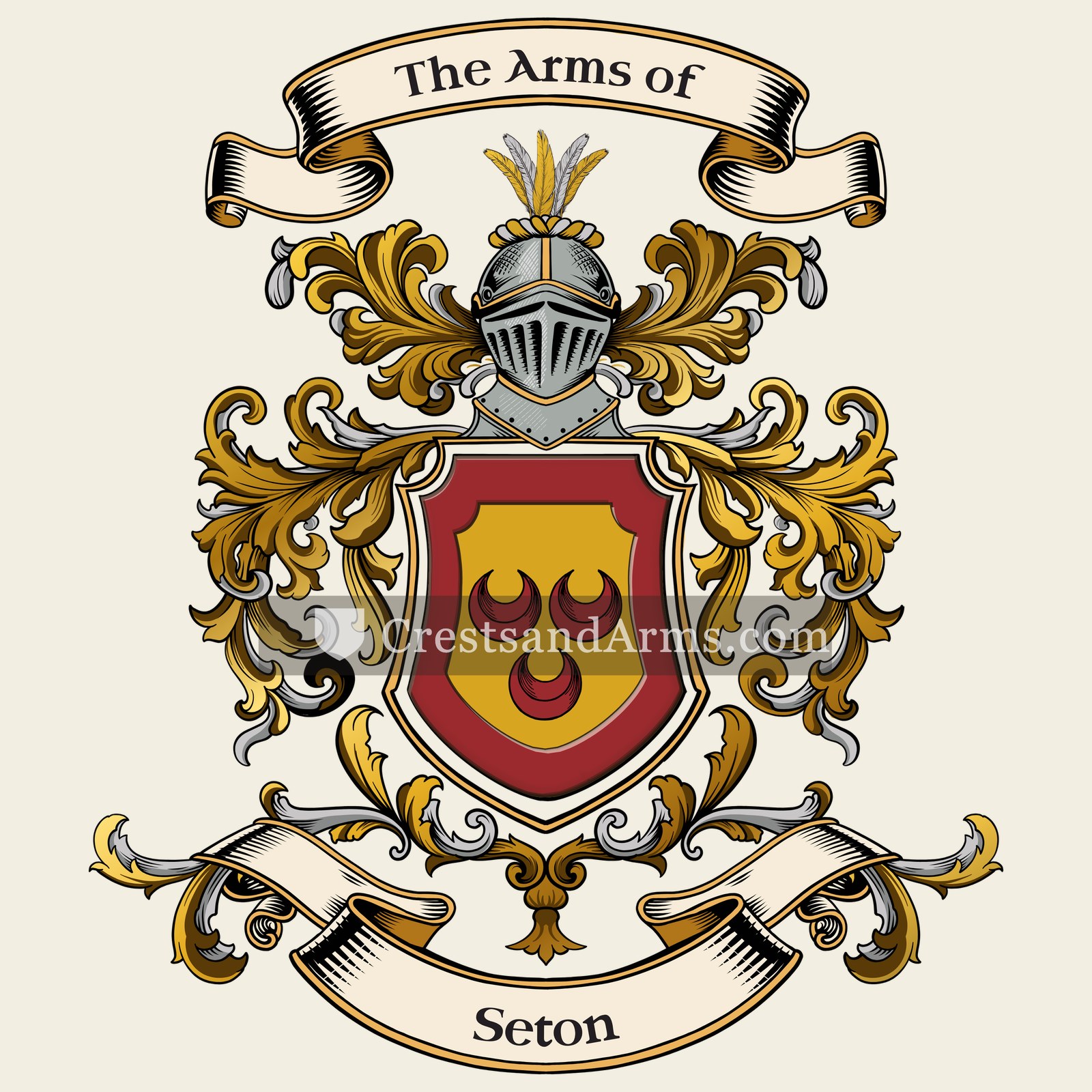
Reg. 5746 · French, T–V
Coat of Arms & Family Crest Details
Symbols on this shield
crescentHonour by the sovereign, and the second son
swordJustice, and military honour
wheatsheafPlenty, and the harvest of one's own labour
starThe celestial goddess, and nobility
Colours
Gold (Or)Means: Generosity
Blue (Azure)Means: Loyalty and truth
Red (Gules)Means: Military strength
Silver (Argent)Means: Peace and sincerity
Historical info
Source
J. B. Rietstap, Armorial Général, Gouda: G. B. van Goor Zonen, 1884–87
Blazon (the actual original written record)
“Ec.: aux 1 et 4 d'or à trois croiss. de gu., enclos dans un double trècheur fleur. et c.-fleur. du même (Seton); aux 2 et 3 d'azur à trois gerbes d'or (Buchan). Sur le tout un écusson parti: a. de gu. à une épée d'arg., garnie d'or, supp. une couronne royale du même, le tout enclos dans un double trècheur fleur. et c.-fleur. aussi d'or, ce trècheur interrompu par le parti (concession du roi Robert Bruce); b. d'azur à une étoile (12) d'arg. (Winton). Cq. cour. C.: un dragon ailé et pass. de sin., vomissant des flammes. Légende: INTAMINATIS FULGET HONORIBUS. S.: deux renards au nat., coll. et enchainés d'or, chaque collier ch. de trois croiss. de gu. D.: INVIA VIRTUTI VIA NULLA.”
Francec. 1600
Digital archive packCoat of arms PNG, gold border print PDF, vector SVG and the certificate of authenticity. Sent to your email in minutes.
Map of France showing where the Seton arms are recorded
The Seton arms were recorded in France, c. 1600.
Arms such as these were typically recorded in Bretagne.
More families held coats of arms in Bretagne than anywhere else in France. The land was divided into many small estates rather than a few large ones, so far more households counted as gentry, and each needed a shield of its own to be told apart.
This is where the arms were entered in the register. Families often moved to other parts of the country, so the same name can turn up in more than one region.
The body that granted and recorded arms in France in this period.
Henry IV of France
Sovereign of the period
Henry IV of France
1589–1610
Reigning in France when the Seton arms are first recorded.
How Arms Worked in France
In France, a coat of arms was a mark of honor that passed down through the male line to all legitimate descendants. Families often used the same shield without changes to show their shared heritage. If a branch wanted to stand out, they could add a small mark to their shield to show their specific place in the family tree.
Granting authority
The Juge d'armes de France acted as the official authority that regulated and verified coats of arms across the country.
How they got arms
Families typically inherited their arms from ancestors, though they could also receive them through royal grants or by proving their noble status.
Where arms were recorded
Coats of arms were officially recorded in the Armorial Général de France, which began its main collection in the year 1696.
The family's standing
Recorded among the armigerous families of France.
Origin & History of the Seton Family in France
The history of the Seton name in France is deeply tied to the region of Brittany, where members of the family established themselves by the year 1600. While the name is famously associated with Scottish nobility, its presence in France grew through the movement of soldiers and merchants who crossed the channel during periods of political upheaval. These early settlers in Brittany integrated into the local social fabric by forming alliances with regional families and participating in the administrative life of the province. Over time, the name adapted to the linguistic patterns of the area, reflecting the transition of a family that moved from the British Isles to become part of the French landscape. Their survival and growth in this new environment highlight the ways that families maintained their identity while adapting to the customs and community structures of seventeenth-century France.
Coat of Arms & Family Crest Details
Symbols on this shield
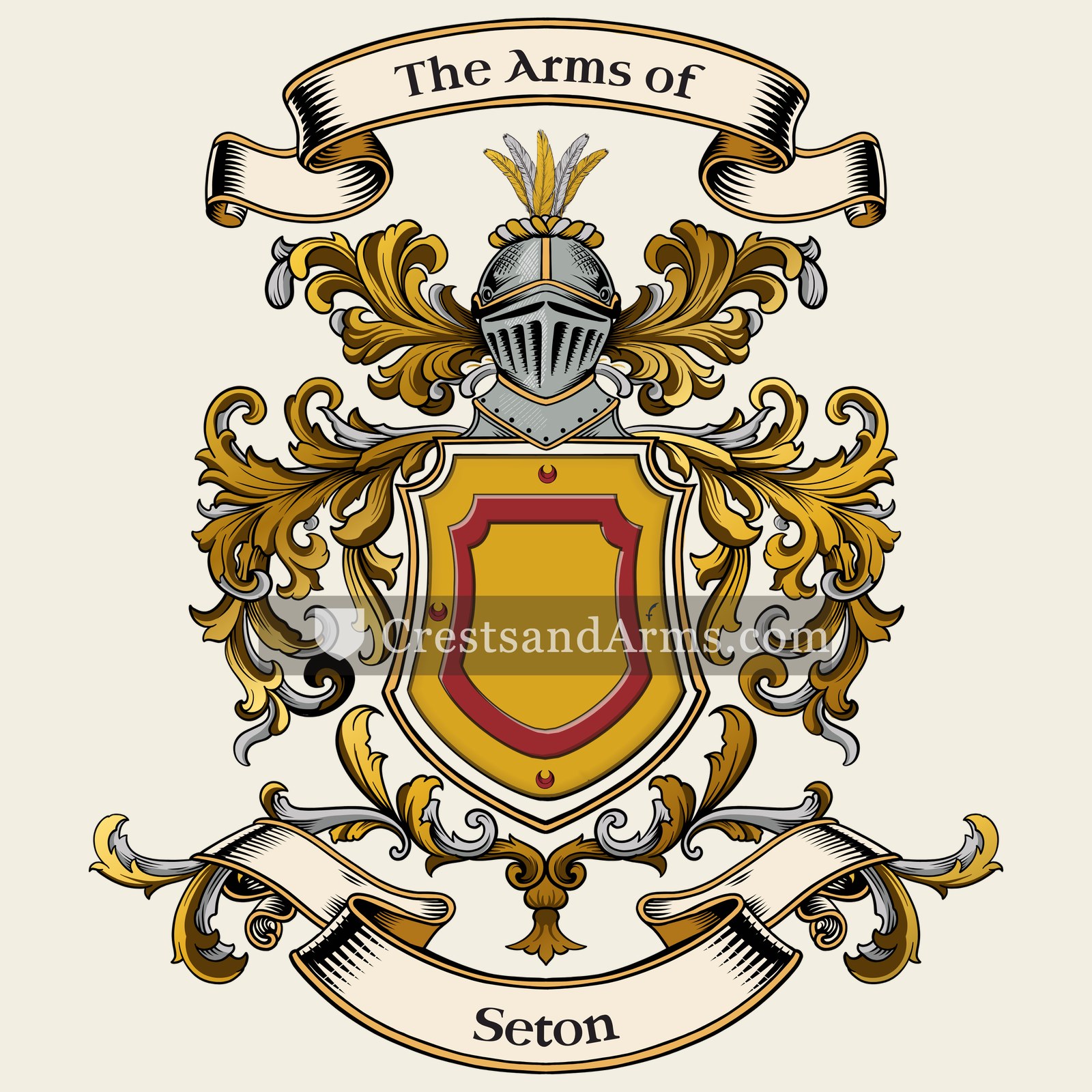
bordureA difference between branches of one family
crescentHonour by the sovereign, and the second son
Colours
Gold (Or)Means: Generosity
Red (Gules)Means: Military strength
Historical info
Source
Sir Bernard Burke, The General Armory of England, Scotland, Ireland and Wales, London: Harrison & Sons, 1884
Blazon (the actual original written record)
“Or, three crescents within a double tressure flory counterflory gu. a bordure engr. quarterly ar. and az”
HaddingtonProvost · Haddington, c. 1680
Digital archive packCoat of arms PNG, gold border print PDF, vector SVG and the certificate of authenticity. Sent to your email in minutes.
Map of Scotland showing where the Seton arms are recorded
The Seton arms were recorded in Haddington, c. 1680.
Haddington, now East Lothian, was the best farmland in Scotland and lay close to Edinburgh. Good land near the capital stayed in the hands of families of standing, and standing brought arms.
This is where the arms were entered in the register. Families often moved to other parts of the country, so the same name can turn up in more than one region.
The body that granted and recorded arms in Scotland in this period.
Charles II of England
Sovereign of the period
Charles II of England
1660–1685
Reigning in France when the Seton arms are first recorded.
How Arms Worked in Scotland
Scottish heraldry is unique because it treats a coat of arms as a piece of personal property protected by law. Only one person can own a specific design at any given time. When a family grows, the head keeps the original shield while other relatives must apply for their own distinct version with slight changes to prove their specific identity.
Granting authority
The Court of the Lord Lyon acts as the official body that regulates and controls all heraldic matters throughout Scotland.
How they got arms
Individuals obtain a legal right to their arms through a formal petition process that confirms their identity and family connection.
Where arms were recorded
All valid coats of arms are officially entered into the Public Register of All Arms and Bearings starting from 1672.
The family's standing
Recorded among the armigerous families of Haddington.
Origin & History of the Seton Family in Scotland
The Seton family name is deeply rooted in the landscape of East Lothian, where the family established a significant presence long before the seventeenth century. The name itself is territorial, originating from the lands of Seton near the town of Haddington. By the time historical records confirm their residency in Haddington in 1680, the family had already spent centuries as influential figures in Scottish society. They were known for their close connections to the Scottish monarchy and their role in managing local estates. The family often held positions of authority within the region, which allowed them to shape the development of the surrounding countryside. Their long history in this specific area reflects a tradition of land ownership and local leadership that defined their status for generations.
Coat of Arms & Family Crest Details
Symbols on this shield
swordJustice, and military honour
crescentHonour by the sovereign, and the second son
Colours
Gold (Or)Means: Generosity
Red (Gules)Means: Military strength
Blue (Azure)Means: Loyalty and truth
Historical info
Source
Sir Bernard Burke, The General Armory of England, Scotland, Ireland and Wales, London: Harrison & Sons, 1884
Blazon (the actual original written record)
“Or, a sword in pale az. betw. three crescents gu. all within a double tressure flory counterflory of the last”
EnglandLondon, c. 1766
Digital archive packCoat of arms PNG, gold border print PDF, vector SVG and the certificate of authenticity. Sent to your email in minutes.
Map of England showing where the Seton arms are recorded
The Seton arms were recorded in London, c. 1766.
This is where the arms were entered in the register. Families often moved to other parts of the country, so the same name can turn up in more than one region.
The body that granted and recorded arms in England in this period.
George III of Great Britain
Sovereign of the period
George III of Great Britain
1760–1801
Reigning in France when the Seton arms are first recorded.
How Arms Worked in England
English heraldry allowed arms to be shared by all legitimate descendants of the original owner. These symbols were treated as personal property that moved through the generations to all children. While the eldest son kept the original design, other family members could use the same shield without needing to change it or register their own unique versions.
Granting authority
The College of Arms in London has regulated the use of coats of arms throughout England and Wales since 1484.
How they got arms
Families typically obtained their coats of arms through a formal grant from the Crown or by proving their ancient right to them.
Where arms were recorded
All official coats of arms are recorded in the registers kept at the College of Arms, which date back to the fifteenth century.
The family's standing
Recorded among the armigerous families of England.
Origin & History of the Seton Family in England
The history of the Seton name in England is deeply connected to the movement of families across the border from Scotland during the eighteenth century. While the name originated in the Scottish Lowlands, by 1766, records confirm that members of the Seton family had established a presence in London. This period saw many families relocating to the capital to take advantage of the growing opportunities in trade, law, and government service. These early arrivals in London often integrated into the city’s professional classes, helping to transition the family name from a regional Scottish identity to a broader presence within the British Empire. By settling in major urban centers, these individuals ensured that the name became part of the diverse social fabric of Georgian England, marking a shift from their ancestral roots toward a new life in the bustling heart of the country.
Related Branches & Arms
Root word
Seint-tone
Derived from the Old French phrase meaning saint's town or estate.
This name
SetonRefers to a person originating from a settlement associated with a saint.
also spelled
Setton
Setone
Setonn
Seaton
Seyton
Related arms
Edmonstonesimilar arms
Sayton, or Seatonvariant spelling
Seatonvariant spelling
Seytonvariant spelling
Documented Sources
J. B. Rietstap, Armorial Général, Gouda: G. B. van Goor Zonen, 1884–87
Archives départementales d'Ille-et-Vilaine, Série E: Familles et seigneuries
Poterie, Michel, Histoire de la Bretagne, 1970
Vallée, Arthur, Les familles nobles de Bretagne, 1925
Digital archive packCoat of arms PNG, gold border print PDF, vector SVG and the certificate of authenticity. Sent to your email in minutes.


 crescentHonour by the sovereign, and the second son
 swordJustice, and military honour
 wheatsheafPlenty, and the harvest of one's own labour
 starThe celestial goddess, and nobility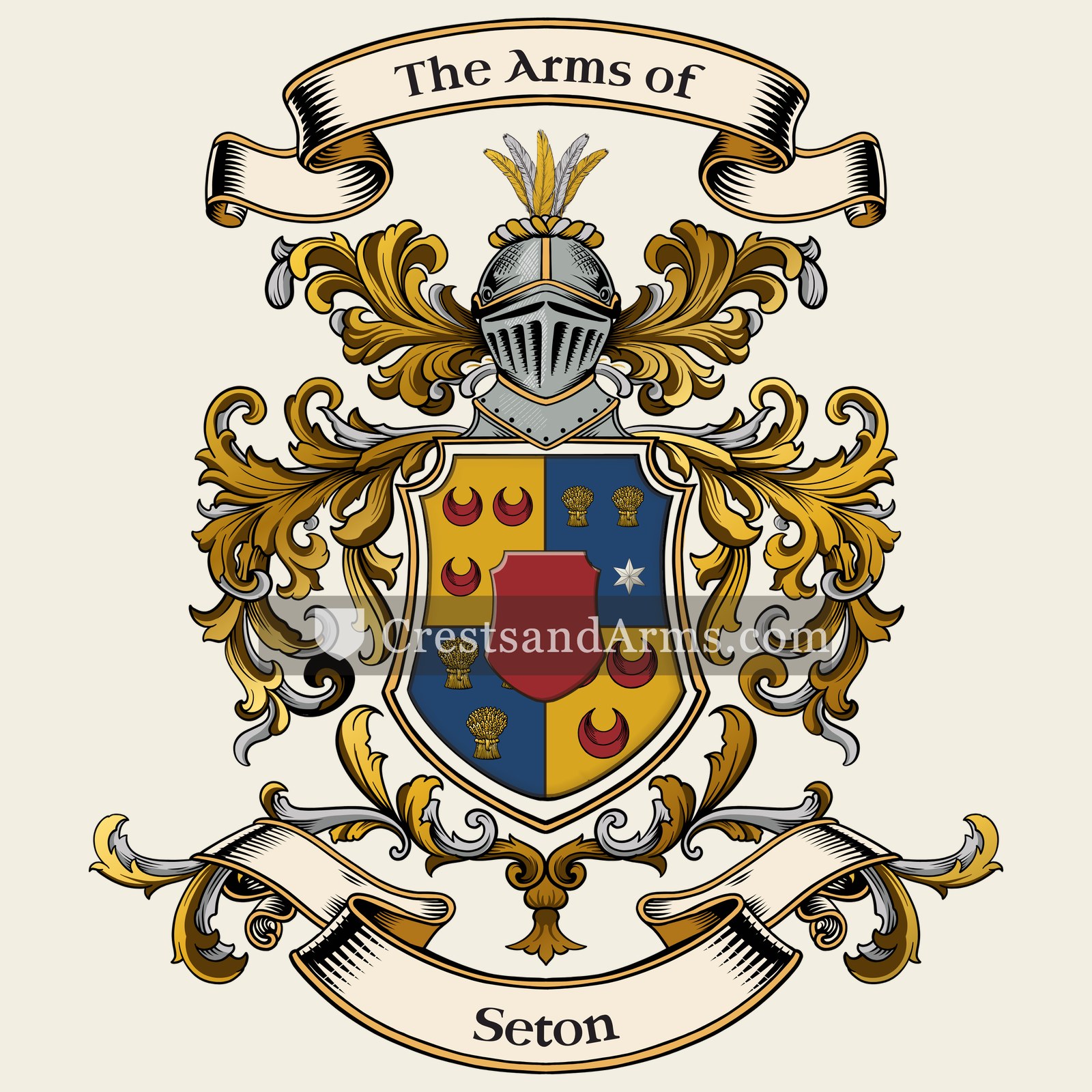


 bordureA difference between branches of one family