A record of documented arms, meaning and origin, researched for the Shandro family lines. Documented in 2 countries.
Reg. 1344 · Dutch, T–V
Meaning of the Shandro family crest colors & symbols
Symbols on this shield
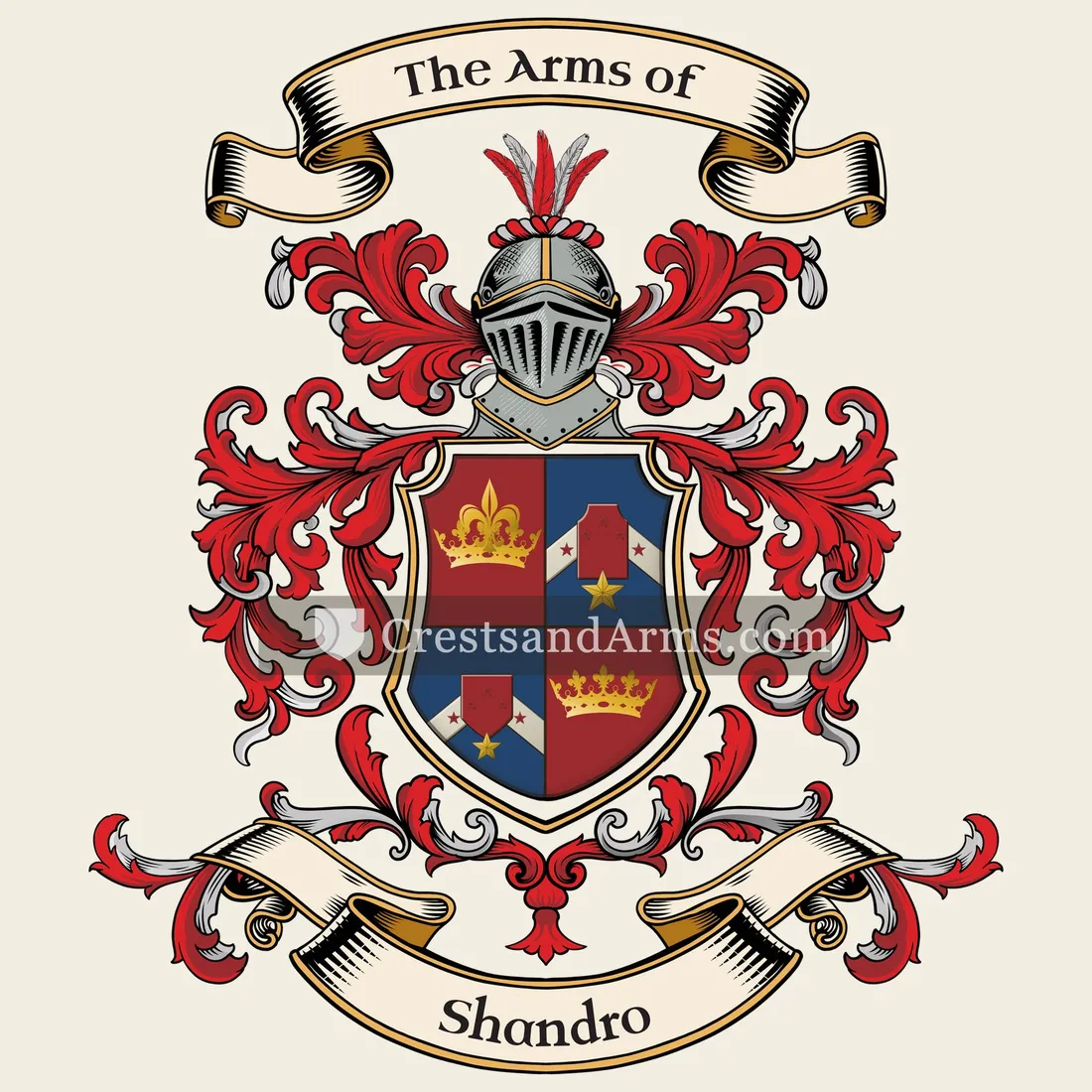
chevronProtection, and faithful service completed
fleur de lisPurity, light, and the sixth son
crownSovereignty, authority and just reward
mulletThe third son, and a divine quality from above
Colours
Red (Gules)Means: Military strength
Blue (Azure)Means: Loyalty and truth
Silver (Argent)Means: Peace and sincerity
Gold (Or)Means: Generosity
Historical info
Source
J. B. Rietstap, Armorial Général, Gouda: G. B. van Goor Zonen, 1884–87
Blazon (the actual original written record)
“Ec.: aux 1 et 4 de gu. à une couronne d'or; aux 2 et 3 d'azur au chev. d'arg., ch. de cinq étoiles de gu. et acc. en p. d'une étoile d'or. Sur le tout d'azur à une fleur-de-lis d'or.”
Netherlandsc. 1815
Digital archive packCoat of arms PNG, gold border print PDF, vector SVG and the certificate of authenticity. Sent to your email in minutes.
Map of Netherlands showing where the Shandro arms are recorded
The Shandro arms were recorded in Netherlands, c. 1815.
Arms such as these were typically recorded in Friesland.
Friesland was low, wet country on the northern coast of the Netherlands, farmed by families who had held the same land for centuries. Free landholders were unusually common there, and a free landholder could carry arms.
This is where the arms were entered in the register. Families often moved to other parts of the country, so the same name can turn up in more than one region.
Region
Friesland
First recorded
1815
Granting Authority for the Shandro Arms
Hoge Raad van Adel
Photograph made by me · CC BY-SA 3.0
The body that granted and recorded arms in Netherlands in this period.
William I of the Netherlands
Sovereign of the period
William I of the Netherlands
1815–1840
Reigning in Netherlands when the Shandro arms are first recorded.
How Arms Worked in Netherlands
In the Netherlands, coats of arms were often used by noble families and those who held specific public offices. These arms were passed down through the generations to legitimate descendants. Younger branches of a family usually kept the original design without needing to add special marks. This system ensured that the family identity remained clear and consistent over many years.
Granting authority
The Hoge Raad van Adel is the official body that regulates and manages noble titles and coats of arms in the Netherlands.
How they got arms
Families typically obtained their coats of arms through official royal grants or by proving their long-standing historical use of the symbols.
Where arms were recorded
Coats of arms are officially recorded in the registers held by the Hoge Raad van Adel, which began its work in 1814.
The family's standing
Recorded among the armigerous families of Netherlands.
Origin & History of the Shandro Family in Netherlands
The Shandro family name finds its early documented roots in the northern province of Friesland during the early nineteenth century. Historical records from 1815 confirm that members of the family were living in this region, which is known for its distinct language and strong maritime traditions. During this period, the Netherlands underwent significant administrative changes following the end of French rule, leading to the formal registration of surnames for tax and census purposes. The Shandro name likely emerged within this specific cultural landscape, where families often identified themselves through localized naming customs that reflected their community ties. As the family navigated the social shifts of the post-Napoleonic era, they remained part of the Frisian population that valued independence and agricultural stability. This early presence in Friesland serves as the foundational point for the family history, marking their transition into the official Dutch civil records that define the modern era.
Meaning of the Shandro family crest colors & symbols
Symbols on this shield
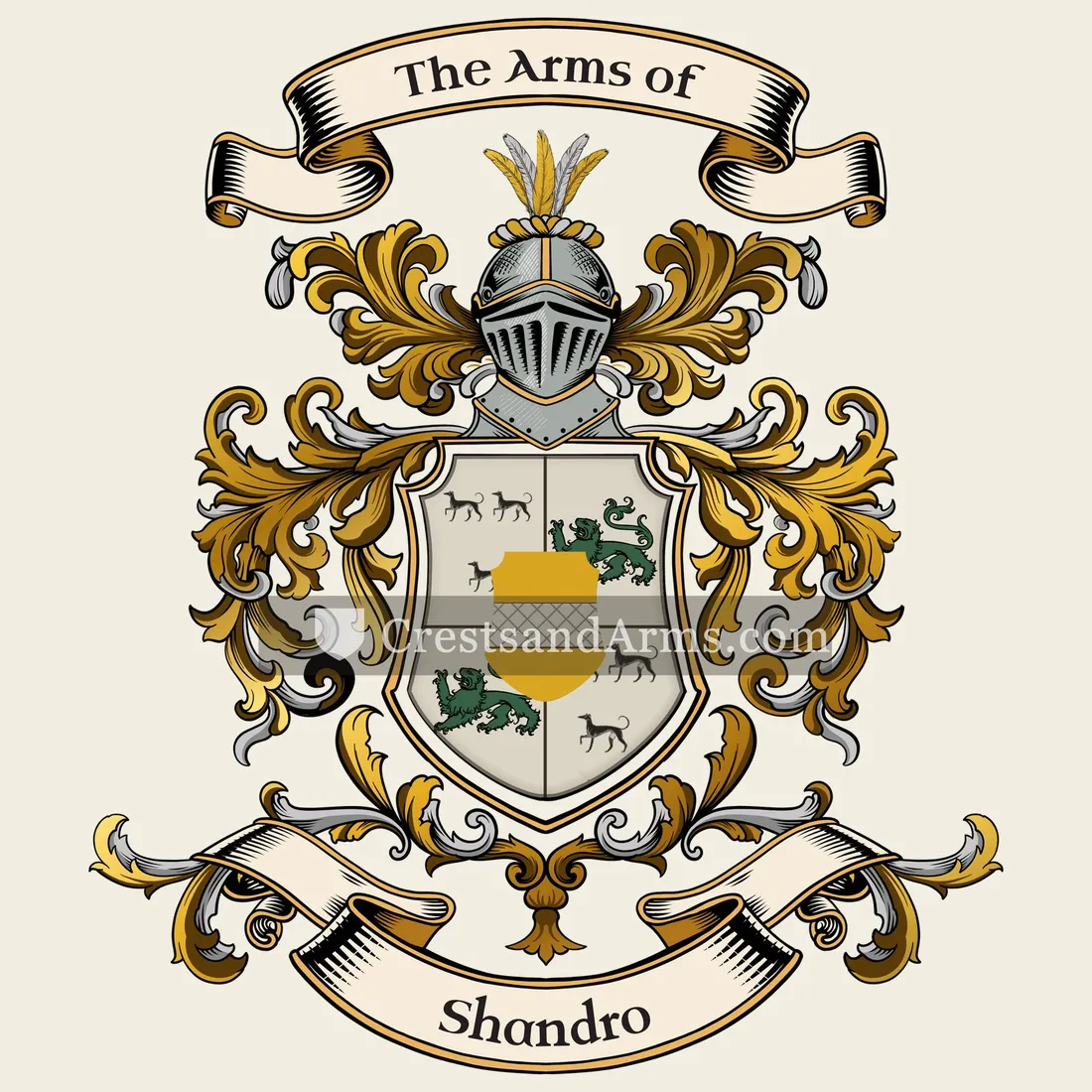
fessThe military belt, and readiness to serve
greyhoundCourage, vigilance and loyalty
lionCourage, strength and royalty
Colours
Silver (Argent)Means: Peace and sincerity
Gold (Or)Means: Generosity
Blue (Azure)Means: Loyalty and truth
Black (Sable)Means: Constancy
Green (Vert)Means: Hope
Historical info
Source
J. B. Rietstap, Armorial Général, Gouda: G. B. van Goor Zonen, 1884–87
Blazon (the actual original written record)
“Ec.: aux 1 et 4 d'arg. à trois lévriers de sa., coll. du champ, l'un sur l'autre; aux 2 et 3 d'arg. au lion de sin., cour. d'or. Sur le tout gironné d'or et d'azur de douze pièces. Sur le tout du tout de gu. à la fasce d'arg. Cq. cour. C.: le lion, iss.”
FlandreFlandre, c. 1663
Digital archive packCoat of arms PNG, gold border print PDF, vector SVG and the certificate of authenticity. Sent to your email in minutes.
Map of Belgium showing where the Shandro arms are recorded
The Shandro arms were recorded in Flandre, c. 1663.
Flandre grew rich on cloth, and its towns were among the busiest in Europe. Merchant families bought land with their profits and took arms to go with it, so trade put as many names in the registers here as land did.
This is where the arms were entered in the register. Families often moved to other parts of the country, so the same name can turn up in more than one region.
The body that granted and recorded arms in Belgium in this period.
Philip IV of Spain
Sovereign of the period
Philip IV of Spain
1621–1665
Reigning in Netherlands when the Shandro arms are first recorded.
How Arms Worked in Belgium
In Belgium, a coat of arms is considered personal property that is passed down through the male line to legitimate descendants. Families often use the same shield design across generations to show their shared heritage. If a branch of the family wants to change the design, they must apply for an official update to their specific version of the arms.
Granting authority
The Conseil héraldique is the official body that regulates and approves all coats of arms in Belgium.
How they got arms
Families obtain their coats of arms through formal royal grants or by confirming their historical right to use existing designs.
Where arms were recorded
All approved coats of arms are officially recorded in the public registers of the Conseil héraldique since 1844.
The family's standing
Recorded among the armigerous families of Flandre.
Origin & History of the Shandro Family in Belgium
The history of the Shandro name in Belgium begins in the seventeenth century within the region of Flanders. Historical records confirm that members of the family were established in this area by 1663. During this period, Flanders was a center of trade and agriculture, and families like the Shandros were often deeply connected to the local parish systems and regional land management. Life in the Flemish countryside at this time was defined by strict social structures and the influence of the Catholic Church, which kept detailed registers of births, marriages, and deaths. These early Shandros likely navigated a world shaped by the shifting borders of the Spanish Netherlands and the daily demands of a society built on craftsmanship and farming. By maintaining their presence in the region, the family became part of the long-standing cultural fabric of the Flemish people, eventually moving through the social transitions that defined the Low Countries during the late seventeenth century.
Shandro Meaning & Related Branches
Root word
Alexander
Derived from Greek meaning defender or helper of mankind.
This name
ShandroA patronymic or variant form originating from the Greek name Alexander.
also spelled
Sandre
Sandrah
Zandra
Documented Sources
J. B. Rietstap, Armorial Général, Gouda: G. B. van Goor Zonen, 1884–87
Tresoar (Fries Historisch en Letterkundig Centrum), Burgerlijke Stand (Civil Registration) of Friesland, 1811–1950
Digital archive packCoat of arms PNG, gold border print PDF, vector SVG and the certificate of authenticity. Sent to your email in minutes.


 chevronProtection, and faithful service completed
 fleur de lisPurity, light, and the sixth son
 crownSovereignty, authority and just reward
 mulletThe third son, and a divine quality from above
 chevronProtection, and faithful service completed
 fleur de lisPurity, light, and the sixth son
 crownSovereignty, authority and just reward
 mulletThe third son, and a divine quality from above


 fessThe military belt, and readiness to serve
 greyhoundCourage, vigilance and loyalty
 lionCourage, strength and royalty