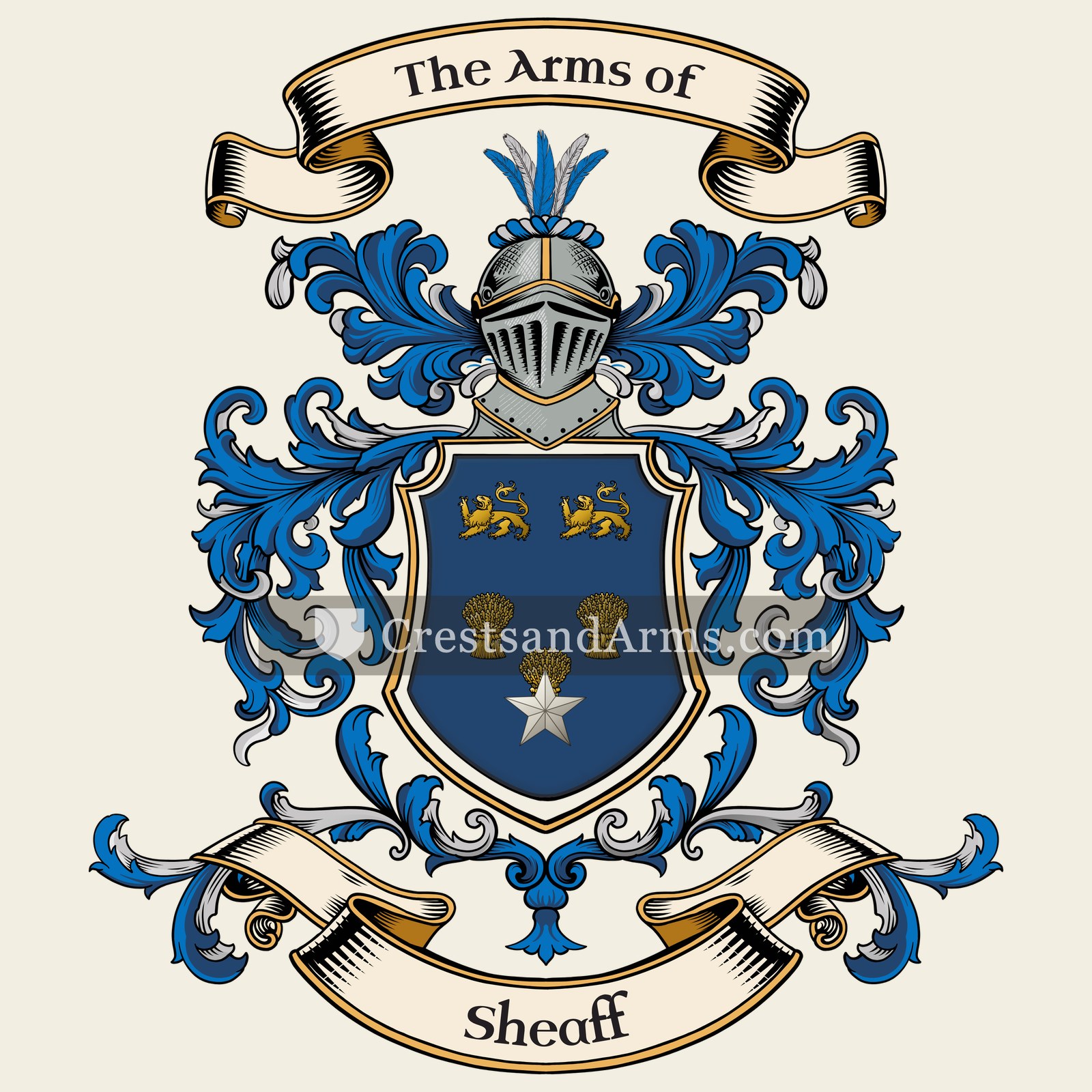
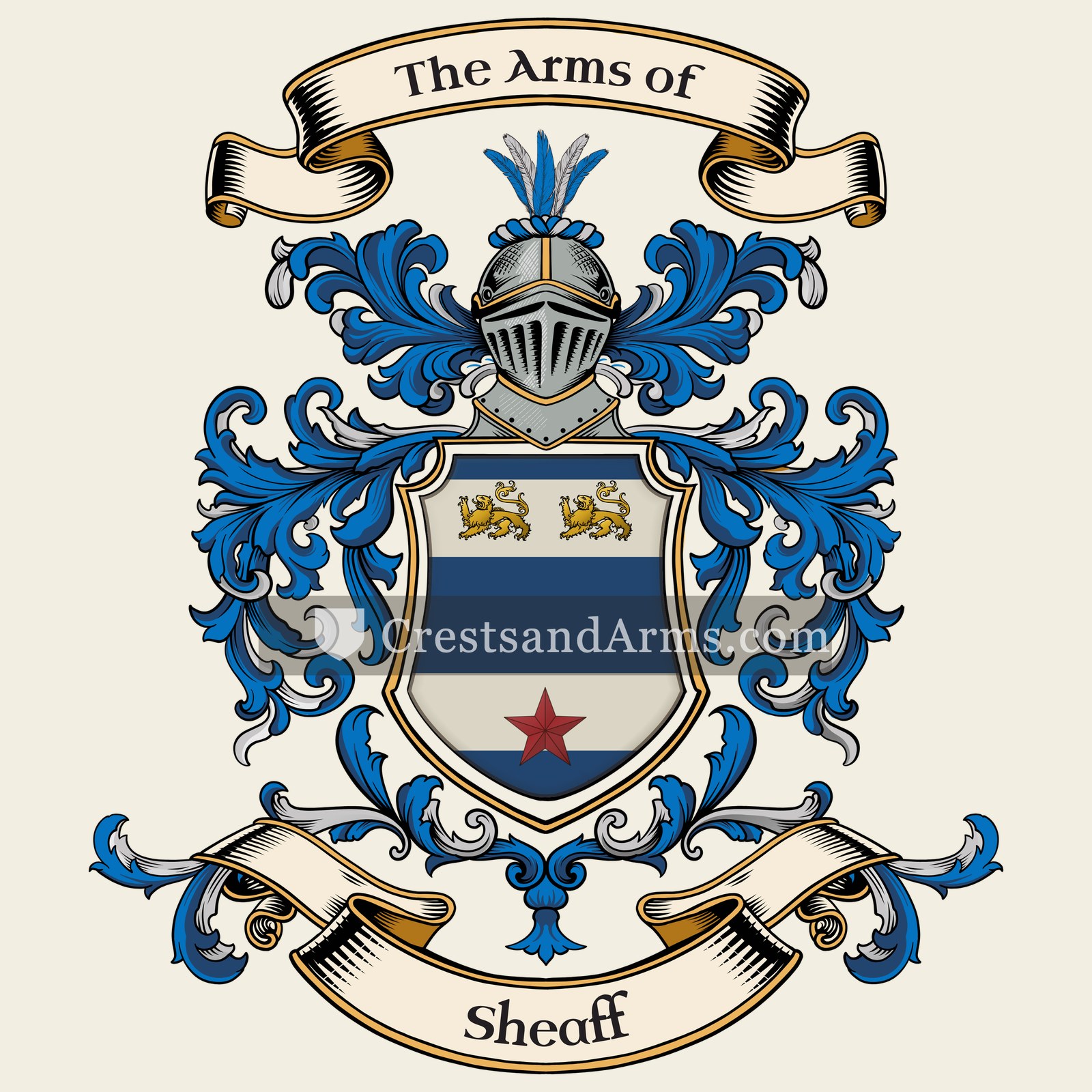
A record of documented arms, meaning and origin, researched for the Sheaff family lines. Documented in 2 countries.
Reg. 3471 · Britain, T–V
Coat of Arms & Family Crest Details
Symbols on this shield
ermineDignity and rank
wheatsheafPlenty, and the harvest of one's own labour
lionCourage, strength and royalty
mulletThe third son, and a divine quality from above
Colours
Blue (Azure)Means: Loyalty and truth
Gold (Or)Means: Generosity
Silver (Argent)Means: Peace and sincerity
Historical info
Source
J. B. Rietstap, Armorial Général, Gouda: G. B. van Goor Zonen, 1884–87
Blazon (the actual original written record)
“D'azur à trois gerbes d'or, rangées en fasce entre deux burèles d'arg., accompagnées en chef de deux têtes de lion d'or semées de mouch. d'herm. de sa. et en p. d'une étoile d'arg. Cq. timbré d'une couronne murale d'arg. C.: un avant-bras, en pal, paré de gu., retr. de sin., la main de carn. tenant une épée d'arg., garnie d'or; le tout embrassé par une branche de laurier et une branche de chêne.”
BritainLondres, c. 1700
Digital archive packCoat of arms PNG, gold border print PDF, vector SVG and the certificate of authenticity. Sent to your email in minutes.
Map of Britain showing where the Sheaff arms are recorded
The Sheaff arms were recorded in Londres, c. 1700.
Arms such as these were typically recorded in Kent.
Kent sits between London and the short crossing to Europe, and the trade passing through made it wealthy. Merchant families bought land with that money, and it was landowners who took coats of arms.
This is where the arms were entered in the register. Families often moved to other parts of the country, so the same name can turn up in more than one region.
The body that granted and recorded arms in Britain in this period.
William III of England
Sovereign of the period
William III of England
1694–1702
Reigning in Britain when the Sheaff arms are first recorded.
How Arms Worked in Britain
English heraldry allowed arms to be shared by all legitimate descendants of the original owner. These symbols were treated as personal property that moved through the generations to all children. While the eldest son kept the original design, other family members could use the same shield without needing to change it or register their own unique versions.
Granting authority
The College of Arms in London has regulated the use of coats of arms throughout England and Wales since 1484.
How they got arms
Families typically obtained their coats of arms through a formal grant from the Crown or by proving their ancient right to them.
Where arms were recorded
All official coats of arms are recorded in the registers kept at the College of Arms, which date back to the fifteenth century.
The family's standing
Recorded among the armigerous families of Britain.
Origin & History of the Sheaff Family in Britain
The surname Sheaff is believed to have originated as a descriptive name, likely referring to a person who worked with bundles of grain or lived near a farmstead. By the early 18th century, the family was well-established in the county of Kent, a region known for its rich agricultural history and proximity to the English Channel. During this period, families in Kent often lived in small, tight-knit rural communities where they contributed to the local economy through farming and trade. The name appears in regional parish records from the 1700s, which document the daily lives of these early ancestors through baptisms, marriages, and burials. These records suggest that the Sheaff family was deeply rooted in the local landscape, maintaining a steady presence in the English countryside as the nation transitioned into the modern era.
Coat of Arms & Family Crest Details
Symbols on this shield
wheatsheafPlenty, and the harvest of one's own labour
lionCourage, strength and royalty
mulletThe third son, and a divine quality from above
Colours
Blue (Azure)Means: Loyalty and truth
Silver (Argent)Means: Peace and sincerity
Gold (Or)Means: Generosity
Red (Gules)Means: Military strength
Historical info
Source
Sir Bernard Burke, The General Armory of England, Scotland, Ireland and Wales, London: Harrison & Sons, 1884
Blazon (the actual original written record)
“Az. three garbs or, betw. two barrulets ar. in chief two lions' heads erased, in base a mullet of the third”
ClareEdswall · Clare, c. 1813
Digital archive packCoat of arms PNG, gold border print PDF, vector SVG and the certificate of authenticity. Sent to your email in minutes.
Map of Ireland showing where the Sheaff arms are recorded
The Sheaff arms were recorded in Clare, c. 1813.
Clare was rocky western Irish country, poor in farmland but held tightly by a few old families. Land there changed hands rarely, and families who stayed put ended up in the records.
This is where the arms were entered in the register. Families often moved to other parts of the country, so the same name can turn up in more than one region.
The body that granted and recorded arms in Ireland in this period.
George III of Great Britain
Sovereign of the period
George III of Great Britain
1801–1820
Reigning in Britain when the Sheaff arms are first recorded.
How Arms Worked in Ireland
The Ulster King of Arms granted coats of arms to individuals who proved their social standing and good character. These symbols were typically inherited by all legitimate descendants of the original holder. If a family branch wanted a unique look, they could apply for a specific change to their design through the office to ensure their identity remained distinct.
Granting authority
The Ulster King of Arms acted as the official body that regulated and issued all coats of arms throughout Ireland.
How they got arms
Families obtained their arms through formal grants issued by the office after proving their eligibility and paying the required fees.
Where arms were recorded
All official grants were recorded in the registers held by the Ulster King of Arms starting from the year 1552.
The family's standing
Recorded among the armigerous families of Clare.
Origin & History of the Sheaff Family in Ireland
The family name Sheaff has roots that connect to the complex social landscape of nineteenth-century Ireland. By 1813, records confirm that members of the family were established in County Clare, a region defined by its rugged landscape and a history of shifting land ownership. During this era, the name likely existed within a society transitioning through significant agricultural and economic changes. Families in Clare at this time often lived in rural communities where they navigated the challenges of tenant farming and local trade. While the name itself may have origins linked to the migration of settlers or the Anglicization of local surnames, its presence in Clare suggests the family was part of the local fabric during a time of great historical transformation. These early ancestors helped shape the local community through their daily labor and their participation in the social life of the west of Ireland.
Related Branches & Arms
Root word
sceaf
Old English word for a sheaf of corn or bundle of grain.
This name
SheaffAn occupational name for a person who worked with or gathered bundles of harvested grain.
also spelled
Sheaf
Sheef
Sheefe
Sheff
Documented Sources
J. B. Rietstap, Armorial Général, Gouda: G. B. van Goor Zonen, 1884–87
Reaney, P.H., A Dictionary of English Surnames, 1958
Cottle, Basil, The Penguin Dictionary of Surnames, 1967
Kent Archives and Local History Centre, Parish Registers of Kent, 1700–1750
Digital archive packCoat of arms PNG, gold border print PDF, vector SVG and the certificate of authenticity. Sent to your email in minutes.


 ermineDignity and rank
 wheatsheafPlenty, and the harvest of one's own labour
 lionCourage, strength and royalty
 mulletThe third son, and a divine quality from above
 ermineDignity and rank
 wheatsheafPlenty, and the harvest of one's own labour
 lionCourage, strength and royalty
 mulletThe third son, and a divine quality from above