Map of Belgium showing where the Shellard arms are recorded
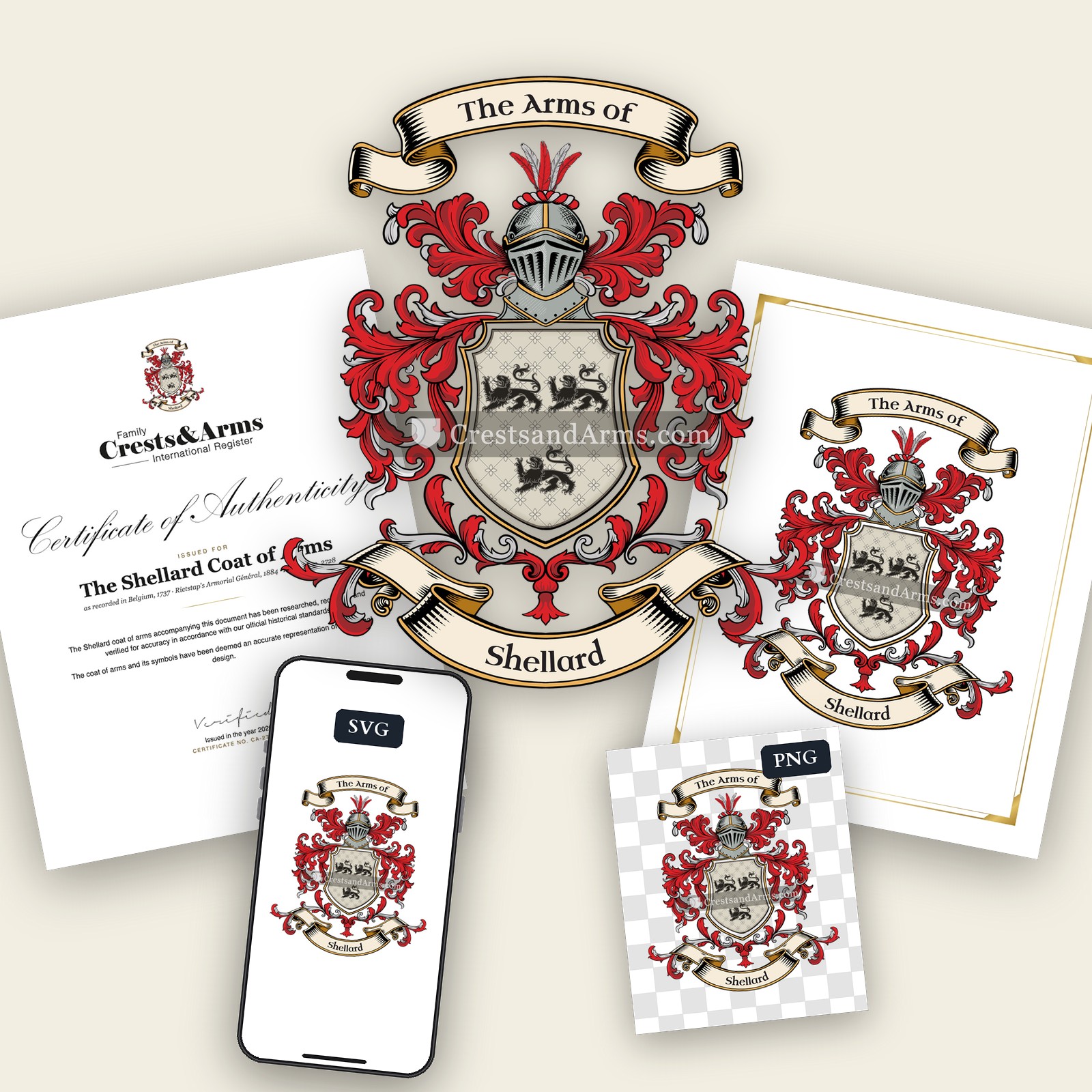
The Shellard arms were recorded in Luxemb, c. 1737.
This is where the arms were entered in the register. Families often moved to other parts of the country, so the same name can turn up in more than one region.
The body that granted and recorded arms in Belgium in this period.
Charles VI, Holy Roman Emperor
Sovereign of the period
Charles VI, Holy Roman Emperor
1711–1740
Reigning in Belgium when the Shellard arms are first recorded.
How Arms Worked in Belgium
In Belgium, a coat of arms is considered personal property that is passed down through the male line to legitimate descendants. Families often use the same shield design across generations to show their shared heritage. If a branch of the family wants to change the design, they must apply for an official update to their specific version of the arms.
Granting authority
The Conseil héraldique is the official body that regulates and approves all coats of arms in Belgium.
How they got arms
Families obtain their coats of arms through formal royal grants or by confirming their historical right to use existing designs.
Where arms were recorded
All approved coats of arms are officially recorded in the public registers of the Conseil héraldique since 1844.
The family's standing
Recorded among the armigerous families of Belgium.
Origin & History of the Shellard Family in Belgium
The history of the Shellard name in the region of modern-day Belgium and Luxembourg is deeply tied to the movement of people across shifting European borders during the eighteenth century. While the family is firmly documented in the Luxembourg territory by 1737, the name likely evolved from regional dialects spoken in the borderlands between the Low Countries and the German states. During this period, families often moved between these areas to find work in agriculture or local trades, as the region was a crossroads for merchants and laborers. The name itself may have originated as a descriptive term for a person living near a specific landmark or a particular type of woodland. Because the borders of the Southern Netherlands and the Duchy of Luxembourg were frequently redefined by treaties and dynastic changes, the Shellard family members were part of a mobile population that adapted to different legal and social systems. Their presence in the records of the 1700s reflects a time when families were beginning to establish more permanent roots in the local parishes of the Ardennes and surrounding areas.
Meaning of the Shellard family crest colors & symbols
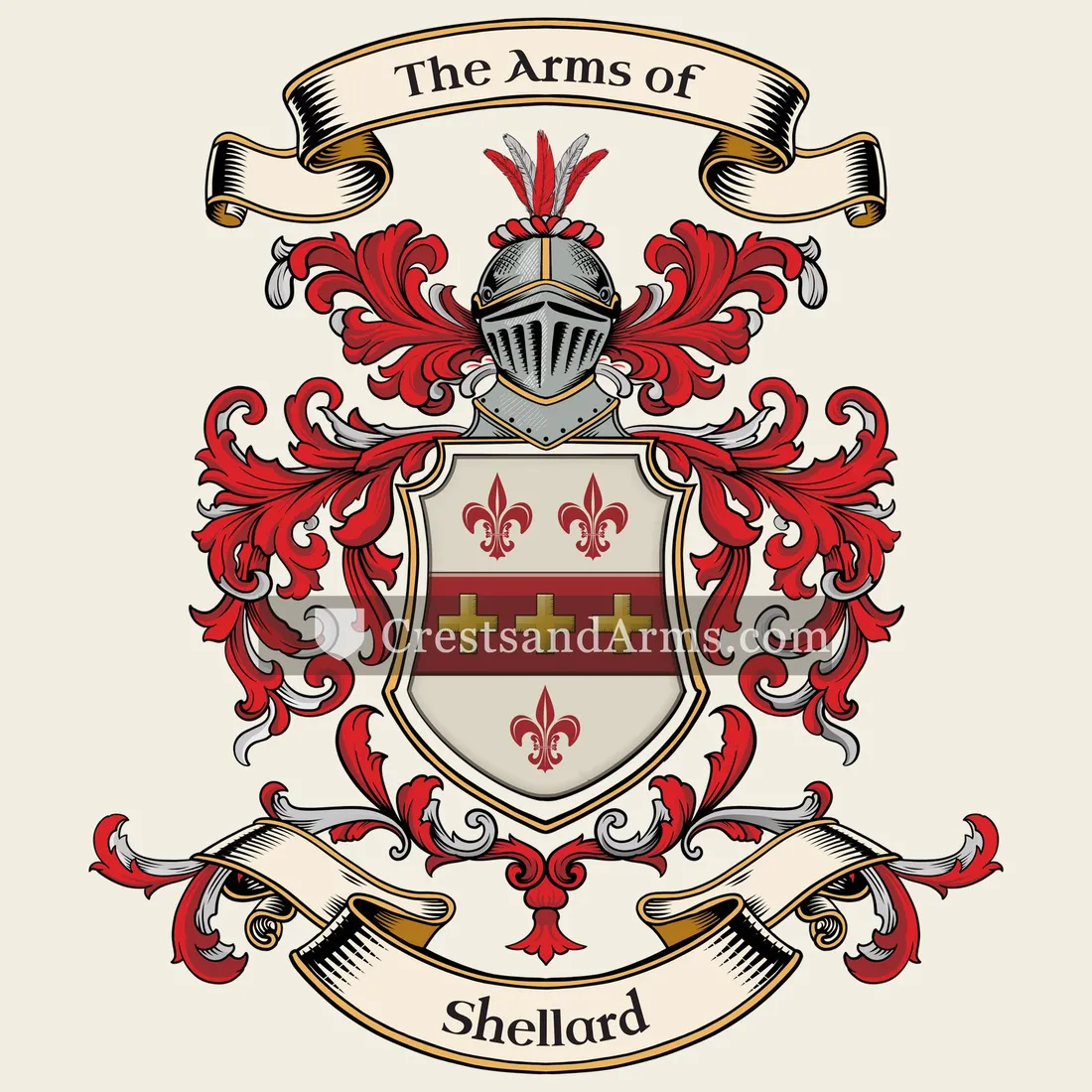
Symbols on this shield
fessThe military belt, and readiness to serve
cross symbolChristian faith and service
fleur de lisPurity, light, and the sixth son
Colours
Silver (Argent)Means: Peace and sincerity
Red (Gules)Means: Military strength
Gold (Or)Means: Generosity
Historical info
Source
J. B. Rietstap, Armorial Général, Gouda: G. B. van Goor Zonen, 1884–87
Blazon (the actual original written record)
“D'arg. à la fasce de gu., ch. de trois croisettes d'or et acc. de trois fleurs-de-lis du sec. C.: cinq pl. d'aut. d'arg., la 1ère, 3e et 5e sommées chacune d'une fleur-de-lis de gu.: ou, un bonnet de gu., retr. d'arg., sommé de deux fleurs-de-lis de gu.”
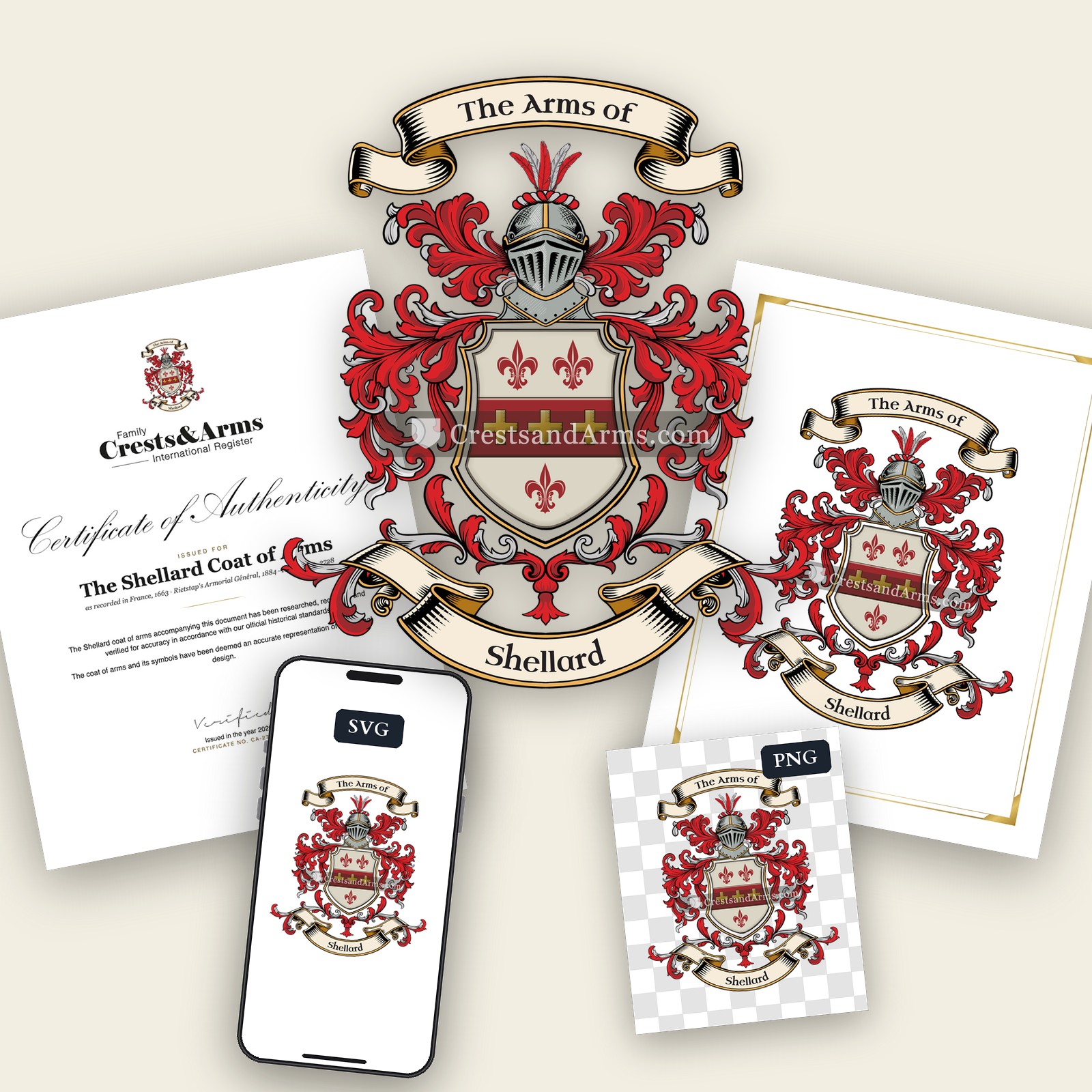
Francec. 1663
Digital archive packCoat of arms PNG, gold border print PDF, vector SVG and the certificate of authenticity. Sent to your email in minutes.
Map of France showing where the Shellard arms are recorded
The Shellard arms were recorded in France, c. 1663.
Arms such as these were typically recorded in Bretagne.
More families held coats of arms in Bretagne than anywhere else in France. The land was divided into many small estates rather than a few large ones, so far more households counted as gentry, and each needed a shield of its own to be told apart.
This is where the arms were entered in the register. Families often moved to other parts of the country, so the same name can turn up in more than one region.
The body that granted and recorded arms in France in this period.
Louis XIV of France
Sovereign of the period
Louis XIV of France
1643–1715
Reigning in Belgium when the Shellard arms are first recorded.
How Arms Worked in France
In France, a coat of arms was a mark of honor that passed down through the male line to all legitimate descendants. Families often used the same shield without changes to show their shared heritage. If a branch wanted to stand out, they could add a small mark to their shield to show their specific place in the family tree.
Granting authority
The Juge d'armes de France acted as the official authority that regulated and verified coats of arms across the country.
How they got arms
Families typically inherited their arms from ancestors, though they could also receive them through royal grants or by proving their noble status.
Where arms were recorded
Coats of arms were officially recorded in the Armorial Général de France, which began its main collection in the year 1696.
The family's standing
Recorded among the armigerous families of France.
Origin & History of the Shellard Family in France
The history of the Shellard family in France is deeply rooted in the rugged landscape of Bretagne, where records confirm their presence as early as 1663. During the seventeenth century, this region was a distinct province with its own unique customs and strong ties to the sea. Families living in Bretagne at this time often worked in agriculture or maritime trades, adapting their lives to the rocky coastline and the changing seasons. The name likely evolved through local dialects, reflecting the way people spoke in the small villages scattered across the Breton countryside. As members of the family settled into their communities, they became part of the social fabric of the region, participating in the daily life and local traditions that defined life in western France. Their presence in 1663 suggests that the family was well-established long before the major political shifts that would later reshape the nation.
Shellard Meaning & Related Branches
Root word
Schellaert
Derived from the Middle Dutch word for a bell or bell-ringer.
This name
ShellardAn occupational surname for a bell-founder or a person who rang bells.
also spelled
Shellart
Documented Sources
J. B. Rietstap, Armorial Général, Gouda: G. B. van Goor Zonen, 1884–87
Archives nationales de Luxembourg, État civil et registres paroissiaux
Archives de l'État à Arlon, Registres paroissiaux de la province de Luxembourg
Heintz, Paul, Luxemburger Familiennamen: Herkunft und Bedeutung, 1982
Muller, Jean-Claude, Les familles luxembourgeoises: Études généalogiques et historiques, 1995
Digital archive packCoat of arms PNG, gold border print PDF, vector SVG and the certificate of authenticity. Sent to your email in minutes.


 lionCourage, strength and royalty
 lionCourage, strength and royalty
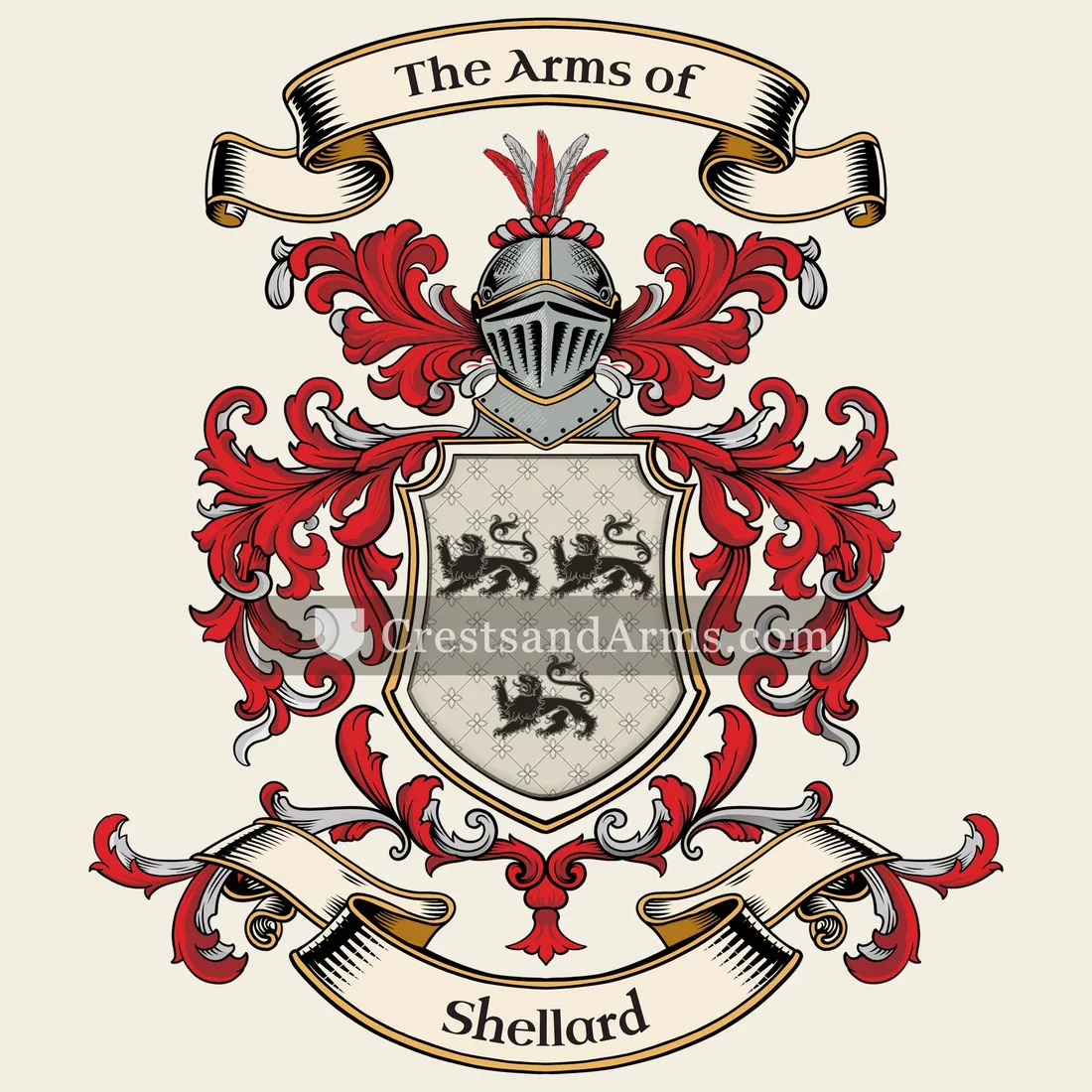


 fessThe military belt, and readiness to serve
 cross symbolChristian faith and service
 fleur de lisPurity, light, and the sixth son