A record of documented arms, meaning and origin, researched for the Shubert family lines. Documented in 3 countries.
Reg. 4954 · Polish, T–V
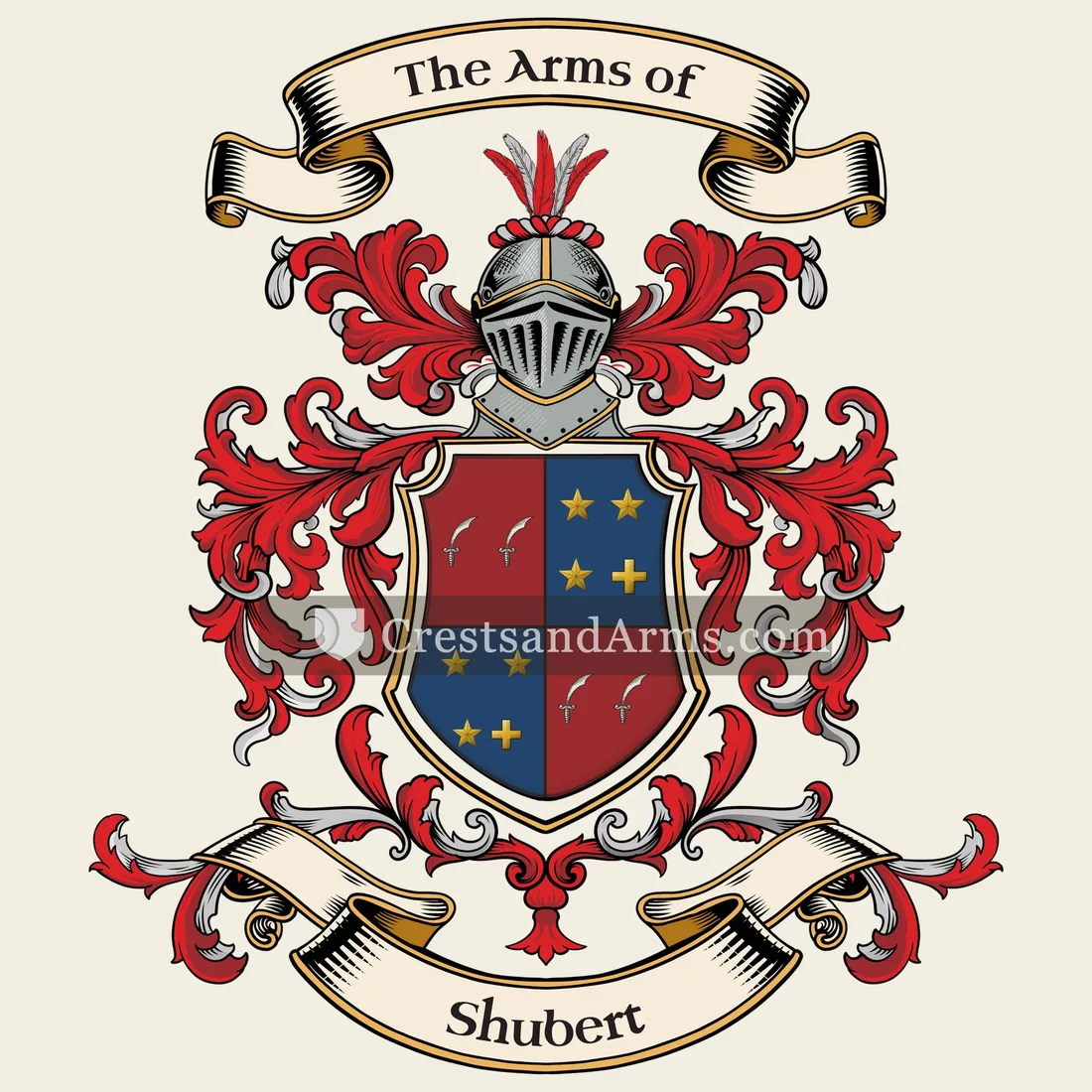
Meaning of the Shubert family crest colors & symbols
Symbols on this shield
cross symbolChristian faith and service
swordJustice, and military honour
mulletThe third son, and a divine quality from above
Colours
Red (Gules)Means: Military strength
Blue (Azure)Means: Loyalty and truth
Silver (Argent)Means: Peace and sincerity
Gold (Or)Means: Generosity
Historical info
Source
J. B. Rietstap, Armorial Général, Gouda: G. B. van Goor Zonen, 1884–87
Blazon (the actual original written record)
“Ec.: aux 1 et 4 de gu. à deux épées d'arg., garnies d'or, passées en saut.; aux 2 et 3 d'azur à trois étoiles mal-ordonnées d'or en chef et une croix latine du même en p. Sur le tout d'arg. à un Saint-Michel, arm. de toutes pièces d'arg., ceint d'un tablier de gu., ailé d'or, la tête entourée d'une auréole du même, enfonçant sa lance dans la gueule d'un dragon couché et renv. de sin., la tête à sen. Brl. d'arg. et d'azur. C.: un cygne iss. d'arg., langué de gu., le vol ouv. L. d'arg. et d'azur. S.: à dextre un léopard lionné au nat., à sen. un cheval blanc. D.: QUO FAS ET GLORIA DUCUNT.”
LivoniaEsthonie · Livonia, c. 1772
Digital archive packCoat of arms PNG, gold border print PDF, vector SVG and the certificate of authenticity. Sent to your email in minutes.
Map of Poland showing where the Shubert arms are recorded
The Shubert arms were recorded in Livonia, c. 1772.
Livonia was Baltic country held by a small number of landed families who kept their estates for centuries. Land there passed down whole rather than being divided, and long unbroken tenure is what fills a register.
This is where the arms were entered in the register. Families often moved to other parts of the country, so the same name can turn up in more than one region.
Region
Livonia
Town
Esthonie
First recorded
1772
Granting Authority for the Shubert Arms
Ennoblement by the Sejm
Author: Olek Remesz · CC BY-SA 3.0
The body that granted and recorded arms in Poland in this period.
Stanisław August Poniatowski
Sovereign of the period
Stanisław August Poniatowski
1764–1795
Reigning in Poland when the Shubert arms are first recorded.
How Arms Worked in Poland
Polish noble families shared a single coat of arms across many different surnames, creating large clans rather than individual designs. These symbols were held collectively by all members of the clan regardless of their specific family name. When a new family joined the nobility, they were adopted into an existing clan and began using that group's established shield.
Granting authority
The Sejm, which was the Polish parliament, held the power to grant noble status and the right to bear arms.
How they got arms
Families typically received their coat of arms through a formal act of ennoblement granted by the Sejm for distinguished service.
Where arms were recorded
These grants were officially recorded in the Crown Metrica, which served as the central archive for state documents starting in the sixteenth century.
The family's standing
Recorded among the armigerous families of Livonia.
Origin & History of the Shubert Family in Poland
The Shubert family name has deep roots in the regions surrounding the Baltic Sea, with a significant presence in Livonia by 1772. During this period, Livonia was a territory that experienced complex shifts in power between the Polish-Lithuanian Commonwealth and the Russian Empire. Many families with this name were part of the German-speaking minority that settled in these eastern lands to serve as administrators, merchants, or landowners. Because of the fluid borders and the movement of people across the Polish-Lithuanian territories, the name became associated with the professional classes who navigated the cultural landscape of the region. As the family established themselves in these areas, they became integrated into the local social structures that defined life in the eighteenth century. Their history reflects the broader patterns of migration and settlement that shaped the diverse population of the Baltic provinces during a time of great political change.
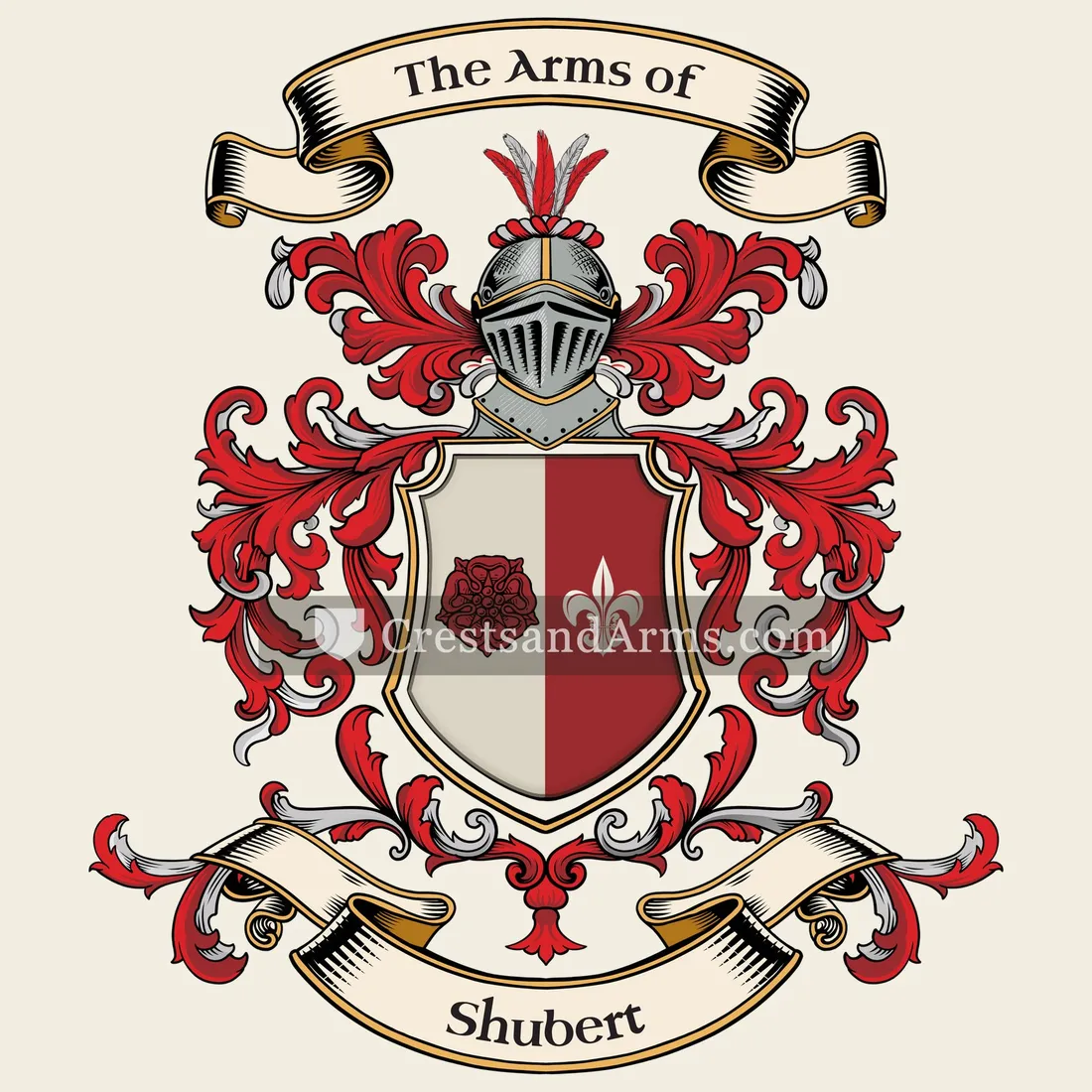
Meaning of the Shubert family crest colors & symbols
Symbols on this shield
roseThe seventh son, and beauty with grace
fleur de lisPurity, light, and the sixth son
Colours
Silver (Argent)Means: Peace and sincerity
Red (Gules)Means: Military strength
Historical info
Source
J. B. Rietstap, Armorial Général, Gouda: G. B. van Goor Zonen, 1884–87
Blazon (the actual original written record)
“Parti: au 1 d'arg. à la moitié d'une rose à quatre feuilles de gu., mouv. du parti; au 2 de gu. à une demi-fleur-de-lis d'arg., mouv. du parti. Cq. cour. C.: un homme iss., revêtu d'une cuirasse et d'une cotte d'armes partie d'arg. et de gu., tort. d'arg. et de gu., tenant de sa main dextre une épée et de sa sen. une couronne de myrthe d'arg. D.: DILIGENTER ET FIDELITER.”
SaxonySaxony, c. 1878
Digital archive packCoat of arms PNG, gold border print PDF, vector SVG and the certificate of authenticity. Sent to your email in minutes.
Map of Germany showing where the Shubert arms are recorded
The Shubert arms were recorded in Saxony, c. 1878.
Saxony had mines, trade and old landed families all at once. Silver made some fortunes and land held others, and both sorts of family kept arms, which is why Saxon names appear so often in the registers.
This is where the arms were entered in the register. Families often moved to other parts of the country, so the same name can turn up in more than one region.
The body that granted and recorded arms in Germany in this period.
Wilhelm I
Sovereign of the period
Wilhelm I
1861–1888
Reigning in Poland when the Shubert arms are first recorded.
How Arms Worked in Germany
Prussian heraldry was strictly tied to social rank and noble status rather than being a free choice for every citizen. These symbols were treated as permanent family property that moved through the generations to all legitimate heirs. If a family branch wanted to change their design to stand out, they had to apply for official permission to alter their specific version of the shield.
Granting authority
The Prussian Heroldsamt acted as the central state office that managed and strictly controlled all noble titles and coats of arms.
How they got arms
Families usually obtained their arms through formal royal grants or by proving their long-standing noble status to the state authorities.
Where arms were recorded
All official coats of arms were kept in the rolls of the Prussian Heroldsamt, which functioned from 1706 until 1918.
The family's standing
Recorded among the armigerous families of Saxony.
Origin & History of the Shubert Family in Germany
The surname Shubert, often spelled Schubert in its native German, is an occupational name that traces its roots back to the Middle Ages. It is derived from the Middle High German word *schuohwürhte*, which literally translates to shoe-maker. During the era when hereditary surnames were becoming common, this name was given to individuals who crafted footwear for their local communities. By the time the family was firmly established in the region of Saxony by 1878, the name had long been associated with skilled craftsmanship and trade. Families bearing this name were often integrated into the social fabric of German towns, where they contributed to the local economy through their specialized labor. Because the name is tied to a specific profession rather than a single location, it spread across various German-speaking territories as shoemakers traveled to find work or set up their own shops in growing industrial centers like those found in Saxony.
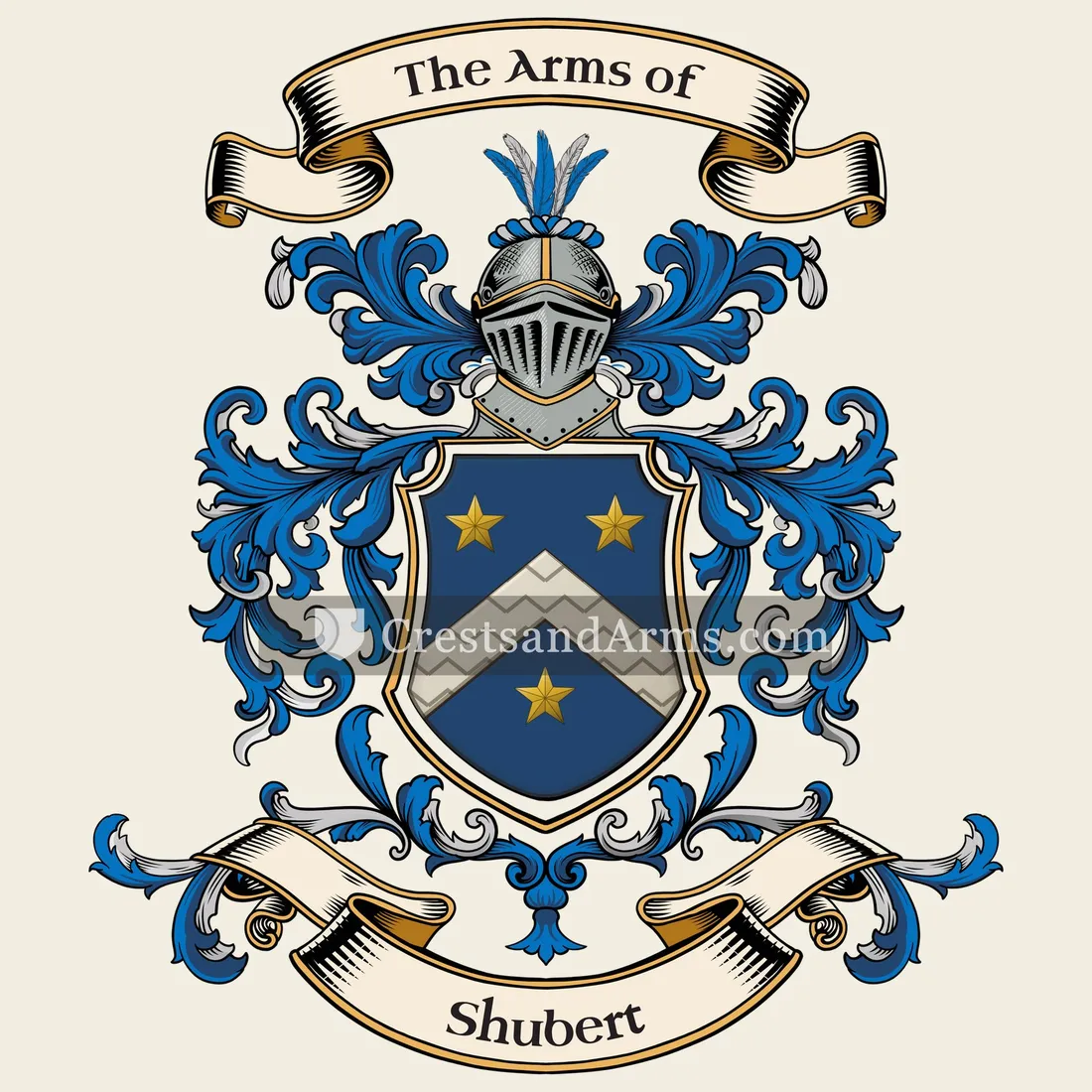
Meaning of the Shubert family crest colors & symbols
Symbols on this shield
chevronProtection, and faithful service completed
mulletThe third son, and a divine quality from above
Colours
Blue (Azure)Means: Loyalty and truth
Silver (Argent)Means: Peace and sincerity
Gold (Or)Means: Generosity
Historical info
Source
J. B. Rietstap, Armorial Général, Gouda: G. B. van Goor Zonen, 1884–87
Blazon (the actual original written record)
“D'azur au chev. ployé d'arg., acc. de trois étoiles d'or, et un collier de sept perles au nat., suspendu au chev., lesdites perles diminuant en grosseur vers dextre et”
BohemiaPrague, c. 1866
Digital archive packCoat of arms PNG, gold border print PDF, vector SVG and the certificate of authenticity. Sent to your email in minutes.
The body that granted and recorded arms in Bohemia in this period.
Franz Joseph I of Austria
Sovereign of the period
Franz Joseph I of Austria
1848–1916
Reigning in Poland when the Shubert arms are first recorded.
How Arms Worked in Bohemia
Bohemian heraldry functioned as a system tied strictly to noble status and royal favor. Arms were typically granted by the monarch to individuals, then shared by all members of that family line. If a family branch wanted to distinguish itself, they often petitioned the chancery for a unique augmentation to their existing shield design.
Granting authority
The Bohemian court chancery managed the legal process of granting and confirming coats of arms for the kingdom.
How they got arms
Families usually obtained their arms through a formal royal grant or by proving their noble status to the chancery.
Where arms were recorded
Official records of these grants were kept in the Bohemian Land Rolls, which began documenting these honors in 1348.
The family's standing
Recorded among the armigerous families of Bohemia.
Origin & History of the Shubert Family in Bohemia
The name Shubert is a variation of the German occupational surname Schubert, which historically identified a person who worked as a shoemaker. In the region of Bohemia, this name became well-established as families moved into urban centers like Prague to practice their trades. By the mid-19th century, the city was a bustling hub of industry and culture under the Austrian Empire. Records confirm that members of the Shubert family were living and working in Prague by 1866. During this period, the city was undergoing significant social changes, and families with this name were often integrated into the growing middle class of artisans and merchants. Their presence in the city during this time reflects the broader movement of skilled workers who helped shape the economic life of Bohemia before the turn of the century.
Shubert Meaning & Related Branches
Root word
Schuh
A covering for the foot.
This name
ShubertAn occupational surname for a shoemaker or cobbler.
also spelled
Schubart
Shubert
Documented Sources
J. B. Rietstap, Armorial Général, Gouda: G. B. van Goor Zonen, 1884–87
Kappeler, Andreas. Rußland als Vielvölkerreich: Entstehung, Geschichte, Zerfall. 1992
Plakans, Andrejs. The Kinship Universe in Late Imperial Latvia. 1995
Raun, Toivo U. Estonia and the Estonians. 2001
Latvian State Historical Archives, Fond 235: Livland Gouvernement Administration Records
Estonian Historical Archives, Fond 854: Livonian Nobility and Landowner Registries
Digital archive packCoat of arms PNG, gold border print PDF, vector SVG and the certificate of authenticity. Sent to your email in minutes.


 cross symbolChristian faith and service
 swordJustice, and military honour
 mulletThe third son, and a divine quality from above
 cross symbolChristian faith and service
 swordJustice, and military honour
 mulletThe third son, and a divine quality from above


 roseThe seventh son, and beauty with grace
 fleur de lisPurity, light, and the sixth son


 chevronProtection, and faithful service completed