Map of Finland showing where the Shulman arms are recorded
The Shulman arms were recorded in Livonia, c. 1719.
Livonia was Baltic country held by a small number of landed families who kept their estates for centuries. Land there passed down whole rather than being divided, and long unbroken tenure is what fills a register.
This is where the arms were entered in the register. Families often moved to other parts of the country, so the same name can turn up in more than one region.
The body that granted and recorded arms in Finland in this period.
How Arms Worked in Finland
Nobility in Finland held the exclusive right to register their coats of arms with the House of Nobility. These symbols were tied to the family name and were inherited by all members of the noble house. If a family branch moved or changed status, they kept their original design to maintain their identity within the official records.
Granting authority
The Finnish House of Nobility served as the official body that managed and protected all noble coats of arms.
How they got arms
Families received their arms through formal letters of nobility or by having their existing ancestral symbols confirmed by the House.
Where arms were recorded
All approved coats of arms were officially recorded in the Finnish House of Nobility Armorial starting in 1818.
The family's standing
Recorded among the armigerous families of Livonia.
Origin & History of the Shulman Family in Finland
The surname Shulman is an occupational name that originated from the Yiddish and German words for school and man. In the context of Eastern European Jewish life, a shul was the center of the community, serving as both a synagogue and a place for religious study. The title of Shulman was typically given to the sexton or the caretaker who managed the daily operations of the synagogue. By 1719, families carrying this name were already established in the region of Livonia, which was a territory located in present-day Latvia and Estonia. These early ancestors likely played a vital role in maintaining the religious and social infrastructure of their local communities during a time when Livonia was under the control of the Russian Empire. Because the name was tied to a specific communal duty, it reflects a family history rooted in service, education, and the preservation of cultural traditions within the Baltic region.
Related Branches & Arms
Root word
Schul
A German word derived from the Latin schola meaning school.
This name
ShulmanAn occupational surname for a person who worked at or attended a school or synagogue.
also spelled
Schulmann
Schullman
Schulmans
Shulman
Documented Sources
J. B. Rietstap, Armorial Général, Gouda: G. B. van Goor Zonen, 1884–87
Beider, Alexander, A Dictionary of Jewish Surnames from the Russian Empire, 1993
Kaganoff, Benzion C., A Dictionary of Jewish Names and Their History, 1977
Latvian State Historical Archives, Livland Consistory Records (Vidzemes evaņģēliski luteriskās baznīcas konsistorijas fonds)
Digital archive packCoat of arms PNG, gold border print PDF, vector SVG and the certificate of authenticity. Sent to your email in minutes.


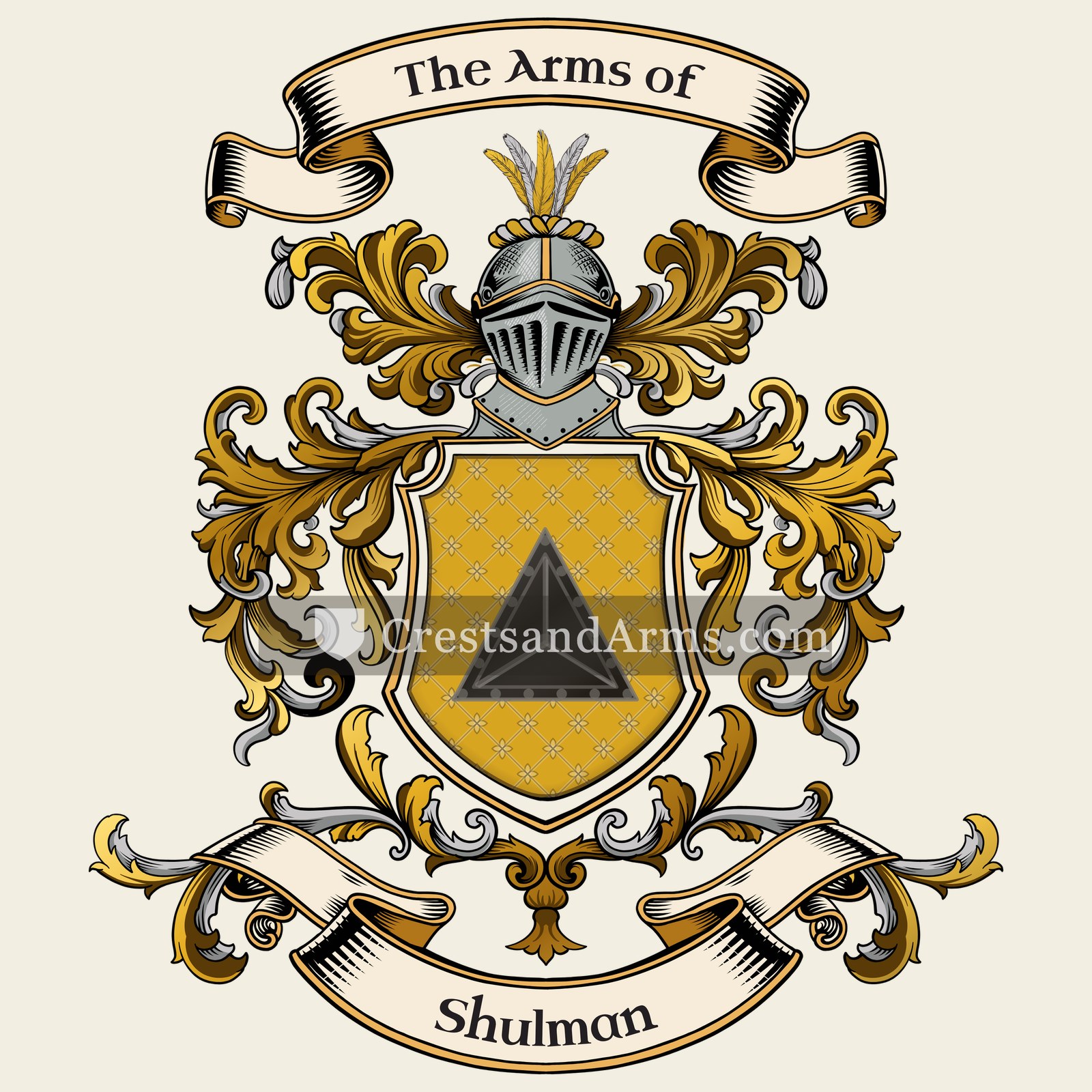
 triangleThe Trinity, and stability
 triangleThe Trinity, and stability