A record of documented arms, meaning and origin, researched for the Shutter family lines. Documented in 2 countries.
Reg. 6345 · German, T–V
Meaning of the Shutter family crest colors & symbols
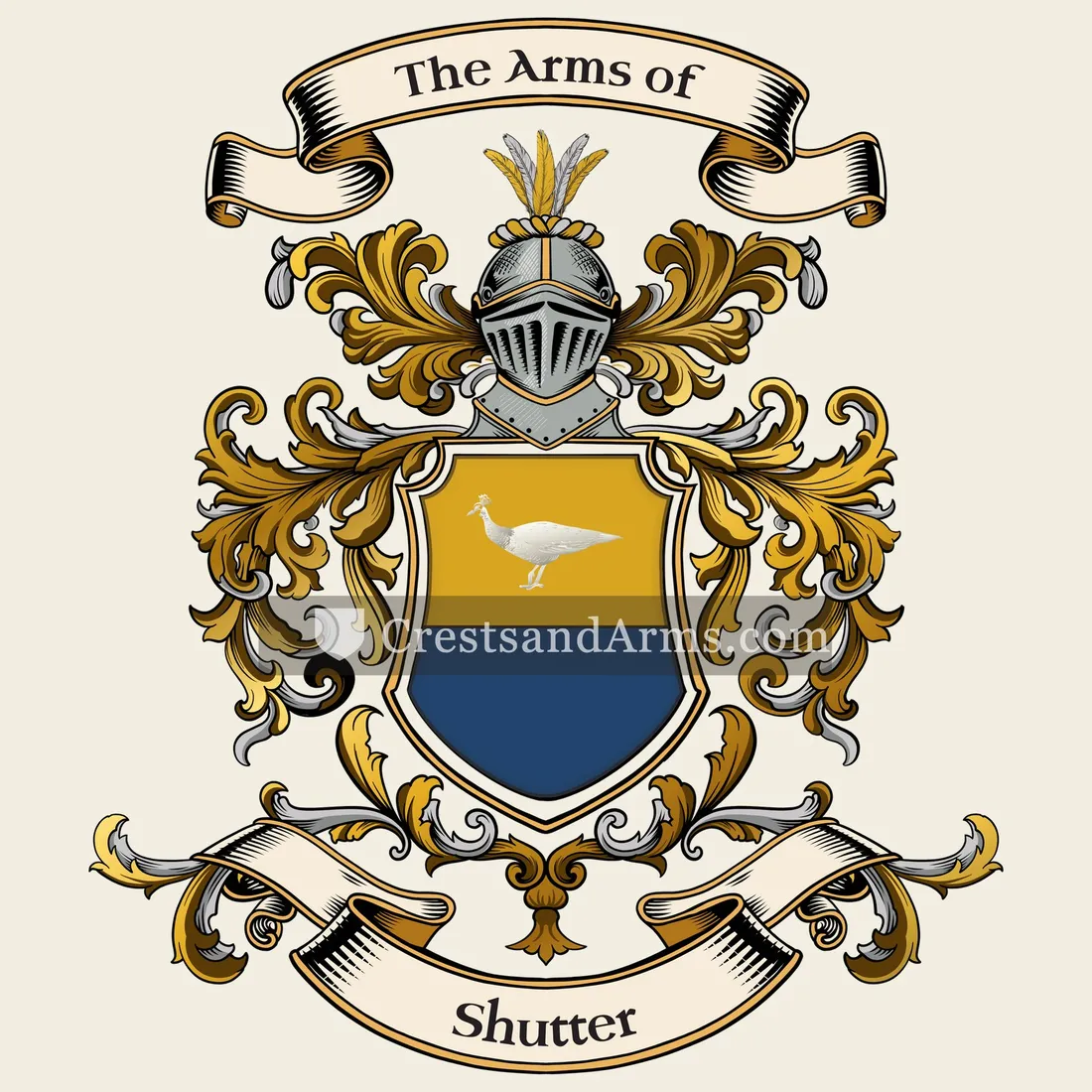
Symbols on this shield
peacockBeauty, power and knowledge
Colours
Gold (Or)Means: Generosity
Blue (Azure)Means: Loyalty and truth
Historical info
Source
J. B. Rietstap, Armorial Général, Gouda: G. B. van Goor Zonen, 1884–87
Blazon (the actual original written record)
“Coupé d'or sur azur ; à une tête et col de paon au nat., mouv. d'une couronne d'or, br. sur le coupé. Cq. cour. C.: un paon rouant au nat., cont. L. d'or et d'azur.”
BavariaBavaria, c. 1570
Digital archive packCoat of arms PNG, gold border print PDF, vector SVG and the certificate of authenticity. Sent to your email in minutes.
Map of Germany showing where the Shutter arms are recorded
The Shutter arms were recorded in Bavaria, c. 1570.
Bavaria was a country of old landed families and walled market towns. Estates passed down the same line for centuries, and both the landowners and the leading townsmen kept arms, which is why so many Bavarian names sit in the registers.
This is where the arms were entered in the register. Families often moved to other parts of the country, so the same name can turn up in more than one region.
The body that granted and recorded arms in Germany in this period.
Maximilian II, Holy Roman Emperor
Sovereign of the period
Maximilian II, Holy Roman Emperor
1564–1576
Reigning in Germany when the Shutter arms are first recorded.
How Arms Worked in Germany
In the Holy Roman Empire, coats of arms were often granted to individuals by the Emperor or his representatives. These arms were then passed down through the generations to all legitimate descendants of the original holder. Younger branches of a family usually kept the same shield design without needing to change it, as the arms belonged to the entire lineage.
Granting authority
The Holy Roman Emperor held the sole power to grant new coats of arms throughout his vast imperial territories.
How they got arms
Families typically obtained their coats of arms through a formal imperial grant or by proving their noble status to the authorities.
Where arms were recorded
These grants were officially recorded in the Imperial Chancery registers, which began keeping formal records of such honors during the Middle Ages.
The family's standing
Recorded among the armigerous families of Bavaria.
Origin & History of the Shutter Family in Germany
The family name Shutter, often appearing in German records as Schutter or Schütter, has deep roots in the southern region of Bavaria. By 1570, families bearing this name were already established members of the local community. The name likely originated as a descriptive occupational surname, derived from the Middle High German word "schütze," which referred to a marksman, a guard, or someone responsible for protecting land and property. During the sixteenth century, Bavaria was a landscape of small villages and agricultural estates, and individuals with this name often served as watchmen or foresters who monitored the borders of local territories. As these families grew, they became integrated into the social fabric of the region, contributing to the development of local trade and the management of rural lands. This early history reflects a time when surnames were becoming permanent identifiers, linking these individuals to their specific roles and duties within the Bavarian countryside.
Meaning of the Shutter family crest colors & symbols
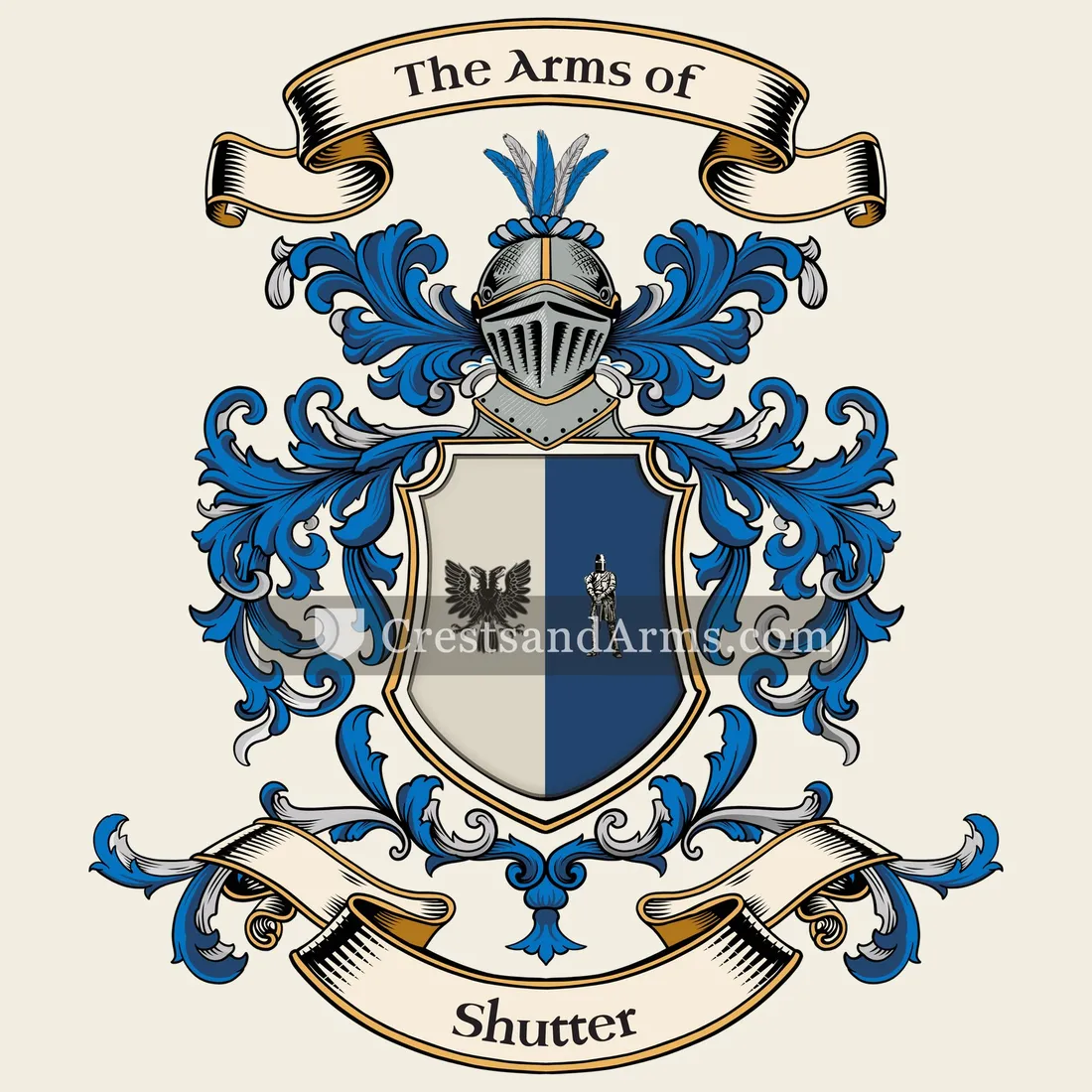
Symbols on this shield
eagleNobility, strength and a keen mind
knightChivalry and service in arms
Colours
Silver (Argent)Means: Peace and sincerity
Blue (Azure)Means: Loyalty and truth
Black (Sable)Means: Constancy
Historical info
Source
J. B. Rietstap, Armorial Général, Gouda: G. B. van Goor Zonen, 1884–87
Blazon (the actual original written record)
“Parti: au 1 d'arg. à la demi-aigle de sa., mouv. du parti; au 2 d'azur à un homme tenant arc et flèche de sa main dextre. C.: un faisceau de trois flèches.”
Netherlandsc. 1815
Digital archive packCoat of arms PNG, gold border print PDF, vector SVG and the certificate of authenticity. Sent to your email in minutes.
Map of Netherlands showing where the Shutter arms are recorded
The Shutter arms were recorded in Netherlands, c. 1815.
Arms such as these were typically recorded in Friesland.
Friesland was low, wet country on the northern coast of the Netherlands, farmed by families who had held the same land for centuries. Free landholders were unusually common there, and a free landholder could carry arms.
This is where the arms were entered in the register. Families often moved to other parts of the country, so the same name can turn up in more than one region.
Region
Friesland
First recorded
1815
Granting Authority for the Shutter Arms
Hoge Raad van Adel
Photograph made by me · CC BY-SA 3.0
The body that granted and recorded arms in Netherlands in this period.
William I of the Netherlands
Sovereign of the period
William I of the Netherlands
1815–1840
Reigning in Germany when the Shutter arms are first recorded.
How Arms Worked in Netherlands
In the Netherlands, coats of arms were often used by noble families and those who held specific public offices. These arms were passed down through the generations to legitimate descendants. Younger branches of a family usually kept the original design without needing to add special marks. This system ensured that the family identity remained clear and consistent over many years.
Granting authority
The Hoge Raad van Adel is the official body that regulates and manages noble titles and coats of arms in the Netherlands.
How they got arms
Families typically obtained their coats of arms through official royal grants or by proving their long-standing historical use of the symbols.
Where arms were recorded
Coats of arms are officially recorded in the registers held by the Hoge Raad van Adel, which began its work in 1814.
The family's standing
Recorded among the armigerous families of Netherlands.
Origin & History of the Shutter Family in Netherlands
The history of the surname Shutter in the Netherlands is deeply connected to the northern province of Friesland. By the early 19th century, the family was well-established in this region, which was a time of significant change for Dutch naming customs. In 1811, under the rule of Napoleon Bonaparte, the Dutch government required all citizens to adopt permanent, hereditary surnames to improve tax collection and military conscription. While many families in Friesland had used traditional patronymic names based on their father’s first name, the Shutter family name likely emerged during this period as a fixed identifier. The name itself is thought to be an occupational or descriptive term, potentially linked to the Dutch word "schutter," which refers to a marksman or a member of a local civic guard. These guards were essential to Dutch community life for centuries, as they were responsible for maintaining public order and defending their towns. By 1815, families bearing this name were documented as active participants in the local economy and social structure of the Frisian countryside.
Shutter Meaning & Related Branches
Root word
Schütten
To pour, shed, or dispense.
This name
ShutterAn occupational surname for someone who worked as a pourer or grain measurer.
also spelled
Schuttere
Schutters
Schutterer
Shuter
Documented Sources
J. B. Rietstap, Armorial Général, Gouda: G. B. van Goor Zonen, 1884–87
Bahlow, Hans, Deutsches Namenlexikon: Familien- und Vornamen nach Ursprung und Sinn erklärt, 1967
Heintze, Albert, Die deutschen Familien-Namen: geschichtlich, geographisch, sprachlich, 1903


 peacockBeauty, power and knowledge
 peacockBeauty, power and knowledge


 eagleNobility, strength and a keen mind
 knightChivalry and service in arms