A record of documented arms, meaning and origin, researched for the Sieber family lines. Documented in 2 countries.
Reg. 2589 · German, T–V
Meaning of the Sieber family crest colors & symbols
Symbols on this shield
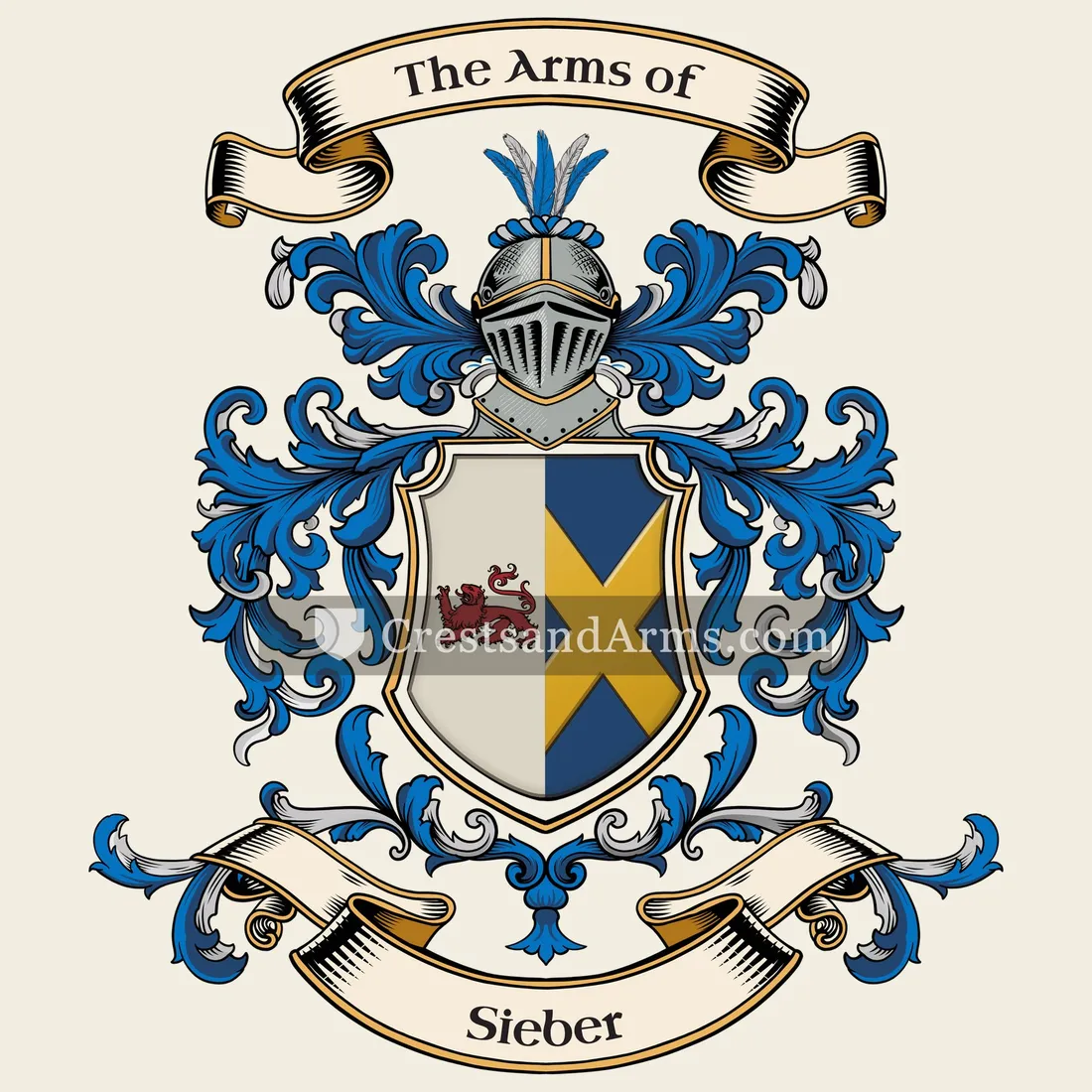
saltireResolution, and St Andrew's cross
lionCourage, strength and royalty
Colours
Silver (Argent)Means: Peace and sincerity
Blue (Azure)Means: Loyalty and truth
Gold (Or)Means: Generosity
Red (Gules)Means: Military strength
Historical info
Source
J. B. Rietstap, Armorial Général, Gouda: G. B. van Goor Zonen, 1884–87
Blazon (the actual original written record)
“Parti: au 1 d'arg. au lion de gu., supp. de sa patte dextre un crible du même; au 2 d'azur au saut. alésé d'or. Cq. cour. C.: un homme iss., hab. d'un parti d'or et d'azur, coiffé d'un bonnet pointu pareil, tenant de sa main dextre un crible de gu.; entre deux prob. coupées, à dextre d'or sur azur, à sen. de gu. sur arg. L. conformes aux émaux des prob.”
GermanyCham Bav, c. 1631
Digital archive packCoat of arms PNG, gold border print PDF, vector SVG and the certificate of authenticity. Sent to your email in minutes.
Map of Germany showing where the Sieber arms are recorded
The Sieber arms were recorded in Cham Bav, c. 1631.
This is where the arms were entered in the register. Families often moved to other parts of the country, so the same name can turn up in more than one region.
The body that granted and recorded arms in Germany in this period.
Ferdinand II, Holy Roman Emperor
Sovereign of the period
Ferdinand II, Holy Roman Emperor
1619–1637
Reigning in Germany when the Sieber arms are first recorded.
How Arms Worked in Germany
In the Holy Roman Empire, coats of arms were often granted to individuals by the Emperor or his representatives. These arms were then passed down through the generations to all legitimate descendants of the original holder. Younger branches of a family usually kept the same shield design without needing to change it, as the arms belonged to the entire lineage.
Granting authority
The Holy Roman Emperor held the sole power to grant new coats of arms throughout his vast imperial territories.
How they got arms
Families typically obtained their coats of arms through a formal imperial grant or by proving their noble status to the authorities.
Where arms were recorded
These grants were officially recorded in the Imperial Chancery registers, which began keeping formal records of such honors during the Middle Ages.
The family's standing
Recorded among the armigerous families of Germany.
Origin & History of the Sieber Family in Germany
The surname Sieber originated as a descriptive name rooted in the German language, likely evolving from the Middle High German word *sîber*, which referred to a person who worked with a sieve or a sifter. This suggests that the earliest ancestors were likely craftsmen, such as millers or farmers, who used these tools in their daily labor. By the early 17th century, the family had established a clear presence in the town of Cham, located in the Upper Palatinate region of Bavaria. Records from 1631 confirm that members of the Sieber family were living in this area during a time of significant upheaval caused by the Thirty Years' War. Because Cham served as a strategic point for trade and military movement, the family likely navigated the challenges of this era by maintaining their roles within the local community. Over time, the name became firmly anchored in the region, reflecting the transition of the family from common laborers to established residents of the Bavarian landscape.
Meaning of the Sieber family crest colors & symbols
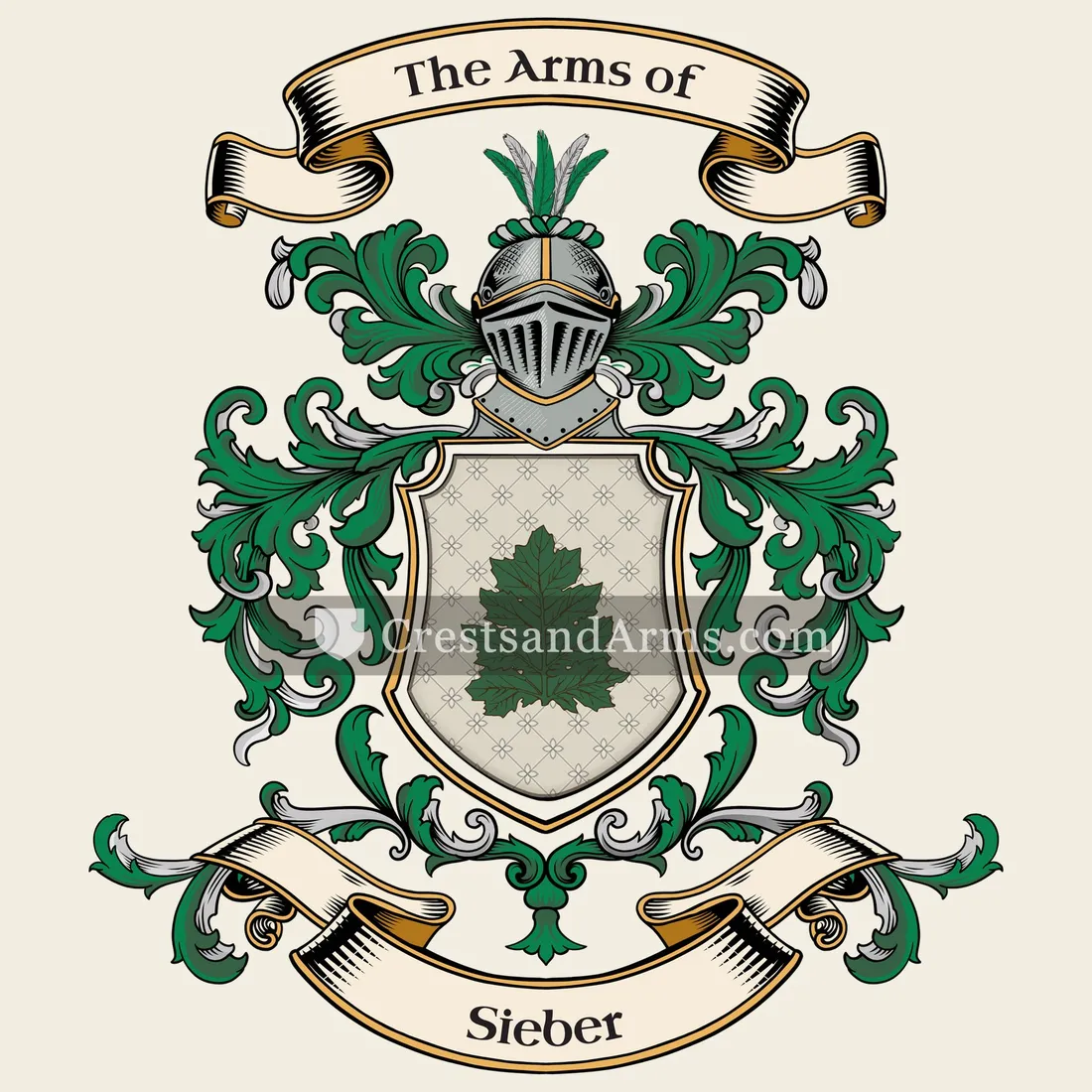
Symbols on this shield
leafHappiness and abundance
Colours
Silver (Argent)Means: Peace and sincerity
Green (Vert)Means: Hope
Historical info
Source
J. B. Rietstap, Armorial Général, Gouda: G. B. van Goor Zonen, 1884–87
Blazon (the actual original written record)
“D'arg. à une feuille de tilleul de sin., la tige en bas. C.: un homme iss., hab. de sin. au rabat d'arg., rebr. et bout. du même, coiffé d'un bonnet pointu de sin., retr. et houppé d'arg., tenant de sa main dextre un livre relié de gu., doré sur tranche, à fermoirs d'or, la sen. appuyée sur sa hanche.”
SwitzerlandBâle, c. 1745
Digital archive packCoat of arms PNG, gold border print PDF, vector SVG and the certificate of authenticity. Sent to your email in minutes.
Map of Switzerland showing where the Sieber arms are recorded
The Sieber arms were recorded in Bâle, c. 1745.
This is where the arms were entered in the register. Families often moved to other parts of the country, so the same name can turn up in more than one region.
The body that granted and recorded arms in Switzerland in this period.
How Arms Worked in Switzerland
In Switzerland, coats of arms were not restricted to the nobility and were often adopted by common citizens and families. These symbols were passed down through generations to show family identity. When branches of a family grew, they often changed small details of the design to distinguish their own line from the original group.
Granting authority
Cantonal and civic authorities managed the use of coats of arms within their specific regions and local jurisdictions.
How they got arms
Families typically assumed their own coats of arms based on local custom rather than receiving them from a central monarch.
Where arms were recorded
Arms were recorded in various cantonal and civic registers starting from the fourteenth century throughout the Swiss region.
The family's standing
Recorded among the armigerous families of Switzerland.
Origin & History of the Sieber Family in Switzerland
The surname Sieber has deep roots in the German-speaking regions of Switzerland, where it functioned as a descriptive name for individuals who worked as sieve makers or grain sifters. By the mid-eighteenth century, the family had established a notable presence in the city of Bâle. Records confirm that members of the Sieber family were active residents there by 1745, participating in the city’s vibrant trade and social life during a period of significant economic growth. As the family settled into the urban environment of Bâle, they integrated into the local guilds and civic structures that defined Swiss life at the time. Over the following generations, the name became firmly associated with the region, reflecting the steady movement and professional contributions of families who helped shape the historical identity of the Swiss cantons.
Sieber Meaning & Related Branches
Root word
Siegbert
Derived from the Germanic elements for victory and bright or famous.
This name
SieberA topographic name for someone living near a sieve-maker or a strainer.
also spelled
Syber
Zeeber
Related arms
Debschützsimilar arms
Hasenweilersimilar arms
Mauschwitzsimilar arms
Reisnersimilar arms
Documented Sources
J. B. Rietstap, Armorial Général, Gouda: G. B. van Goor Zonen, 1884–87
Bahlow, Hans, Deutsches Namenlexikon: Familien- und Vornamen nach Ursprung und Sinn erklärt, 1967
Stadtarchiv Cham, Bürgerbücher und Ratsprotokolle der Stadt Cham, 1600–1650
Heintze, Albert, Die deutschen Familiennamen: geschichtlich, geographisch, sprachlich, 1903
Digital archive packCoat of arms PNG, gold border print PDF, vector SVG and the certificate of authenticity. Sent to your email in minutes.


 saltireResolution, and St Andrew's cross
 lionCourage, strength and royalty
 saltireResolution, and St Andrew's cross
 lionCourage, strength and royalty


 leafHappiness and abundance