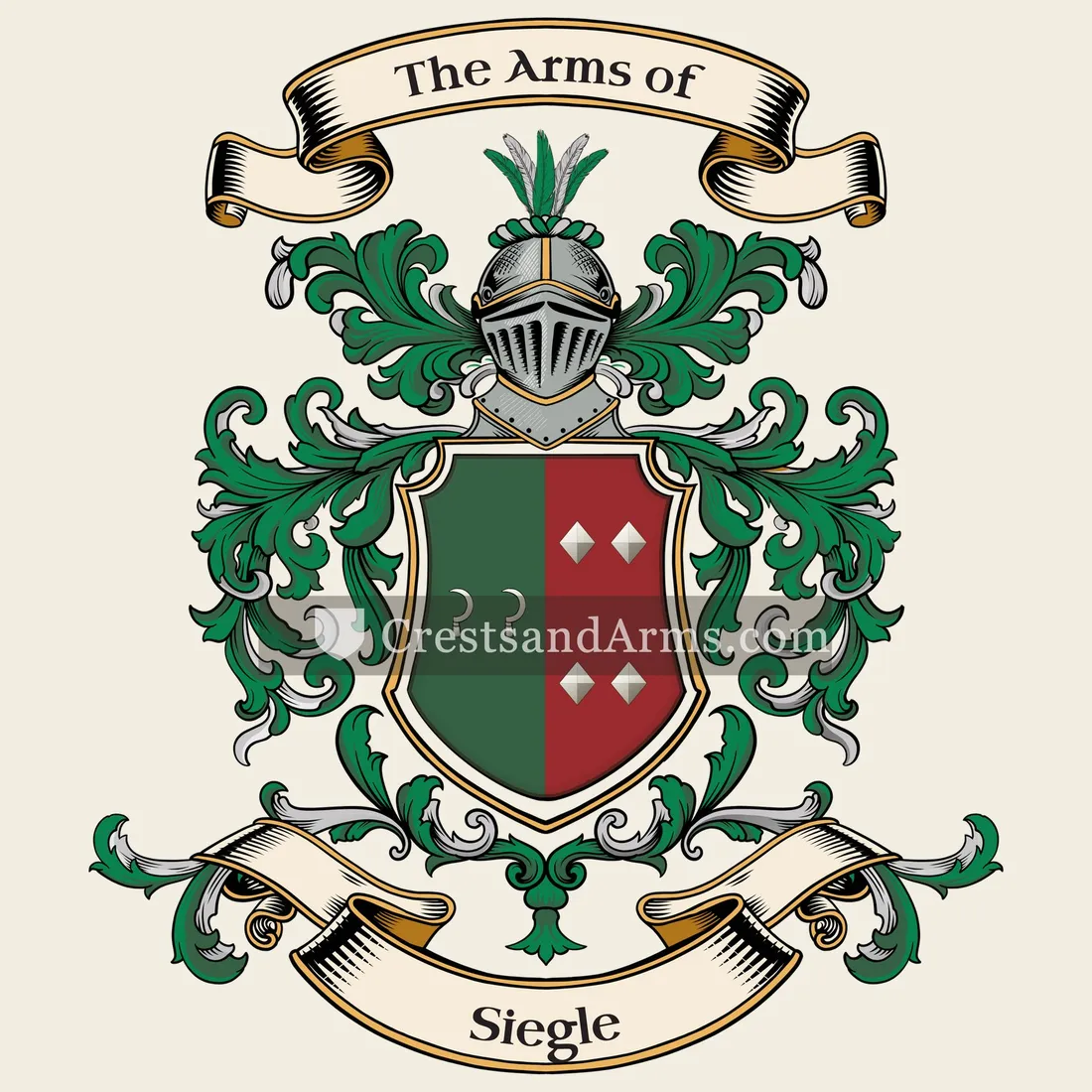
A record of documented arms, meaning and origin, researched for the Siegle family of Germany.
Reg. 4757 · German, T–V
Meaning of the Siegle family crest colors & symbols
Symbols on this shield
sickleThe harvest, and the reaping of what was sown
lozengeHonour and nobility, and the arms of a woman
Colours
Green (Vert)Means: Hope
Red (Gules)Means: Military strength
Silver (Argent)Means: Peace and sincerity
Historical info
Source
J. B. Rietstap, Armorial Général, Gouda: G. B. van Goor Zonen, 1884–87
Blazon (the actual original written record)
“Parti: au 1 de sin. à deux fau-cilles affr. d'arg.; au 2 de gu. à quatre los. d'arg., rangées en deux bandes, 2 et 2. C.: une colombe d'arg., tenant en son bec un rameau d'olivier de sin. L.: à dextre d'arg. et de sin., à sen. d'arg. et de gu.”
Germanyc. 1765
Digital archive packCoat of arms PNG, gold border print PDF, vector SVG and the certificate of authenticity. Sent to your email in minutes.
Map of Germany showing where the Siegle arms are recorded
The Siegle arms were recorded in Germany, c. 1765.
Arms such as these were typically recorded in Bavaria.
Bavaria was a country of old landed families and walled market towns. Estates passed down the same line for centuries, and both the landowners and the leading townsmen kept arms, which is why so many Bavarian names sit in the registers.
This is where the arms were entered in the register. Families often moved to other parts of the country, so the same name can turn up in more than one region.
The body that granted and recorded arms in Germany in this period.
Francis I, Holy Roman Emperor
Sovereign of the period
Francis I, Holy Roman Emperor
1745–1765
Reigning in Germany when the Siegle arms are first recorded.
How Arms Worked in Germany
In the Holy Roman Empire, coats of arms were often granted to individuals by the Emperor or his representatives. These arms were then passed down through the generations to all legitimate descendants of the original holder. Younger branches of a family usually kept the same shield design without needing to change it, as the arms belonged to the entire lineage.
Granting authority
The Holy Roman Emperor held the sole power to grant new coats of arms throughout his vast imperial territories.
How they got arms
Families typically obtained their coats of arms through a formal imperial grant or by proving their noble status to the authorities.
Where arms were recorded
These grants were officially recorded in the Imperial Chancery registers, which began keeping formal records of such honors during the Middle Ages.
The family's standing
Recorded among the armigerous families of Germany.
Origin & History of the Siegle Family in Germany
The surname Siegle is a variation of the Germanic name Siegfried, which combines the roots for victory and peace. By the middle of the 18th century, families bearing this name were well-established in the Bavarian region of Germany. During this period, the Siegle family lived within a society defined by agrarian traditions and local craft guilds. Life in 1765 Bavaria was shaped by the influence of the Holy Roman Empire, where families often stayed in the same villages for generations to work the land or practice specialized trades. As the name evolved from its older roots, it became a marker of identity for families who were deeply connected to the social and economic structures of southern Germany. These early ancestors lived through a time of significant cultural change, helping to preserve the regional heritage that defines the name today.
Siegle Meaning & Related Branches
Root word
Sieg
Derived from the Old High German word for victory.
This name
SiegleA diminutive form referring to a person who is victorious or triumphant.
also spelled
Siegels
Siegele
Siegel de la Motte
Seegel
Documented Sources
J. B. Rietstap, Armorial Général, Gouda: G. B. van Goor Zonen, 1884–87
Bahlow, Hans. Deutsches Namenlexikon: Familien- und Vornamen nach Ursprung und Sinn erklärt. 1967


 sickleThe harvest, and the reaping of what was sown
 lozengeHonour and nobility, and the arms of a woman
 sickleThe harvest, and the reaping of what was sown
 lozengeHonour and nobility, and the arms of a woman