Map of Denmark showing where the Sievers arms are recorded
The Sievers arms were recorded in Denmark, c. 1722.
Arms such as these were typically recorded in Sjaælland.
Zealand held the Danish court, the crown's offices and Copenhagen itself. Families who served the king kept estates within reach of it, and royal service was the ordinary route to a coat of arms.
This is where the arms were entered in the register. Families often moved to other parts of the country, so the same name can turn up in more than one region.
The body that granted and recorded arms in Denmark in this period.
Frederik IV of Denmark
Sovereign of the period
Frederik IV of Denmark
1699–1730
Reigning in Denmark when the Sievers arms are first recorded.
How Arms Worked in Denmark
Danish heraldry during this period was closely tied to noble status and royal favor rather than being open to all citizens. Arms were typically granted by the monarch to individuals, and these symbols were then shared by all members of the noble house. If a family line died out, the right to use those specific arms ended with them.
Granting authority
The Danish royal chancery held the power to issue and regulate official coats of arms for the kingdom.
How they got arms
Families usually received their arms through a formal royal grant that confirmed their noble status and rights.
Where arms were recorded
These grants were officially recorded in the Danish Royal Chancery records starting in the sixteenth century.
The family's standing
Recorded among the armigerous families of Denmark.
Origin & History of the Sievers Family in Denmark
The surname Sievers traces its roots back to the Low German name Sievert, which evolved from the ancient Germanic name Sigifrid, meaning victory and peace. By the early 18th century, the name had established a presence in the region of Sjælland, Denmark. During this period, Denmark was undergoing significant social changes, and families often moved between rural parishes to find work in agriculture or trade. The presence of the Sievers family in Sjælland by 1722 suggests they were part of a broader movement of families who carried North German naming traditions into the Danish landscape. As the name took root in local church records, it became a permanent part of the regional identity. These early ancestors lived through a time when Denmark was transitioning toward modern census keeping, allowing their presence to be documented in the official records of the Danish state.
Coat of Arms & Family Crest Details
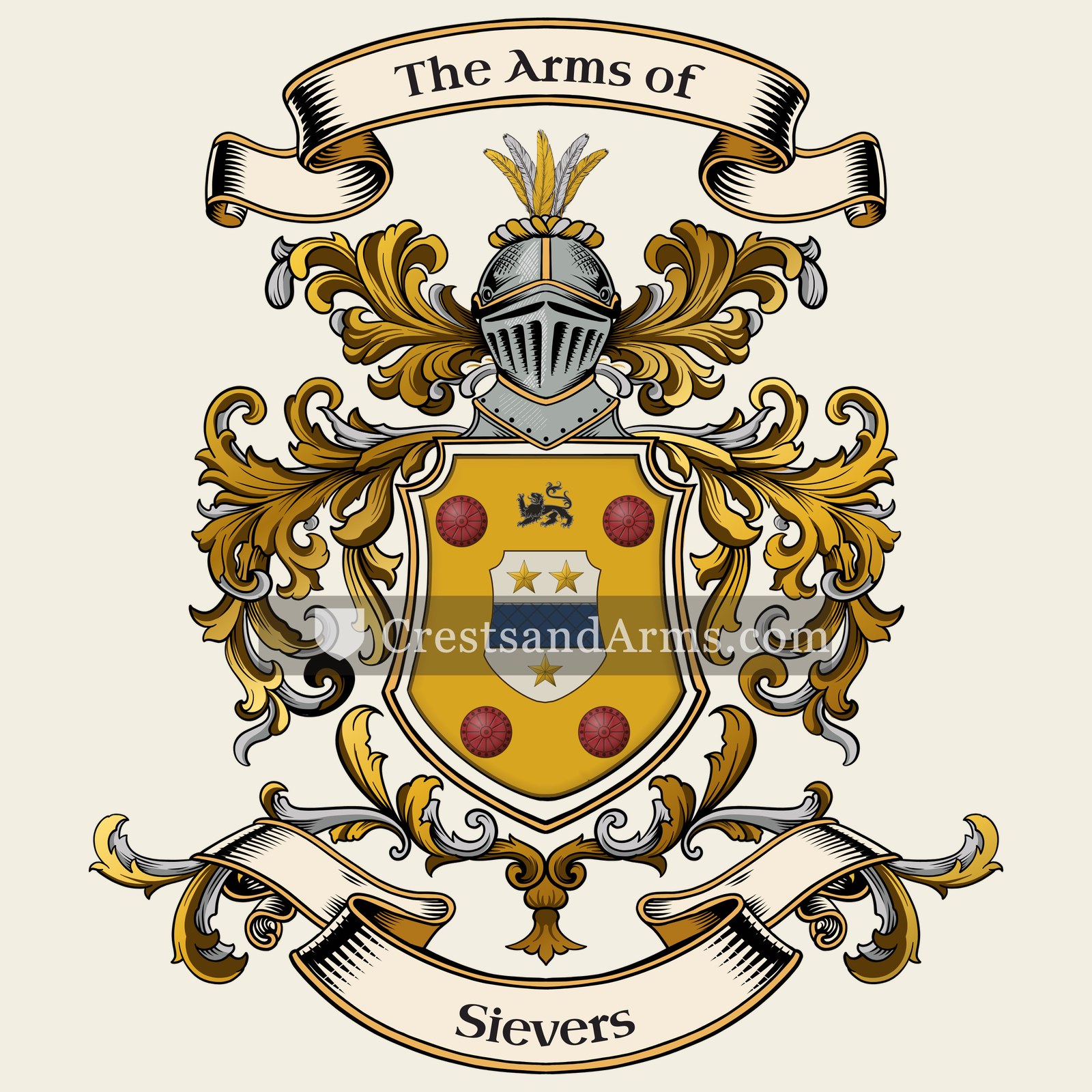
Symbols on this shield
fessThe military belt, and readiness to serve
lionCourage, strength and royalty
roundelA coin, and one who has been to the crusades
mulletThe third son, and a divine quality from above
Colours
Gold (Or)Means: Generosity
Silver (Argent)Means: Peace and sincerity
Blue (Azure)Means: Loyalty and truth
Black (Sable)Means: Constancy
Red (Gules)Means: Military strength
Historical info
Source
J. B. Rietstap, Armorial Général, Gouda: G. B. van Goor Zonen, 1884–87
Blazon (the actual original written record)
“D'or au lion de sa., arm. et lamp. de gu. Sur le tout d'arg. à la fasce d'azur, ch. de trois étoiles d'or et acc. de quatre boules de gu., 3 rangées en chef et 1 posée en p. Deux cq. cour. C.: 1° un lion iss. et cont. de sa., arm. et lamp. de gu.; entre deux prob. d'or; 1. d'or et de sa.; 2° deux boules accostées de gu., soutenant une étoile d'or; entre un vol coupé alt. d'azur et de gu.; l. d'arg. et de gu.”
LivoniaEsthonie · Livonia, c. 1745
Digital archive packCoat of arms PNG, gold border print PDF, vector SVG and the certificate of authenticity. Sent to your email in minutes.
Map of Poland showing where the Sievers arms are recorded
The Sievers arms were recorded in Livonia, c. 1745.
Livonia was Baltic country held by a small number of landed families who kept their estates for centuries. Land there passed down whole rather than being divided, and long unbroken tenure is what fills a register.
This is where the arms were entered in the register. Families often moved to other parts of the country, so the same name can turn up in more than one region.
Region
Livonia
Town
Esthonie
First recorded
1745
Granting Authority for the Sievers Arms
Ennoblement by the Sejm
Author: Olek Remesz · CC BY-SA 3.0
The body that granted and recorded arms in Poland in this period.
Augustus III of Poland
Sovereign of the period
Augustus III of Poland
1733–1763
Reigning in Denmark when the Sievers arms are first recorded.
How Arms Worked in Poland
Polish noble families shared a single coat of arms across many different surnames, creating large clans rather than individual designs. These symbols were held collectively by all members of the clan regardless of their specific family name. When a new family joined the nobility, they were adopted into an existing clan and began using that group's established shield.
Granting authority
The Sejm, which was the Polish parliament, held the power to grant noble status and the right to bear arms.
How they got arms
Families typically received their coat of arms through a formal act of ennoblement granted by the Sejm for distinguished service.
Where arms were recorded
These grants were officially recorded in the Crown Metrica, which served as the central archive for state documents starting in the sixteenth century.
The family's standing
Recorded among the armigerous families of Livonia.
Origin & History of the Sievers Family in Poland
The history of the Sievers family in the Baltic region is closely tied to the shifting borders and political influence of the eighteenth century. By 1745, records confirm the family was well-established in Livonia, a territory that served as a crossroads between the Russian Empire, the Kingdom of Sweden, and the Polish-Lithuanian Commonwealth. During this era, the Sievers family acted as prominent landowners and administrators who navigated the complex social hierarchies of the Baltic provinces. Their presence in this area was often linked to the service of the Russian crown, which frequently recruited German-speaking families to manage the administrative and military affairs of its western territories. As the influence of the Polish-Lithuanian Commonwealth fluctuated in the surrounding regions, the Sievers family maintained their status by integrating into the local nobility and participating in the governance of the Baltic lands. Their ability to adapt to these changing political landscapes allowed them to remain a significant force in the region for generations.
Related Branches & Arms
Root word
Siegfried
Derived from Germanic elements meaning victory and peace or protection.
This name
SieversA patronymic surname meaning son of Sievert, a variant of the name Siegfried.
also spelled
Sivers
Zeevers
Related arms
Bernardsimilar arms
Cousse (de la) d'Arcelotsimilar arms
Kochsimilar arms
Pettresimilar arms
Documented Sources
J. B. Rietstap, Armorial Général, Gouda: G. B. van Goor Zonen, 1884–87
Nielsen, Oluf. Oldtidsminder i Sjælland. 1872
Krarup, Alfred. Dansk Personalhistorisk Bibliografi. 1935
Rigsarkivet (Danish National Archives), Kirkebøger for Sjællands Stift (Church records for the Diocese of Sjælland)
Rigsarkivet (Danish National Archives), Folketællinger og Mandtaller (Censuses and nominal rolls)
Digital archive packCoat of arms PNG, gold border print PDF, vector SVG and the certificate of authenticity. Sent to your email in minutes.


 mulletThe third son, and a divine quality from above
 fleur de lisPurity, light, and the sixth son
 mulletThe third son, and a divine quality from above
 fleur de lisPurity, light, and the sixth son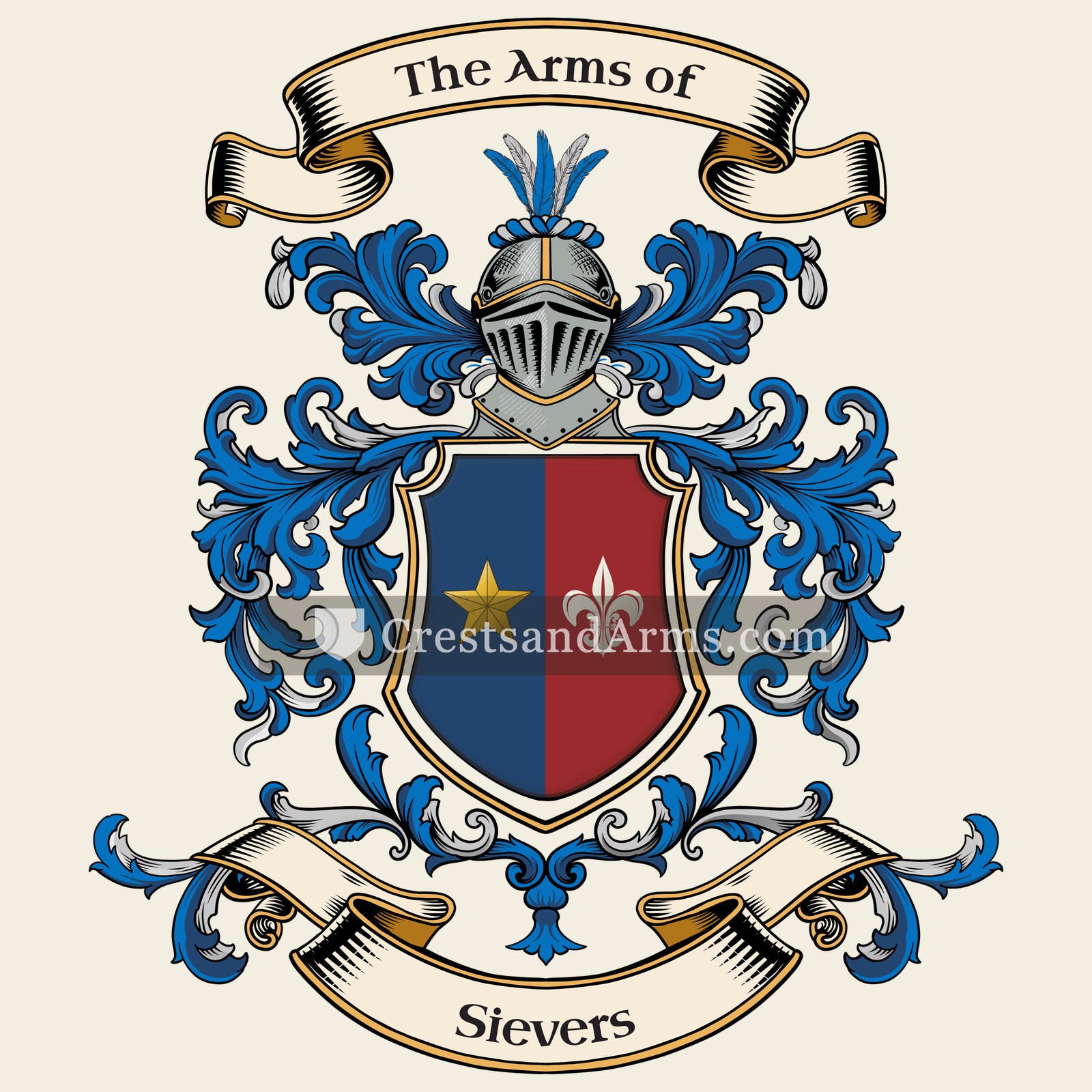


 fessThe military belt, and readiness to serve
 lionCourage, strength and royalty
 roundelA coin, and one who has been to the crusades