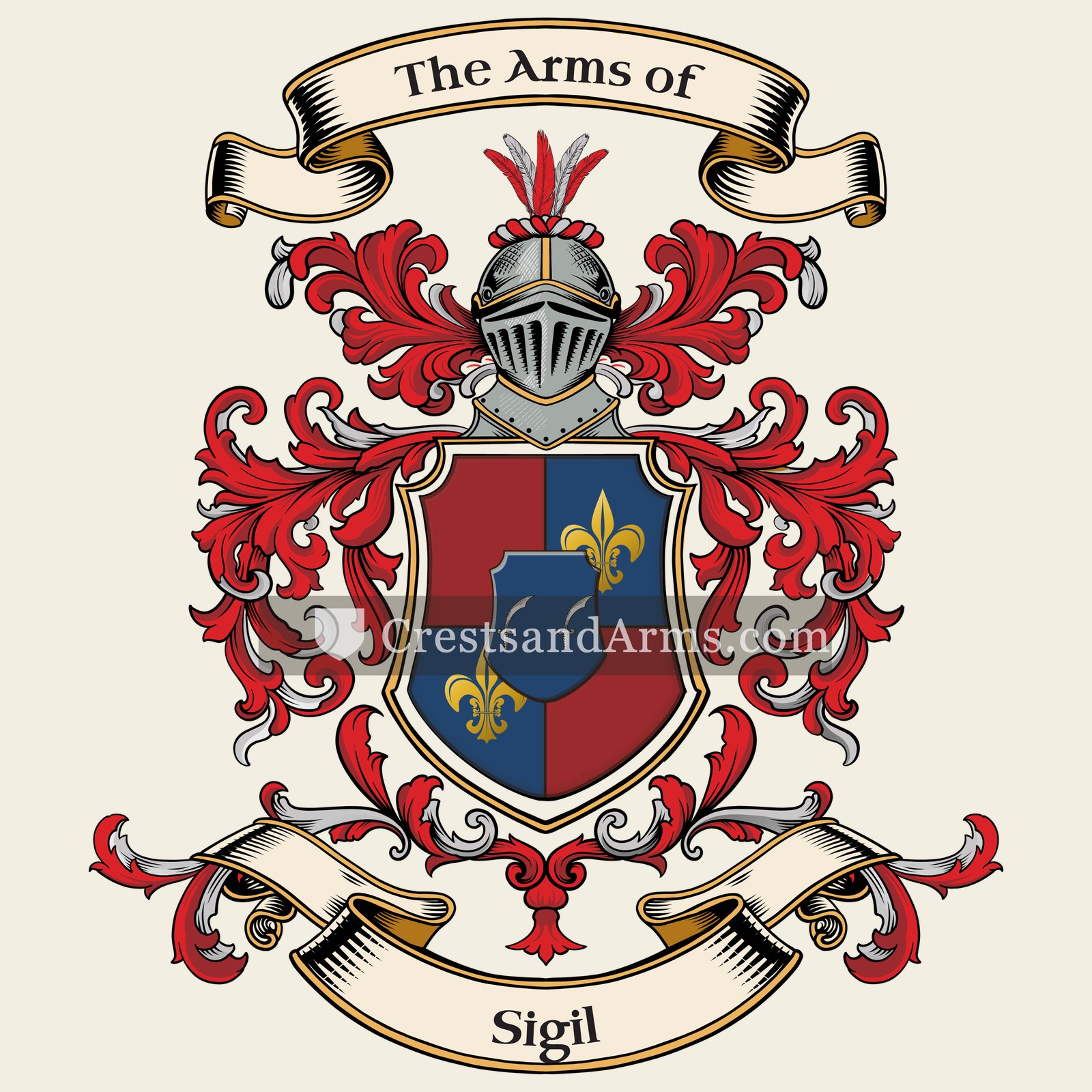
A record of documented arms, meaning and origin, researched for the Sigil family of Germany.
Reg. 9377 · German, T–V
Coat of Arms & Family Crest Details
Symbols on this shield
saltireResolution, and St Andrew's cross
swordJustice, and military honour
fleur de lisPurity, light, and the sixth son
Colours
Red (Gules)Means: Military strength
Blue (Azure)Means: Loyalty and truth
Silver (Argent)Means: Peace and sincerity
Gold (Or)Means: Generosity
Historical info
Source
J. B. Rietstap, Armorial Général, Gouda: G. B. van Goor Zonen, 1884–87
Blazon (the actual original written record)
“Ec., de gu. plein, et d'azur à une fleur-de-lis d'or. Sur le tout d'azur à deux épées d'arg., garnies d'or, passées en saut. Cq. cour. C.: un jeune homme iss., hab. d'un parti de gu. et d'or, au rabat parti d'or et d'azur, le bras dextre rebr. d'or et le bras sen. d'azur, tenant de sa main dextre une épée d'arg., garnie d'or, et de sa sen. une bague d'or, châtonnée d'un rubis. L.: à dextre d'or et de gu., à sen. d'or et d'azur.”
WurttembergWurttemberg, c. 1807
Digital archive packCoat of arms PNG, gold border print PDF, vector SVG and the certificate of authenticity. Sent to your email in minutes.
Map of Germany showing where the Sigil arms are recorded
The Sigil arms were recorded in Wurttemberg, c. 1807.
Wurttemberg was southern German country of small estates and well-off market towns. Both landowners and leading townsmen kept arms there, so the region carries far more names than its size suggests.
This is where the arms were entered in the register. Families often moved to other parts of the country, so the same name can turn up in more than one region.
The body that granted and recorded arms in Germany in this period.
Frederick William III of Prussia
Sovereign of the period
Frederick William III of Prussia
1797–1840
Reigning in Germany when the Sigil arms are first recorded.
How Arms Worked in Germany
Prussian heraldry was strictly tied to social rank and noble status rather than being a free choice for every citizen. These symbols were treated as permanent family property that moved through the generations to all legitimate heirs. If a family branch wanted to change their design to stand out, they had to apply for official permission to alter their specific version of the shield.
Granting authority
The Prussian Heroldsamt acted as the central state office that managed and strictly controlled all noble titles and coats of arms.
How they got arms
Families usually obtained their arms through formal royal grants or by proving their long-standing noble status to the state authorities.
Where arms were recorded
All official coats of arms were kept in the rolls of the Prussian Heroldsamt, which functioned from 1706 until 1918.
The family's standing
Recorded among the armigerous families of Wurttemberg.
Origin & History of the Sigil Family in Germany
The surname Sigil finds its historical roots in the southwestern region of Germany, specifically within the borders of the Kingdom of Württemberg. By the year 1807, records confirm that members of the family were firmly established in this area, which was a time of significant political change following the Napoleonic Wars. The name itself is thought to be derived from Old High German roots that relate to the concept of victory or a sign, suggesting that early ancestors may have been recognized for their roles as messengers or individuals who carried official seals. As the family lived in the fertile lands of Württemberg, they likely participated in the local agrarian economy or served in the skilled trades that defined the region during the early nineteenth century. Over time, the family name became a permanent fixture in local parish registers, documenting their growth and integration into the social fabric of the German states.
Related Branches & Arms
Root word
Sigis
Derived from the Germanic element sigi meaning victory.
This name
SigilA diminutive or variant form referring to one associated with victory or a victorious person.
also spelled
Siegel
Sigl
Seegel
Documented Sources
J. B. Rietstap, Armorial Général, Gouda: G. B. van Goor Zonen, 1884–87
Königlich Württembergisches Statistisch-Topographisches Bureau, Beschreibung des Oberamts, 1824–1886
Staatsarchiv Ludwigsburg, Kirchenbücher der evangelischen Kirchengemeinden in Württemberg
Digital archive packCoat of arms PNG, gold border print PDF, vector SVG and the certificate of authenticity. Sent to your email in minutes.


 saltireResolution, and St Andrew's cross
 swordJustice, and military honour
 fleur de lisPurity, light, and the sixth son
 saltireResolution, and St Andrew's cross
 swordJustice, and military honour
 fleur de lisPurity, light, and the sixth son