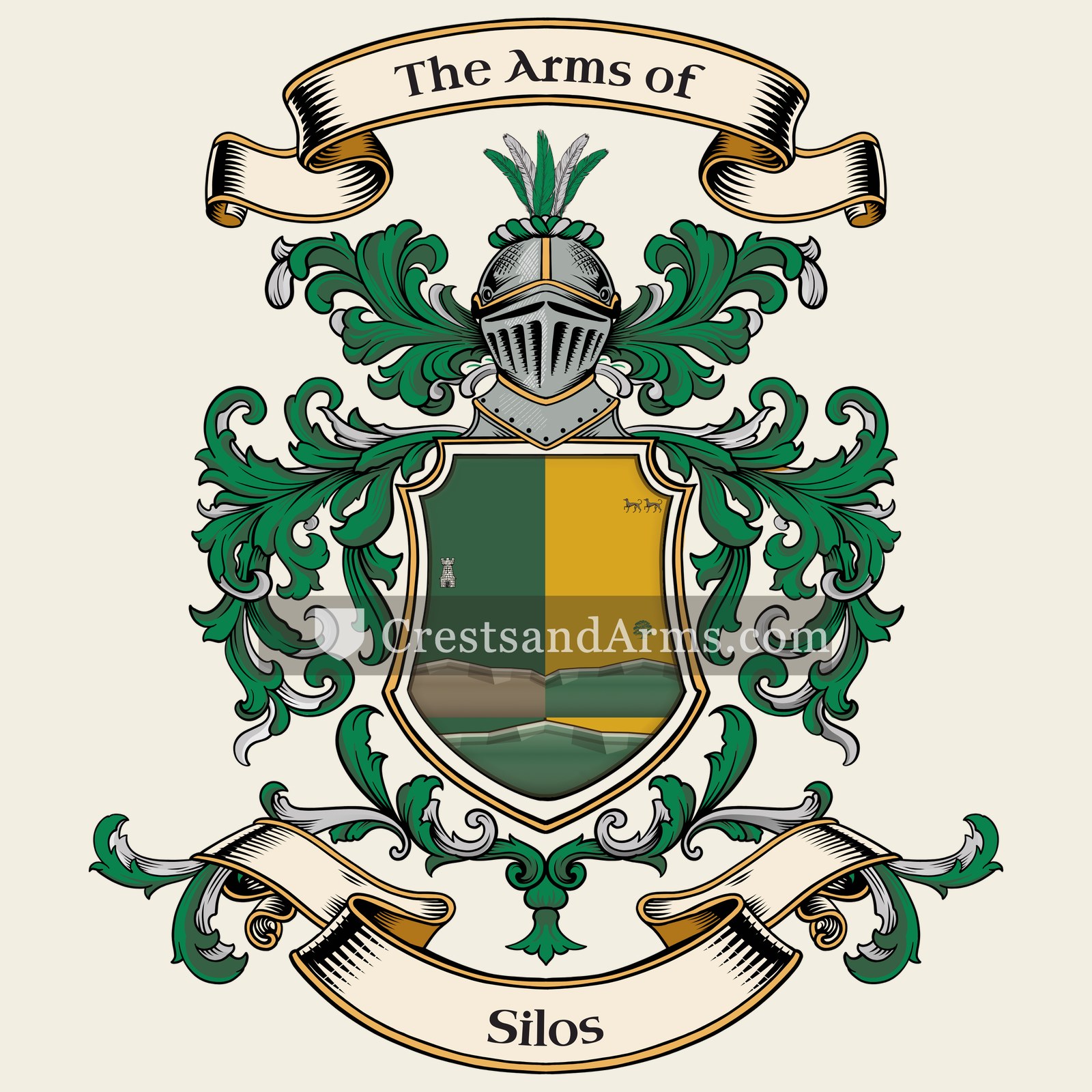
A record of documented arms, meaning and origin, researched for the Silos family of Spain.
Reg. 3220 · Spanish, T–V
Coat of Arms & Family Crest Details
Symbols on this shield
mountThe ground held, and steadfastness upon it
towerGrandeur and solidity, and a stronghold defended
treeLife, endurance and deep roots
greyhoundCourage, vigilance and loyalty
Colours
Green (Vert)Means: Hope
Gold (Or)Means: Generosity
Silver (Argent)Means: Peace and sincerity
Historical info
Source
J. B. Rietstap, Armorial Général, Gouda: G. B. van Goor Zonen, 1884–87
Blazon (the actual original written record)
“Parti: au 1 de sin. à une tour d'arg., sommée de trois tourelles du même, celle du milieu plus élevée, et posée sur une terrasse rocheuse au nat.; au 2 d'or à un arbre de sin., accosté de deux lévriers pass. au nat., celui à sen. cont., enchainés au fût de l'arbre: le tout soutenu d'une terrasse de sin.”
CastileCastile, c. 1722
Digital archive packCoat of arms PNG, gold border print PDF, vector SVG and the certificate of authenticity. Sent to your email in minutes.
Map of Spain showing where the Silos arms are recorded
The Silos arms were recorded in Castile, c. 1722.
Castile was the heart of Spain and the source of most of its noble families. Land won in the long wars against the Moors was granted out to fighting men, and a man granted land was granted arms along with it.
This is where the arms were entered in the register. Families often moved to other parts of the country, so the same name can turn up in more than one region.
The body that granted and recorded arms in Spain in this period.
Philip V of Spain
Sovereign of the period
Philip V of Spain
1714–1724
Reigning in Spain when the Silos arms are first recorded.
How Arms Worked in Spain
In Spain, a coat of arms was considered a form of property that belonged to the entire family line. These arms were passed down from a father to all his children equally. Younger branches of the family usually kept the original design without needing to add any special marks to distinguish their specific line.
Granting authority
The Cronista Rey de Armas was the official body that regulated and granted coats of arms throughout Spain.
How they got arms
Families often obtained their arms through royal grants or by proving their noble status to the official heraldic authority.
Where arms were recorded
Coats of arms were officially recorded in the registers of the Cronista Rey de Armas starting in 1496.
The family's standing
Recorded among the armigerous families of Castile.
Origin & History of the Silos Family in Spain
The family name Silos finds its historical roots in the rugged landscape of Castile, Spain. By the early 18th century, records confirm that members of the family were well-established in this region, particularly by the year 1722. The name itself is closely linked to the famous Monastery of Santo Domingo de Silos, a significant religious and cultural center located in the province of Burgos. It is likely that the family name originated as a topographic or locative surname, which was a common practice at the time to identify individuals based on their proximity to this prominent landmark. Over generations, the family became part of the local social fabric of Castile, contributing to the agricultural and administrative life of the region as Spain transitioned through the Enlightenment era.
Related Branches & Arms
Root word
Silus
Latin term meaning flat-nosed or snub-nosed.
This name
SilosDerived from a topographic location near the Silos monastery or a descriptive nickname for a person.
also spelled
Silloss
Siloss
Silosse
Related arms
Sylosvariant spelling
Documented Sources
J. B. Rietstap, Armorial Général, Gouda: G. B. van Goor Zonen, 1884–87
Pérez de Urbel, Justo, Historia del Condado de Castilla, 1945
Archivo de la Real Chancillería de Valladolid, Registro de Ejecutorias, 1722
Digital archive packCoat of arms PNG, gold border print PDF, vector SVG and the certificate of authenticity. Sent to your email in minutes.


 mountThe ground held, and steadfastness upon it
 towerGrandeur and solidity, and a stronghold defended
 treeLife, endurance and deep roots
 greyhoundCourage, vigilance and loyalty
 mountThe ground held, and steadfastness upon it
 towerGrandeur and solidity, and a stronghold defended
 treeLife, endurance and deep roots
 greyhoundCourage, vigilance and loyalty