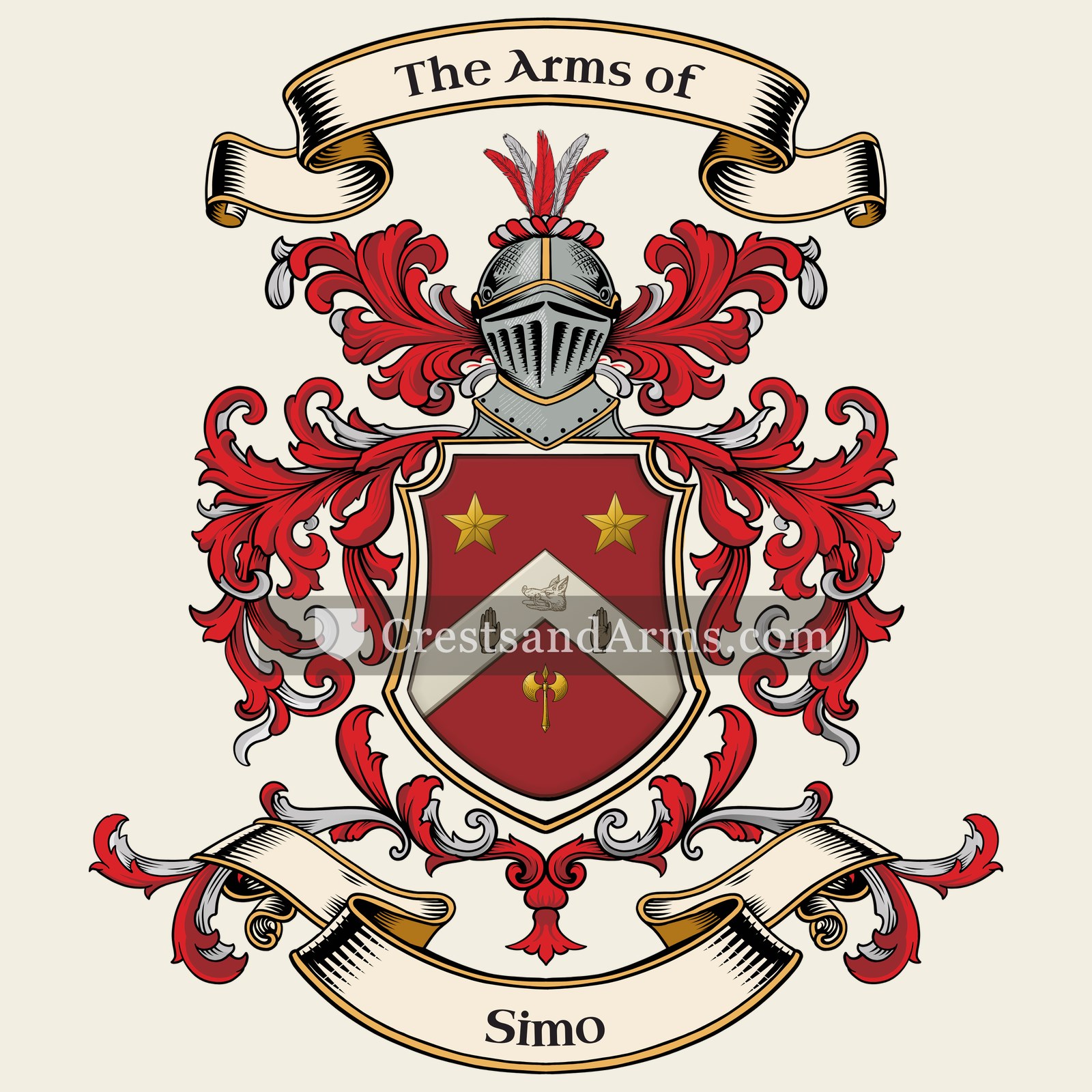
A record of documented arms, meaning and origin, researched for the Simo family of England.
Reg. 9167 · English, T–V
Coat of Arms & Family Crest Details
Symbols on this shield
chevronProtection, and faithful service completed
boars headA fierce fighter who battles to the end
mulletThe third son, and a divine quality from above
axeThe execution of military duty
handFaith, sincerity and justice
Colours
Red (Gules)Means: Military strength
Silver (Argent)Means: Peace and sincerity
Gold (Or)Means: Generosity
Historical info
Source
Sir Bernard Burke, The General Armory of England, Scotland, Ireland and Wales, London: Harrison & Sons, 1884
Blazon (the actual original written record)
“Gu. on a chev. ar. betw. two mullets pierced or, and a halbert in base of the last, a boar's head erased betw. two hands issuing from the dexter and sinister sides of the shield, each holding a dagger ppr”
SurreyCoombe Wood · Surrey, c. 1858
Digital archive packCoat of arms PNG, gold border print PDF, vector SVG and the certificate of authenticity. Sent to your email in minutes.
Map of England showing where the Simo arms are recorded
The Simo arms were recorded in Surrey, c. 1858.
Surrey sat just south of London and filled up with families who had made money in the City. Buying an estate there was the usual next step, and an estate was the usual reason to take arms.
This is where the arms were entered in the register. Families often moved to other parts of the country, so the same name can turn up in more than one region.
The body that granted and recorded arms in England in this period.
Victoria
Sovereign of the period
Victoria
1837–1901
Reigning in England when the Simo arms are first recorded.
How Arms Worked in England
English heraldry allowed arms to be shared by all legitimate descendants of the original owner. These symbols were treated as personal property that moved through the generations to all children. While the eldest son kept the original design, other family members could use the same shield without needing to change it or register their own unique versions.
Granting authority
The College of Arms in London has regulated the use of coats of arms throughout England and Wales since 1484.
How they got arms
Families typically obtained their coats of arms through a formal grant from the Crown or by proving their ancient right to them.
Where arms were recorded
All official coats of arms are recorded in the registers kept at the College of Arms, which date back to the fifteenth century.
The family's standing
Recorded among the armigerous families of Surrey.
Origin & History of the Simo Family in England
The surname Simo is a distinctive name with deep roots that often trace back to variations of the name Simon, which is derived from the Hebrew word for listening or hearing. While the name appears in various cultures across Europe, the presence of the family in Surrey by 1858 suggests a history tied to the social and economic shifts of the Victorian era. During this period, Surrey was transitioning from a largely rural landscape into a region increasingly influenced by the growth of nearby London. Families like the Simos living in this area were likely part of the skilled working class or professional trades that supported the expansion of local infrastructure and community services. By settling in this region during the mid-nineteenth century, these early family members became part of the local fabric, contributing to the development of the county as it moved into the modern industrial age.
Related Branches & Arms
Root word
Simon
Derived from the Hebrew name Shim'on meaning he has heard.
This name
SimoA patronymic surname indicating descent from a person named Simon.
also spelled
Sym
Syme
Symes
Syms
Documented Sources
Sir Bernard Burke, The General Armory of England, Scotland, Ireland and Wales, London: Harrison & Sons, 1884
The National Archives, Census Returns of England and Wales, 1861
Surrey History Centre, Surrey Quarter Sessions Records
Reaney, P.H., A Dictionary of English Surnames, 1958
Digital archive packCoat of arms PNG, gold border print PDF, vector SVG and the certificate of authenticity. Sent to your email in minutes.


 chevronProtection, and faithful service completed
 boars headA fierce fighter who battles to the end
 mulletThe third son, and a divine quality from above
 axeThe execution of military duty
 handFaith, sincerity and justice
 chevronProtection, and faithful service completed
 boars headA fierce fighter who battles to the end
 mulletThe third son, and a divine quality from above
 axeThe execution of military duty
 handFaith, sincerity and justice