A record of documented arms, meaning and origin, researched for the Simons family lines. Documented in 2 countries.
Reg. 3761 · Dutch, T–V
Meaning of the Simons family crest colors & symbols
Symbols on this shield
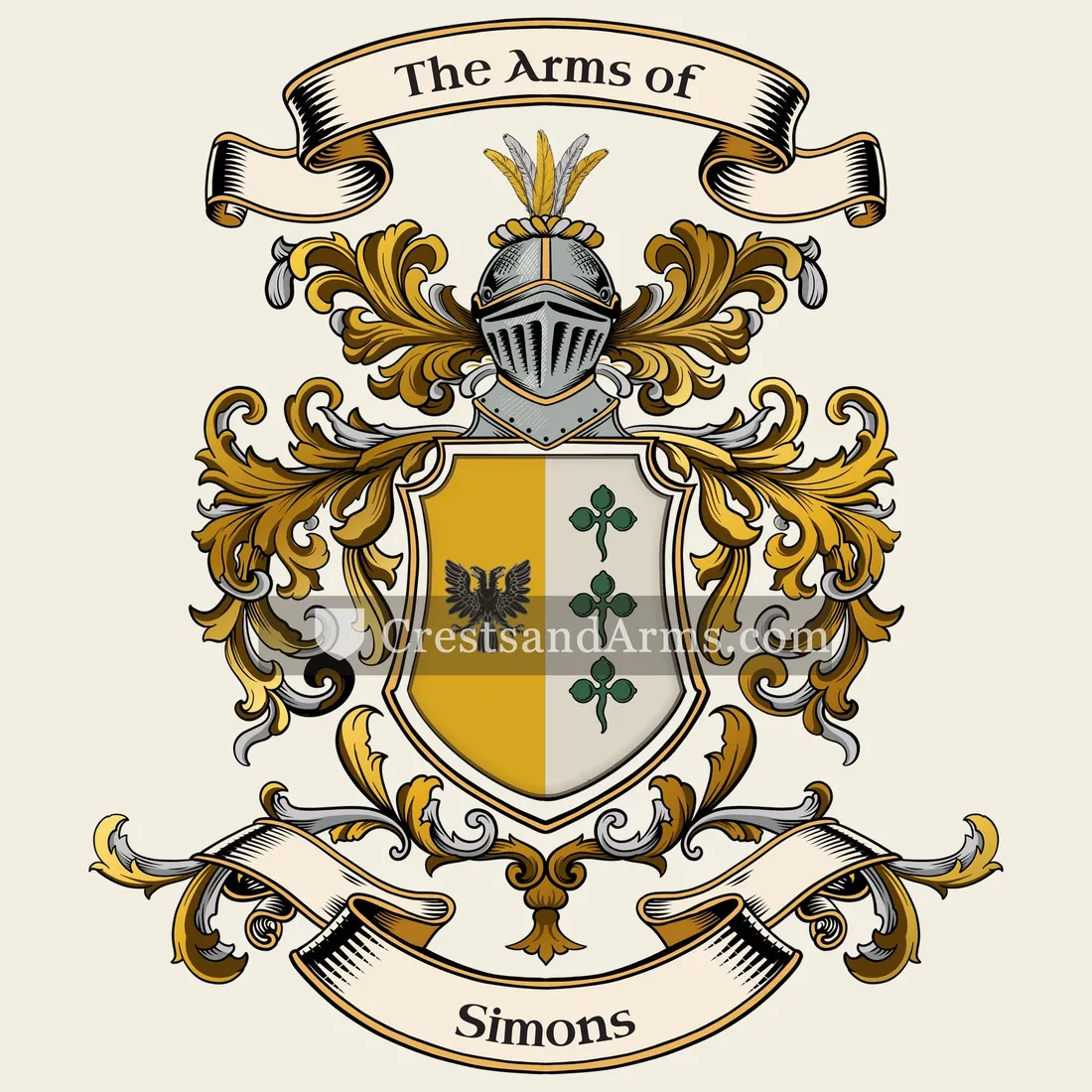
eagleNobility, strength and a keen mind
trefoilPerpetuity, and the Trinity
Colours
Gold (Or)Means: Generosity
Silver (Argent)Means: Peace and sincerity
Black (Sable)Means: Constancy
Green (Vert)Means: Hope
Historical info
Source
J. B. Rietstap, Armorial Général, Gouda: G. B. van Goor Zonen, 1884–87
Blazon (the actual original written record)
“Parti: au 1 d'or à la demi-aigle de sa., mouv. du parti; au 2 d'arg. à trois trèfles de sin., rangés en pal [Armes du docteur G. Simons, ministre de l'intérieur aux Pays-Bas, 1856-57.]”
Netherlandsc. 1815
Digital archive packCoat of arms PNG, gold border print PDF, vector SVG and the certificate of authenticity. Sent to your email in minutes.
Map of Netherlands showing where the Simons arms are recorded
The Simons arms were recorded in Netherlands, c. 1815.
Arms such as these were typically recorded in Friesland.
Friesland was low, wet country on the northern coast of the Netherlands, farmed by families who had held the same land for centuries. Free landholders were unusually common there, and a free landholder could carry arms.
This is where the arms were entered in the register. Families often moved to other parts of the country, so the same name can turn up in more than one region.
Region
Friesland
First recorded
1815
Granting Authority for the Simons Arms
Hoge Raad van Adel
Photograph made by me · CC BY-SA 3.0
The body that granted and recorded arms in Netherlands in this period.
William I of the Netherlands
Sovereign of the period
William I of the Netherlands
1815–1840
Reigning in Netherlands when the Simons arms are first recorded.
How Arms Worked in Netherlands
In the Netherlands, coats of arms were often used by noble families and those who held specific public offices. These arms were passed down through the generations to legitimate descendants. Younger branches of a family usually kept the original design without needing to add special marks. This system ensured that the family identity remained clear and consistent over many years.
Granting authority
The Hoge Raad van Adel is the official body that regulates and manages noble titles and coats of arms in the Netherlands.
How they got arms
Families typically obtained their coats of arms through official royal grants or by proving their long-standing historical use of the symbols.
Where arms were recorded
Coats of arms are officially recorded in the registers held by the Hoge Raad van Adel, which began its work in 1814.
The family's standing
Recorded among the armigerous families of Netherlands.
Origin & History of the Simons Family in Netherlands
The surname Simons is a patronymic name, which means it was originally created to identify a person as the son of someone named Simon. In the Netherlands, this naming style became common as families moved away from using only a single given name. By the early 19th century, the name was well-established in the northern province of Friesland. The year 1815 is a significant milestone for Dutch genealogy because it marks the period when the government began requiring citizens to register permanent family names in the civil records. Before this time, many people in rural areas like Friesland used flexible naming customs, but the new laws forced families to choose a fixed surname for official documentation. Because Friesland had a unique culture and language compared to the rest of the country, families there often maintained strong local ties that helped preserve these names across generations. The presence of the Simons family in Friesland during this era reflects the broader transition of Dutch society toward standardized record-keeping and formal family identities.
Meaning of the Simons family crest colors & symbols
Symbols on this shield
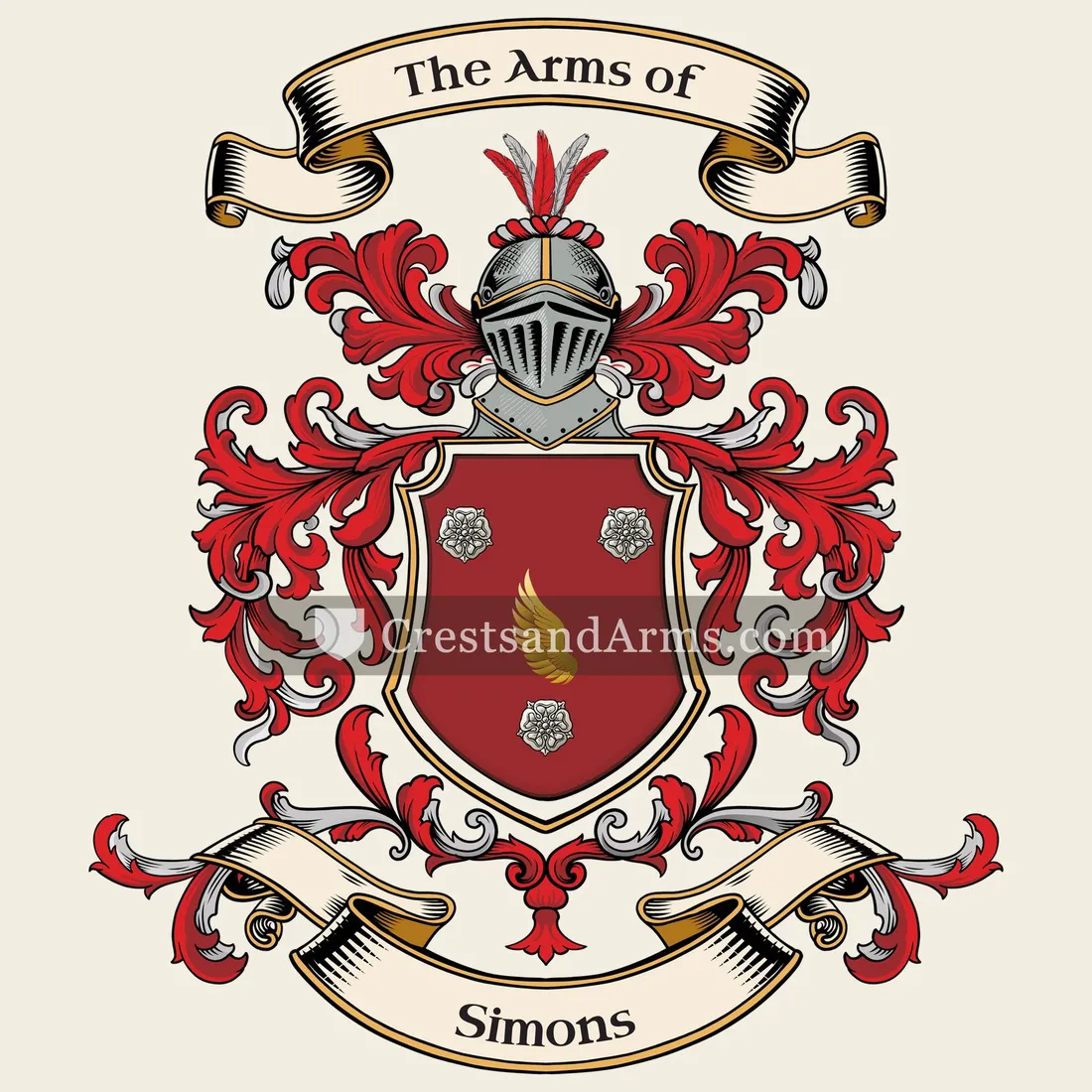
wingSwiftness, and protection under a raised wing
roseThe seventh son, and beauty with grace
Colours
Red (Gules)Means: Military strength
Gold (Or)Means: Generosity
Silver (Argent)Means: Peace and sincerity
Historical info
Source
Sir Bernard Burke, The General Armory of England, Scotland, Ireland and Wales, London: Harrison & Sons, 1884
Blazon (the actual original written record)
“Gu. a wing or, betw. three roses ar. barbed and seeded ppr”
LeicesterUllesthorpe · Leicester, c. 1620
Digital archive packCoat of arms PNG, gold border print PDF, vector SVG and the certificate of authenticity. Sent to your email in minutes.
Map of England showing where the Simons arms are recorded
The Simons arms were recorded in Leicester, c. 1620.
Leicestershire was grazing country, and wool and cattle made steady money rather than spectacular fortunes. Steady money bought manors, and manors are what brought families into the registers.
This is where the arms were entered in the register. Families often moved to other parts of the country, so the same name can turn up in more than one region.
The body that granted and recorded arms in England in this period.
James VI and I
Sovereign of the period
James VI and I
1603–1625
Reigning in Netherlands when the Simons arms are first recorded.
How Arms Worked in England
English heraldry allowed arms to be shared by all legitimate descendants of the original owner. These symbols were treated as personal property that moved through the generations to all children. While the eldest son kept the original design, other family members could use the same shield without needing to change it or register their own unique versions.
Granting authority
The College of Arms in London has regulated the use of coats of arms throughout England and Wales since 1484.
How they got arms
Families typically obtained their coats of arms through a formal grant from the Crown or by proving their ancient right to them.
Where arms were recorded
All official coats of arms are recorded in the registers kept at the College of Arms, which date back to the fifteenth century.
The family's standing
Recorded among the armigerous families of Leicester.
Origin & History of the Simons Family in England
The surname Simons is a patronymic name, which means it originated as a way to identify a person as the son of Simon. This given name was popular throughout England following the Norman Conquest, as it was associated with Saint Simon the Apostle. By the time members of the family were documented in Leicester in 1620, the name had already become firmly established as a hereditary surname passed down through generations. During the seventeenth century, families in the East Midlands were often involved in local trade, agriculture, or the growing textile industry that defined the region. Living in a hub like Leicester suggests that these early ancestors were likely part of a rising class of townspeople who contributed to the local economy and community life. As the name spread across the English countryside, it evolved from a simple description of parentage into a permanent family identity that linked individuals to their specific local roots.
Simons Meaning & Related Branches
Root word
Shim'on
Hebrew for he has heard or God has heard.
This name
SimonsA patronymic surname meaning son of Simon, derived from the biblical name.
also spelled
Symons
Simmons
Simuns
Symuns
Symon
Related arms
Symonsvariant spelling
Symon, or Symondsvariant spelling
de Geeprecorded with Simons, same area
Cozensrecorded with Simons, same area
Documented Sources
J. B. Rietstap, Armorial Général, Gouda: G. B. van Goor Zonen, 1884–87
Meertens, P.J., De betekenis van de Nederlandse familienamen, 1959
Tresoar (Frisian Historical and Literary Center), Burgerlijke Stand van Friesland (Civil Registry of Friesland), 1811-1950
Van der Schaar, J., Woordenboek van voornamen, 1964
Digital archive packCoat of arms PNG, gold border print PDF, vector SVG and the certificate of authenticity. Sent to your email in minutes.


 eagleNobility, strength and a keen mind
 trefoilPerpetuity, and the Trinity
 eagleNobility, strength and a keen mind
 trefoilPerpetuity, and the Trinity


 wingSwiftness, and protection under a raised wing
 roseThe seventh son, and beauty with grace