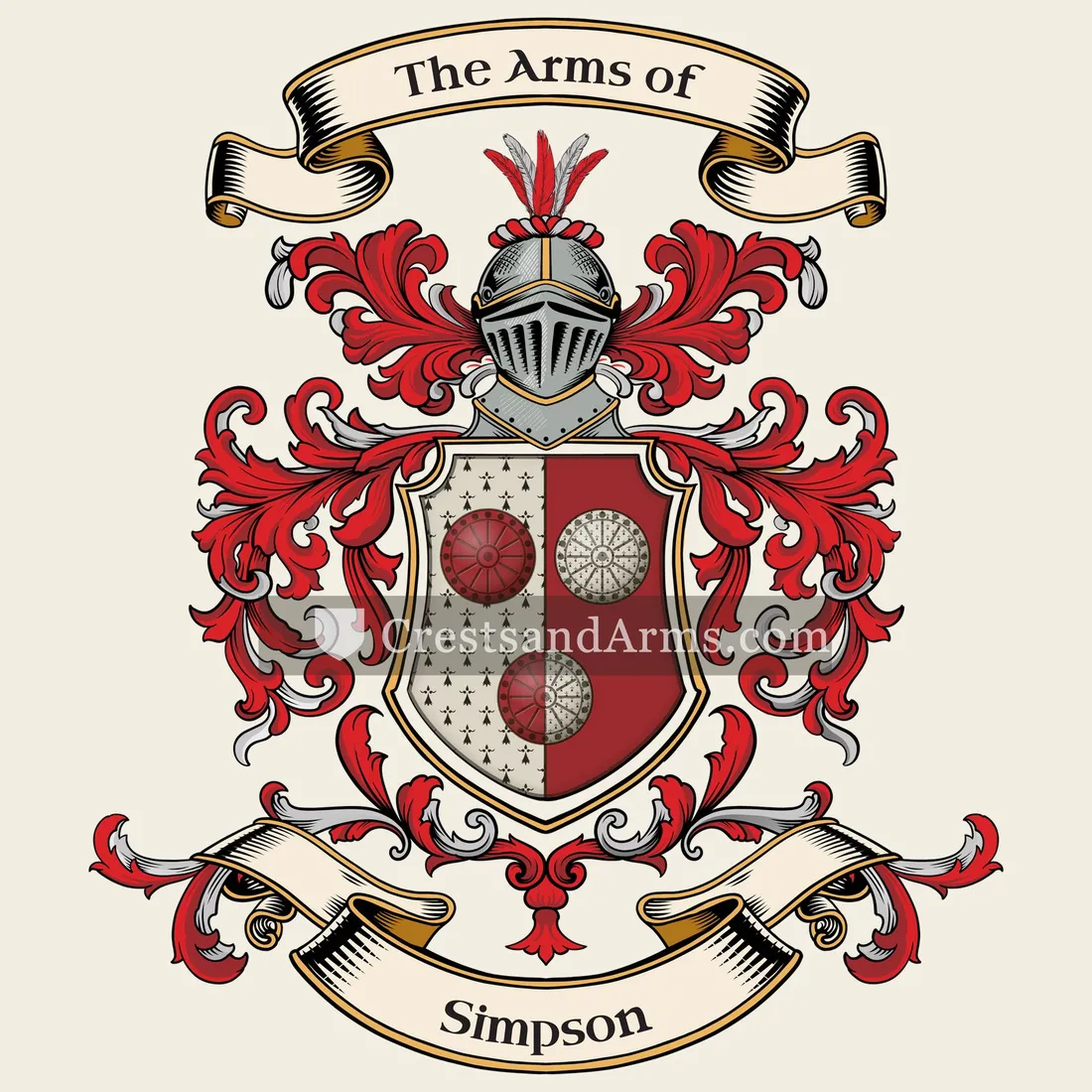
A record of documented arms, meaning and origin, researched for the Simpson family lines. Documented in 3 countries.
Reg. 0770 · German, T–V
Meaning of the Simpson family crest colors & symbols
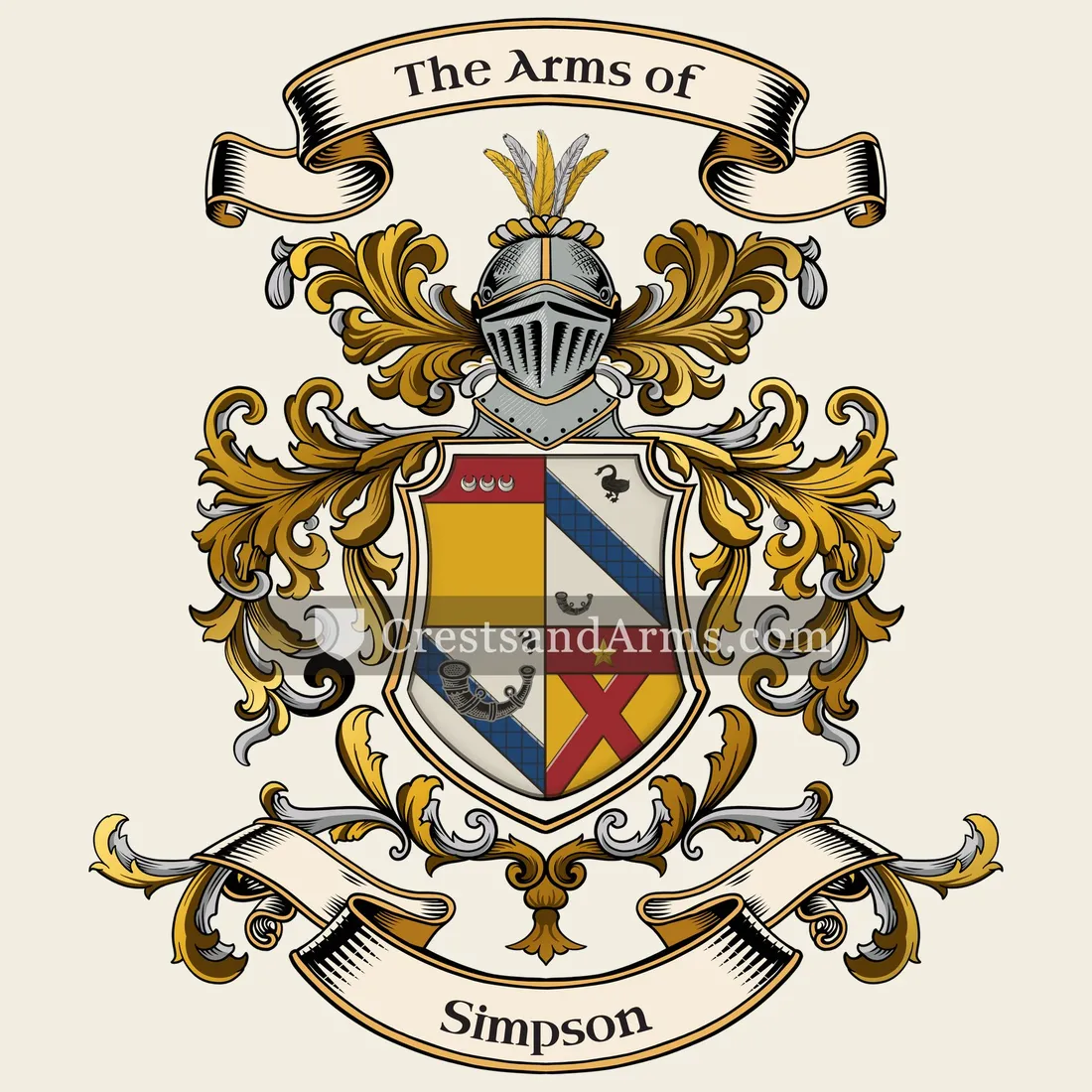
Symbols on this shield
chiefAuthority, wisdom and dominion
bendDefence, and the scarf of a commander
saltireResolution, and St Andrew's cross
crescentHonour by the sovereign, and the second son
swanGrace, light and the poet's art
hunting horn stringedOne who delights in the chase
mulletThe third son, and a divine quality from above
Colours
Gold (Or)Means: Generosity
Silver (Argent)Means: Peace and sincerity
Red (Gules)Means: Military strength
Blue (Azure)Means: Loyalty and truth
Black (Sable)Means: Constancy
Historical info
Source
J. B. Rietstap, Armorial Général, Gouda: G. B. van Goor Zonen, 1884–87
Blazon (the actual original written record)
“Ec.: au 1 d'or; au chef de gu., ch. de trois croiss. d'arg.; aux 2 et 3 d'arg. à la bande d'azur, acc. en chef d'un cygne de sa. et en p. d'un cor-de-chasse du même; au 4 d'arg. au saut. de gu., acc. en chef d'une étoile d'or; au chef de gu., ch. à sen. d'une étoile d'or.”
Germanyc. 1840
Digital archive packCoat of arms PNG, gold border print PDF, vector SVG and the certificate of authenticity. Sent to your email in minutes.
Map of Germany showing where the Simpson arms are recorded
The Simpson arms were recorded in Germany, c. 1840.
Arms such as these were typically recorded in Bavaria.
Bavaria was a country of old landed families and walled market towns. Estates passed down the same line for centuries, and both the landowners and the leading townsmen kept arms, which is why so many Bavarian names sit in the registers.
This is where the arms were entered in the register. Families often moved to other parts of the country, so the same name can turn up in more than one region.
The body that granted and recorded arms in Germany in this period.
Frederick William III of Prussia
Sovereign of the period
Frederick William III of Prussia
1797–1840
Reigning in Germany when the Simpson arms are first recorded.
How Arms Worked in Germany
Prussian heraldry was strictly tied to social rank and noble status rather than being a free choice for every citizen. These symbols were treated as permanent family property that moved through the generations to all legitimate heirs. If a family branch wanted to change their design to stand out, they had to apply for official permission to alter their specific version of the shield.
Granting authority
The Prussian Heroldsamt acted as the central state office that managed and strictly controlled all noble titles and coats of arms.
How they got arms
Families usually obtained their arms through formal royal grants or by proving their long-standing noble status to the state authorities.
Where arms were recorded
All official coats of arms were kept in the rolls of the Prussian Heroldsamt, which functioned from 1706 until 1918.
The family's standing
Recorded among the armigerous families of Germany.
Origin & History of the Simpson Family in Germany
The name Simpson is primarily recognized as an English patronymic meaning son of Sim, which is a common nickname for Simon. However, the presence of the family in Bavaria by 1840 suggests a distinct historical path within the German-speaking regions. In these areas, the name likely emerged as a localized adaptation or a variation of similar Germanic naming patterns that evolved alongside the shifting borders of Central Europe. During the early nineteenth century, Bavaria was a region characterized by significant social and economic transformation, and families with this name were often integrated into the local agrarian or artisan communities. These early ancestors were part of a broader movement of families who maintained their identity while navigating the complex linguistic and cultural landscape of the Bavarian kingdom. By settling in this region, the family became part of the long-standing tradition of German migration and local record-keeping that defined the nineteenth-century experience.
Meaning of the Simpson family crest colors & symbols
Symbols on this shield
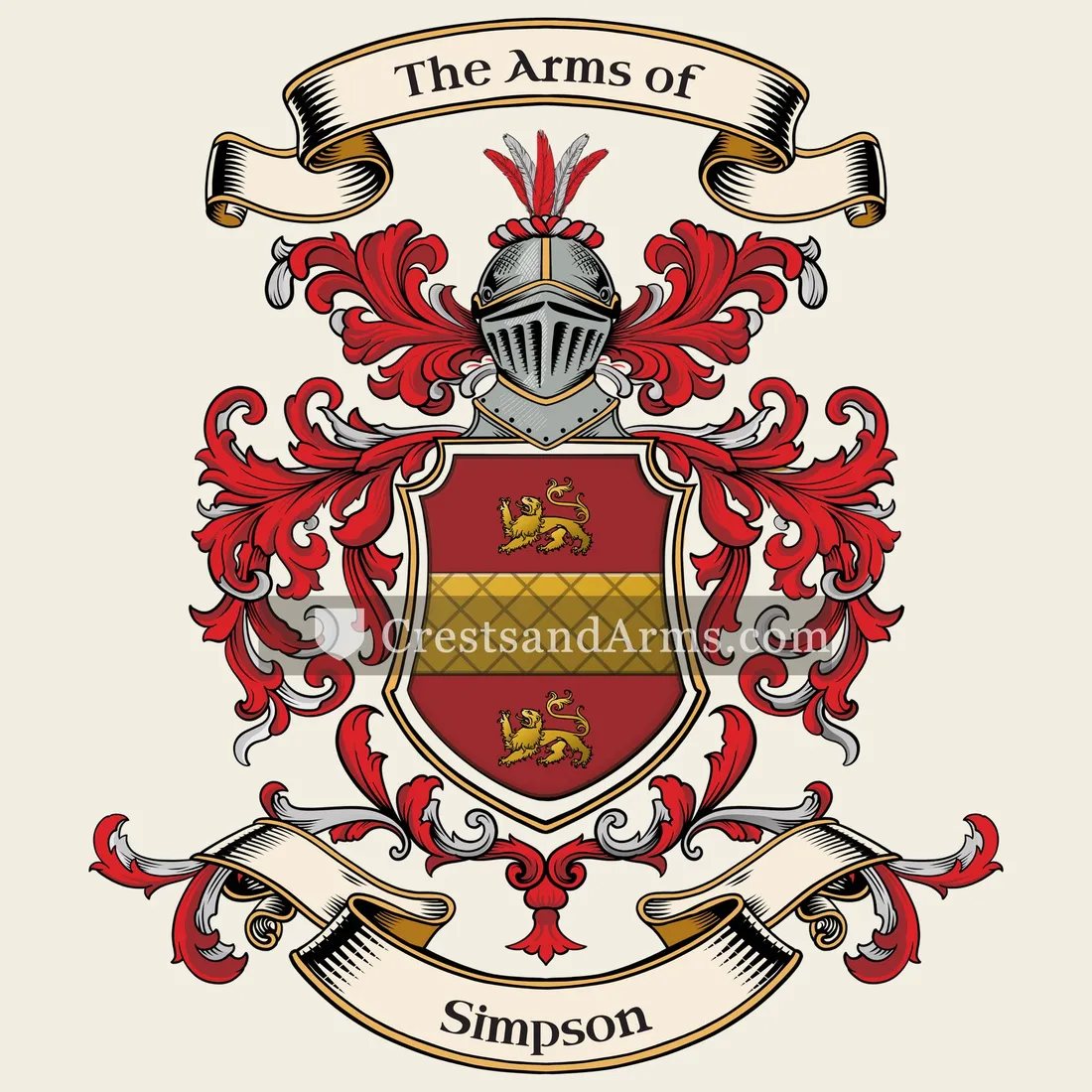
fessThe military belt, and readiness to serve
lionCourage, strength and royalty
Colours
Red (Gules)Means: Military strength
Gold (Or)Means: Generosity
Historical info
Source
Sir Bernard Burke, The General Armory of England, Scotland, Ireland and Wales, London: Harrison & Sons, 1884
Blazon (the actual original written record)
“Gu. a fess betw. two lions or”
DurhamBradley · Durham, c. 1620
Digital archive packCoat of arms PNG, gold border print PDF, vector SVG and the certificate of authenticity. Sent to your email in minutes.
Map of England showing where the Simpson arms are recorded
The Simpson arms were recorded in Durham, c. 1620.
Durham was governed by its bishop rather than the crown for most of its history, with its own courts and its own landed class. That separate world produced a tight group of families, nearly all of whom held arms.
This is where the arms were entered in the register. Families often moved to other parts of the country, so the same name can turn up in more than one region.
The body that granted and recorded arms in England in this period.
James VI and I
Sovereign of the period
James VI and I
1603–1625
Reigning in Germany when the Simpson arms are first recorded.
How Arms Worked in England
English heraldry allowed arms to be shared by all legitimate descendants of the original owner. These symbols were treated as personal property that moved through the generations to all children. While the eldest son kept the original design, other family members could use the same shield without needing to change it or register their own unique versions.
Granting authority
The College of Arms in London has regulated the use of coats of arms throughout England and Wales since 1484.
How they got arms
Families typically obtained their coats of arms through a formal grant from the Crown or by proving their ancient right to them.
Where arms were recorded
All official coats of arms are recorded in the registers kept at the College of Arms, which date back to the fifteenth century.
The family's standing
Recorded among the armigerous families of Durham.
Origin & History of the Simpson Family in England
The surname Simpson is a patronymic name, which means it was originally created to identify a person as the son of Simon. This naming tradition became common in England during the Middle Ages as populations grew and people needed more specific ways to distinguish themselves from their neighbors. By the early 17th century, the name was firmly established in the northern regions of England. Records confirm that members of the Simpson family were living in Durham by 1620. During this era, families in Durham often worked in agriculture, local trade, or the burgeoning coal industry that defined the landscape of the North East. Because the name was tied to a common given name like Simon, it developed independently in several different parts of the country rather than originating from a single ancestor. This helped the name spread quickly across English towns and villages as families moved for work or marriage.
Meaning of the Simpson family crest colors & symbols
Symbols on this shield
roundelA coin, and one who has been to the crusades
Colours
ErmineMeans: Dignity
Red (Gules)Means: Military strength
Historical info
Source
Sir Bernard Burke, The General Armory of England, Scotland, Ireland and Wales, London: Harrison & Sons, 1884
Blazon (the actual original written record)
“Per pale erm. and gu. three roundles counterchanged”
Scotlandc. 1748
Digital archive packCoat of arms PNG, gold border print PDF, vector SVG and the certificate of authenticity. Sent to your email in minutes.
Map of Scotland showing where the Simpson arms are recorded
The Simpson arms were recorded in Scotland, c. 1748.
Arms such as these were typically recorded in Edinburgh.
Edinburgh was the seat of Scotland's government, its courts and its heralds. Families with business there settled nearby, and being close to where arms were recorded is exactly why so many of them appear.
This is where the arms were entered in the register. Families often moved to other parts of the country, so the same name can turn up in more than one region.
The body that granted and recorded arms in Scotland in this period.
George II of Great Britain
Sovereign of the period
George II of Great Britain
1727–1760
Reigning in Germany when the Simpson arms are first recorded.
How Arms Worked in Scotland
Scottish heraldry is unique because it treats a coat of arms as a piece of personal property protected by law. Only one person can own a specific design at any given time. When a family grows, the head keeps the original shield while other relatives must apply for their own distinct version with slight changes to prove their specific identity.
Granting authority
The Court of the Lord Lyon acts as the official body that regulates and controls all heraldic matters throughout Scotland.
How they got arms
Individuals obtain a legal right to their arms through a formal petition process that confirms their identity and family connection.
Where arms were recorded
All valid coats of arms are officially entered into the Public Register of All Arms and Bearings starting from 1672.
The family's standing
Recorded among the armigerous families of Scotland.
Origin & History of the Simpson Family in Scotland
The surname Simpson is a patronymic name, which means it originated as a way to identify someone as the son of Sim, a common medieval nickname for Simon. While the name has roots across the British Isles, it became firmly established in the Scottish Lowlands during the eighteenth century. By 1748, records show that families bearing the name were well-integrated into the bustling urban life of Edinburgh. During this period, the city was undergoing a massive cultural and intellectual transformation known as the Scottish Enlightenment. Families named Simpson living in the capital were often involved in the growing trade, legal, and craft sectors that defined the city’s expansion beyond its medieval walls. These early residents helped shape the name into a recognized part of the Scottish social fabric, moving away from its origins as a simple descriptor to a permanent family identity that persisted through generations of urban growth.
Simpson Meaning & Related Branches
Root word
Sim
A diminutive form of the Hebrew name Simon meaning he has heard.
This name
SimpsonA patronymic surname meaning son of Sim or son of Simon.
also spelled
Sympson
Simson
Symson
Related arms
Sympsonsame arms
Symsonsame arms
Fraunceyssimilar arms
Simsonvariant spelling
Documented Sources
J. B. Rietstap, Armorial Général, Gouda: G. B. van Goor Zonen, 1884–87
Bavarian State Archives (Bayerisches Hauptstaatsarchiv), Generalakten des Staatsministeriums des Innern
Kohlhammer, W., Historischer Atlas von Bayern, 1960
Kunze, Konrad, dtv-Atlas Namenkunde: Vor- und Familiennamen im deutschen Sprachgebiet, 1998
Digital archive packCoat of arms PNG, gold border print PDF, vector SVG and the certificate of authenticity. Sent to your email in minutes.


 chiefAuthority, wisdom and dominion
 bendDefence, and the scarf of a commander
 saltireResolution, and St Andrew's cross
 crescentHonour by the sovereign, and the second son
 swanGrace, light and the poet's art
 hunting horn stringedOne who delights in the chase
 mulletThe third son, and a divine quality from above


 fessThe military belt, and readiness to serve
 lionCourage, strength and royalty


 roundelA coin, and one who has been to the crusades