Map of England showing where the Singleton arms are recorded
The Singleton arms were recorded in Essex, c. 1620.
Essex lay close enough to London for City money to buy land there. Merchants who prospered moved out to estates within a day's ride, and a new landowner almost always wanted arms to go with the ground.
This is where the arms were entered in the register. Families often moved to other parts of the country, so the same name can turn up in more than one region.
The body that granted and recorded arms in England in this period.
James VI and I
Sovereign of the period
James VI and I
1603–1625
Reigning in England when the Singleton arms are first recorded.
How Arms Worked in England
English heraldry allowed arms to be shared by all legitimate descendants of the original owner. These symbols were treated as personal property that moved through the generations to all children. While the eldest son kept the original design, other family members could use the same shield without needing to change it or register their own unique versions.
Granting authority
The College of Arms in London has regulated the use of coats of arms throughout England and Wales since 1484.
How they got arms
Families typically obtained their coats of arms through a formal grant from the Crown or by proving their ancient right to them.
Where arms were recorded
All official coats of arms are recorded in the registers kept at the College of Arms, which date back to the fifteenth century.
The family's standing
Recorded among the armigerous families of Essex.
Origin & History of the Singleton Family in England
The surname Singleton originated as a locational name, meaning it was first used to identify people who lived in or came from a specific place. In England, the name is derived from the Old English words for a single settlement or a farmstead. While the name is famously associated with the village of Singleton in Lancashire, families carrying this name spread across the country over several centuries. By the early 17th century, members of the Singleton family had established a notable presence in the county of Essex. These early settlers were part of a period of significant social movement, as families began to move away from their ancestral lands to pursue new opportunities in different regions. Their presence in Essex by 1620 reflects the broader history of English families who adapted to changing economic conditions while maintaining their identity through their inherited name.
Meaning of the Singleton family crest colors & symbols
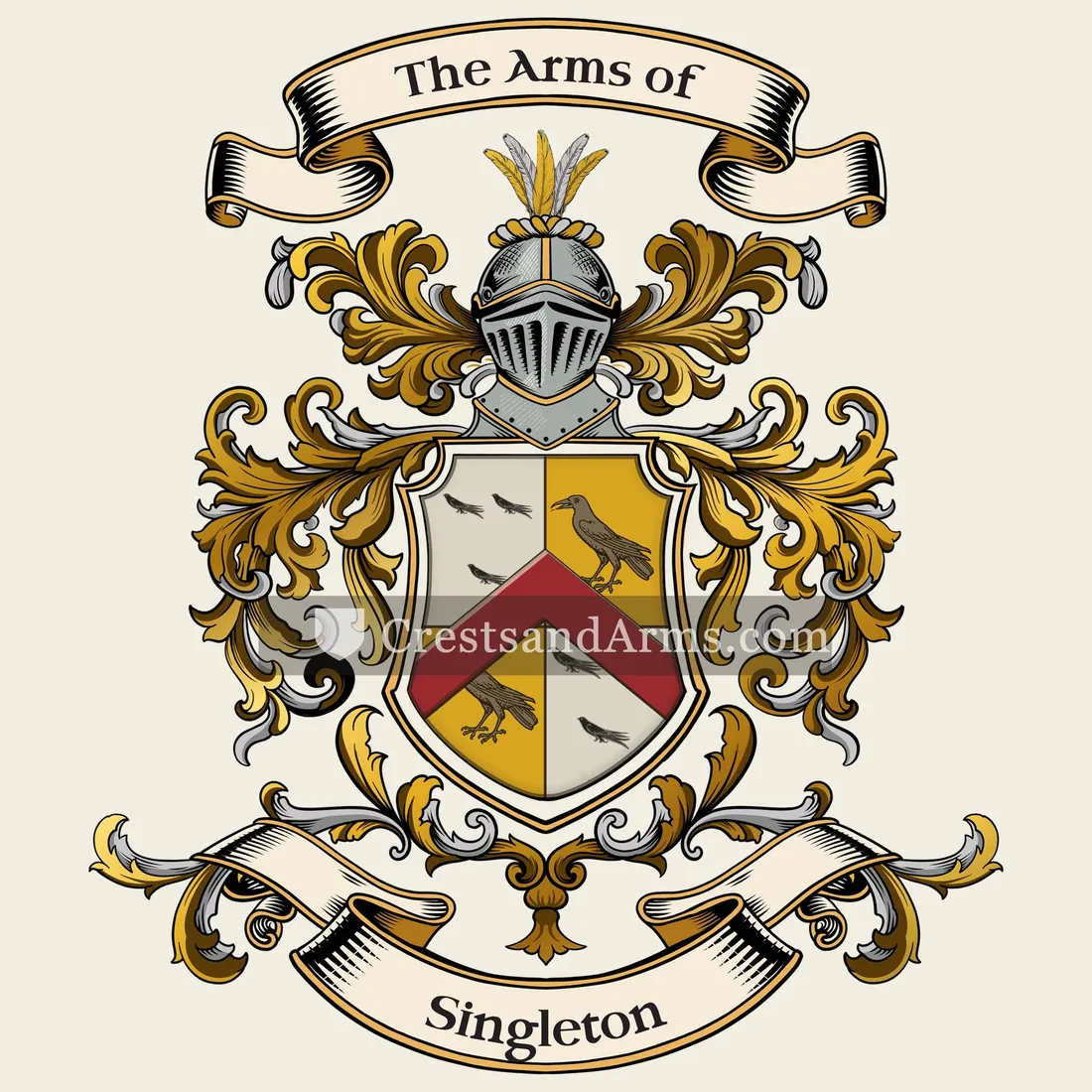
Symbols on this shield
martletA younger son, who must win his own land
ravenConstancy and divine providence
Colours
Silver (Argent)Means: Peace and sincerity
Gold (Or)Means: Generosity
Red (Gules)Means: Military strength
Black (Sable)Means: Constancy
Historical info
Source
Sir Bernard Burke, The General Armory of England, Scotland, Ireland and Wales, London: Harrison & Sons, 1884
Blazon (the actual original written record)
“Quarterly, 1st and 4th, ar. three chevronels gu. betw. as many martlets sa., for SINGLETON; 2nd and 3rd, or, a raven close ppr., for CORBET”
MeathAclare · Meath, c. 1820
Digital archive packCoat of arms PNG, gold border print PDF, vector SVG and the certificate of authenticity. Sent to your email in minutes.
Map of Ireland showing where the Singleton arms are recorded
The Singleton arms were recorded in Meath, c. 1820.
Meath was the best farmland in Ireland and the old seat of its high kings. Norman families took it early and held it, and land of that quality kept the same families on it for centuries.
This is where the arms were entered in the register. Families often moved to other parts of the country, so the same name can turn up in more than one region.
The body that granted and recorded arms in Ireland in this period.
George III of Great Britain
Sovereign of the period
George III of Great Britain
1801–1820
Reigning in England when the Singleton arms are first recorded.
How Arms Worked in Ireland
The Ulster King of Arms granted coats of arms to individuals who proved their social standing and good character. These symbols were typically inherited by all legitimate descendants of the original holder. If a family branch wanted a unique look, they could apply for a specific change to their design through the office to ensure their identity remained distinct.
Granting authority
The Ulster King of Arms acted as the official body that regulated and issued all coats of arms throughout Ireland.
How they got arms
Families obtained their arms through formal grants issued by the office after proving their eligibility and paying the required fees.
Where arms were recorded
All official grants were recorded in the registers held by the Ulster King of Arms starting from the year 1552.
The family's standing
Recorded among the armigerous families of Meath.
Origin & History of the Singleton Family in Ireland
The name Singleton is of English origin, but it became firmly established in Ireland through the movement of settlers across the Irish Sea. By the early nineteenth century, the family had secured a notable presence in County Meath, a region historically central to Irish agriculture and administration. Records from 1820 indicate that members of the family were integrated into the local community during a time of significant social and economic transition in Ireland. Because the name is locational, it likely arrived with individuals who migrated from the village of Singleton in Lancashire, England, to seek new opportunities in the fertile lands of the Pale. Over time, these families transitioned from being newcomers to becoming part of the local fabric of Meath, participating in the rural life and regional development that defined the area during the early modern period.
Singleton Meaning & Related Branches
Root word
singelton
A settlement or farmstead located near a burnt or cleared area.
This name
SingletonDerived from a place name in Lancashire, referring to a dwelling situated at a burnt clearing.
also spelled
Syngleton
Singletun
Syngletun
Related arms
Allenrecorded with Singleton, same area
Atwoodrecorded with Singleton, same area
Dowserecorded with Singleton, same area
Loverecorded with Singleton, same area
Documented Sources
Sir Bernard Burke, The General Armory of England, Scotland, Ireland and Wales, London: Harrison & Sons, 1884
Reaney, P.H., A Dictionary of British Surnames, 1958
Essex Record Office, Quarter Sessions Rolls (Q/SR), 1620
Mills, A.D., A Dictionary of English Place-Names, 1991
Digital archive packCoat of arms PNG, gold border print PDF, vector SVG and the certificate of authenticity. Sent to your email in minutes.


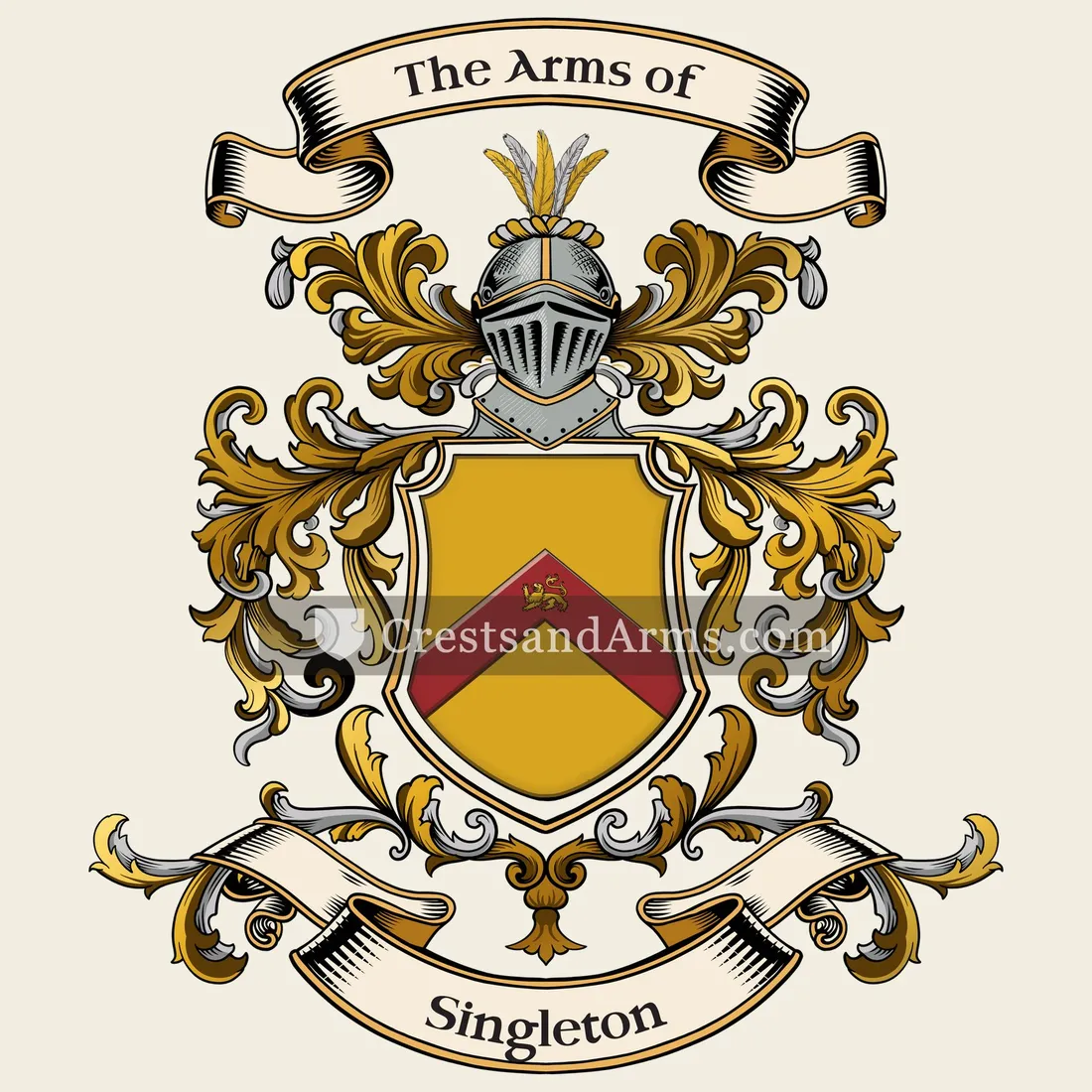
 chevronProtection, and faithful service completed
 lionCourage, strength and royalty
 chevronProtection, and faithful service completed
 lionCourage, strength and royalty


 martletA younger son, who must win his own land
 ravenConstancy and divine providence