Map of France showing where the Singson arms are recorded
The Singson arms were recorded in Orleanais, c. 1663.
Orleanais lay on the Loire around Orleans, close enough to Paris for court money to reach it. Officials and lawyers who did well bought estates there, and an estate brought a coat of arms with it.
This is where the arms were entered in the register. Families often moved to other parts of the country, so the same name can turn up in more than one region.
The body that granted and recorded arms in France in this period.
Louis XIV of France
Sovereign of the period
Louis XIV of France
1643–1715
Reigning in France when the Singson arms are first recorded.
How Arms Worked in France
In France, a coat of arms was a mark of honor that passed down through the male line to all legitimate descendants. Families often used the same shield without changes to show their shared heritage. If a branch wanted to stand out, they could add a small mark to their shield to show their specific place in the family tree.
Granting authority
The Juge d'armes de France acted as the official authority that regulated and verified coats of arms across the country.
How they got arms
Families typically inherited their arms from ancestors, though they could also receive them through royal grants or by proving their noble status.
Where arms were recorded
Coats of arms were officially recorded in the Armorial Général de France, which began its main collection in the year 1696.
The family's standing
Recorded among the armigerous families of Orleanais.
Origin & History of the Singson Family in France
The history of the Singson family in France traces back to the fertile region of Orleanais, where records confirm their presence as early as 1663. During this period, the Orleanais area served as a vital agricultural and cultural hub located along the Loire River. Families living in this province were often deeply connected to the local land and the administrative life of the nearby city of Orleans. While the name itself carries a distinct phonetic structure, its roots in this region suggest that early members were likely integrated into the social fabric of rural French society during the reign of King Louis XIV. These ancestors navigated a time of significant transition in French history, living through an era defined by agricultural development and the growth of provincial towns. By establishing their presence in Orleanais, the early Singsons became part of the long-standing demographic history of central France, contributing to the local community long before the name spread to other parts of the world.
Coat of Arms & Family Crest Details
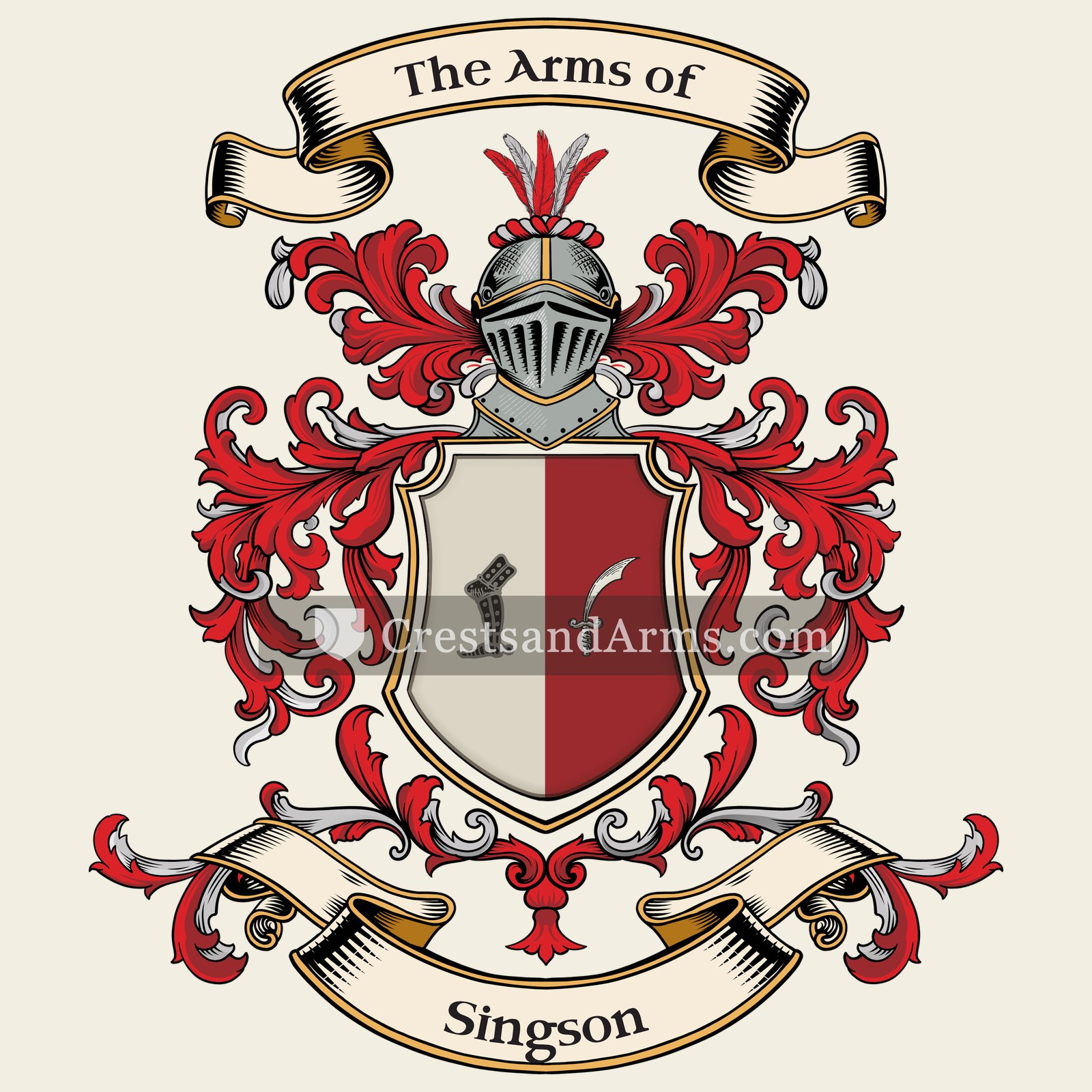
Symbols on this shield
legStrength and swiftness
swordJustice, and military honour
Colours
Silver (Argent)Means: Peace and sincerity
Red (Gules)Means: Military strength
Black (Sable)Means: Constancy
Historical info
Source
J. B. Rietstap, Armorial Général, Gouda: G. B. van Goor Zonen, 1884–87
Blazon (the actual original written record)
“Parti: au 1 d'arg. à un membre d'aigle de sa., la patte d'or; au 2 de gu. à un sabre d'arg. C.: un chapeau de sa., retr. de gu., sommé de quatre pl. d'aut., de sa., d'arg., de gu. et d'or. L.: à dextre d'arg. et de sa., à sen. d'arg. et de gu.”
Germanyc. 1726
Digital archive packCoat of arms PNG, gold border print PDF, vector SVG and the certificate of authenticity. Sent to your email in minutes.
Map of Germany showing where the Singson arms are recorded
The Singson arms were recorded in Germany, c. 1726.
Arms such as these were typically recorded in Bavaria.
Bavaria was a country of old landed families and walled market towns. Estates passed down the same line for centuries, and both the landowners and the leading townsmen kept arms, which is why so many Bavarian names sit in the registers.
This is where the arms were entered in the register. Families often moved to other parts of the country, so the same name can turn up in more than one region.
The body that granted and recorded arms in Germany in this period.
Charles VI, Holy Roman Emperor
Sovereign of the period
Charles VI, Holy Roman Emperor
1711–1740
Reigning in France when the Singson arms are first recorded.
How Arms Worked in Germany
In the Holy Roman Empire, coats of arms were often granted to individuals by the Emperor or his representatives. These arms were then passed down through the generations to all legitimate descendants of the original holder. Younger branches of a family usually kept the same shield design without needing to change it, as the arms belonged to the entire lineage.
Granting authority
The Holy Roman Emperor held the sole power to grant new coats of arms throughout his vast imperial territories.
How they got arms
Families typically obtained their coats of arms through a formal imperial grant or by proving their noble status to the authorities.
Where arms were recorded
These grants were officially recorded in the Imperial Chancery registers, which began keeping formal records of such honors during the Middle Ages.
The family's standing
Recorded among the armigerous families of Germany.
Origin & History of the Singson Family in Germany
The history of the Singson family in Germany is rooted in the cultural landscape of eighteenth-century Bavaria. By 1726, records indicate that members of the family were established within this region, which was then a prominent center of the Holy Roman Empire. The name likely evolved from regional linguistic patterns, potentially linked to occupational descriptions or geographic identifiers common among German families of that era. During this period, Bavaria was undergoing significant social changes following the War of the Spanish Succession, and families like the Singsons were part of the local fabric that navigated the transition from agrarian life to more structured town communities. Their presence in official documents from this time suggests they were integrated into the local administrative systems, which were essential for tracking residents during the early modern period. This era of German history was defined by a strong emphasis on parish registration and civil record-keeping, providing a clear window into the lives of families who helped shape the identity of the Bavarian countryside.
Related Branches & Arms
Root word
Sing
Derived from the Old French verb singier meaning to sing or chant.
This name
SingsonA surname historically used to describe a professional singer or a person with a melodic voice.
also spelled
Sainsonne
Sainsonh
Sanson
Documented Sources
J. B. Rietstap, Armorial Général, Gouda: G. B. van Goor Zonen, 1884–87
Archives départementales du Loiret, Série E: État civil et registres paroissiaux
Bouchard, Gérard, Quelques arpents d'Amérique: Population et économie du peuplement français au Canada, 1996
Denis, Michel, Histoire de l'Orléanais, 1983
Digital archive packCoat of arms PNG, gold border print PDF, vector SVG and the certificate of authenticity. Sent to your email in minutes.


 chevronProtection, and faithful service completed
 chiefAuthority, wisdom and dominion
 roseThe seventh son, and beauty with grace
 mulletThe third son, and a divine quality from above
 chevronProtection, and faithful service completed
 chiefAuthority, wisdom and dominion
 roseThe seventh son, and beauty with grace
 mulletThe third son, and a divine quality from above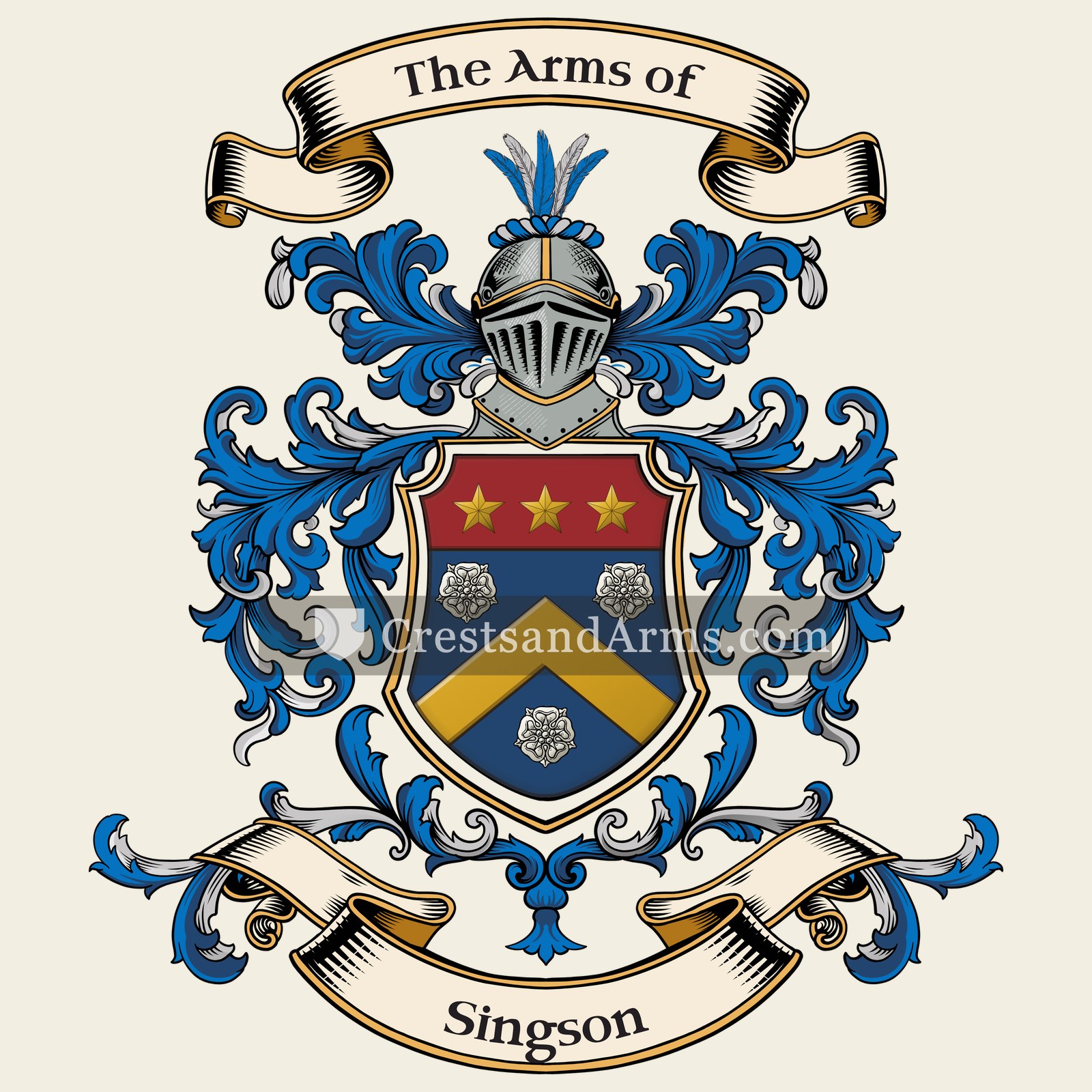


 legStrength and swiftness
 swordJustice, and military honour