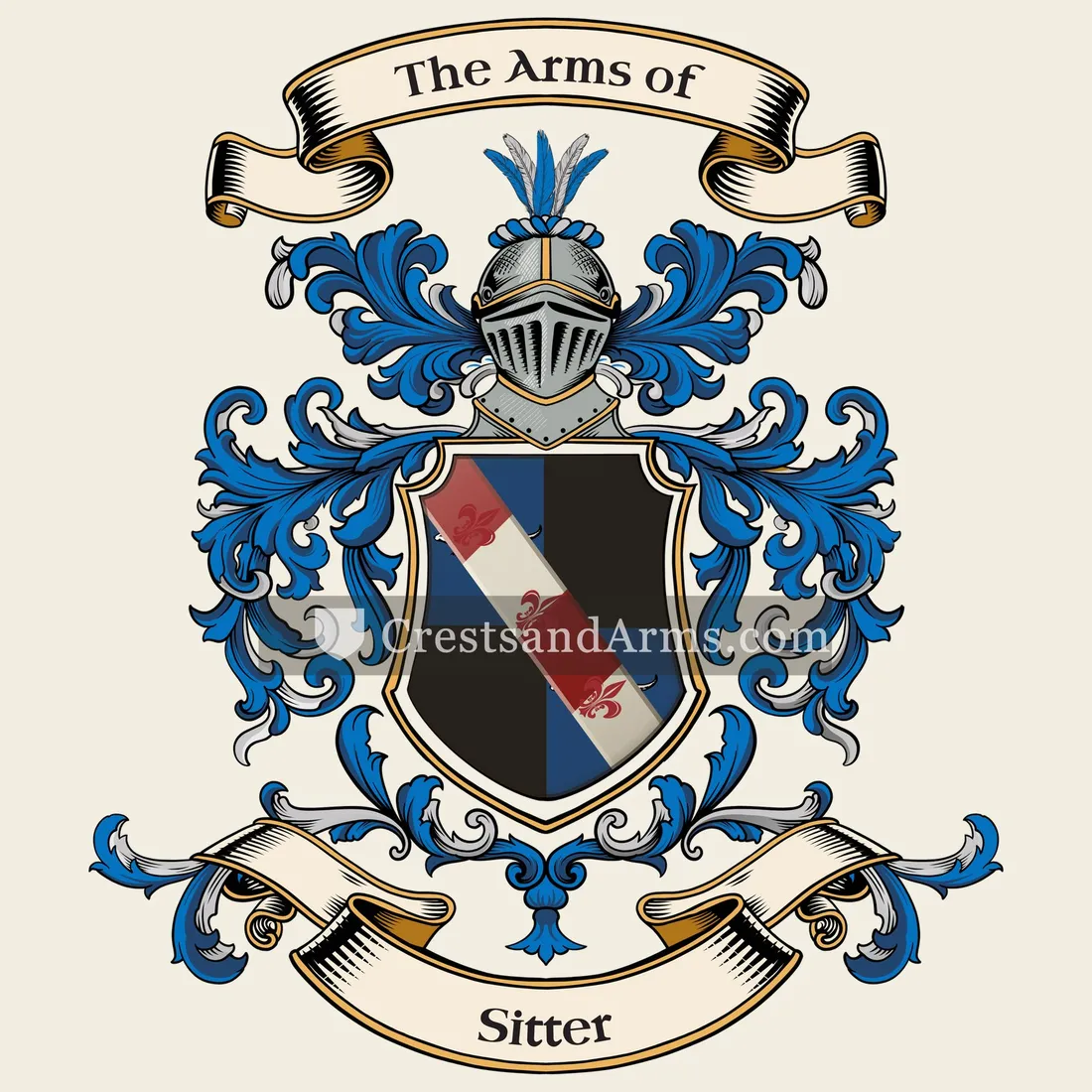
A record of documented arms, meaning and origin, researched for the Sitter family lines. Documented in 3 countries.
Reg. 8360 · Austrian, T–V
Meaning of the Sitter family crest colors & symbols
Symbols on this shield
bendDefence, and the scarf of a commander
fleur de lisPurity, light, and the sixth son
otterOne who lives life to the full
Colours
Blue (Azure)Means: Loyalty and truth
Black (Sable)Means: Constancy
Silver (Argent)Means: Peace and sincerity
Red (Gules)Means: Military strength
Historical info
Source
J. B. Rietstap, Armorial Général, Gouda: G. B. van Goor Zonen, 1884–87
Blazon (the actual original written record)
“Ec.: aux 1 et 4 d'azur à une loutre naiss. au nat., mouv. d'une eau d'arg. et tenant entre ses dents un poisson au nat.; aux 2 et 3 tranché de sa. sur or; à la bande d'arg., br. sur le tranché et ch. de trois fleurs-de-lis de gu., posées dans le sens de la bande.”
Austriac. 1772
Digital archive packCoat of arms PNG, gold border print PDF, vector SVG and the certificate of authenticity. Sent to your email in minutes.
Map of Austria showing where the Sitter arms are recorded
The Sitter arms were recorded in Austria, c. 1772.
Arms such as these were typically recorded in Tyrol.
Tyrol was mountain country in western Austria, where the valleys were held by families who had been there a very long time. Old tenure counted for more than money, and old families carried arms.
This is where the arms were entered in the register. Families often moved to other parts of the country, so the same name can turn up in more than one region.
Region
Tyrol
First recorded
1772
Granting Authority for the Sitter Arms
Imperial and Royal chancery
Sodacan · CC BY-SA 3.0
The body that granted and recorded arms in Austria in this period.
Joseph II, Holy Roman Emperor
Sovereign of the period
Joseph II, Holy Roman Emperor
1765–1790
Reigning in Austria when the Sitter arms are first recorded.
How Arms Worked in Austria
Austrian coats of arms were often linked directly to noble titles granted by the Emperor. These symbols belonged to the entire family line rather than just one individual. When a family grew, new branches kept the original design without needing to change it. This system allowed all members of a noble house to share the same identity across many generations.
Granting authority
The Imperial and Royal chancery managed all heraldic matters and controlled the official granting of arms throughout the Austrian lands.
How they got arms
Families typically received their arms through a formal imperial decree that often accompanied the elevation of a person to noble status.
Where arms were recorded
Official records of these grants were kept in the Imperial Register of Nobility which began its formal documentation process in 1453.
The family's standing
Recorded among the armigerous families of Austria.
Origin & History of the Sitter Family in Austria
The family name Sitter has deep roots in the mountainous landscape of the Austrian Tyrol, where records confirm members of the family were living as early as 1772. In this region, surnames often developed from a person’s occupation, their physical traits, or the specific location of their farm. The name Sitter is likely linked to the Middle High German word "sitten," which relates to someone who lived in a particular settlement or held a specific social standing within a village community. During the late 18th century, families in Tyrol were closely tied to the land and the local parish system, which tracked births, marriages, and deaths with great care. Life for the early Sitters in this alpine environment revolved around agriculture and the seasonal rhythms of the mountain valleys. As the family grew, they became part of the long history of Tyrolean farmers and tradespeople who helped shape the cultural identity of the region.
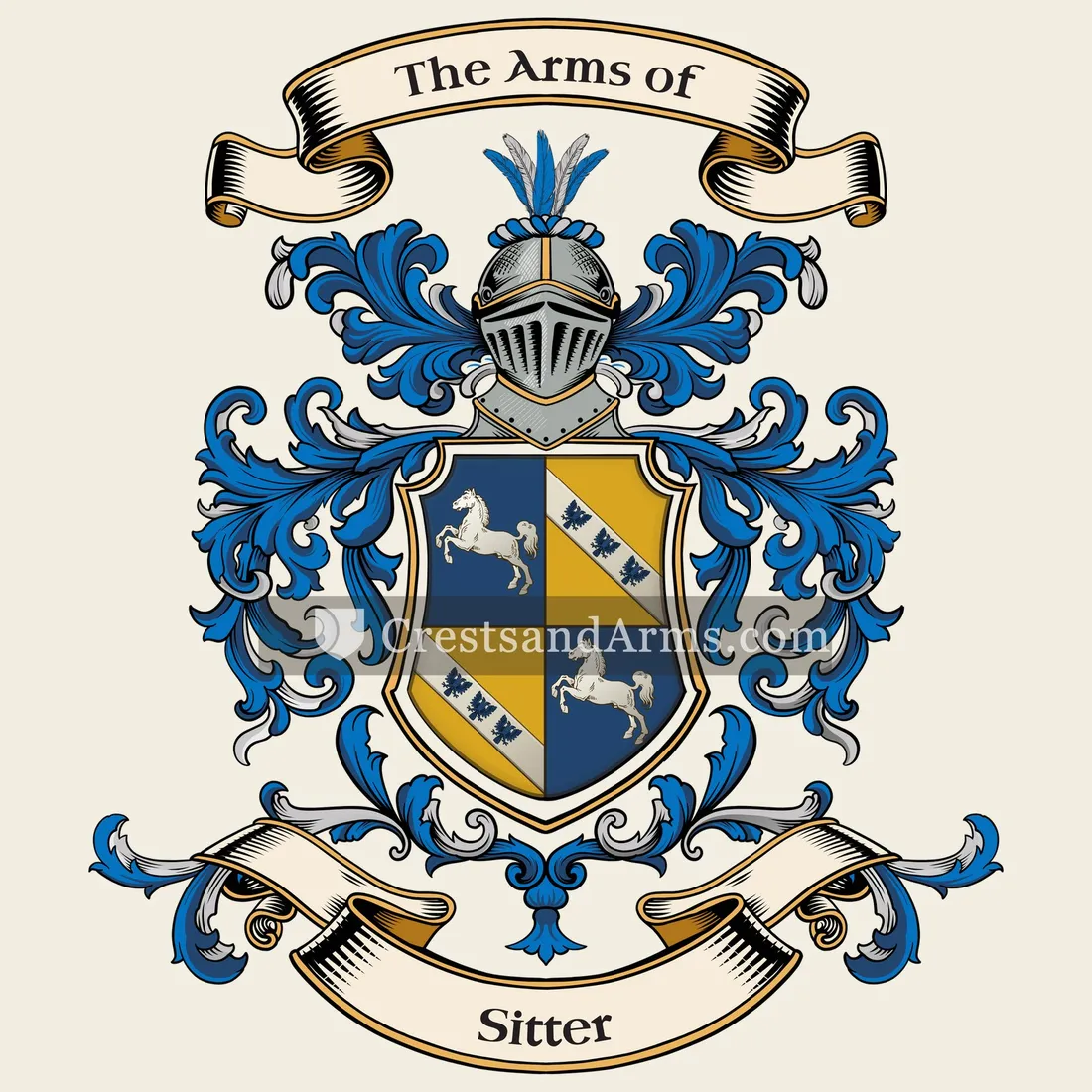
Meaning of the Sitter family crest colors & symbols
Symbols on this shield
bendDefence, and the scarf of a commander
horseReadiness to serve king and country
eagleNobility, strength and a keen mind
Colours
Blue (Azure)Means: Loyalty and truth
Gold (Or)Means: Generosity
Silver (Argent)Means: Peace and sincerity
Historical info
Source
J. B. Rietstap, Armorial Général, Gouda: G. B. van Goor Zonen, 1884–87
Blazon (the actual original written record)
“Ec.: aux 1 et 4 d'azur à un cheval naiss. d'arg., mouv. du bas; aux 2 et 3 d'or à la bande d'arg., ch. de trois alérions d'azur, posés dans le sens de la bande. Cq. cour. C.: un demi-vol aux armes du 2. L.: d'or et d'azur.”
SwitzerlandBâle, c. 1745
Digital archive packCoat of arms PNG, gold border print PDF, vector SVG and the certificate of authenticity. Sent to your email in minutes.
Map of Switzerland showing where the Sitter arms are recorded
The Sitter arms were recorded in Bâle, c. 1745.
This is where the arms were entered in the register. Families often moved to other parts of the country, so the same name can turn up in more than one region.
The body that granted and recorded arms in Switzerland in this period.
How Arms Worked in Switzerland
In Switzerland, coats of arms were not restricted to the nobility and were often adopted by common citizens and families. These symbols were passed down through generations to show family identity. When branches of a family grew, they often changed small details of the design to distinguish their own line from the original group.
Granting authority
Cantonal and civic authorities managed the use of coats of arms within their specific regions and local jurisdictions.
How they got arms
Families typically assumed their own coats of arms based on local custom rather than receiving them from a central monarch.
Where arms were recorded
Arms were recorded in various cantonal and civic registers starting from the fourteenth century throughout the Swiss region.
The family's standing
Recorded among the armigerous families of Switzerland.
Origin & History of the Sitter Family in Switzerland
The family name Sitter has deep roots in the Swiss region, with historical records confirming their presence in the city of Basel by 1745. During the eighteenth century, Basel served as a major center for trade and craftsmanship, which likely influenced the lives of early family members living within the city walls. The name itself is often linked to the geography of the region, as it shares a connection with the Sitter River in northeastern Switzerland. Families in this era were frequently identified by their proximity to local landmarks or their specific trade skills, suggesting that the early Sitters were well-integrated into the bustling urban life of the Swiss Confederation. As the family established themselves in Basel, they became part of a society that valued record-keeping and civic participation, ensuring that their name remained a documented part of the local history for generations to come.
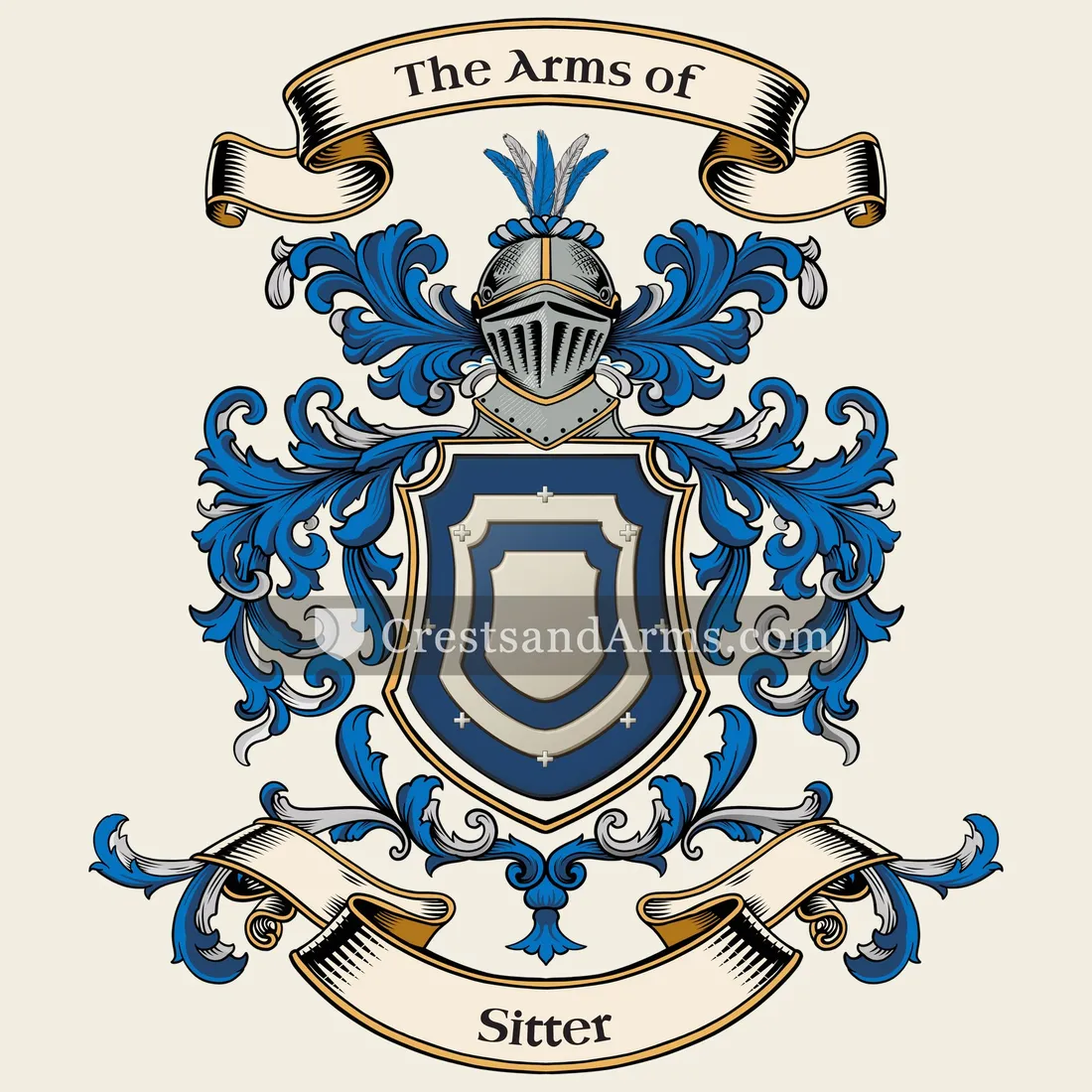
Meaning of the Sitter family crest colors & symbols
Symbols on this shield
orlePreservation, and protection in battle
cross symbolChristian faith and service
Colours
Blue (Azure)Means: Loyalty and truth
Silver (Argent)Means: Peace and sincerity
Historical info
Source
Sir Bernard Burke, The General Armory of England, Scotland, Ireland and Wales, London: Harrison & Sons, 1884
Blazon (the actual original written record)
“Az. an escutcheon ar. an orle of eight crosses crosslet fitchée of the last”
Englandc. 1620
Digital archive packCoat of arms PNG, gold border print PDF, vector SVG and the certificate of authenticity. Sent to your email in minutes.
Map of England showing where the Sitter arms are recorded
The Sitter arms were recorded in England, c. 1620.
Arms such as these were typically recorded in York.
Yorkshire is the largest of the English counties, and it held more gentry families than any other. Land there was split among a great many households rather than a few, so a great many of them carried arms.
This is where the arms were entered in the register. Families often moved to other parts of the country, so the same name can turn up in more than one region.
The body that granted and recorded arms in England in this period.
James VI and I
Sovereign of the period
James VI and I
1603–1625
Reigning in Austria when the Sitter arms are first recorded.
How Arms Worked in England
English heraldry allowed arms to be shared by all legitimate descendants of the original owner. These symbols were treated as personal property that moved through the generations to all children. While the eldest son kept the original design, other family members could use the same shield without needing to change it or register their own unique versions.
Granting authority
The College of Arms in London has regulated the use of coats of arms throughout England and Wales since 1484.
How they got arms
Families typically obtained their coats of arms through a formal grant from the Crown or by proving their ancient right to them.
Where arms were recorded
All official coats of arms are recorded in the registers kept at the College of Arms, which date back to the fifteenth century.
The family's standing
Recorded among the armigerous families of England.
Origin & History of the Sitter Family in England
The family name Sitter carries a history rooted in the northern landscape of England, with documented evidence placing members of the family in the city of York by the year 1620. During the early seventeenth century, York served as a vital center for trade and administration, drawing people from the surrounding countryside to participate in its growing urban economy. The name likely originated as a descriptive occupational or locational identifier, perhaps referring to someone who held a specific position within the local community or lived near a notable landmark. As these early ancestors settled into the social fabric of the city, they became part of the vibrant life of Northern England during a period of significant religious and political transition. Their presence in the city records suggests that the family was integrated into the local parish life and the daily commerce that defined the region at the time.
Sitter Meaning & Related Branches
Root word
Sitz
A seat, residence, or place of settlement.
This name
SitterAn occupational name for a person who held a specific position or lived at a particular estate.
also spelled
Suter
Suttar
Sutor
Documented Sources
J. B. Rietstap, Armorial Général, Gouda: G. B. van Goor Zonen, 1884–87
Tiroler Landesarchiv, Tauf-, Trauungs- und Sterbebücher der Pfarreien in Tirol (1772)


 bendDefence, and the scarf of a commander
 fleur de lisPurity, light, and the sixth son
 otterOne who lives life to the full
 bendDefence, and the scarf of a commander
 fleur de lisPurity, light, and the sixth son
 otterOne who lives life to the full


 horseReadiness to serve king and country
 eagleNobility, strength and a keen mind

 orlePreservation, and protection in battle
 cross symbolChristian faith and service