Map of Italy showing where the Skala arms are recorded
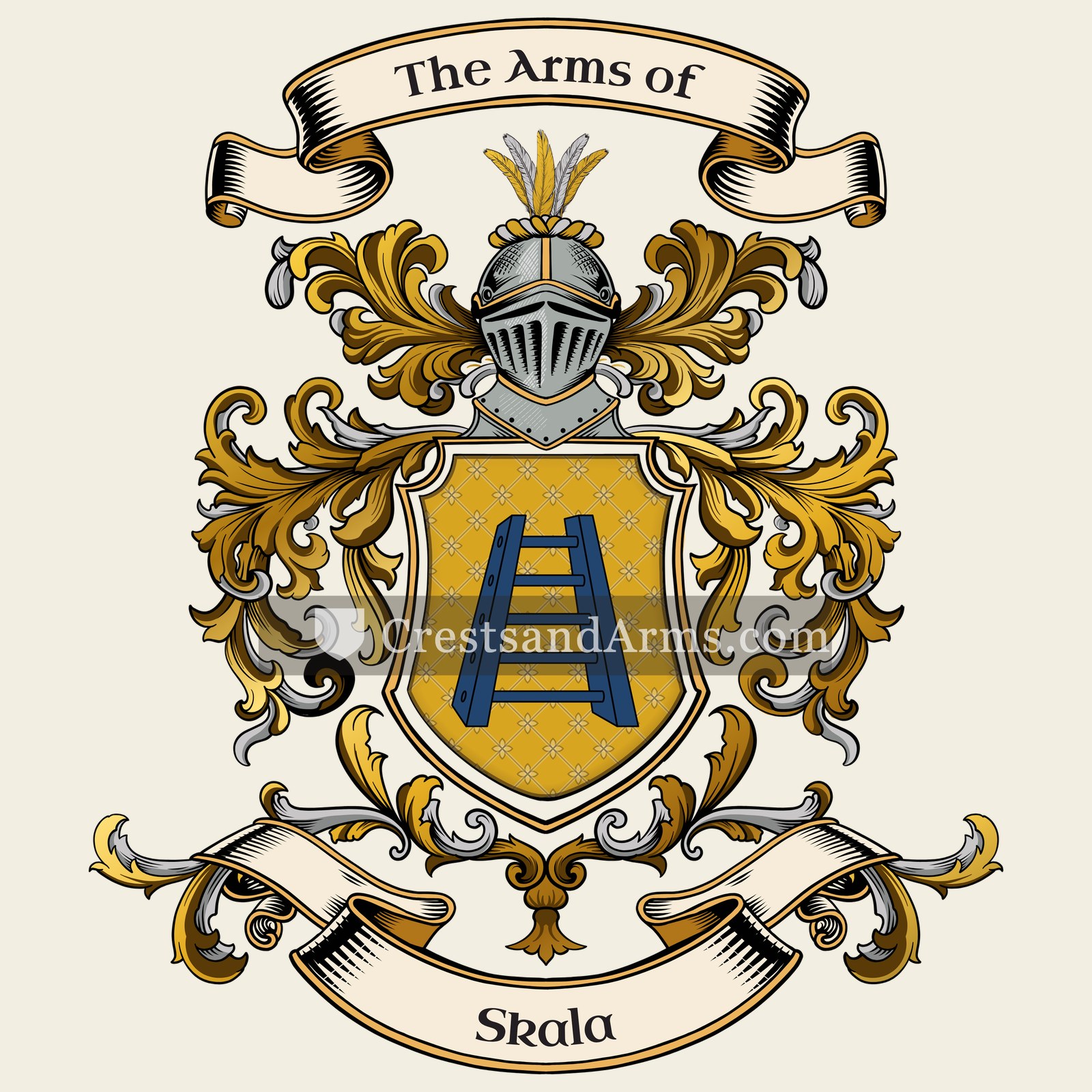
The Skala arms were recorded in Florence, c. 1775.
This is where the arms were entered in the register. Families often moved to other parts of the country, so the same name can turn up in more than one region.
The body that granted and recorded arms in Italy in this period.
Alvise Giovanni Mocenigo
Sovereign of the period
Alvise Giovanni Mocenigo
1763–1778
Reigning in Italy when the Skala arms are first recorded.
How Arms Worked in Italy
In the Italian states, coats of arms were often used by noble families to show their status and history. These symbols were passed down through the generations to all legitimate male descendants. Younger branches of a family usually kept the original design but sometimes added small changes to distinguish their specific line from the main branch.
Granting authority
Various local rulers and city governments controlled the use of coats of arms across the different Italian states.
How they got arms
Families often assumed their own arms or received them as official grants from local lords, popes, or city councils.
Where arms were recorded
Arms were recorded in local city archives or private family books rather than in one single national register.
The family's standing
Recorded among the armigerous families of Italy.
Origin & History of the Skala Family in Italy
The surname Skala is deeply rooted in the linguistic traditions of Central and Eastern Europe, where it is derived from the Slavic word for a rock or a cliff. This name often served as a topographic identifier for families who lived near prominent stone formations or rocky outcrops. By the late 18th century, the family had established a notable presence in Florence, Italy, as evidenced by records dating back to 1775. During this period, Florence was a bustling center of trade and intellectual exchange under the rule of the Grand Duchy of Tuscany. The presence of the Skala family in such a prominent Italian city suggests they were likely part of the mobile merchant or professional classes who moved across European borders to seek new opportunities. Their transition from their Slavic origins to the heart of the Italian Renaissance landscape highlights the fluid nature of family movement and identity during the Enlightenment era.
Related Branches & Arms
Root word
Scala
Latin term for a flight of stairs or a ladder.
This name
SkalaRefers to someone who lived near a staircase or worked as a builder of stairs.
also spelled
Scalas
Scalae
Scal
Skala
Documented Sources
J. B. Rietstap, Armorial Général, Gouda: G. B. van Goor Zonen, 1884–87
Archivio di Stato di Firenze, Stato Civile della Restaurazione
Beider, Alexander, A Dictionary of Ashkenazic Given Names: Their Origins, Structure, Pronunciations, and Migrations, 2001


 ladderAmbition, and a fearless assault
 ladderAmbition, and a fearless assault