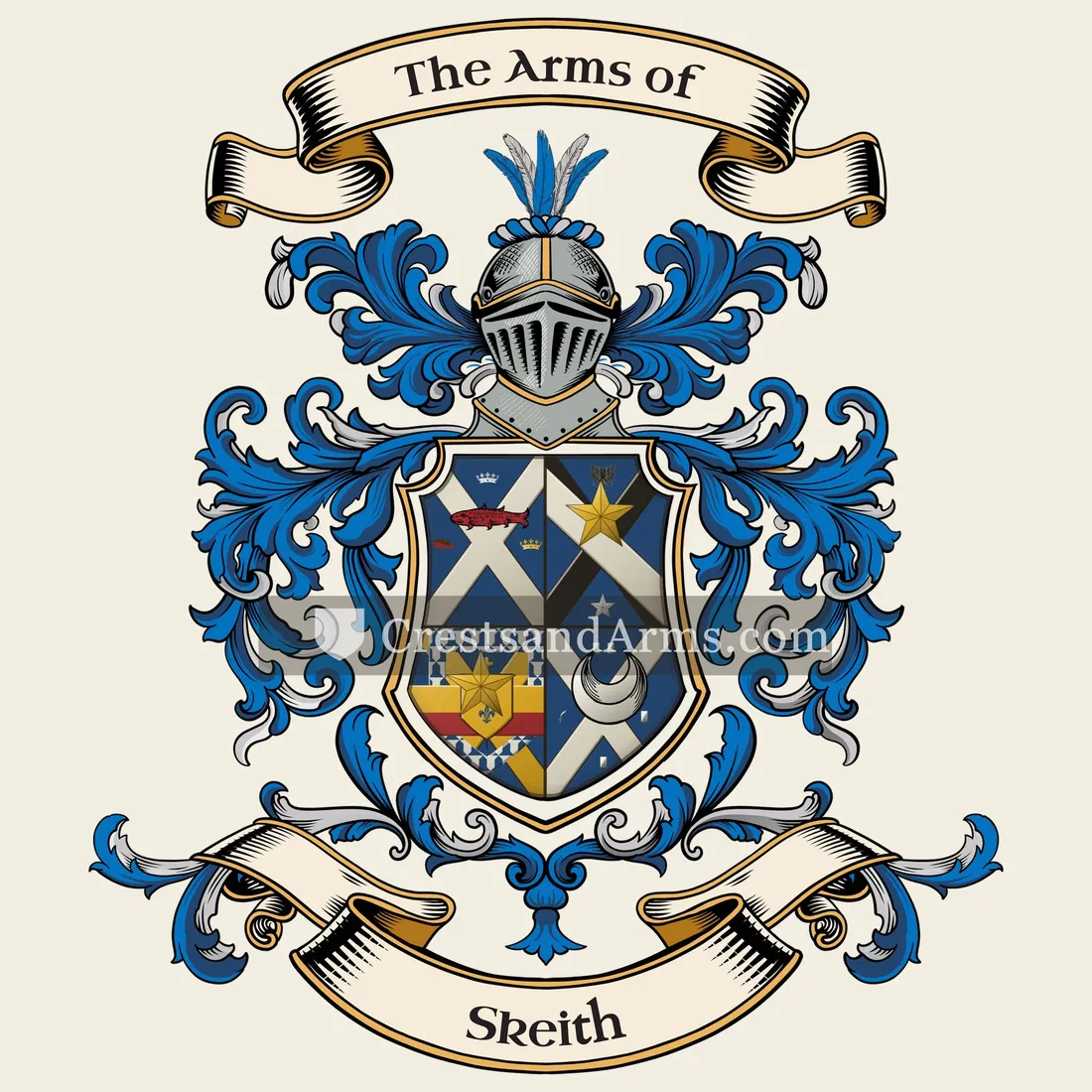
A record of documented arms, meaning and origin, researched for the Skeith family lines. Documented in 2 countries.
Reg. 6465 · German, T–V
Meaning of the Skeith family crest colors & symbols
Symbols on this shield
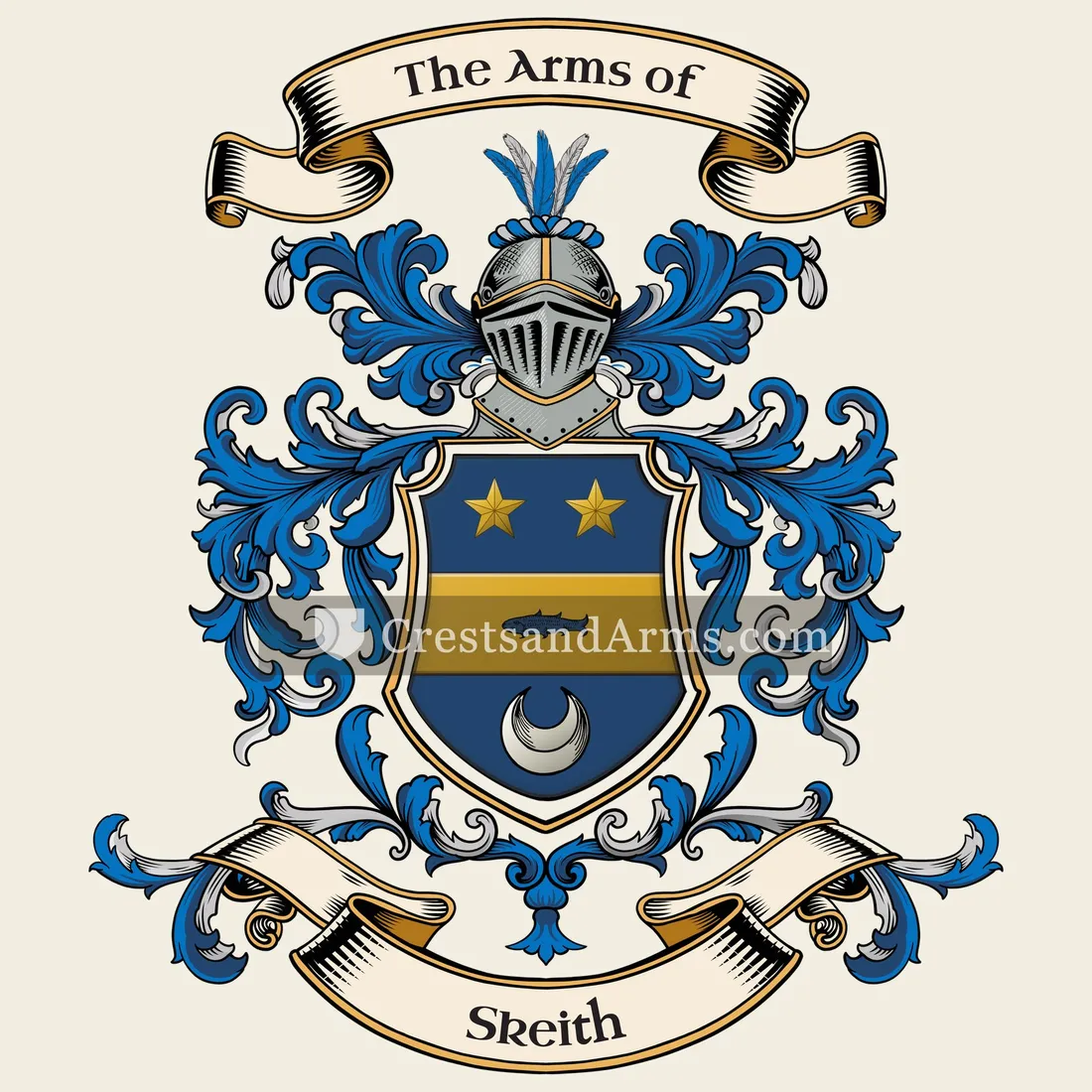
fessThe military belt, and readiness to serve
fishA true and generous mind, and Christian faith
mulletThe third son, and a divine quality from above
crescentHonour by the sovereign, and the second son
Colours
Blue (Azure)Means: Loyalty and truth
Gold (Or)Means: Generosity
Silver (Argent)Means: Peace and sincerity
Historical info
Source
J. B. Rietstap, Armorial Général, Gouda: G. B. van Goor Zonen, 1884–87
Blazon (the actual original written record)
“D'azur à la fasce d'or, ch. d'un poisson nageant du champ, et acc. en chef de deux étoiles (5) du sec. et en p. d'un croiss. d'arg. C.: un vol d'azur, chaque aile ch. d'une étoile (5) d'or. L. d'or et d'azur.”
GermanyHambourg, c. 1765
Digital archive packCoat of arms PNG, gold border print PDF, vector SVG and the certificate of authenticity. Sent to your email in minutes.
Map of Germany showing where the Skeith arms are recorded
The Skeith arms were recorded in Hambourg, c. 1765.
This is where the arms were entered in the register. Families often moved to other parts of the country, so the same name can turn up in more than one region.
The body that granted and recorded arms in Germany in this period.
Francis I, Holy Roman Emperor
Sovereign of the period
Francis I, Holy Roman Emperor
1745–1765
Reigning in Germany when the Skeith arms are first recorded.
How Arms Worked in Germany
In the Holy Roman Empire, coats of arms were often granted to individuals by the Emperor or his representatives. These arms were then passed down through the generations to all legitimate descendants of the original holder. Younger branches of a family usually kept the same shield design without needing to change it, as the arms belonged to the entire lineage.
Granting authority
The Holy Roman Emperor held the sole power to grant new coats of arms throughout his vast imperial territories.
How they got arms
Families typically obtained their coats of arms through a formal imperial grant or by proving their noble status to the authorities.
Where arms were recorded
These grants were officially recorded in the Imperial Chancery registers, which began keeping formal records of such honors during the Middle Ages.
The family's standing
Recorded among the armigerous families of Germany.
Origin & History of the Skeith Family in Germany
The history of the Skeith family in Germany is deeply rooted in the bustling maritime environment of Hamburg during the mid-eighteenth century. By 1765, records confirm that members of the family were established within this major port city, which served as a vital hub for trade and migration in Northern Europe. The name itself likely evolved from regional dialects or occupational descriptions common to the Germanic populations of the era. Living in a city defined by its connection to the North Sea, the early Skeiths were part of a dynamic urban society that relied on international commerce and skilled craftsmanship. Their presence in Hamburg suggests they were likely integrated into the merchant classes or the specialized guilds that governed city life at the time. This period was one of significant growth for Hamburg, and the family would have experienced the city as it transformed into a central gateway between the German states and the wider world.
Meaning of the Skeith family crest colors & symbols
Symbols on this shield
saltireResolution, and St Andrew's cross
bendDefence, and the scarf of a commander
cross symbolChristian faith and service
fessThe military belt, and readiness to serve
fishA true and generous mind, and Christian faith
mulletThe third son, and a divine quality from above
crescentHonour by the sovereign, and the second son
crownSovereignty, authority and just reward
hat or capDignity, and the honour of office
eagleNobility, strength and a keen mind
fleur de lisPurity, light, and the sixth son
swordJustice, and military honour
billetThe sealed letter, and a message delivered
Colours
Blue (Azure)Means: Loyalty and truth
Silver (Argent)Means: Peace and sincerity
Black (Sable)Means: Constancy
Gold (Or)Means: Generosity
ErmineMeans: Dignity
Red (Gules)Means: Military strength
Historical info
Source
J. B. Rietstap, Armorial Général, Gouda: G. B. van Goor Zonen, 1884–87
Blazon (the actual original written record)
“Ec. en saut.: au 1 tiercé en pal: a. d'azur à une couronne navale d'arg.; b. d'or à un chapeau de gu.; c. d'azur à une couronne navale d'or; au 2 parti: a. d'or à une tête et col d'aigle de sa., surm. d'une étoile (5) d'azur; b. d'azur à trois bandes ondées d'arg.; au 3 d'azur à la croix d'or, ch. d'une fleur-de-lis d'azur, et une bord. d'herm.; au 4 d'azur à une épée d'arg., garnie d'or; et un aviron d'arg. en bande, le manche en haut, et un tube de canon en barre, brochants en saut. sur l'épée; le tout acc. de quatre bill. d'arg., 2 accostant l'épée en chef et 2 accostant le saut. Sur le tout d'azur à la fasce d'or, ch. d'un poisson nageant de gu. et acc. en chef de deux étoiles (5) d'or et en p. d'un croiss. d'arg. Trois cq. cour. C.: 1° une couronne de laurier de sin., entre deux prob. d'arg.; 2° un vol d'azur, chaque aile ch. d'une étoile (5) d'or; 3° une tour de deux étages de gu. S.: deux chevaux reg. d'arg.”
Swedenc. 1672
Digital archive packCoat of arms PNG, gold border print PDF, vector SVG and the certificate of authenticity. Sent to your email in minutes.
Map of Sweden showing where the Skeith arms are recorded
The Skeith arms were recorded in Sweden, c. 1672.
Arms such as these were typically recorded in Stockholm.
Stockholm held the Swedish court and the House of Nobility, where every noble family's arms were entered and kept. Families ennobled for service registered there, which is why so many are recorded around the city.
This is where the arms were entered in the register. Families often moved to other parts of the country, so the same name can turn up in more than one region.
The body that granted and recorded arms in Sweden in this period.
Charles XI of Sweden
Sovereign of the period
Charles XI of Sweden
1660–1697
Reigning in Germany when the Skeith arms are first recorded.
How Arms Worked in Sweden
In Sweden, a coat of arms belonged to a noble family as a whole rather than just one individual. These arms were passed down through the generations to all legitimate descendants. Younger branches of the family used the same shield without needing to change it. This system ensured that the entire lineage shared the same identity and status under the law.
Granting authority
The Riddarhuset, or House of Nobility, regulated all noble coats of arms in Sweden under royal authority.
How they got arms
Families received their coats of arms through royal grants of nobility which were then officially registered with the House.
Where arms were recorded
Coats of arms were officially recorded in the Swedish House of Nobility register starting in the year 1626.
The family's standing
Recorded among the armigerous families of Sweden.
Origin & History of the Skeith Family in Sweden
The family name Skeith carries a distinct history rooted in the urban development of seventeenth-century Stockholm. By the year 1672, records confirm that members of the family were already established within the capital city during a period of significant growth for the Swedish Empire. During this era, Stockholm was transforming into a major administrative and commercial hub, attracting skilled workers and families who often integrated into the city’s burgeoning professional classes. The name itself likely evolved through the linguistic shifts common in Scandinavia, where local dialects and the influence of trade connections shaped how surnames were recorded in official church and tax documents. As residents of Stockholm, the early Skeiths would have lived through a time of rapid modernization, participating in the daily life of a city that was quickly becoming the heart of Swedish political power.
Skeith Meaning & Related Branches
Root word
Scheit
A piece of wood or a split log.
This name
SkeithAn occupational name for a woodcutter or someone who split logs for fuel.
also spelled
Sethe
Setth
Set
Documented Sources
J. B. Rietstap, Armorial Général, Gouda: G. B. van Goor Zonen, 1884–87
Staatsarchiv Hamburg, Hamburger Kirchenbücher (Tauf-, Heirats- und Sterberegister), 1765
Staatsarchiv Hamburg, Bürger- und Einwohnerverzeichnisse der Stadt Hamburg, 1765
Digital archive packCoat of arms PNG, gold border print PDF, vector SVG and the certificate of authenticity. Sent to your email in minutes.


 fessThe military belt, and readiness to serve
 fishA true and generous mind, and Christian faith
 mulletThe third son, and a divine quality from above
 crescentHonour by the sovereign, and the second son
 fessThe military belt, and readiness to serve
 fishA true and generous mind, and Christian faith
 mulletThe third son, and a divine quality from above
 crescentHonour by the sovereign, and the second son


 saltireResolution, and St Andrew's cross
 bendDefence, and the scarf of a commander
 cross symbolChristian faith and service
 crownSovereignty, authority and just reward
 hat or capDignity, and the honour of office
 eagleNobility, strength and a keen mind
 fleur de lisPurity, light, and the sixth son
 swordJustice, and military honour
 billetThe sealed letter, and a message delivered