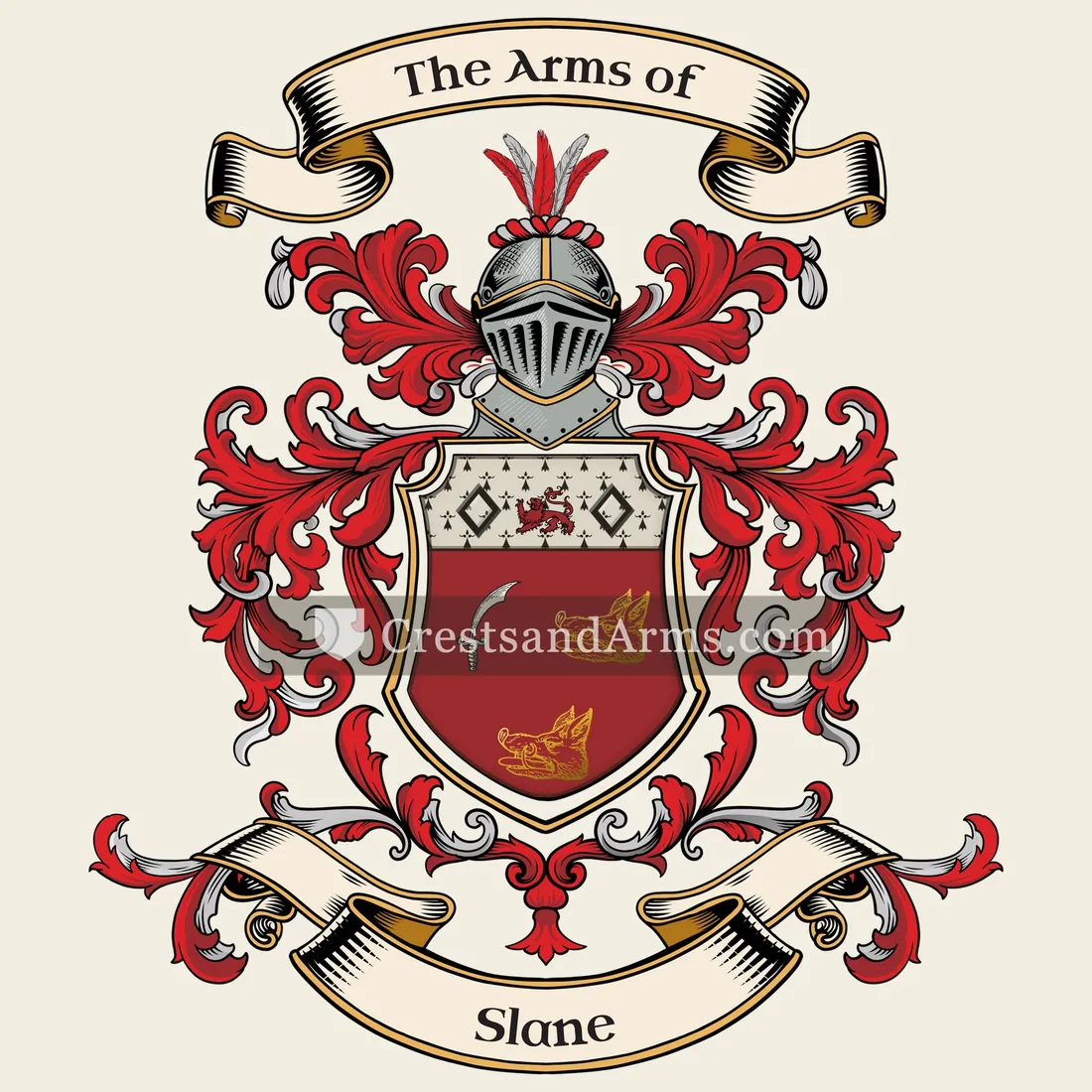
A record of documented arms, meaning and origin, researched for the Slane family lines. Documented in 2 countries.
Reg. 9298 · Britain, T–V
Meaning of the Slane family crest colors & symbols
Symbols on this shield
chiefAuthority, wisdom and dominion
swordJustice, and military honour
lionCourage, strength and royalty
masclePersuasion and the mail of a knight's coat
Colours
Red (Gules)Means: Military strength
ErmineMeans: Dignity
Silver (Argent)Means: Peace and sincerity
Black (Sable)Means: Constancy
Historical info
Source
J. B. Rietstap, Armorial Général, Gouda: G. B. van Goor Zonen, 1884–87
Blazon (the actual original written record)
“De gu. à une épée d'arg., garnie d'or, la pointe en bas, accostée de deux hures et cols de sanglier du même; au chef d'herm., ch. d'un lion léopardé du champ, entre deux mâcles de sa. C.: une tête et col de lion d'or, coll. d'un collier de mâcles de sa.”
Britainc. 1716
Digital archive packCoat of arms PNG, gold border print PDF, vector SVG and the certificate of authenticity. Sent to your email in minutes.
Map of Britain showing where the Slane arms are recorded
The Slane arms were recorded in Britain, c. 1716.
Arms such as these were typically recorded in Kent.
Kent sits between London and the short crossing to Europe, and the trade passing through made it wealthy. Merchant families bought land with that money, and it was landowners who took coats of arms.
This is where the arms were entered in the register. Families often moved to other parts of the country, so the same name can turn up in more than one region.
The body that granted and recorded arms in Britain in this period.
George I of Great Britain
Sovereign of the period
George I of Great Britain
1714–1727
Reigning in Britain when the Slane arms are first recorded.
How Arms Worked in Britain
English heraldry allowed arms to be shared by all legitimate descendants of the original owner. These symbols were treated as personal property that moved through the generations to all children. While the eldest son kept the original design, other family members could use the same shield without needing to change it or register their own unique versions.
Granting authority
The College of Arms in London has regulated the use of coats of arms throughout England and Wales since 1484.
How they got arms
Families typically obtained their coats of arms through a formal grant from the Crown or by proving their ancient right to them.
Where arms were recorded
All official coats of arms are recorded in the registers kept at the College of Arms, which date back to the fifteenth century.
The family's standing
Recorded among the armigerous families of Britain.
Origin & History of the Slane Family in Britain
The surname Slane is deeply rooted in the historical landscape of southeastern England, particularly within the county of Kent. By the early eighteenth century, records confirm that members of the family were well-established in this region, living and working amidst the rural communities of the English countryside. The name itself is thought to be locational, likely derived from an ancient place name or a specific geographic feature that identified the family’s original home. During the 1700s, families in Kent were often tied to the land through agriculture or local trades, contributing to the steady development of the county’s social fabric. While the name may have evolved in spelling over the centuries, its presence in Kent by 1716 suggests that the family was part of the long-standing demographic history of the region, living through the significant economic and cultural shifts that defined Britain during the Georgian era.
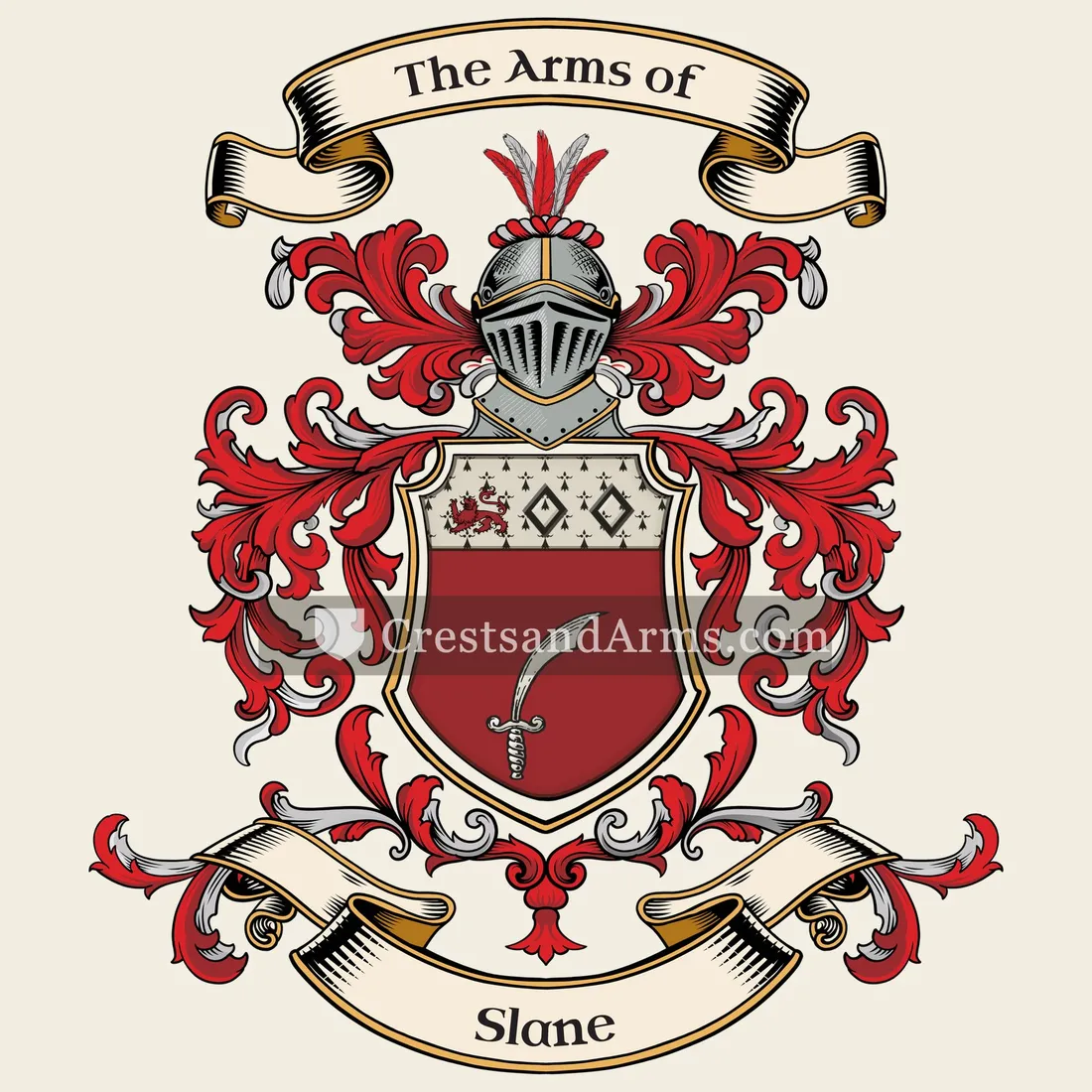
Meaning of the Slane family crest colors & symbols
Symbols on this shield
chiefAuthority, wisdom and dominion
swordJustice, and military honour
lionCourage, strength and royalty
boars headA fierce fighter who battles to the end
masclePersuasion and the mail of a knight's coat
Colours
Red (Gules)Means: Military strength
ErmineMeans: Dignity
Silver (Argent)Means: Peace and sincerity
Gold (Or)Means: Generosity
Black (Sable)Means: Constancy
Historical info
Source
Sir Bernard Burke, The General Armory of England, Scotland, Ireland and Wales, London: Harrison & Sons, 1884
Blazon (the actual original written record)
“Gu. a sword in pale, point downwards ar. pommel and hilt or, betw. two boars' heads couped at the neck of the third, on a chief erm. a lion pass. of the first betw. two mascles sa”
MiddlesexChelsea · Middlesex, c. 1716
Digital archive packCoat of arms PNG, gold border print PDF, vector SVG and the certificate of authenticity. Sent to your email in minutes.
Map of England showing where the Slane arms are recorded
The Slane arms were recorded in Middlesex, c. 1716.
Middlesex was the county around London, and City money flowed straight into it. Merchants and officials bought estates within reach of the capital, and a new estate brought a coat of arms with it.
This is where the arms were entered in the register. Families often moved to other parts of the country, so the same name can turn up in more than one region.
The body that granted and recorded arms in England in this period.
George I of Great Britain
Sovereign of the period
George I of Great Britain
1714–1727
Reigning in Britain when the Slane arms are first recorded.
How Arms Worked in England
English heraldry allowed arms to be shared by all legitimate descendants of the original owner. These symbols were treated as personal property that moved through the generations to all children. While the eldest son kept the original design, other family members could use the same shield without needing to change it or register their own unique versions.
Granting authority
The College of Arms in London has regulated the use of coats of arms throughout England and Wales since 1484.
How they got arms
Families typically obtained their coats of arms through a formal grant from the Crown or by proving their ancient right to them.
Where arms were recorded
All official coats of arms are recorded in the registers kept at the College of Arms, which date back to the fifteenth century.
The family's standing
Recorded among the armigerous families of Middlesex.
Origin & History of the Slane Family in England
The family name Slane has deep roots in the English landscape, with historical records confirming that members of the family were established in the county of Middlesex by the early eighteenth century. During this period, Middlesex was a bustling region surrounding London, serving as a hub for trade, agriculture, and rapid social change. Families living in this area often navigated the transition from rural life to the growing influence of the city. While the name itself may have originated as a descriptive term for a person living near a specific landmark or a particular type of terrain, those who carried it in 1716 were part of the local fabric of English society. They lived during a time of significant economic development, where families often worked as skilled tradespeople or laborers to support the expanding infrastructure of the region. By settling in Middlesex, the early Slane family became part of the long history of migration and community building that defined the English countryside during the Georgian era.
Slane Meaning & Related Branches
Root word
Sláine
Old Irish term derived from the word for health or healing.
This name
SlaneA locational surname referring to people from the town of Slane in County Meath, Ireland.
also spelled
Slone
Sloan
Slowane
Documented Sources
J. B. Rietstap, Armorial Général, Gouda: G. B. van Goor Zonen, 1884–87
C.W. Chalklin, Seventeenth-century Kent: A social and economic history, 1965
Kent Archives, Quarter Sessions Records, Q/S
Kent Archives, Parish Registers, P200/1/A1
Digital archive packCoat of arms PNG, gold border print PDF, vector SVG and the certificate of authenticity. Sent to your email in minutes.


 chiefAuthority, wisdom and dominion
 swordJustice, and military honour
 lionCourage, strength and royalty
 masclePersuasion and the mail of a knight's coat
 chiefAuthority, wisdom and dominion
 swordJustice, and military honour
 lionCourage, strength and royalty
 masclePersuasion and the mail of a knight's coat


 boars headA fierce fighter who battles to the end